Laura's Secret Review: Triple Matching With a Town to Build
A Laura's Secret review of the seven-slot tray, the nine-minute stage timer, the magnet booster and the farms and homes of its seaside town.
Game at a glance
Laura's Secret:Match&Story
7/ 10
Our score
Another triple-match hybrid, this time with a town of orders and farms to grow.
In this article6 sections
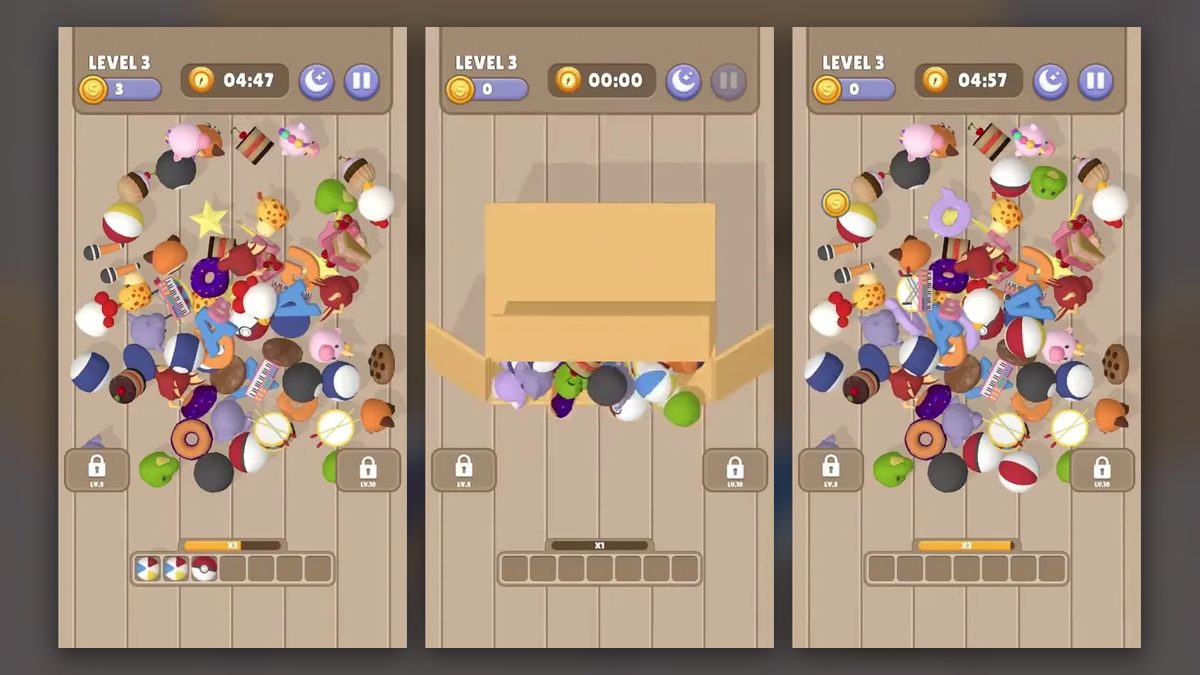
Pick items off a heaped pink plate one at a time and they drop into a seven-slot tray, where three of a kind clear away. That loop sits at the center of Laura’s Secret, a mobile puzzle game from the family of match 3d games, with a seaside town of farms, factories and houses waiting between its timed stages.
We played the first four stages, with a stop in the town before the fourth. The core blends a heap of 3D objects with the tray rule of tile-matching games, where picked pieces wait in a row until three match, and the town gives it a long-running, order-driven management side. With a refined drawing style and boosters designed with care on top, it is a mature, mid-weight casual game.
Goal Cards Over a Seven-Slot Tray
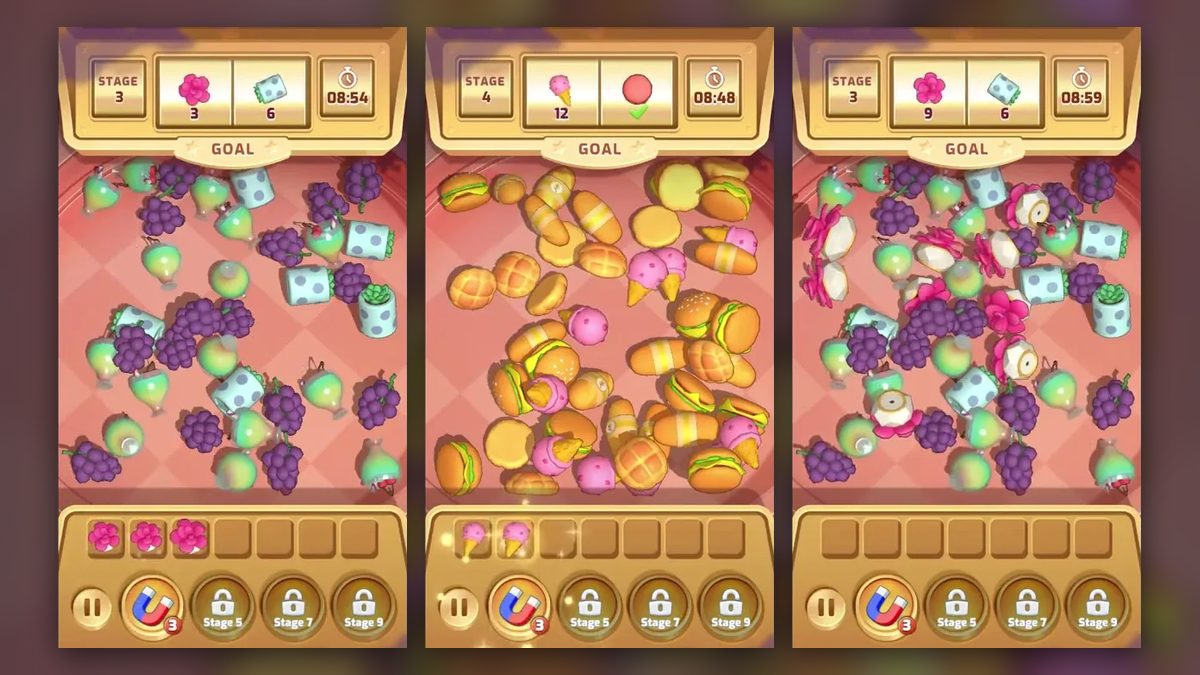
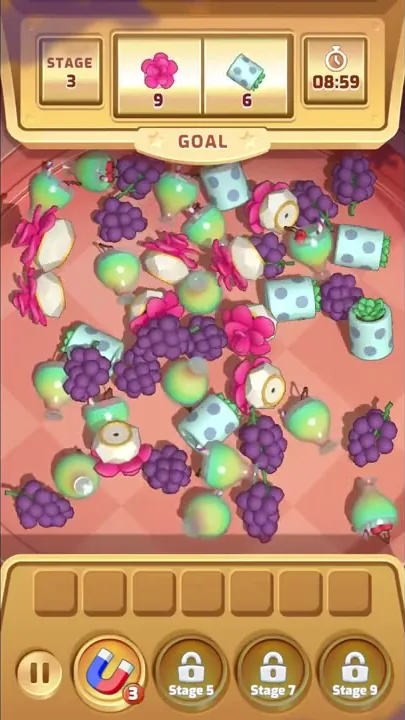
Every stage drops a heap of 3D objects onto a round pink plate with a diamond-check pattern, seen from straight above. Items leave the heap one at a time and land in the next free slot of the wooden tray below. Three identical items in the tray clear, and the goal card for that item counts down by three. Partway through Stage 3, three pink flowers sit side by side while the flower card reads 3; moments later the tray is empty and the card shows a green check.
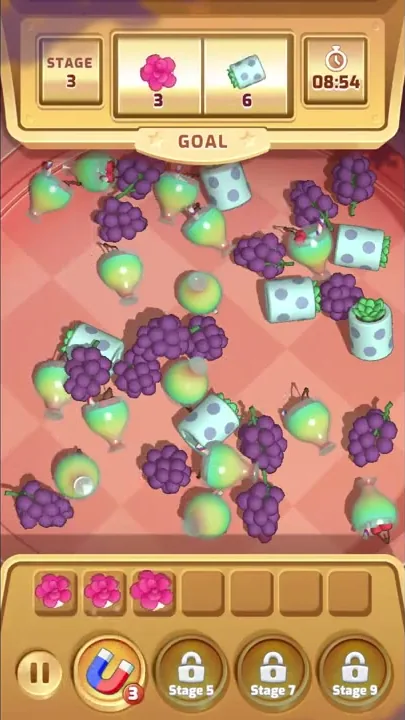
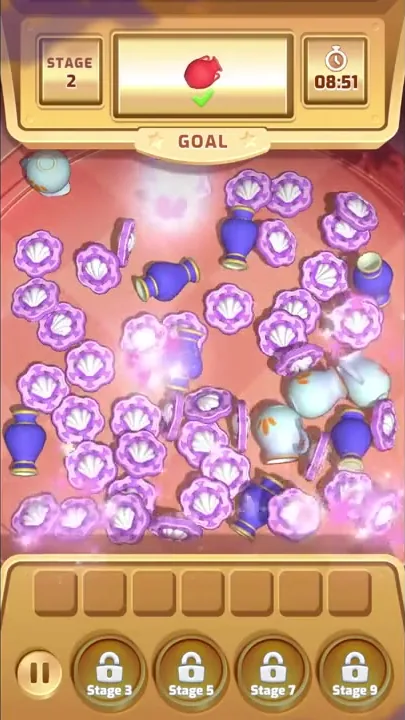
A stage is won when every goal card shows a green check, and the plate does not have to be emptied. Stage 2 ended with blue vases and white jugs still lying on it.
Items travel to the tray singly: a blue cup is in flight early in Stage 1, a red pot in Stage 2. A pause button holds the left end of the bottom bar, with four round booster buttons lined up beside it.
A countdown in the top-right box gives each stage about nine minutes, reading 08:59 as Stages 2 and 3 open and 08:58 as Stage 4 does. Every stage ended with more than 08:40 still on the clock.
The countdown shares a gold panel with a STAGE box on the left and the goal cards in the middle. Each card shows a 3D icon of an item and how many are still needed, and a finished card swaps its number for a green check.
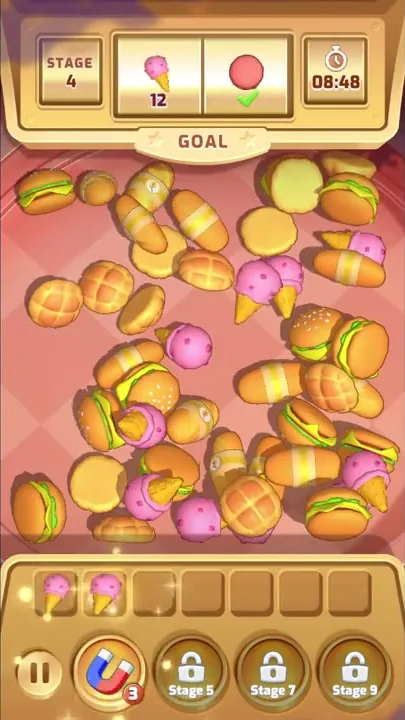
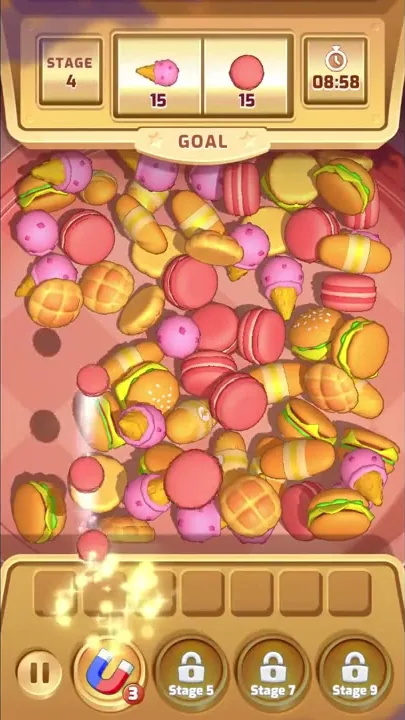
Burgers and crosshatched buns crowd the plate as Stage 4 opens, alongside flat buns and striped bread rolls, with pink ice-cream cones and red macarons mixed in, 15 of each on the goal cards and sparkles rising from the magnet button over the tray. By 08:53 the macaron card is down to 3, with two macarons waiting in the tray. At 08:48 that card is checked while the cone card reads 12, and at 08:41 both are done.
The four booster buttons start out padlocked and marked ‘Stage 3’, ‘Stage 5’, ‘Stage 7’ and ‘Stage 9’. When Stage 3 begins, the first one becomes a red-and-blue magnet with a small red badge, and the other three stay locked. The loading screen after that stage shows the magnet pulling burgers out of a mixed group with bolts of lightning, above the tip ‘The magnet can eliminate two sets of target items.’
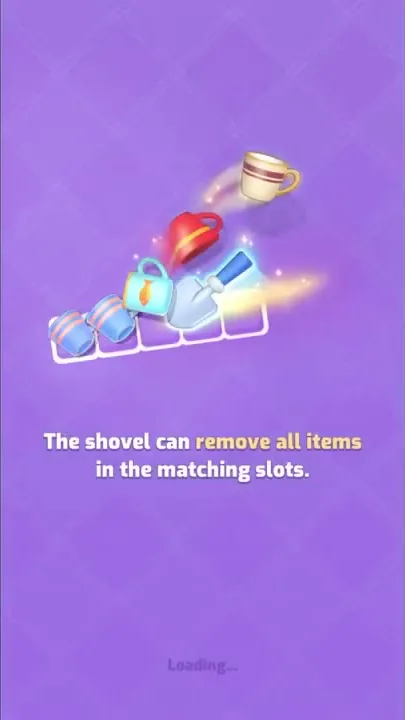
Two more boosters turn up only on these purple loading screens, which pick out each tip’s key words in yellow above a faint ‘Loading…’ line. One shows a shovel scooping cups out of a row of slots: ‘The shovel can remove all items in the matching slots.’
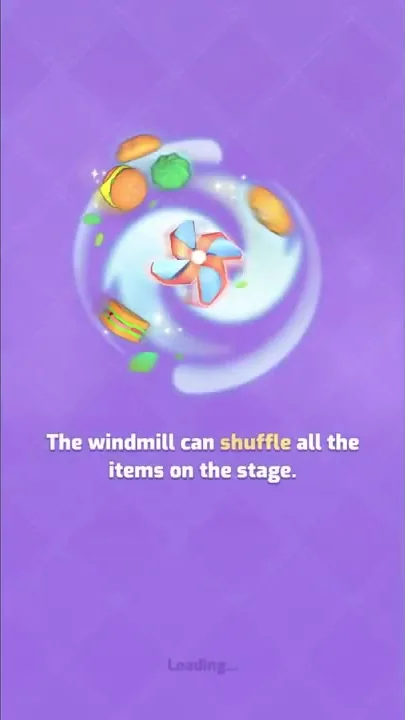
The other shows a pinwheel whirling burgers and lettuce in a swirl: ‘The windmill can shuffle all the items on the stage.’ Neither the shovel nor the windmill appears in the booster bar during the stages.
Checking off the last goal dims the board under a pink script banner reading ‘Noah’, ringed by glowing particles. At the end of Stage 2, a shower of purple flower-shaped tokens then pours onto the plate over the leftover vases and jugs. They look like the purple tokens paid out on the Reward screens between stages.
More Goal Cards, Then Farms and Homes
One change is in the goal panel. A single card runs each of the first two stages, the second asking for 18 red pots, while Stages 3 and 4 split the panel between two items. The magnet arrives along with that second card and holds the first booster slot from then on.
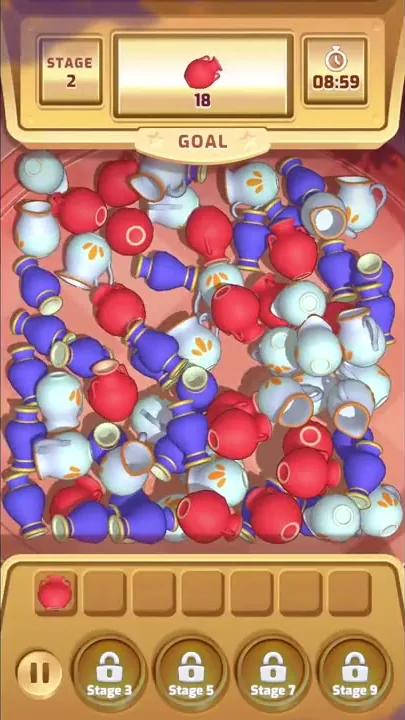
The plates change as well. Early in Stage 1, croissants and blue teaware with a yellow flower pattern lie in a loose scatter with pink showing between them. The second plate opens with red pots packed edge to edge among cobalt vases with gold rims and white jugs with orange leaf marks.
The third stage starts on an empty plate, its items dropping in from above and casting shadows until grape bunches, pear-shaped fruit, pink flowers and polka-dot pots holding a succulent cover all of it. The fourth plate turns to bakery and fast food, with ice-cream cones and macarons as the two targets at 15 each.
The rest of the Laura’s Secret gameplay sits outside the plate. After a stage, a Reward screen sets a cartoon woman in glasses and a beige jacket inside a round portrait, with confetti and lens flares around her. Both Reward screens that appeared paid out green cash and purple tokens in equal amounts, 18 of each after Stage 1 and 30 of each after Stage 3, and the first one led straight into Stage 2.
Stages 3 and 4 start from a panel titled ‘Fun Mini_Games’ over the town, each beginning within seconds of it. It shows the same woman beside a chest of green banknotes labeled 20000 ‘Final Reward’, with an event countdown above a progress bar and a green Start button below. A red heart counter marked Max sits in its top-left corner and looks the same before both stages.
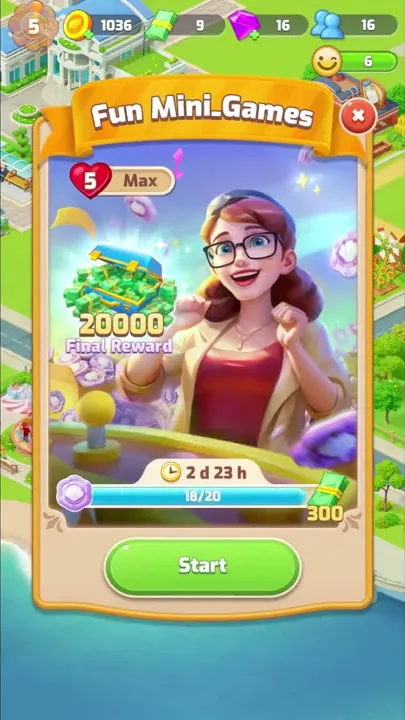
The progress bar runs from a purple token icon to a stack of cash labeled 300. Just before Stage 3, a ‘Next Reward’ banner crosses the panel, and the green cash count in the top bar has jumped. After that stage a ‘Reward’ pop-up with a blue gift box opens over the panel; once it closes, the coins in the top bar have risen, and so have the cash and gems.
That top bar opens with a flower badge, followed by gold coins, green banknotes and magenta gems, then a blue people icon and a smiley face over a green bar. The build menus keep only the flower badge alongside the coins and gems.
The town is an isometric map by the sea. A white civic building stands near a treehouse playground and a building topped by a large billboard, with a carousel park below them and the farm off to the right. A beach and a pier line the water. Townspeople walk the streets while a stork flies overhead and a cow stands in a field, and ‘Z’ symbols float above some buildings.
Round buttons sit in the lower corners. A red cash register with a NEW tag sits at the lower left under a book-like stack. On the right, a flour sack later gives way to a gift box, while a ducks-and-pinwheel button in the lower right carries the same 2 d 23 h countdown as the event panel. A speech bubble with wheat and sunflower icons floats over the farm.
A green check bubble hovers over the treehouse and billboard buildings. In another view, a blue gift box sits over the same pair with a coin popping out, and ‘Tap to claim’ is written beneath it.
The farm’s ‘Plantation’ panel has three empty plots marked with plus signs and a fourth padlocked at 8 gems. Under them, wheat carries a 20 s timer and a green 1-coin button, and sunflowers carry 1 m and 3 coins. A gray third crop reads ‘Lv.6 to unlock’.
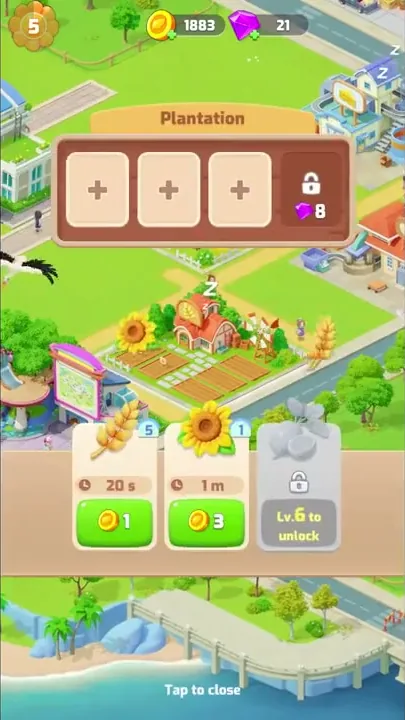
The ‘Livestock Ranch’ panel follows the same layout, with three open slots and a fourth padlocked at 8 gems. Milk shows 40 s and 2 coins and eggs 8 m and 7 coins, while a third product is marked ‘Lv.10 to unlock’.
The ‘Mill’ and the ‘Cheese Factory’ each have one open slot and a second padlocked at 12 gems, with their products on an arc below. At the Mill, a flour sack and a bottle with a sunflower on it sit beside a padlocked item, and the Flour card asks for wheat, ticked green, over a 2 m timer. The Cheese Factory’s arc holds a cream-colored bowl next to a padlocked item.
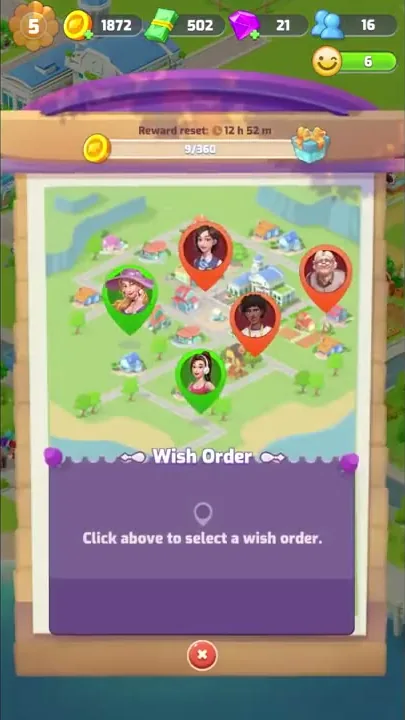
A ‘Wish Order’ screen pins five townspeople’s portraits on a map of the town, two in green and three in orange, above a box reading ‘Click above to select a wish order.’ Along the top, a coin bar leads to a gift box beside a ‘Reward reset:’ countdown.
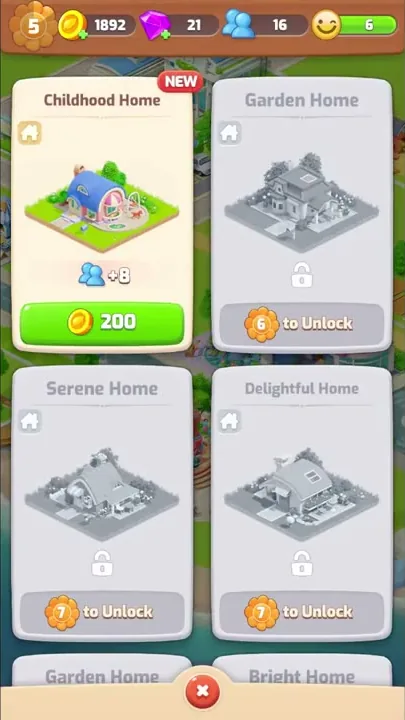
A homes menu sets out house cards in a grid. ‘Childhood Home’ is in full color, with a red NEW tag and a people icon marked +8 over a green 200-coin button. ‘Garden Home’ beside it is gray, with a flower badge of 6 and the words ‘to Unlock’, while the two cards in the next row, ‘Serene Home’ among them, show a 7. More cards, including ‘Bright Home’, continue below.
Next, ‘Childhood Home’ appears on the map over a grid footprint that is partly red and partly green, with a red X and a blue rotate button beside a gray check, while the coin counter still matches the homes menu. Once the home is placed, the coin counter on the map is exactly 200 lower than it was on the homes menu.
One more panel, tagged NEW, opens over the town with art of a tea table and a carousel among pink flowers, while a coin flies toward the top of the screen. Its green banner begins with the word ‘Decorate’ before a page-turn transition covers the rest.
The Tray Rule Lifted Into a 3D Heap
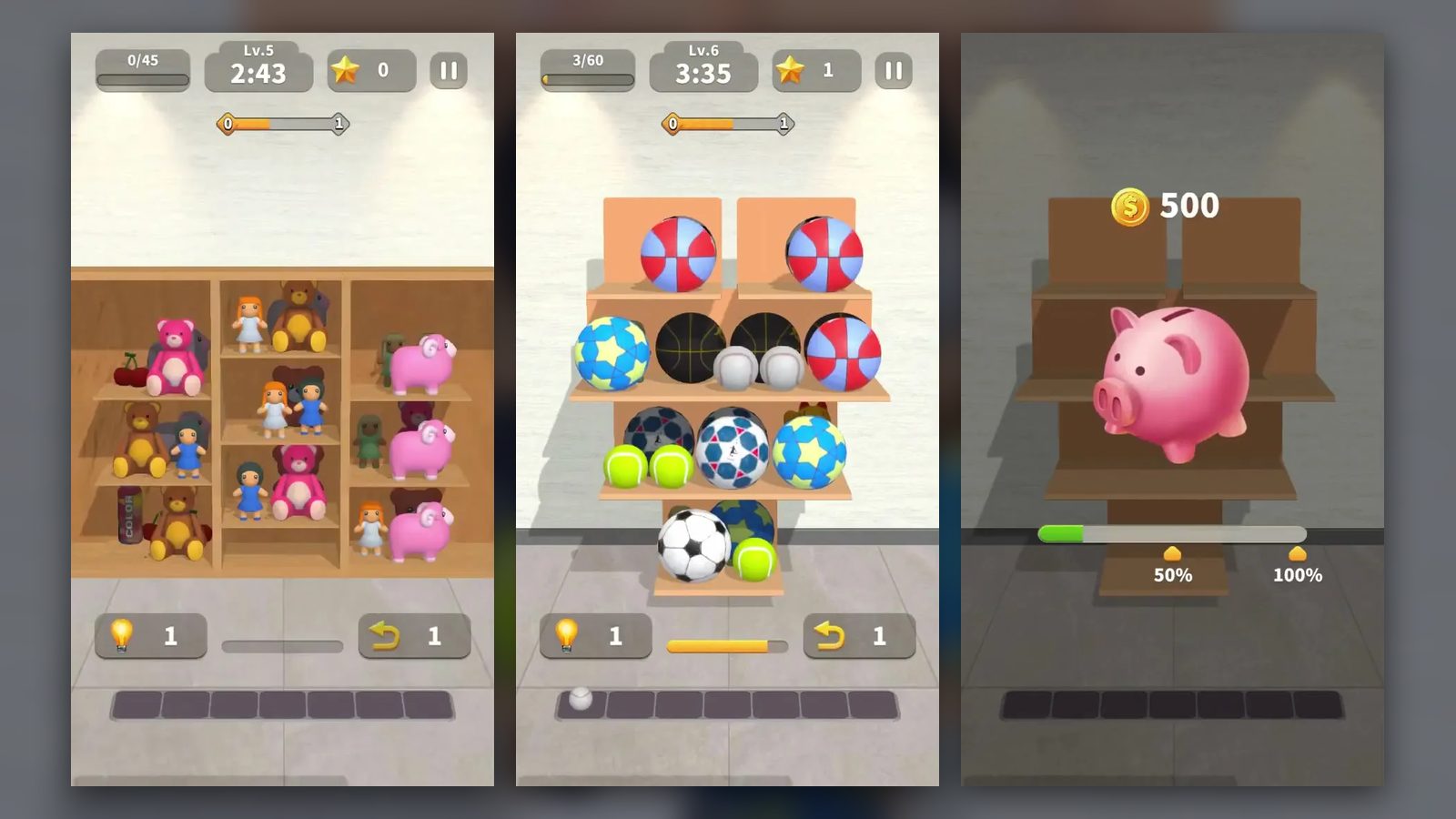
The core is one more hybrid of two familiar formulas. Its heap places it among games like Match Factory, built on pick-three-of-a-kind matching from a pile of 3D objects, while the seven-slot tray comes from tile matching. That tray rule can be mixed into many other kinds of game, and Laura’s Secret gave us a new idea along those lines: part of one core can be split out and blended with another, rebuilding the structure of the core itself. In Stage 4 the tray serves goal cards rather than a cleared board, with both cards checked while burgers and buns still cover most of the plate.
The difference this time is the town it mixes in, a fairly mid-weight, order-driven management layer that runs for the long haul, and together with the art and the boosters the mix makes a mature, mid-weight casual game. The Wish Order map and the timed farm panels share the town with the Fun Mini_Games panel that Stages 3 and 4 start from, while the homes menu keeps houses waiting behind badges of 6 and 7.
The drawing style is quite polished. Each item is a glossy 3D model with small touches, like the gold rims on the cobalt vases and the orange leaf marks on the white jugs, and the town is animated down to a stork crossing the sky.
The boosters were designed with care. The loading tips describe three of them: a magnet that eliminates two sets of target items, a shovel that removes all items in the matching slots and a windmill that shuffles everything on the stage, while the locked buttons are marked ‘Stage 5’, ‘Stage 7’ and ‘Stage 9’.
Full Trays and Opened Wish Orders Never Shown
We raised no complaints about Laura’s Secret. None of the stages reached a full tray or an expired clock, and the magnet was never clearly seen in use, although sparkles rose from its button as Stage 4 opened.
In the town, no crop or factory product was made or collected, and no wish order was opened, so what the orders ask for and pay is something we can’t say. No ad offers or in-app purchase screens appeared either, and the green banknotes showed up only inside the game, as a counter and as rewards, with no cash-out screen in anything we played.
Matching Stages Paired With Farm Timers
Inside a stage the work is visual search: spotting the goal items in a crowded pile and getting three of each into the tray against a clock of about nine minutes. Because the goal cards end the stage, the task is to pull cones from among buns or flowers from among grapes, and the rest of the pile can stay where it is.
Between stages the play turns to timers and unlocks, from crop slots measured in seconds and minutes to houses waiting behind badges, plus a map of townspeople with wish orders. That mix fits a taste for short bursts of searching broken up by small building jobs around the map.
Verdict
Laura’s Secret starts from a pairing seen before, a pile of 3D objects feeding a tile tray, and wraps it in a long-running, order-driven town of crops and houses. Finely drawn art and thoughtfully designed boosters round it out, and the result is a mature casual game with mid-weight systems behind its puzzles. Lifting one puzzle’s rule out and blending it into another also gave us something fresh to think about.