Shelf Sort Review: Customer Orders Drive the Sorting
A Shelf Sort review of a shop-counter puzzle where goods fly from a stocked shelf to order cards and spare goods wait in a small counter tray.
Game at a glance
Shelf Sort: Goods Sort & Pack
6.5/ 10
Our score
An enjoyable cashier wrapper for sorting that could afford to be bolder.
In this article6 sections
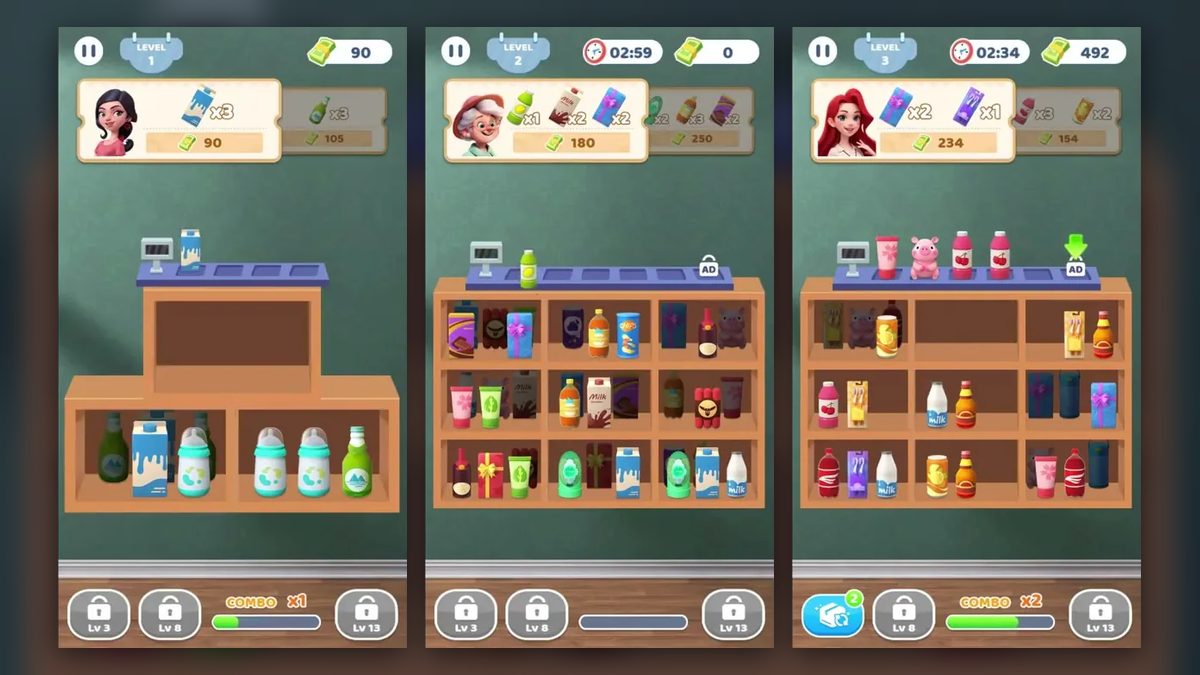
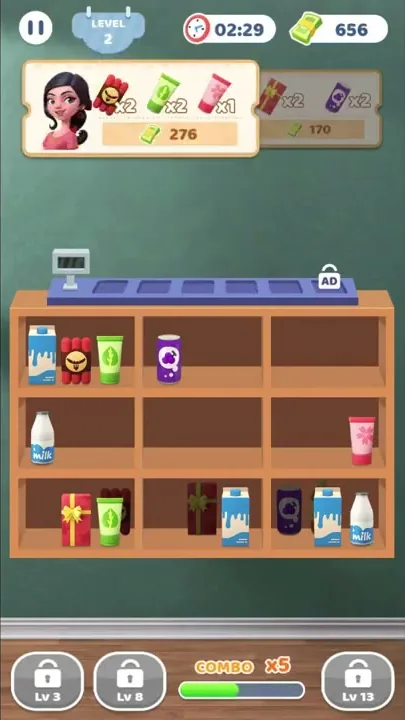
In Level 2 of Shelf Sort, a boy’s order card at the top of the screen pays 250 for two kinds of bottle plus a pair of chocolate bars. A wine bottle and two tubes that are not on his card already wait in the counter tray. Then an orange bottle lifts out of a compartment and arcs up into his order.
Shelf Sort: Goods Sort & Pack, to give it its full name, is a shop-counter take on tile match games and goods sorting. Shoppers queue up with order cards while goods come off a stocked wooden shelf. Whatever the current shopper does not want waits in a small tray on the counter until a later one asks for it.
The shop framing is pretty enjoyable, and the orders tie the shelf and the tray together fairly naturally. What sits around the levels could be bolder.
Goods bound for the card or the tray
We played Levels 1 through 4, leaving the fourth unfinished. Each level is a queue of shoppers served one at a time, and it is won by filling every order. The active card shows a cartoon portrait beside one to three kinds of goods with a count on each, over a cash payout. A dimmed card to its right previews the next order.
The screen is portrait and the view is fixed, looking straight at a wooden shelf against a green wall. A blue counter on top holds a cash register next to the tray, and the register’s small display is green at some moments and red at others. A pause button sits at top left. Along the wooden floor strip at the bottom runs a bar with three booster slots and a combo meter.
A good the current shopper wants flies in an arc from the shelf to the order card, and its count on the card drops. A good the shopper does not want lands in the counter tray instead. When an order is complete, its payout goes onto the cash counter at top right and the previewed shopper steps up as the active order. The Shelf Sort gameplay is built on that split between card and tray.
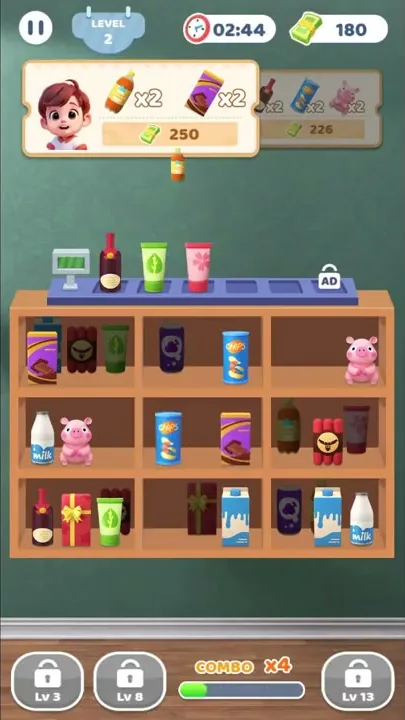
Each compartment shows a front row of up to three goods, with more drawn in darker shades behind them. When the front goods are taken, the ones behind come forward in full color. In the top-right compartment of Level 2, a pink pig plush sits dark behind a bright wine bottle as the level opens. Moments later the pig stands there alone in full color, one of the detailed 3D models that fill the shelves alongside groceries and gift boxes.
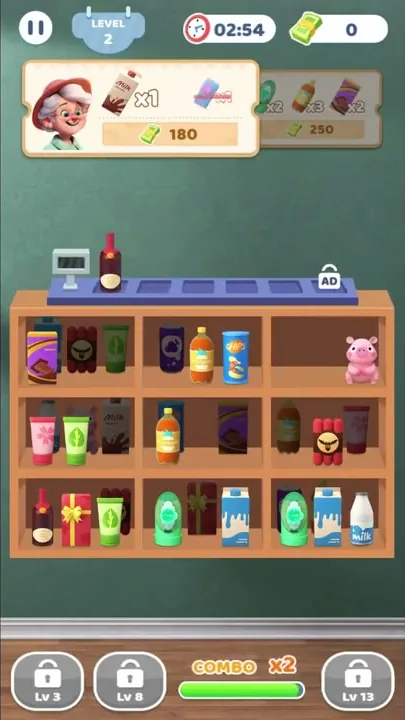
The counter tray is a row of slots beside the register, where goods the current shopper does not want are held. Level 1’s tray has four slots; from Level 2 on it has five open slots plus a padlocked sixth at the right end. During the boy’s order the tray holds a wine bottle and two tubes that his card does not list. What a full tray or an expired timer leads to is something we can’t say.
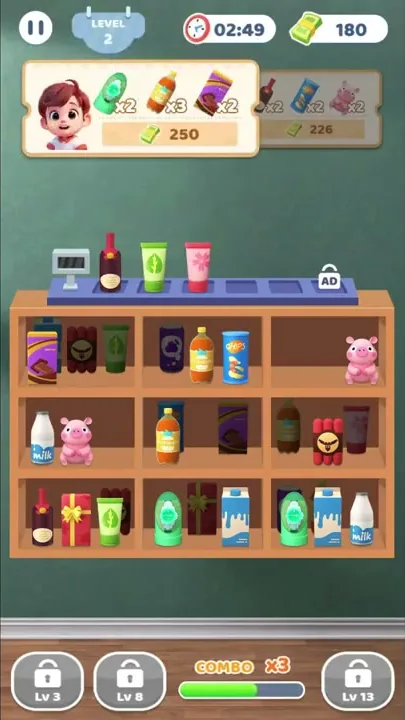
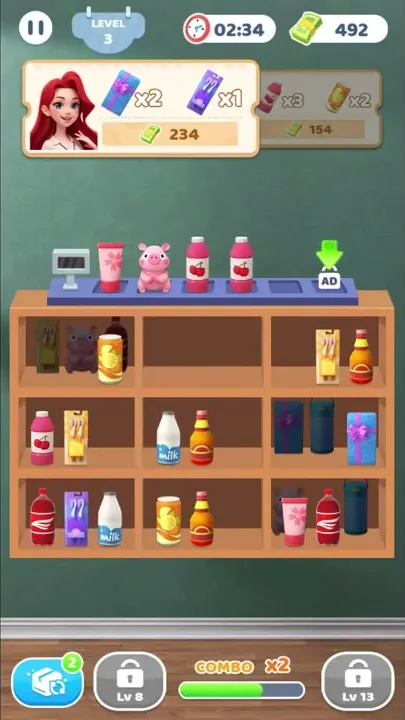
Goods in the tray leave it when a shopper who wants them becomes the active order. With four goods waiting on the counter, wine among them, the preview card asks for wine. Once that red-haired shopper steps up, the bottle leaves the tray for her card, which then needs only one more wine. The new preview card lists the three goods still sitting on the counter.
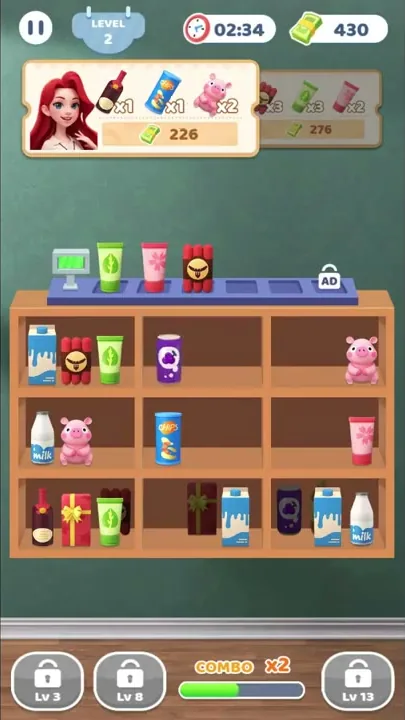
Between the booster slots, a green bar sits under a COMBO label with a multiplier. The multiplier climbed as high as x5 in Level 2 and again in Level 3, dropping back to x1 at other moments. When the bar is empty, the label disappears.
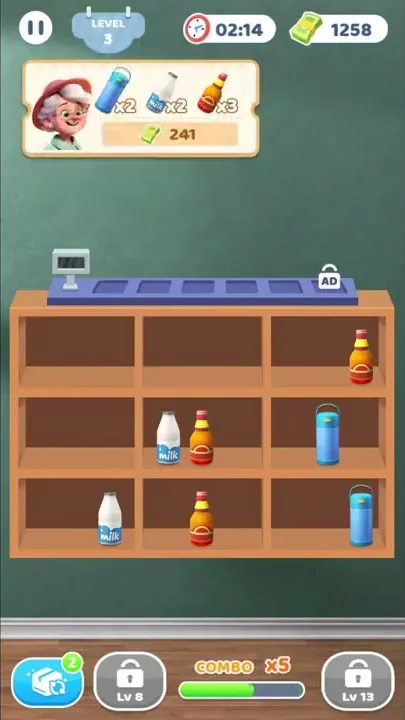
Seven shoppers come through Level 3, starting with an older woman in a hat whose card pays 258. The clock begins at 02:59, and 02:14 is left with the last shopper at the counter. Her card wants two thermoses plus two milk bottles and three orange bottles for 241, exactly the goods left on the shelf. No preview card sits beside it, which marks the end of the queue.
From three compartments to a timed 3x3 shelf
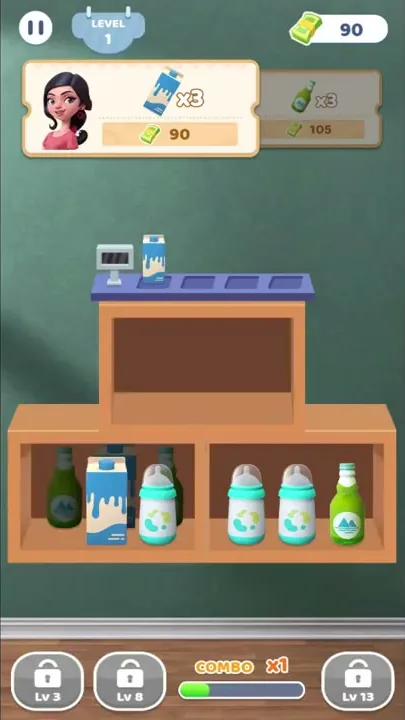
The shelf grows after the first level, and so do the order lists. Early in Level 1 the shelf is a small pyramid of three compartments, a single one stacked on two side by side, under a counter tray of four slots. Orders there ask for three of a single good, such as three milk cartons for 90 or three green bottles for 105. The top bar shows no timer.
From Level 2 on, the shelf is a 3x3 grid of nine compartments, and an order card can list up to three kinds of goods. The tray widens to five open slots with the padlocked AD slot at its end. A countdown timer joins the top bar, set to 02:59 as the level begins, and the next two shelves start from the same time.
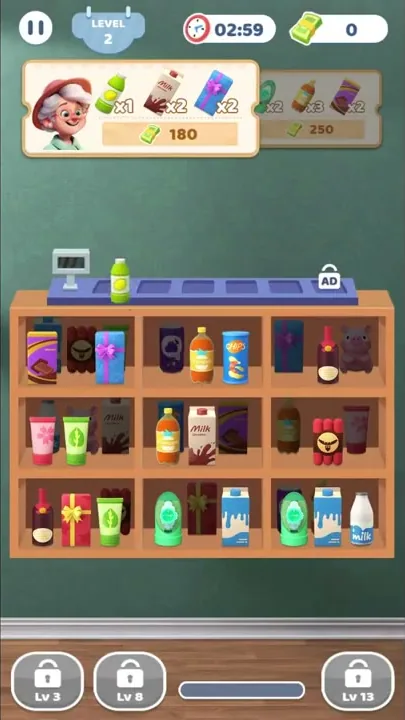
The queues lengthen too. Level 2 has six shoppers and Level 3 seven, while Level 4 shows eight order cards, the last with no preview beside it.
Each restock also changes what is on the shelves. The third shelf mixes in coffee-milk bottles and cans with a chick picture. Blue thermos bottles and cola bottles join them next to a gold bottle with a round emblem, and the pink pig plush is back.
The same level turns the first bottom slot into a blue button with a box-and-arrows icon and a green badge reading 2. Until then the slot had been padlocked under the label Lv 3. The slots marked Lv 8 and Lv 13 are still padlocked in Level 4.
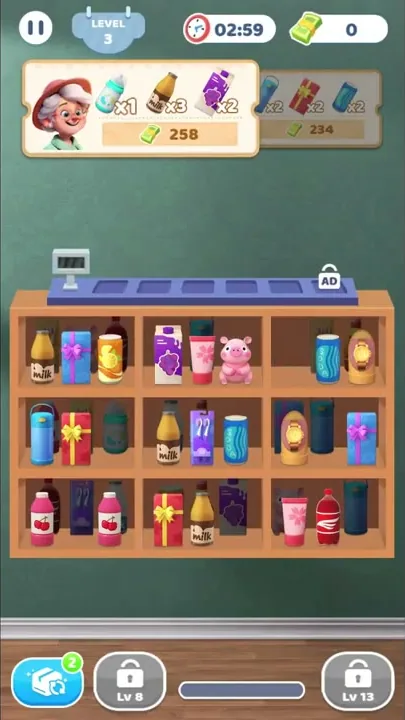
Level 4’s restock adds pink pump bottles with a heart on them and brown jars with yellow lids. Grape jars stand among them, and a gray bunny plush sits in the middle row. A black cat plush turns up later in the level.
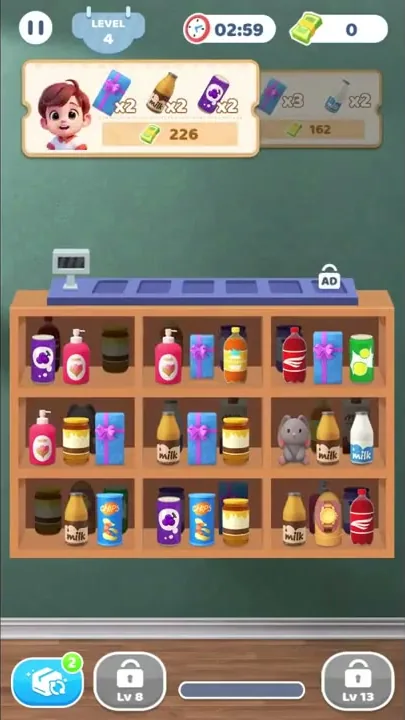
Cash, drawn as a green banknote, is the currency on screen. Each order card prints its payout. The cash counter at top right adds that payout when the order is filled and goes back to zero when the next level opens.
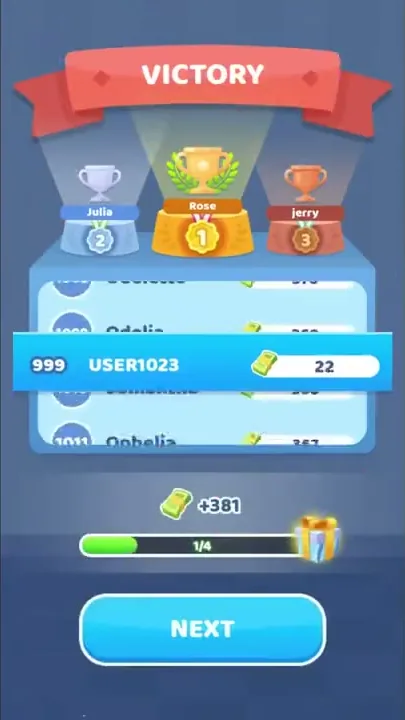
A VICTORY screen with spotlights follows each finished level, with confetti falling after Levels 2 and 3. Three trophies stand on a podium, Rose on the top step between Julia and jerry. Below them, a ranked list highlights the player’s row, USER1023, which climbed from rank 999 after the first win to 959 after the third.
The level’s cash total sits under the list: the +381 after Level 1 and the +1296 after Level 2 are each the sum of that level’s order payouts. Beneath it sits a bar ending in a gift box, which moved up one of its four steps with each of those two wins. A NEXT button leads on to the next level.
The padlocked slot at the right end of the tray carries the label AD. In Level 3, with four of the five open slots filled (two cherry bottles beside a pink tube and the pig plush), a green arrow pointed down at it.
Customer orders that link shelf and tray
Goods sorting has been paired with tile matching a lot lately, and both kinds of game have had plenty of new releases. Shelf Sort crosses goods sorting with tile matching, and its shoppers’ orders are what join the two. That join comes across as fairly natural. The stocked shelf, its back rows waiting in darker shades, carries the sorting side, while the small counter tray is the piece taken from tile matching.
The orders do the linking in play. In Level 3, two cherry bottles parked in the tray left it for the shopper who wanted cherry bottles, whose card then needed only one more. Goods taken early wait on the counter for the shopper who needs them.
A shopper places an order. The cashier gathers the goods, and the finished order is paid in cash. Each card carries a portrait, and a register sits on the counter. That chain is a way of using the shop setting to smooth the play experience, and we found the framing pretty enjoyable.
Room for a bigger store around the shelf
In our view the game could afford to be a bit bolder. Its levels play out on a front-on shelf, and the screen seen between them is the victory page with its leaderboard and gift-box bar.
Beyond the shelf puzzles, the game could grow into a supermarket management game of its own, with stores to build and decorate. It could also pull back for a straight-on view of the whole supermarket from a distance that shows the customers in relation to the player. The levels would then zoom in on the shelves: arranging and grouping the stock, and customers picking up their goods. That would let the puzzle at the center and the business around it grow into one whole.
Reading orders ahead and parking spare goods
Play means keeping an eye on the active order while the dimmed card beside it shows what the next shopper wants. Goods come out of compartments whose back rows only show in darker shades. From Level 2 on, anything taken for a later shopper goes onto a counter with five open slots, and a clock starting at 02:59 runs over all of it.
That suits a taste for filling one shopping list at a time with the next one already in view, and for keeping a small holding area in order. The groups asked for here are copies of one pictured good, matched to a card by sight, which is a different kind of grouping from the one in games like connections.
Verdict
Shelf Sort takes a pairing that plenty of recent releases share and stages it as a cashier’s shift, where each shopper’s request gives the stock and the holding spot one purpose. That shop dressing is quite enjoyable. Around the puzzles it keeps things modest, and a supermarket to run and decorate, viewed from a step back while the levels close in on the stock, is where the idea had room to go further.