Lucky Block Review: Line Clears That Collect Fruit
Fruit printed on the blocks sets the goals; this Lucky Block review covers the watermelon, grape and banana counters and the 10x10 grids.
Game at a glance
Lucky Block
6/ 10
Our score
Add fruit goals to a block puzzle and the puzzle itself plays quite differently.
In this article6 sections
Lucky Block is a block puzzle where one added system, a set of fruit goals, changes how the whole thing plays, and we found that change very interesting. It sits with the block puzzle games where pieces are dragged onto a grid to fill rows and columns, except that the fruit printed on the blocks has to be cleared to count a set of goal counters down.
We played Levels 1, 4 and 5. Across those three, the goal list grows from a single watermelon counter on an 8x8 grid to three fruit counters on a 10x10 grid, where fruit blocks are already waiting before the first move.
Full lines that carry fruit to the counters
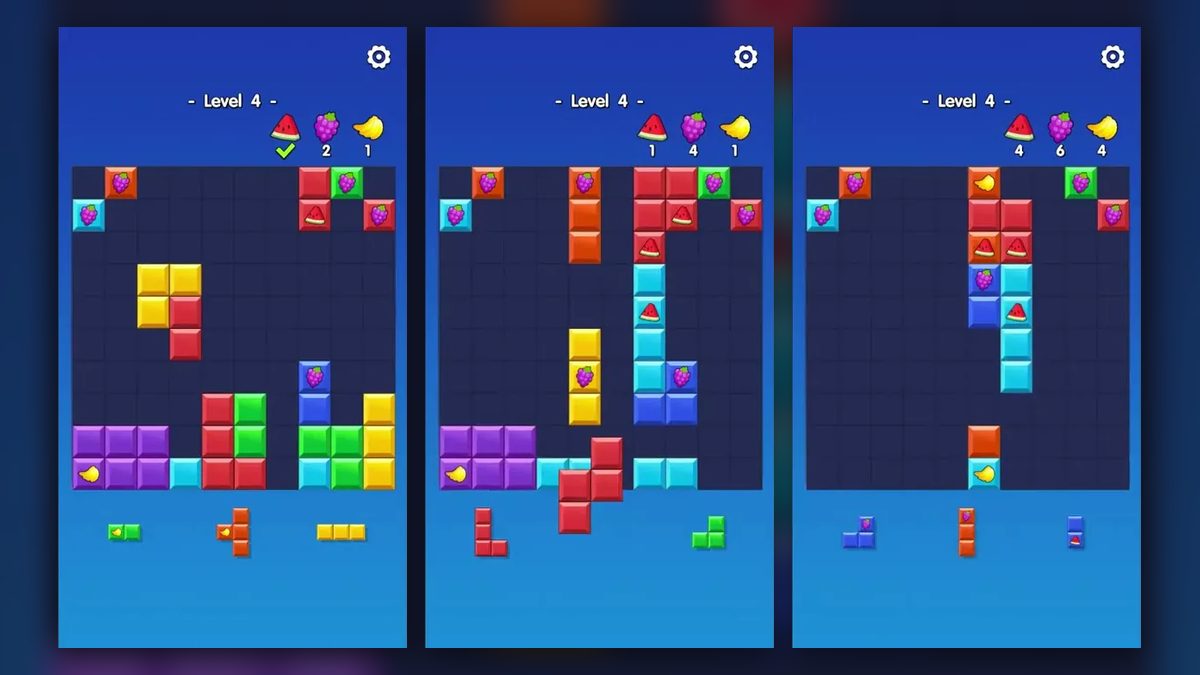
The base will be familiar from games like Block Blast: pieces come from a tray under the grid, and any row or column that is filled completely clears. What Lucky Block puts on top is a row of goal counters in the upper right corner of the screen, a fruit icon for each goal with a number under it. A counter drops as its fruit are cleared, and when it is finished a green check mark takes the place of its number while the other counters keep going.
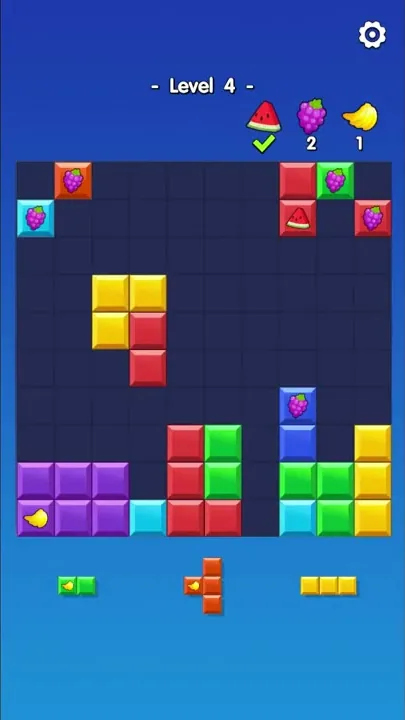
Control is drag and drop. Up to three pieces wait in the tray, drawn small; a piece picked up from there is drawn at full cell size as it moves over the board and drops onto the empty cells beneath it. Lucky Block gameplay runs on a short loop from there: place a piece, complete a line, collect whatever fruit that line held.
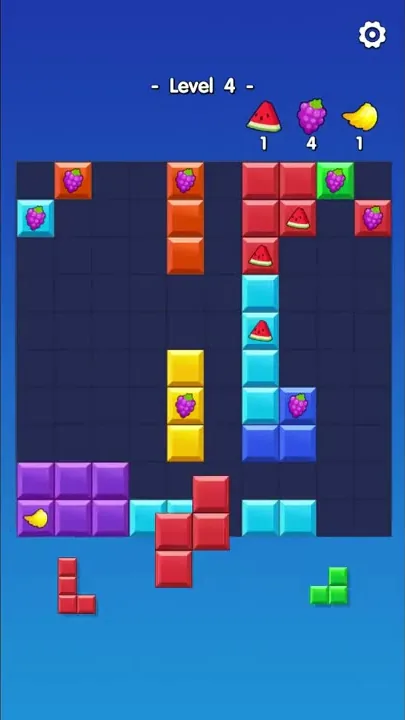
The fruit ride on the pieces. Single cells of a tray piece carry a watermelon, a bunch of grapes or a banana, and the icon stays on its cell once the piece is placed. Not every piece has one: a red L and a small green three-cell corner piece wait in the tray partway through Level 4 with no fruit on them. A fruit counts toward its goal when its row or column clears.
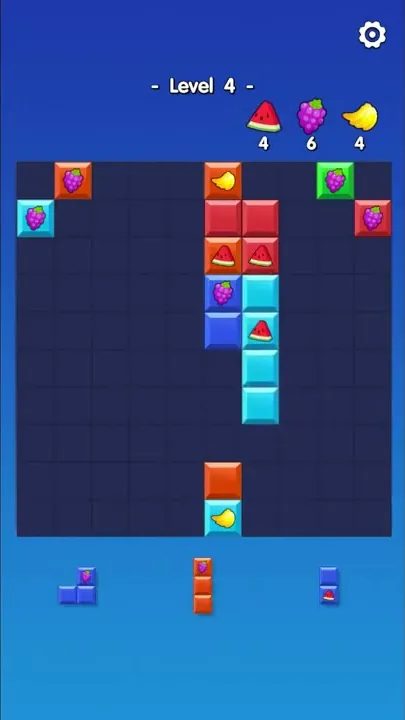
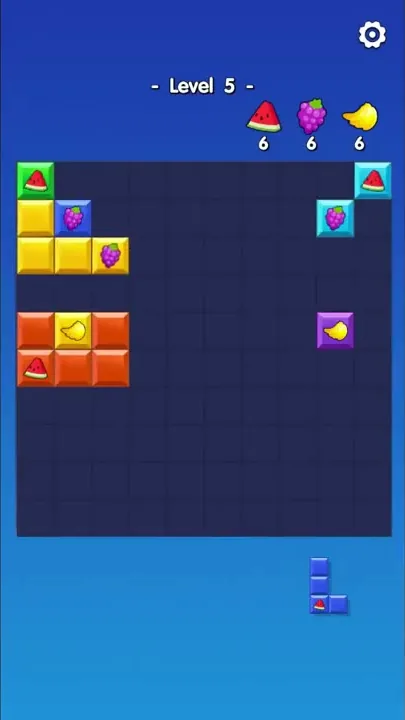
In Levels 4 and 5, single fruit blocks are on the grid before the first piece goes down, and pieces are placed around them. Early in Level 5, an orange U-shape goes down wrapped around a yellow banana block.
A completed row or column clears with a glowing bar running along it. The bar is green on one column and gold on another, and the blocks on either side of the cleared line stay put.
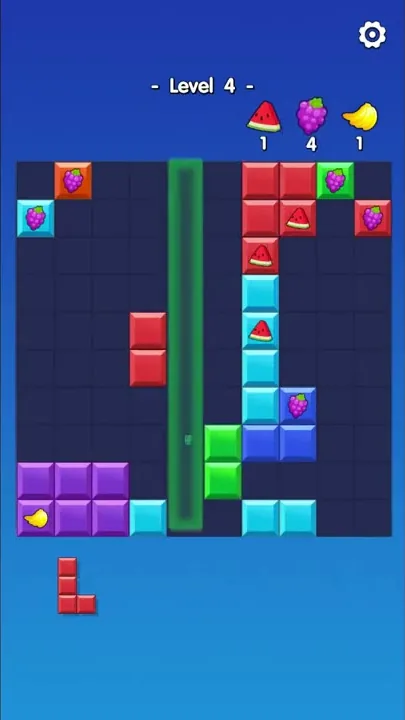
Two lines can clear in one go, each with its own bar. Partway through Level 5, two full rows across the middle of the grid empty together under a pair of blue bars.
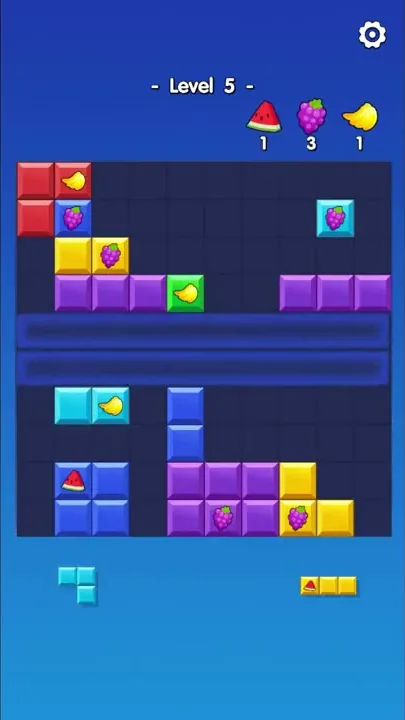
Collected fruit get a moment of their own. When a line holding fruit clears, its icons pop up at large size over the grid, and the matching counter drops afterward. A column cleared along the left edge in Level 5 sends up its watermelon and grape icons this way.
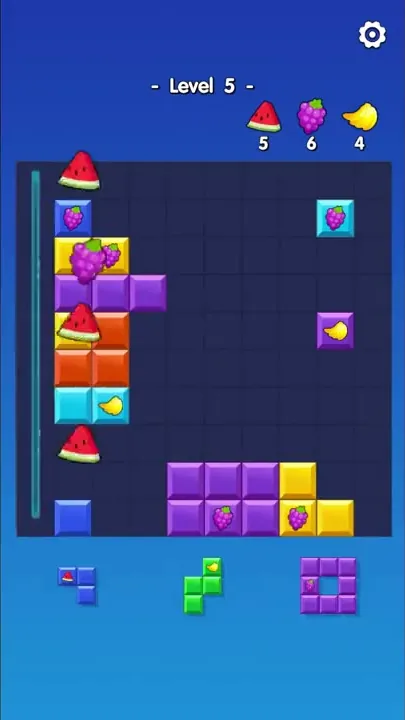
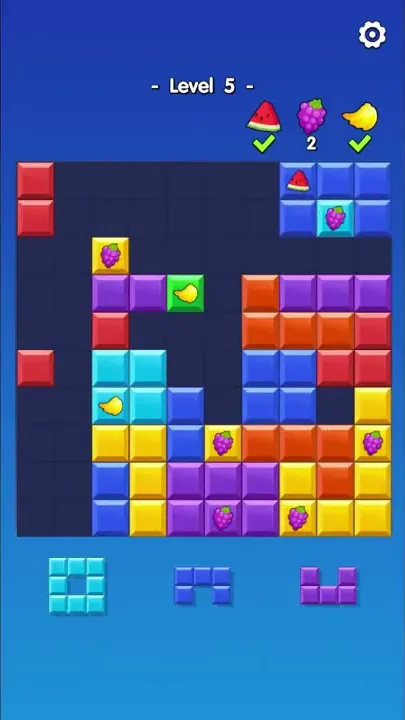
Check marks let a level carry on with some goals finished and others still open. Late in Level 5, watermelons and bananas are both checked off while the grape counter is still counting down.
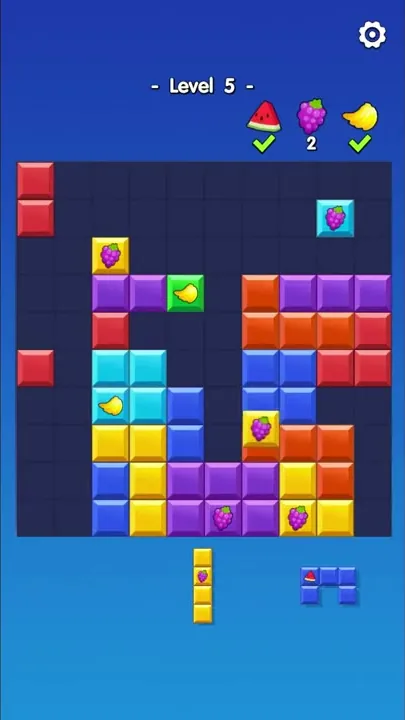
The tray mixes a wide range of shapes. Straight bars run up to five cells long, lying flat or standing upright, alongside L, T and S pieces, 2x2 squares, a 3x2 block, U-shapes, an arch and 3x3 rings with an empty middle.
Goals of 6 for each of the three fruit sit over the Level 4 grid. Four grape blocks start near the top corners, with two watermelon blocks side by side in the third row and two banana blocks side by side at the center of the bottom row. Soon the watermelon and banana counters are down to 4 while grapes still need all 6.
Watermelons are checked off first. Then a red two-cell piece leaves the tray, and the bottom two rows, full except for one column a moment before, are both empty, with the rows above them still in place and a check mark now under the banana. Grapes are the last goal left: the counter is down to 1, with the four corner grape blocks still on the board, shortly before Level 5 opens.
From one watermelon counter to three fruit
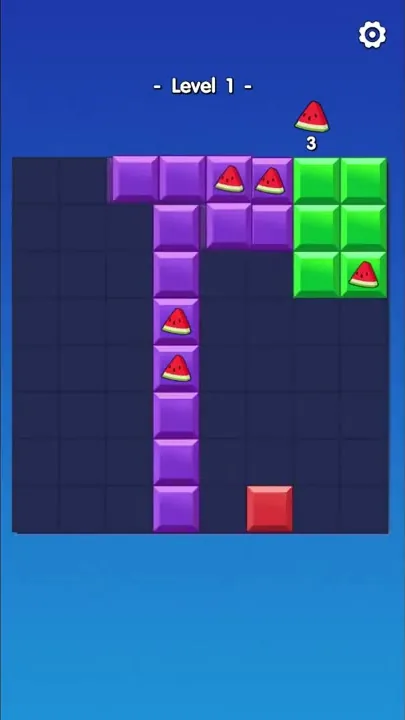
The goal list and the board grow together. Level 1 has an 8x8 grid and a single counter, 8 watermelons.
The 10x10 grid comes with three counters at once, each asking for 6 of its fruit, in both Level 4 and Level 5. That larger grid also holds single fruit blocks before any piece is placed, and the tray pieces start carrying grapes and bananas alongside watermelons.
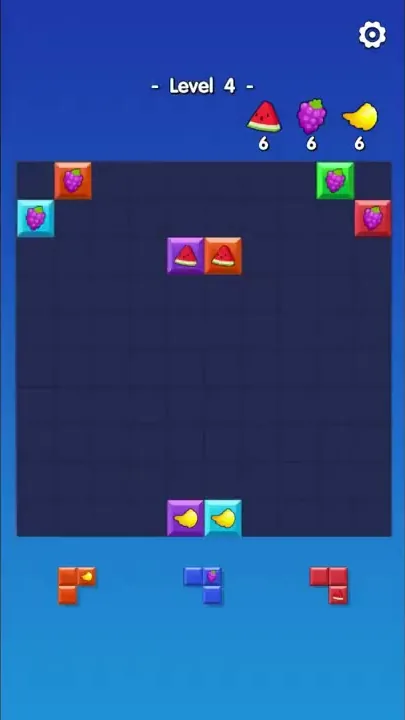
Where those fruit blocks sit differs between the two larger levels. Level 4 places them as described above, with the watermelon and banana pairs side by side at the center; in Level 5 each pair is split between the two sides instead: a watermelon sits in each top corner with a grape one cell diagonally inward, and a banana block sits on each side of row 5.
A light-blue “Target Collection” banner shows the three fruit to collect as Level 5 opens, with the board dimmed behind it.
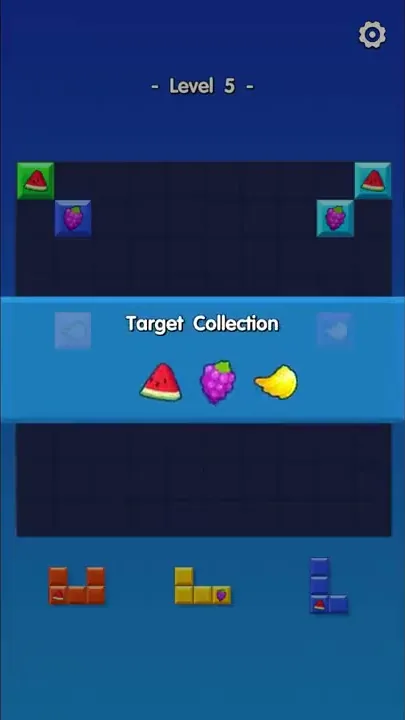
Around the grid, the play screen stays sparse. Its one button is a gear icon at the top right, and apart from the level label, the goal counters are the only numbers on it; no move counter, timer or score sits beside them.
A fruit checklist that changes line building
Putting a collection goal on top of the block puzzle changes it considerably, both in what the player is after and in how lines get built. On the Level 4 grid, the clears that move the counters are the ones running through fruit cells, and the grape blocks placed near the top corners before play are still waiting when the other two goals are done. Building shifts too: early in Level 5, a U-shape goes down around a banana block that sat on the grid from the start.
The design move behind it is to add a single system to one kind of play, so that both the experience and the goals shift until the result reads as a mix of the two: here, line clearing with fruit collecting folded in. Lucky Block is very close to the match-3D games that now come with collection goals of their own, and watching that kind of shift happen on a block grid is a really interesting experience.
Questions about the tray and the gear icon
No complaints come up about Lucky Block itself; what follows are the limits of what the levels showed. They leave open whether a level ends when no tray piece fits the board, whether the tray refills only once all three pieces are used, or whether pieces can be rotated. Late in Level 5 most of the grid is covered, with the grape goal still open.
As for the gear icon at the top right, we can’t say what it opens or whether the game has coins, a shop, boosters or ads. Fruit also stays on the blocks after its goal is done: banana blocks are still on the Level 4 grid once the banana counter shows its check mark.
Line building with a fruit list in view
Lucky Block lines up with a taste for block puzzles that come with a target attached. The play is dragging pieces from the tray while watching the counters at the top right, and steering full rows and columns through the cells that carry the fruit still needed. Fitting pieces around fruit blocks that start on the board, like the mirrored pairs on the Level 5 grid, is part of the same job, and each finished goal turns into a check mark while the rest keep counting.
Verdict
Lucky Block scores a little above the middle of the scale. Its collection layer pulls the line clearing toward gathering fruit, changing what the lines are for and how they get built, and that blend is very interesting.