Oasis Land Review: Spraying Dead Palms Back to Green
How a cracked desert turns green around a growing pond: the Oasis Land review, from the first pond upgrade to a 15-log Market.
Game at a glance
Oasis Land
8/ 10
Our score
Walk-around management that, for once, is about more than wrecking and building
In this article6 sections
Oasis Land is a game we liked a great deal. It belongs to the idle tycoon games family and plays in portrait. Its small character waters a cracked, dead desert back to life, and it also does the chopping and building that games of this type are known for.
The style is walk-around management, in which the character walks between trees, the pond and build plots, and the theme is a desert turning back into an oasis. The character sprays dead palms until they turn green, then cuts them down for logs.
That wood goes into a pond at the center of the oasis or into wooden plots that turn into a Market and an Armory. We played the opening stretch of the map: seven tasks and the start of an eighth.
Watering palms green, then cutting them for wood
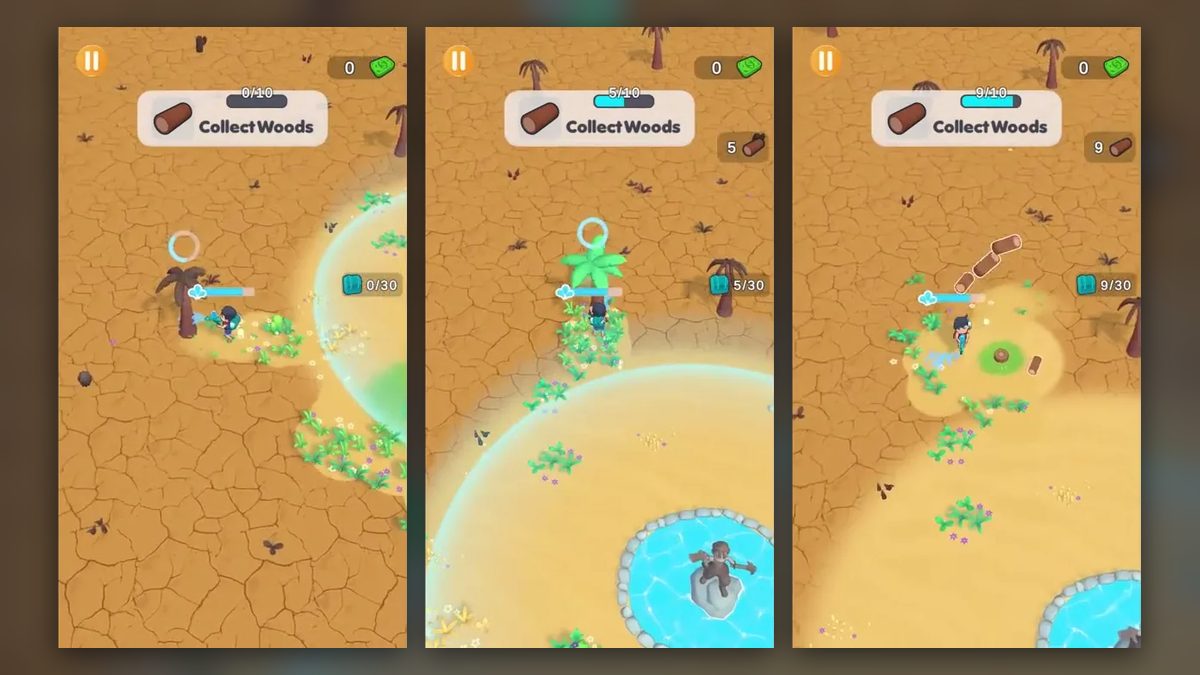
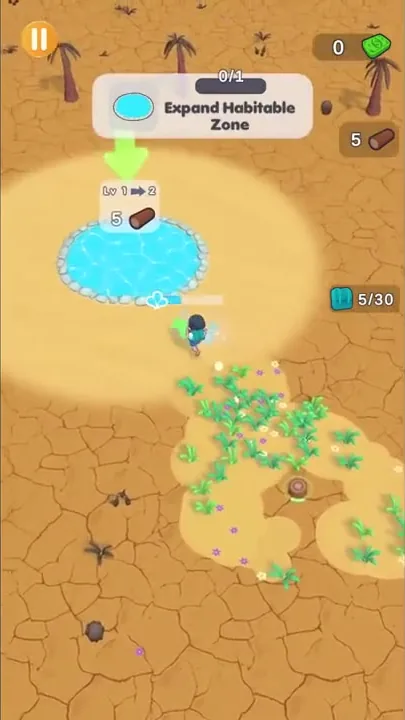
Oasis Land has no numbered levels. Everything happens on one continuous open map, steered by a banner at the top center. The banner holds a single task, shown by name with an icon and a progress counter. When the counter fills, the next task takes over: “Collect Woods” at 9/10 gives way to “Expand Habitable Zone” at 0/1 once the last log comes in.
The opening stretch never shows a clock, a move limit, lives, enemies or a fail screen. The one limit on screen is a carry counter with a teal icon on the right side. It tracks the logs being held against a cap, which is 30 through most of the opening tasks.
The screen stays nearly bare during play. A round orange pause button in the upper-left corner is the only button drawn, no joystick appears, and the character simply walks around the map. Watering and chopping happen while it stands next to a tree. Logs change hands while it stands at the pond or a plot, as a green ring around the target fills up.
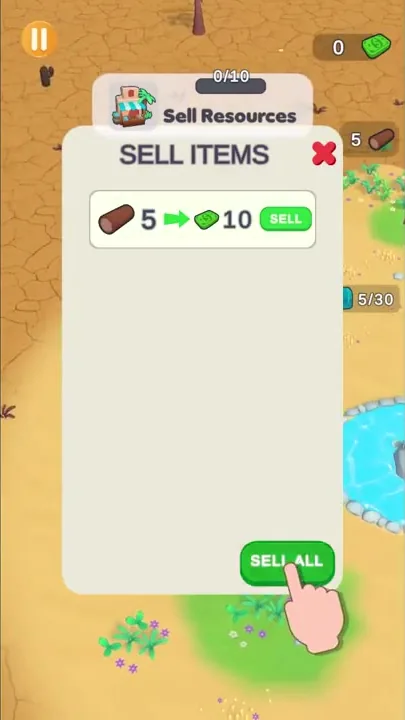
Directions come from arrows. A large green 3D arrow hangs over the next target, and a small green arrow on the ground beside the character points the way there. The only tap shown is a tutorial hand pressing “SELL ALL” in the Market’s panel.
Every task feeds the same round trip, which is the core of the Oasis Land gameplay. Logs end up in the pond or on a build plot, or they are sold at the Market for cash. Each finished upgrade or building puts a new task in the banner.
A wooden-framed plot at the left edge of the sand, marked with a log icon and 15, is the target of the “Unlock Market” task, and it lays out the whole cycle in numbers. The character walks out onto the cracked ground to water and cut palms, with logs flying onto its back after each one. It holds 10 logs while still working the palms at the edge of the sand and 15 when it comes back beside the plot, exactly the plot’s price. Once the plot is paid off, the Market stands in its place and the banner moves on.
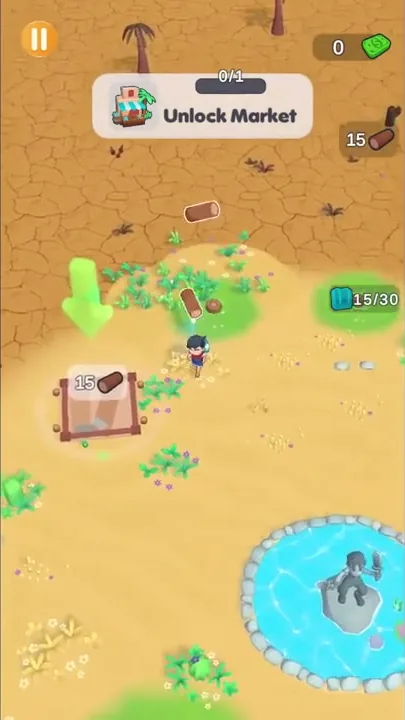
Water is the character’s other tool. A blue bar with a water-drop icon hangs above its head and runs down while the character sprays a blue jet at a tree. The pond sits in the middle of the oasis, and the bar is close to full when the character has just been standing beside it.
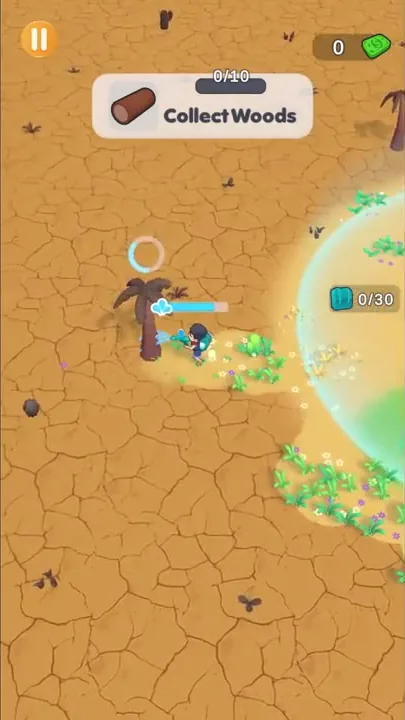
Dead palms are scattered across the cracked orange-brown ground, dark brown and leafless. While one is being sprayed, a white ring hovers above it. Then it becomes a bright green palm, and small plants come up around its base.
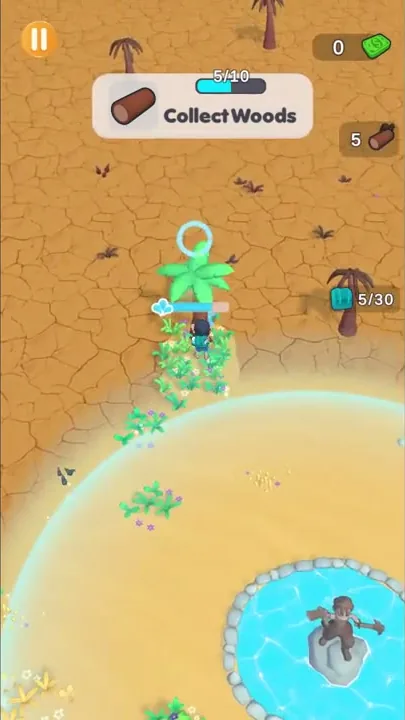
Once green, a palm is cut for wood. As the character fells one, green leaves burst from the trunk, logs and planks arc through the air onto its back, and the log counter on the right climbs. A stump is left behind on a round patch of grass. The log counter only stays on screen while the character is holding wood.
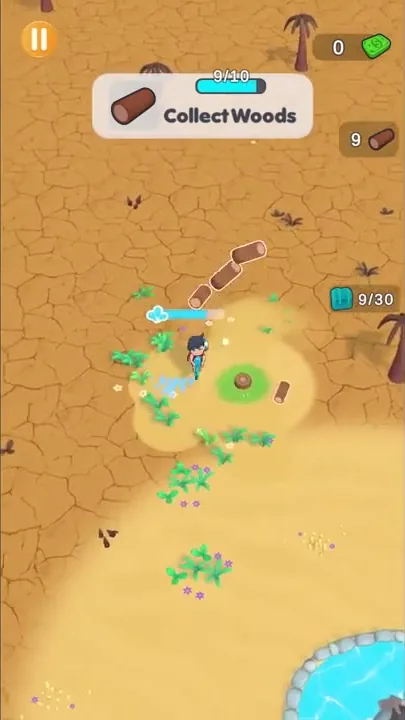
The desert changes underfoot as well. Wherever the character has walked and worked, the cracks give way to patches of smooth sand covered in green plants and small purple, white and yellow flowers. The sand around the pond keeps spreading, and a glowing cyan edge runs along the border between the oasis and the dry ground.
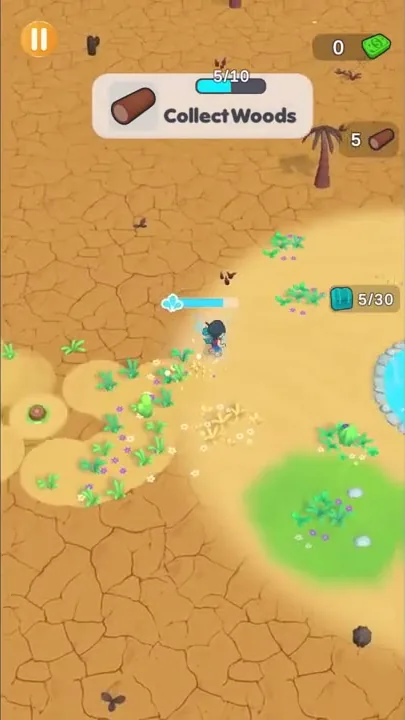
The pond at the center is the first thing the wood pays for. A label over it shows the next upgrade and its price in logs, Lv 1 to 2 for 5 at the start. A green ring around the rim fills as the character drops wood in.
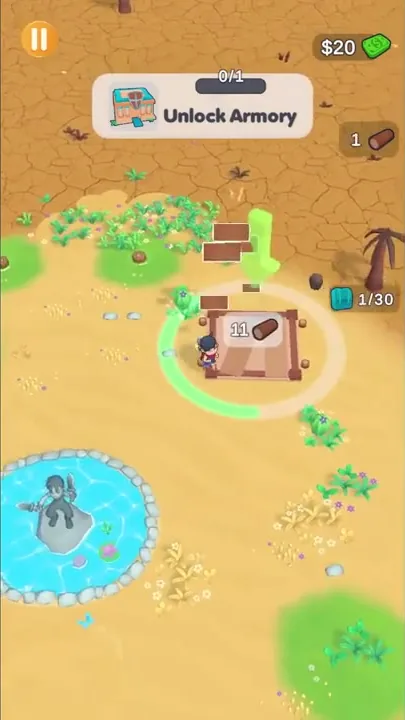
Wooden-framed plots on the sand work the same way. Each shows a log icon with the number of logs still needed, and that number counts down while a green ring closes around the plot. On the second plot it fell from 20 to 11, then 10, then 5. A finished plot turns into a building with a light-green pad in front of it.
From a bare pond to an Armory
The pond is where change shows first. It starts as a plain round pool with a stone rim, and its first upgrade puts a statue on a rock in the water with a rainbow arching over it. Purple butterflies flit nearby, and a glowing cyan ring sweeps out across the sand.
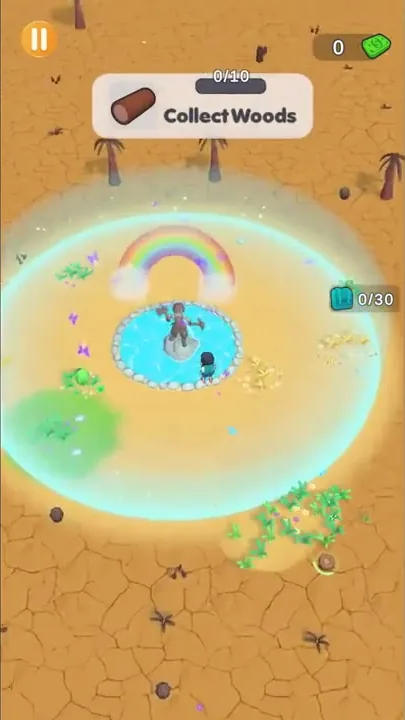
A second “Expand Habitable Zone” task sends wood back to the same spot for the Lv 2 to 3 upgrade. The character turns up carrying a single log, and the label over the pond asks for just one more. Later a pink lily floats on the water.
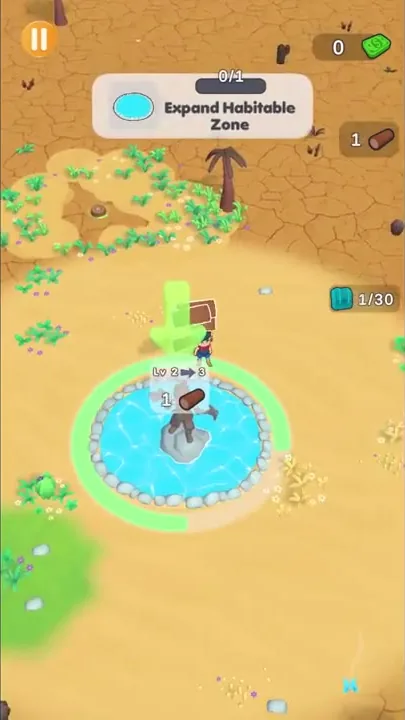
The wood targets grow over the opening stretch. The opening task asks for 5 logs and “Collect Woods” for 10, which sends the character farther out onto the cracked ground. After that the Market plot costs 15 and the second plot 20.
Buildings arrive with the fifth task. The Market, a small shop with a teal-and-white striped awning, goes up where its plot stood. The task after it, “Sell Resources” at 0/10, asks for wood to be sold there.
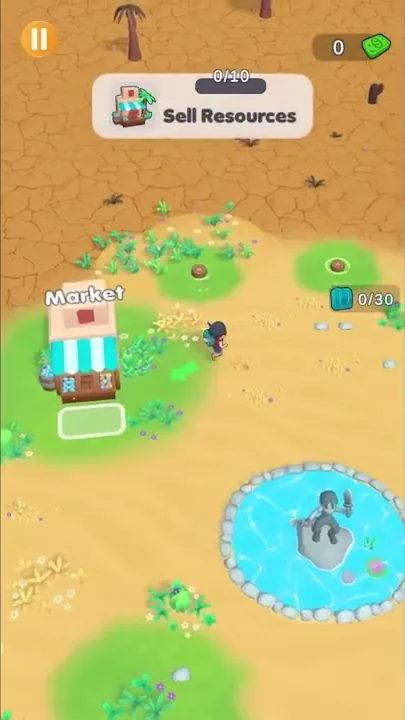
The second plot becomes the Armory, a building with a shield emblem on its front. Straight after it the banner shows a new kind of job, “Wash Clean A Stone Mine” with a rock icon. Around the same moment the carry cap rises from 30 to 40 and the cash counter empties.
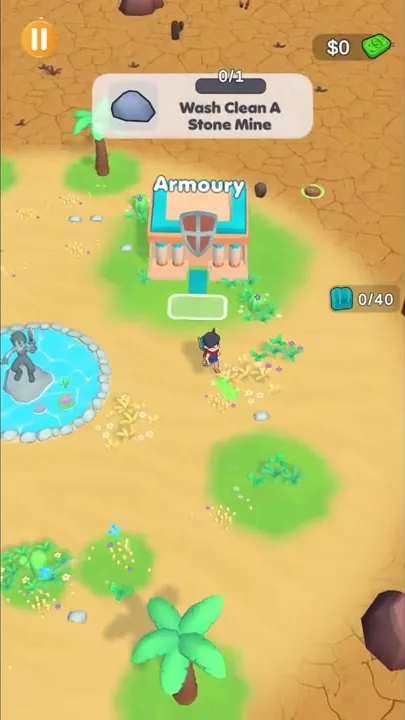
Two currencies run through the opening tasks. Logs pay for everything built so far, since both pond upgrades and both plots are priced in wood rather than cash. Cash has its own counter in the upper-right corner, marked with a green banknote icon, and it stays empty until the first sale at the Market.
Selling happens on a light-green pad in front of the Market labeled “SELL HERE”. Standing there opens a “SELL ITEMS” panel whose one row trades a log icon and 5 for a cash icon and 10, with its own green “SELL” button. A green “SELL ALL” button fills the foot of the panel, and a red X marks its top-right corner. The first 5 logs sold earn $10, and once all 10 resources in the task are sold, the character has $20.
Beyond the map and its counters, nothing else came up in the opening tasks: no shop screen, booster, lives counter, daily reward, ad or offer.
Desert regrowth with rainbows and butterflies
In our view Oasis Land is the first walk-around management game to give players a feeling beyond demolition and construction. Each palm is sprayed back to green before it is cut. The character’s work also leaves grass and flowers on ground that was cracked earth a moment earlier.
The loop around the central pond, where the water bar stands near full, is one of the game’s highlights: a dead tree gets water, turns green and is cut, and its wood builds the pond up. Water also turns the desert into an oasis. Watching plants and flowers sprout over barren ground has a little of the feel of thatgamecompany’s Flower.
The game pairs the play and visual treatment of walk-around management with a soothing, healing mood, and that pairing makes it especially relaxing and easy on the eyes. Step by step, cracked orange-brown ground dotted with dead palms gives way to pale sand and bright grass around the blue pond.
The animation is made with great care. The rainbow over the pond after its first upgrade, the butterflies around it and the flowers opening along the character’s trail are all finely detailed. So are the small blue butterflies that turn up near the bottom of the oasis later on.
An ordinary drawing style in low-poly 3D
The drawing style is only average. Everything is low-poly cartoon 3D seen from a high, angled camera that follows the character, with plain shapes for the figure and the buildings. The finer work goes into the motion and the effects rather than the drawing itself.
The opening tasks also end before the Armory’s purpose or the stone-mine job is shown on screen. Because of that, we can’t say how either one changes the loop.
Short errands between the palms and the plots
Most of the time goes into short, repeated errands with a result in plain view. The player walks out to a dead palm, sprays it, cuts it, carries the wood back and watches the number on a plot count down. A taste for mending a place rather than knocking it over is met by the map itself, which keeps turning greener as the tasks go by.
Attention stays on one thing at a time. The banner holds a single task and a green arrow marks where to go next, and no clock or fail screen turns up in the opening stretch. Play comes down to keeping the loop going while the oasis spreads around the pond.
Verdict
We were very taken with Oasis Land. The walking-and-collecting routine is still its backbone, but tending a dead landscape back to health gives that routine a new kind of feeling. The calm, healing mood wrapped around it leaves the whole game especially restful and pleasing to look at. Its drawing style is nothing special, but its animation shows real care.