Penguin Paradise -3D Review: Familiar Routine, Fresh Snow
Penguin Paradise -3D review: a crowned penguin chops snowy trees, fishes through the ice and sells the catch to pay for new buildings.
Game at a glance
Penguin Paradise -3D
7/ 10
Our score
The usual gather-and-build loop, made new again by penguins and snow.
In this article6 sections
Among idle tycoon games, walk-around management, where standing on a spot does the work, has a familiar routine. One character walks between resources, gathers them, pays for buildings and pushes the base outward. Penguin Paradise -3D follows that routine fairly closely. What it changes is the cast and the climate: a black-and-white penguin in a gold crown does the work, on a snowfield of snow-capped domes and frosted trees.
We played one unbroken stretch of about three minutes on a single snowy map, from the first build pad to a partly paid pad labeled ARMY. The penguin dressing and winter art style are what make this traditional formula feel new.
Gray build pads and a crowned penguin’s errands
The base sits on one snowy map with a rail track along the top. Gray square pads with a white outline and a printed name sit in the snow, and a white tag above each one lists the coins and wood it still needs. Progress means paying those pads off. Paid-off pads give way to buildings such as a fishing pond and a second dome house, and a green arrow hovers over the newest pad.
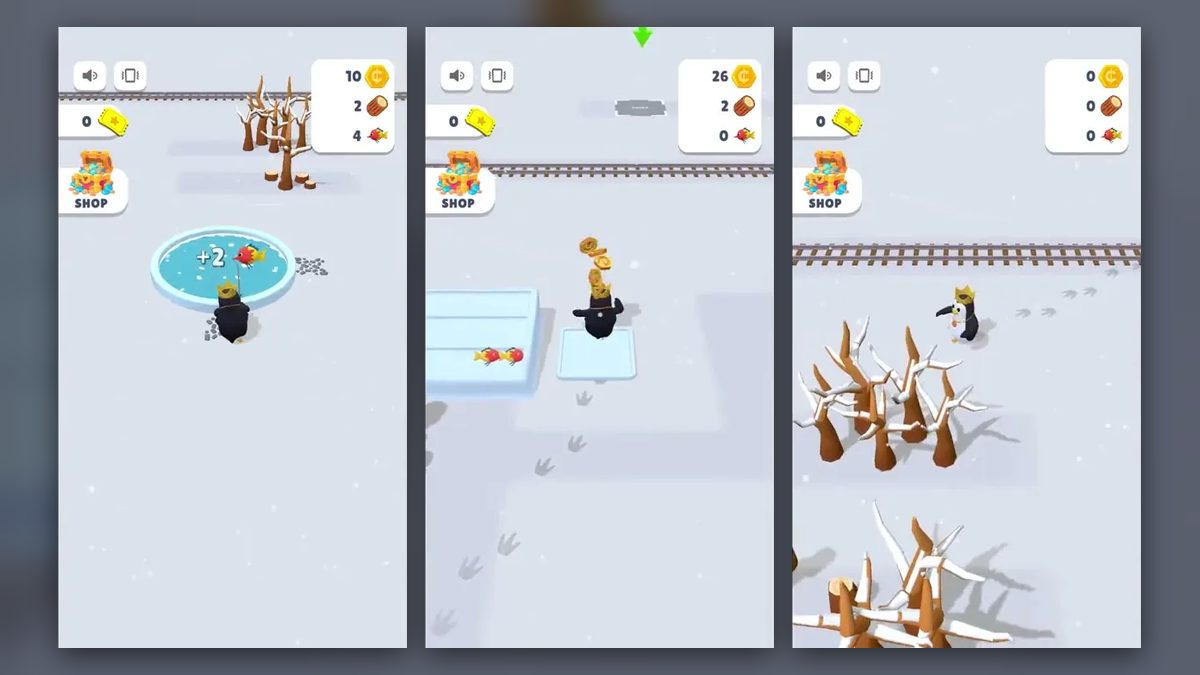
The penguin walks freely across the snow, leaving a trail of footprints. The work happens wherever it stands. Beside a grove it chops, and at the pond’s edge it fishes. On the SELL pad it hands over its catch, and on a build pad it pays in.
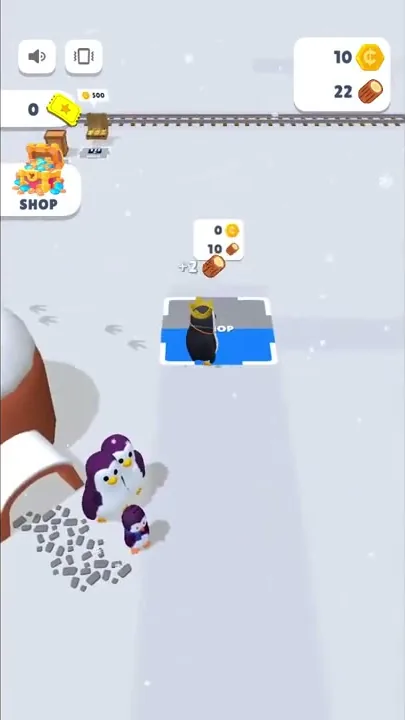
The first pad, labeled SHOP, sits in open snow next to a snow-capped dome house where three penguins stand. It asks for 10 coins and 10 wood. The coins go in first, and part of the pad turns blue. The wood follows after a trip to the trees by the rail track.

Those groves are clusters of bare brown trees with snow along their branches, and the penguin chops beside them with an axe. Logs pop out with a “+2” floating over them and go into a wood count that appears under the coins in the top-right corner. Chopped trees leave round stumps behind.

Paying in happens while the penguin stands on a pad. Logs or coins fly from the penguin onto it, and the numbers on the tag tick down. Blue spreads across the gray surface as the cost is covered.
Fishing follows the same pattern at a round hole of blue water, ringed with pale ice and dotted with floating chunks. The penguin stands at the edge with a rod as fish leap out with a “+2”. A third row with a fish icon then joins the resource counts.

The catch goes to a small gray pad marked SELL beside a counter built from blocks of ice. When the penguin stands there, its fish count empties, and fish then lie in a row along the counter. Purple penguin customers queue beside it, two early on and a longer line later. A tag with a fish icon and a count out of 24 sits above the SELL pad, and a bubble with a fish icon and a number floats over the counter.

Sales turn into coins on a light-blue tile next to the counter. Standing on it pulls a stack of gold coins up onto the penguin and into the coin count. That closes the circuit of Penguin Paradise -3D gameplay: chop, fish, sell, collect, pay into a pad, then start again for a pricier one.

Pricier pads and a second rail line
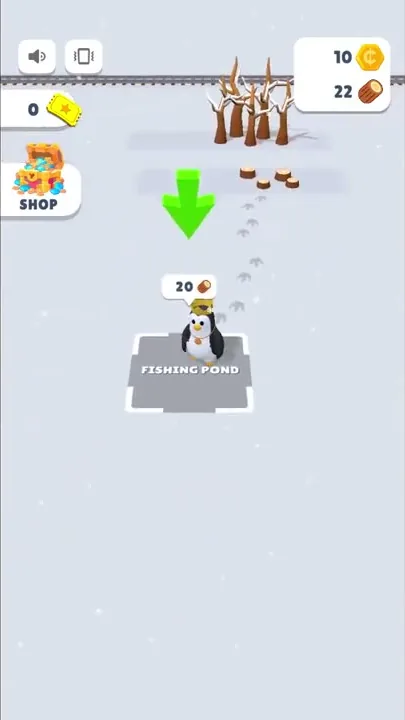
The pads came up in this order: SHOP, FISHING POND, HOUSE, a second pad whose label begins “FISHING P”, and then ARMY. A green arrow marked the FISHING POND pad as it came up, with the view moved over to the pad and the penguin out of sight, and the HOUSE and ARMY pads came into view the same way. The FISHING POND pad asks only for wood, 20 of it. Once that is paid in, the penguin turns up at the edge of the round ice pond.
The HOUSE pad doubles the SHOP pad’s price to 20 coins and 20 wood. It sits a short walk from the ice counter, where fish from the first sales already lie in a row.
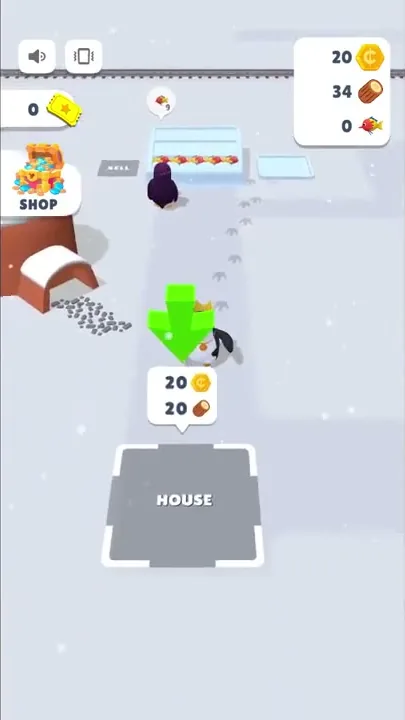
Paying it off raises a second dome house beside the first. It is a brown cylinder under a thick white snow cap, with an arched doorway where penguins in white with purple hoods gather. A yellow emoji face in sunglasses pops up over the crowned penguin, with flecks of colored paper in the air.

Costs climb from there. The second pad marked “FISHING P” asks for 40 wood, twice the first one, and the ARMY pad wants 50 coins and 20 wood. By the end of play the ARMY pad was mostly blue, with 24 coins still owed.

The base spreads outward as well. A second rail track crosses the lower part of the map. Late on, the penguin crosses it to chop a grove on the far side, then walks back over the rails to the ARMY pad.

Beyond the pads, a panel in the top-right corner tracks resources. Coins come first, and wood and fish join as rows once each comes into play. Coins are spent on pads and earned back from fish sales, wood goes into pads, and fish go to the counter. The opposite corner holds a yellow ticket tally and a SHOP button drawn as a treasure chest heaped with gems and gold.
Crates sit on small dark pads beside the rail, each tagged with an amount and a resource icon. Near the first grove, a wooden crate carries a 300 tag with a log icon, and a gold-colored crate has a 500 tag with a coin icon. A later wooden crate, tagged 200, rests on a pad that shows a clapperboard icon and the word FREE.

Penguins and snow-capped domes on a traditional loop
The praise here is for the dressing. The rules stick to the fairly traditional gather, build and expand pattern of the genre. But the workers are penguins and the setting is a snowfield, and that change makes the whole thing feel refreshingly new. The player’s penguin is black and white, with a gold crown and a small gold pendant, the customers at the ice counter are purple penguins, and the residents by the dome houses wear white with purple hoods.
The winter art style carries through the buildings and scenery. Houses are brown domes under thick caps of snow, and sales happen at a counter of ice blocks. Fish come from a round blue hole ringed with ice, and the trees are bare trunks with snow along their branches. Snowflakes drift across the low-poly scene, and the penguin’s footprints trail behind it.
That new dressing and art style give a long-standing formula different surroundings and a different experience to play. It is much the same thinking Whiteout Survival applies to its visuals.
The ARMY pad and other open questions
We had no complaints to raise. The limits come from where play ended, with the ARMY pad still short of coins, so what that building does stays out of view.
The FREE crates, the chest-shaped SHOP button, the ticket tally and the count out of 24 above the SELL pad are all on screen, yet what they lead to is not shown. Neither is anything past the ARMY pad, difficulty included.
Errands between the fishing pond and the build pads
Play here is a circuit of short errands. The penguin walks to the trees and stands while logs pile up, then goes to the pond while fish come in. Next it hands the catch over at the SELL pad and scoops up the coins. Then it empties everything into the next gray pad.
These mechanics fit a taste for steady upkeep, where repeated trips feed a cost tag until a new building rises in the snow. For anyone drawn to winter scenes and animal characters, that routine comes set in a penguin village under snow.
Verdict
Strip away the snow and Penguin Paradise -3D runs the traditional collect-and-construct loop of its genre. Leave the snow in and that loop looks and feels like something new. A crowned penguin at work, a queue of purple customers and domed houses under heavy white caps turn familiar chores into a fresh winter village. The freshness lives in that new look, while the rules underneath stay the ones the genre already knows.