Pill Puzzle Review: Tap-to-Clear Goals Wrapped in Capsules
A Pill Puzzle review of tap-to-clear play with glossy capsules, from a 3x3 board in Level 1 to an 8x8 grid holding four colors.
Game at a glance
Pill Puzzle
5/ 10
Our score
Swap the pieces for pills and the whole game takes on a new tone.
In this article6 sections
Tap a patch of touching yellow pills and the whole patch disappears, its pieces turning into small dots that fly up to a goal counter. Pill Puzzle borrows the look of Dr. Mario, Nintendo’s falling-capsule puzzler, for a tap-to-clear puzzle game: every regular piece on its board is a glossy capsule or a round pill, while the rules stay close to a direct tap-and-clear design.
We played Levels 1 to 7, in which the board grows from 3x3 to 8x8 and the colors go from two to four. Changing nothing but how the pieces look makes the game feel very new, and overall it sits in the middle of the scale.
Clearing capsule halves against a move limit
Each level lists its goals in a blue panel on the right of the white top bar, under the level number. The panel holds one capsule icon for every color that has to be collected, each with a count beside it. Clearing pieces of that color lowers the count, and a finished goal trades its number for a green check mark.
The limit is a MOVES counter in a blue ribbon at the top left, which drops by one with every tap. No timer appears anywhere on screen.
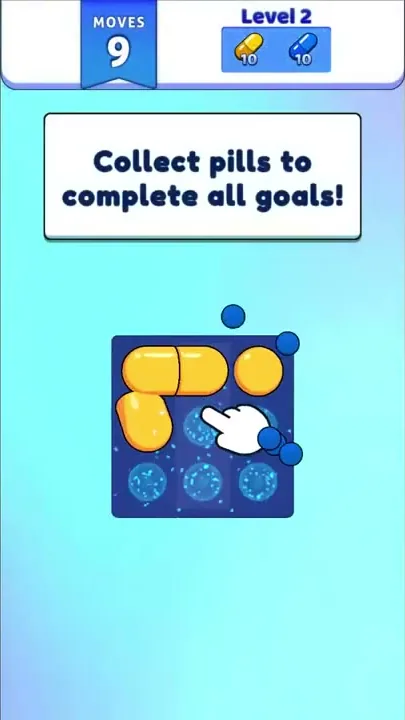
Tapping is the only control, and Pill Puzzle gameplay rests on one repeated action: tap a group of touching pieces in the same color to clear it. The cleared pieces become small colored dots that fly up to the goal panel, and that color’s count falls. Early tutorial cards in dark bold lettering, paired with a white cartoon hand, show where to tap, including one that reads “Collect pills to complete all goals!”
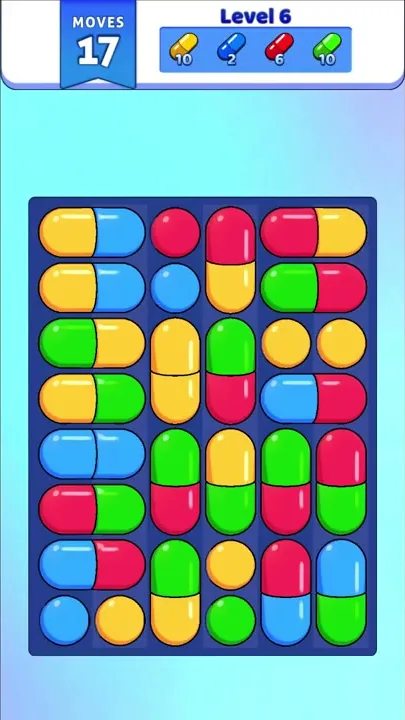
The pieces are glossy two-cell capsules, lying flat or standing upright, either in one color or split between two, alongside round one-cell balls. The two halves of a capsule count separately, so a tap can take one end of a two-tone pill and leave the other behind as a round ball.
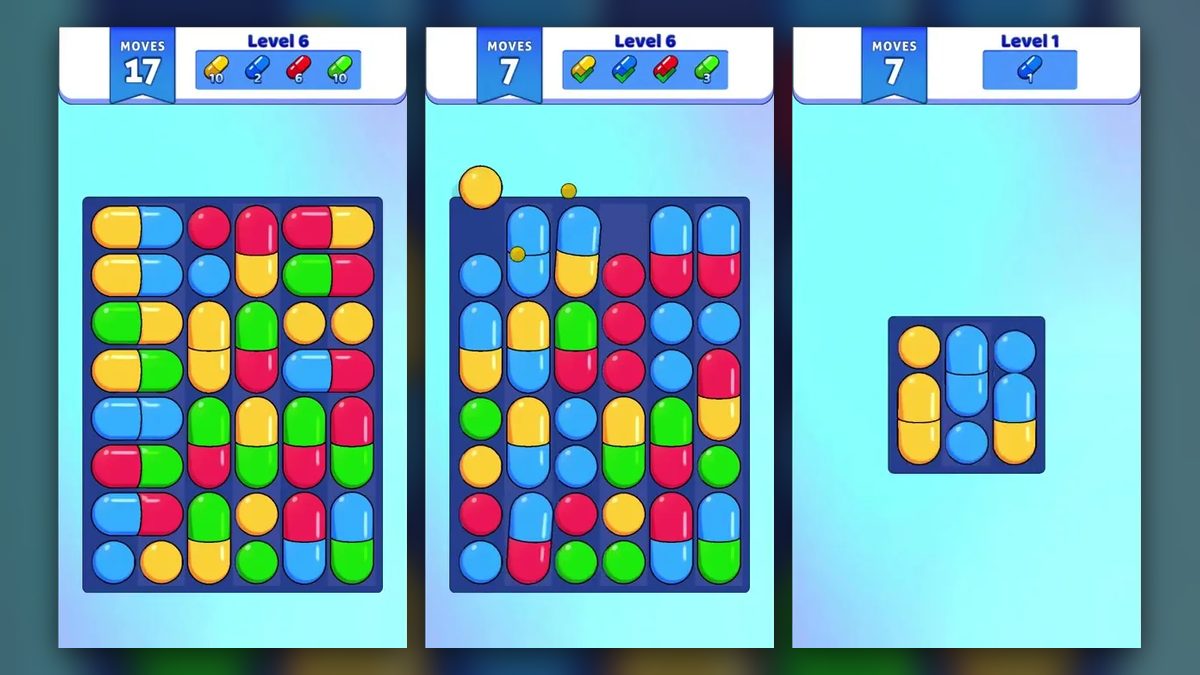
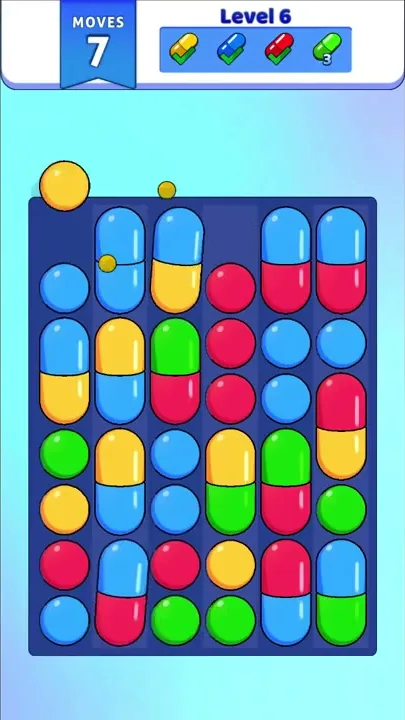
Four colors share the Level 6 board, which is 6 columns wide and 8 rows tall, and its goal panel asks for 10 of each, with 20 moves on the ribbon early in the level. One tap in the upper right took a blue ball, an all-blue capsule and the blue half of a yellow-blue capsule as a single group. The blue count dropped from 6 to 2 and the moves from 18 to 17, while the yellow half stayed put as a round ball. Later in the level, every goal but green had its check mark.
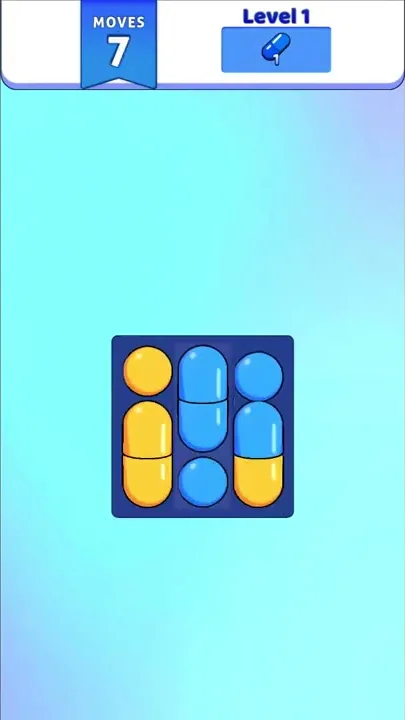
After every clear, the pieces above drop down to fill the gap and new ones fall in from the top of the board. In Level 1 a blue-and-yellow capsule dropped toward an emptied middle column this way, and in Level 6 a lone yellow ball fell toward a vacant top cell.
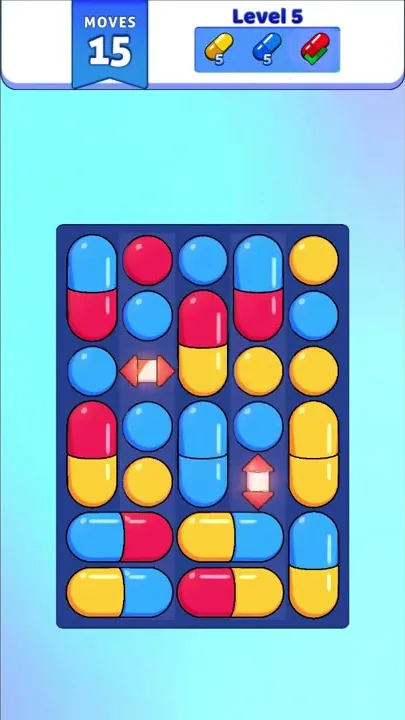
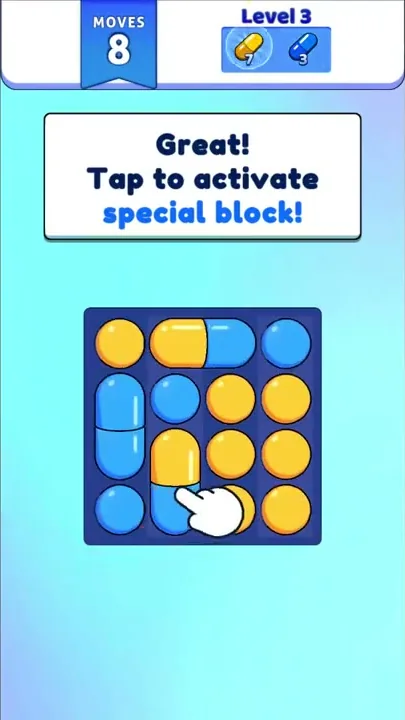
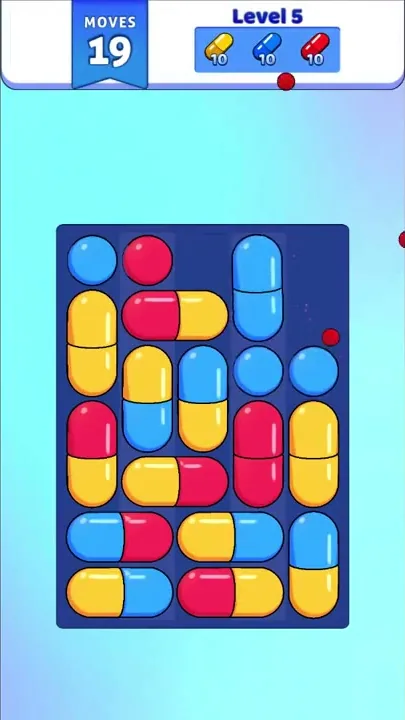
The first special pieces are arrow blocks: one-cell red blocks with a white center and two red arrowheads, pointing either left and right or up and down. The card that introduces them reads “Great! Tap to activate special block!” A left-and-right one sits in the bottom row of Level 3, and up-and-down ones show up in Level 5 and again in Level 7. At one point the Level 5 board holds one of each.
One other special piece turns up: a round black bomb with a lit fuse that fills a single cell. It sits in the bottom row of the Level 4 board, beside an up-and-down arrow block, behind the completion ribbon.
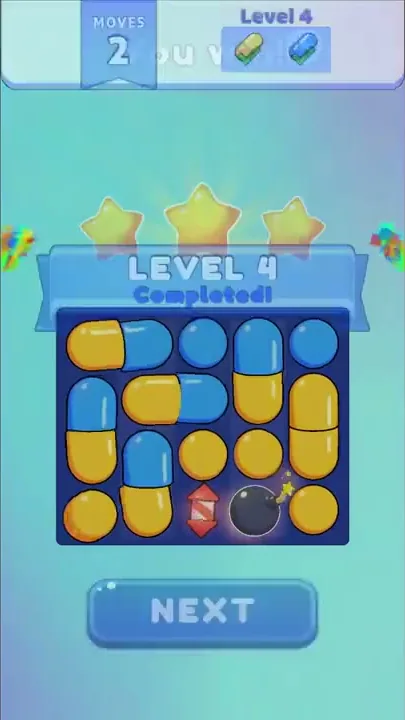
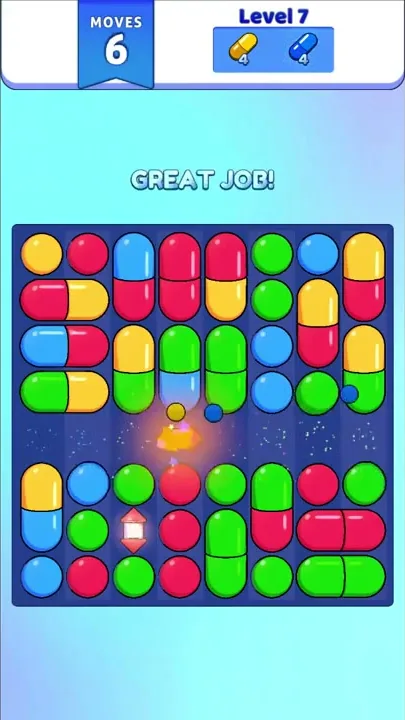
The Level 4 tutorial card talks about mixing special blocks into a huge explosion, and large blasts show up as well. Later in that level the top two rows stand empty while orange-red bursts spray across and past the two rows that remain, under a pink “IMPRESSIVE!” On the Level 7 board a whole row is left empty and sparkling, with a pale “GREAT JOB!” above it.
Pill boards that grow from 3x3 to 8x8
Level 1 uses a 3x3 board on a dark navy tray, with yellow and blue as the only colors and a single blue goal. The next board keeps that size and those two colors but asks for 10 of each.
Larger boards and the first special pieces arrive in Levels 3 and 4. Level 3 widens the board to 4x4 and brings the arrow blocks, along with their tutorial card. Early in that level, the left half of the board is all blue balls and the right half all yellow.
The board stretches again in Level 4, to 5 columns by 4 rows, and both goals climb into the twenties. This is also where the next tutorial card appears: “Mix special blocks to create huge explosion!”
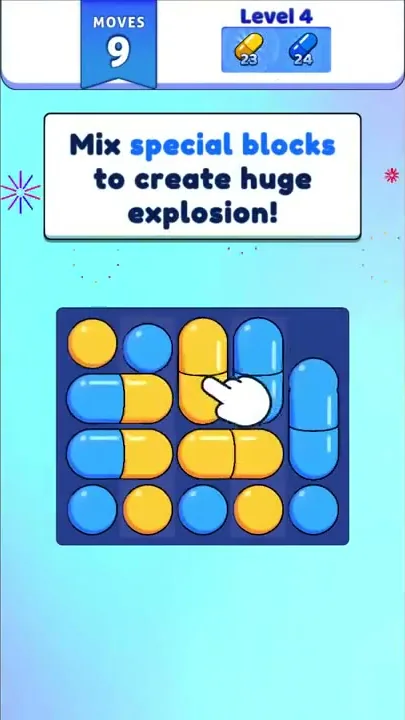
New colors arrive one at a time after that. Red joins in Level 5 as a third color with its own goal of 10, on a board 5 columns wide and 7 rows tall.
Green follows in Level 6 as the fourth color and the fourth goal. Early in that level, two-cell capsules cover almost every cell, most of them split between two colors, with only a blue ball and a yellow ball in the top row. We saw no special blocks on this board.
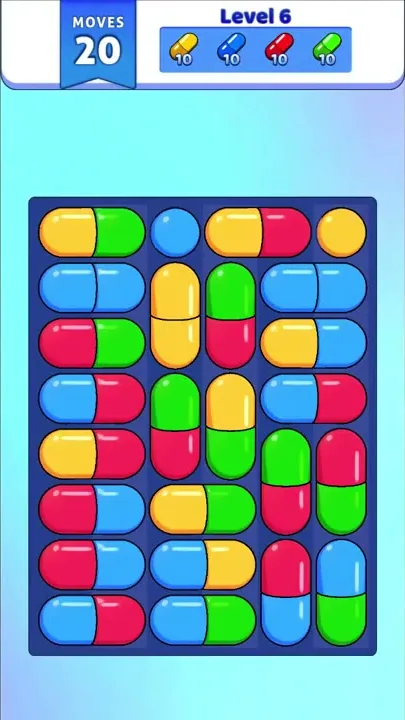
Move counts are higher on the bigger boards of Levels 5 and 6. On the small early boards the highest readings seen were 8 to 10 moves, while early in Level 5 the ribbon shows 19 and early in Level 6 it shows 20. Goals mostly sit at 10 per color.
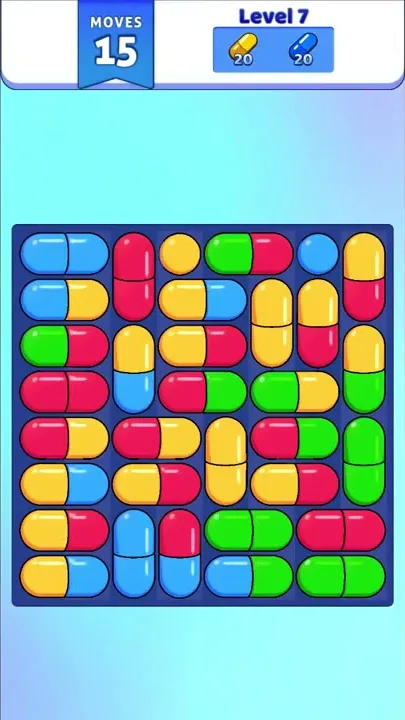
The 8x8 board of Level 7 departs from the one-goal-per-color setup used from Level 2 onward. All four colors fill it, yet only yellow and blue have goals, 20 each, with 15 moves on the ribbon early in the level. Red and green take up much of the board without a goal of their own.
Outside the boards, the one extra screen that appears is the completion card. At the end of Level 4 the screen dims and a blue “LEVEL 4 Completed!” ribbon appears over the board beneath three stars, with confetti at the sides and a NEXT button below.
A pill costume on straightforward tap-to-clear rules
Every regular piece has been repackaged as a pill: a glossy capsule or a round pill with white highlights, in four bright colors, laid on a dark navy tray against a cyan-to-lavender background. On the 8x8 board of Level 7 the capsules cover nearly every cell.
Only the look of the pieces has changed, yet to us the game comes across as very novel. That one change also shifts its tone and feel a great deal, and the pill theme carries past the board into the goal panel, which counts in capsule icons, and into tutorial text that talks about collecting pills.
The straightforward tap-to-clear design is a strength as well. A level asks for little beyond tapping same-color groups, plus the odd special block, until the goal counts are cleared within the move limit, and the only special pieces seen are arrow blocks and a bomb.
Open questions about the bomb and arrows
We raised no specific complaint about Pill Puzzle. Some parts of it stay out of view, though: what the arrow blocks and the bomb clear, how special blocks are made or mixed, and what the three stars on the completion card measure are never shown.
No fail or out-of-moves screen appears either. There is no sign of a shop or a currency, and no ads appear; whether the game has any of these elsewhere is unknown.
Popping color clusters to tick off goals
Each board comes down to the same routine: spot a patch of touching pieces in one color, tap it, and watch its count fall on the goal panel while the move ribbon ticks down. Two-tone capsules mean a single tap can split a pill and leave half of it behind, and on the 8x8 board red and green pieces fill space that no goal asks for.
That routine lines up with a liking for one-tap puzzles with a visible target and a fixed number of moves, here with every regular piece drawn as a pill.
Verdict
Pill Puzzle rests on one decision, drawing its pieces as pills, and that alone gives a straightforward tap-and-collect formula a very different character. Beneath the costume sit the move counter and color goals of a direct tap-to-clear game. Taken as a whole, it lands halfway up the scale.