Pinball Fortress Review: Place Traps Freely on the Table
Traps picked one card from three, then placed freely on a grass table: this Pinball Fortress review covers how the fortress defense works.
Game at a glance
Pinball Fortress
7/ 10
Our score
Take pinball apart, mix in a new setting and new rules, and good new chemistry appears.
In this article6 sections
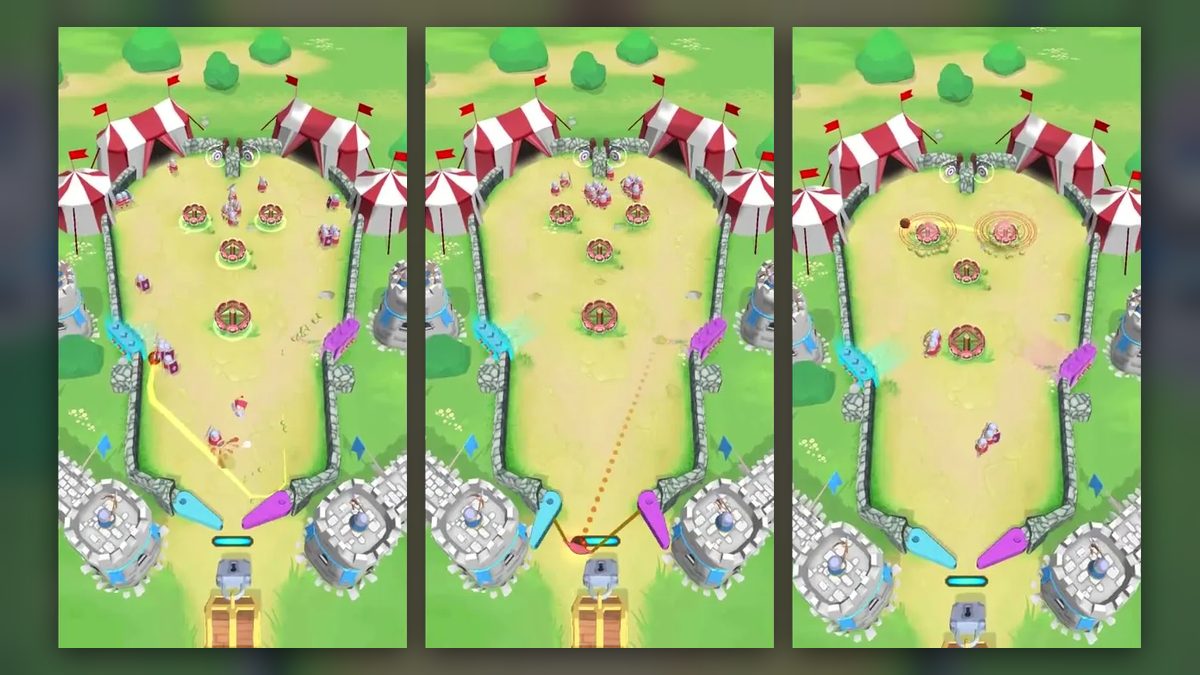
A pinball table normally exists to keep a ball in play and run up a score. Pinball Fortress, a mobile ball bounce game played in portrait, keeps the oval table and its two orange flippers but turns the grass into a battlefield. Monsters come in from the top in waves while a fortress sits below the flippers. The player picks traps from cards and places them freely on the table.
We played Stage 1 from its second wave through to the victory screen, then Stage 2 up to its fourth wave. Underneath the cartoon grass sits a more casual bouncing-ball RPG.
Monster waves on a grass pinball table
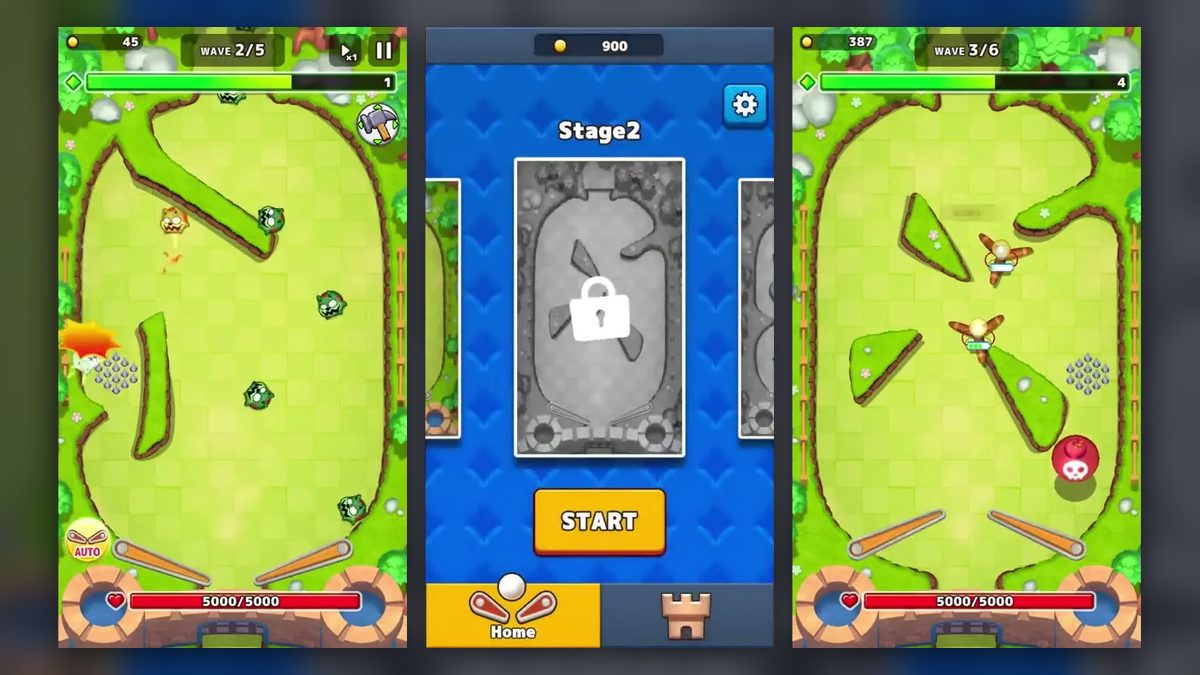
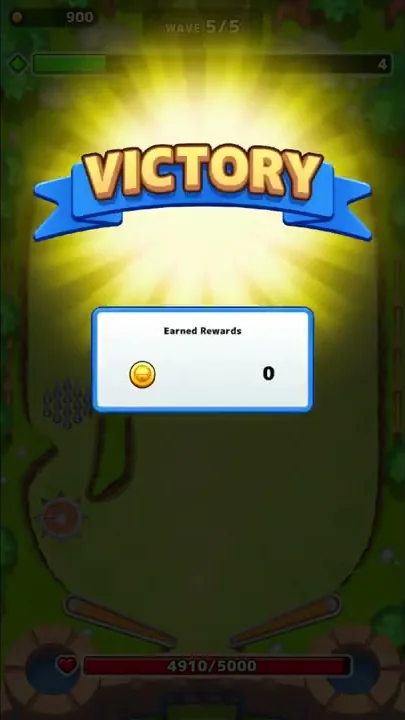
Each stage is a run of numbered waves, tracked by a counter at the top of the screen. The fortress along the bottom edge carries a red health bar with a heart icon, full at 5000/5000. Stage 1 ended in a victory screen once its last wave was over, and no timer or move limit appears at any point.
Pinball Fortress gameplay is built around those waves. The table is a tall oval of light-green checkered grass edged with brown rock, with raised grass ridges breaking up the open space and the two flippers just above the fortress gate.
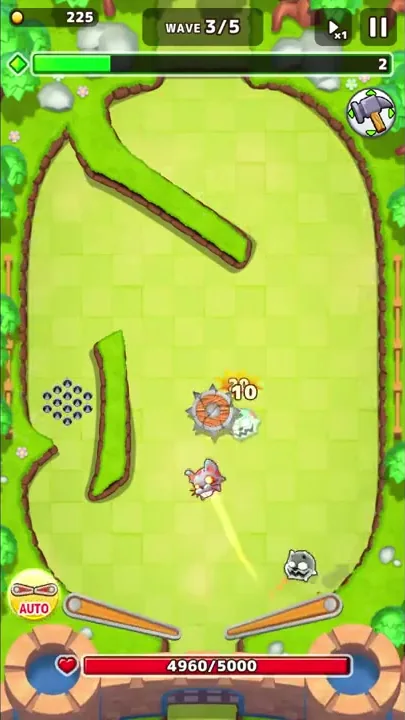
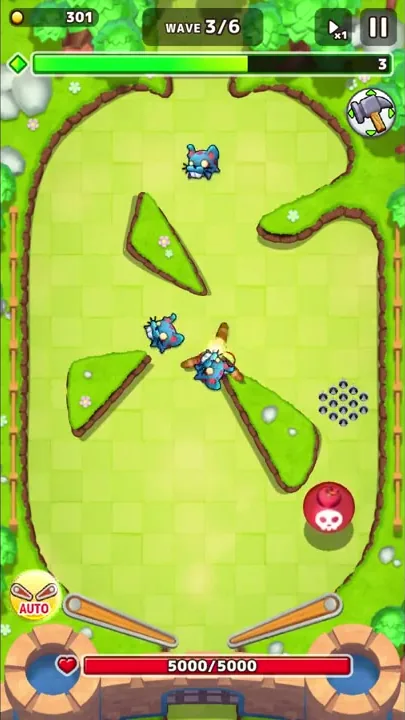
During a wave, monsters spread across the grass while small round characters streak around leaving colored trails. Placed traps hit the monsters, and numbers pop up where they connect. Coins and green gems drop onto the table along the way, and between waves the grass briefly empties.
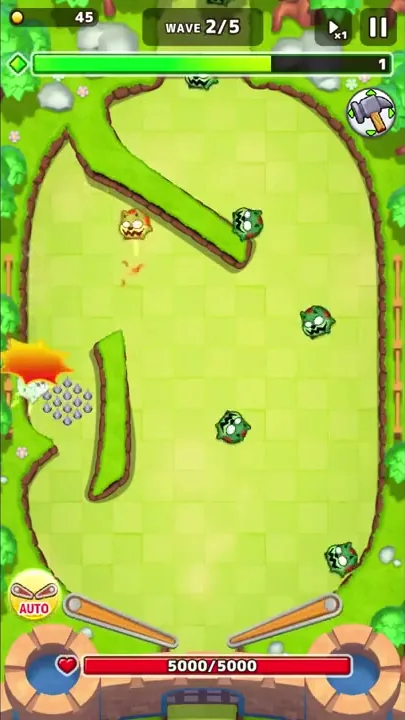
Traps are placed by dragging, and any trap already on the table can be moved later. During waves, the two flippers are down at some moments and raised at others, and a yellow “AUTO” button with a flipper icon waits at the lower left. The top right holds a pause button and a speed button marked “x1”, with a round hammer button below them that was dark gray right after some placement screens and lit again later. All of these buttons vanish in the short gaps between waves.
Two kinds of monster show up: green round ones and blue horned ones. A wave’s monsters appear at the opening at the top of the table, then scatter over the grass. Gray-white creatures, some trailing smoke, turn up among them as well.
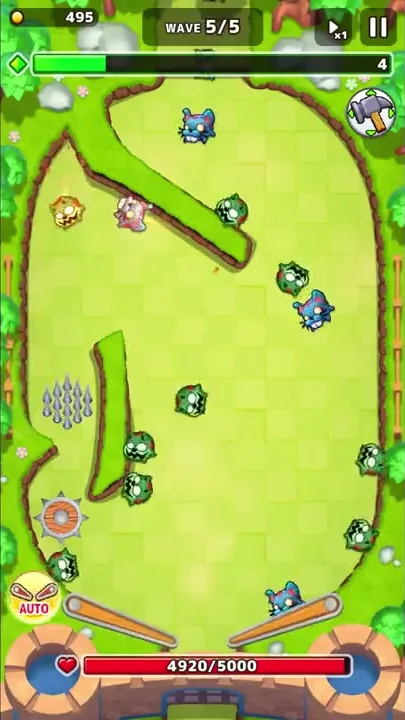
The Spike Trap is a patch of metal spikes set into the grass, and the spikes stand tall at some moments and lie as flat dark dots at others. Orange bursts flare beside it, and at one point an “80” pops up next to it. Its upgrade card reads “The damage increases significantly.” In Stage 1 it is already in a notch in the left wall while wave 2 is under way, and in Stage 2 it goes on the right side of the table.
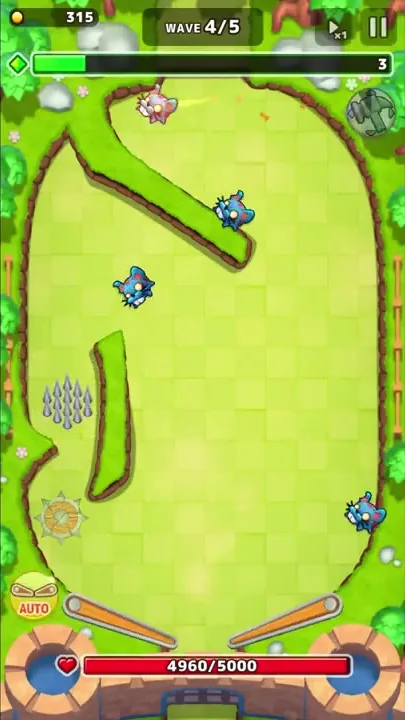
The Bumper is a round disc ringed with metal spikes around an orange wooden center, and its card reads “Blow away the enemies and deal damage.” It went into the middle of the Stage 1 table, where a number pops up when a gray-white creature touches it.
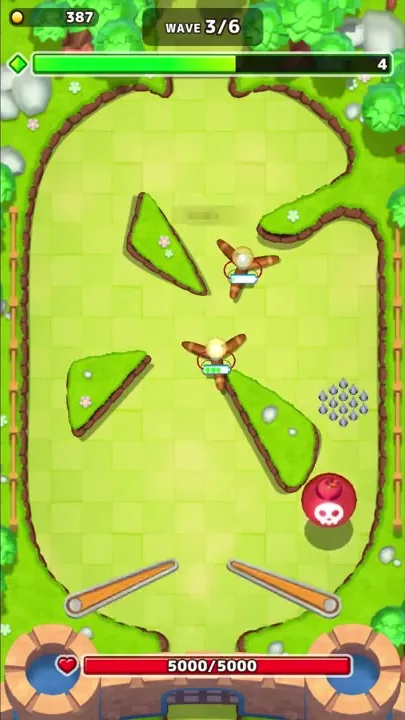
The Balloon Bomb is a red balloon with a white skull, and its card reads “When hit, the trap expands and explodes.” It was offered on the first Trap Choice seen in Stage 1 but passed over there, then taken from a later offer in Stage 2. Dragged to the lower right of the table, it stays put through the waves that follow.
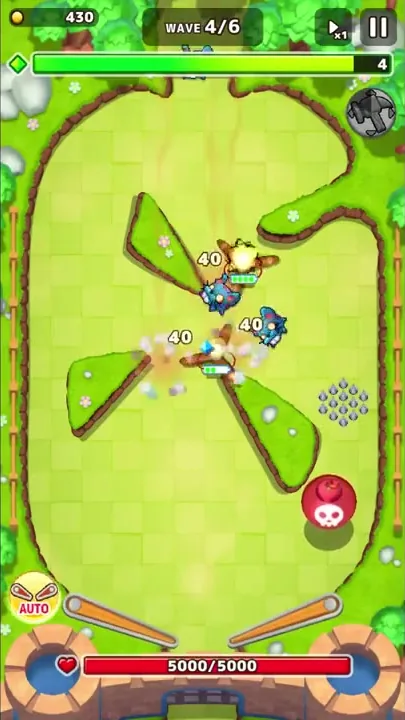
Stage 2 has a wooden device that looks like a crossbow: an upright shaft with two curved arms, and a glowing orb at its center above a small segmented green bar. Its name does not appear in the play we saw. One stands in the middle of the table early in Stage 2’s first wave, facing different ways at different moments, with numbers reading “40” popping up near it. A second one comes from a card at the bottom of the placement screen and goes in just upper right of center.
A bar across the top of the screen, with a green gem icon on the left and a number on the right, fills as green gems drop during play. When it is full, it turns magenta and “Trap Choice” opens over falling confetti with three cards. Each card shows the trap’s name and picture over a one-line description, with a row of four stars along the bottom.
A blue “Add” tag marks a new trap, while an orange “Lv.UP” tag with an orange header marks an upgrade to a trap already on the table. The Spike Trap upgrade card has two of its four stars filled; the new-trap cards have one. Under the cards sit a blue magnifier button and a yellow “Refresh” button marked with a small camera icon.
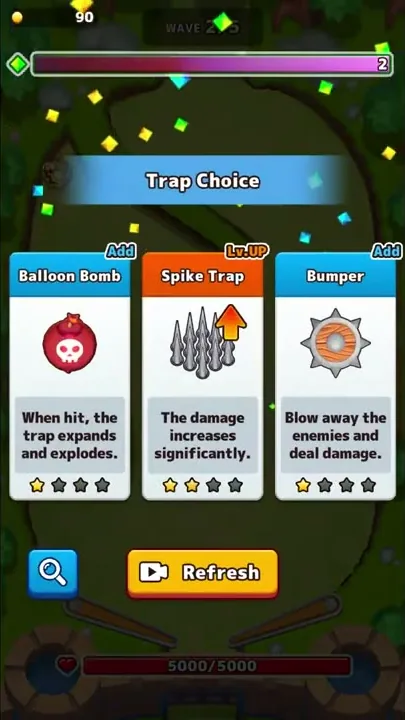
A later offer, in Stage 2, held three new traps: Warp Hole (“When sucked in, they are teleported to another hole.”), Cannon (“Blow away the enemies in one direction.”) and the Balloon Bomb again. This one-card-from-three pick is where Pinball Fortress sits closest to games like Archero. The number on the bar goes up after each fill and starts over in Stage 2.
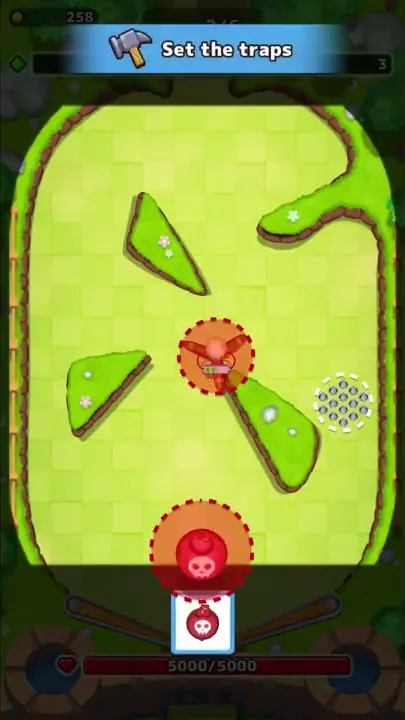
A chosen trap goes down on a screen headed “Set the traps” and marked with a hammer icon, where the area outside the table darkens and every trap already placed is ringed by a white dashed circle. The new trap waits at the bottom as a card or icon and, dragged onto the table, shows as a green ghost until a green check button confirms it. While the Balloon Bomb was being dragged it showed red inside a red dashed circle, and the turret in the center turned red as well. The same screen also opens with no new trap, either to move traps already down or to leave them as they are.
Green round monsters cross the first table with the counter at “WAVE 2/5” and a Spike Trap already in the notch on the left wall. The gem bar fills during that wave, and Trap Choice offers the Bumper and the Balloon Bomb as new traps next to a Spike Trap upgrade; the Bumper goes into the center. A placement screen in wave 4 moves it to the lower left. The fortress bar slips slightly below 5000 as the waves pass, and after “WAVE 5/5” the “VICTORY” banner appears above an “Earned Rewards” panel.
From five waves to six, trap by trap
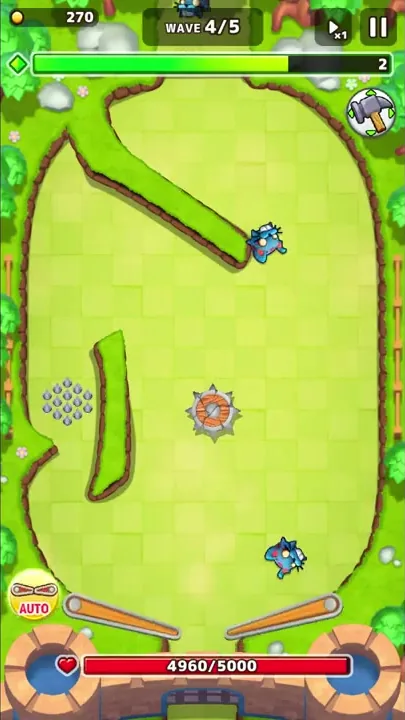
The monster mix shifts as a stage goes on. Green round monsters make up waves 2 and 3 of Stage 1. Blue horned ones take over in wave 4, and wave 5 packs the grass with both kinds at once. The second stage opens with green monsters in its first wave, then sends blue horned ones through waves 2 to 4.
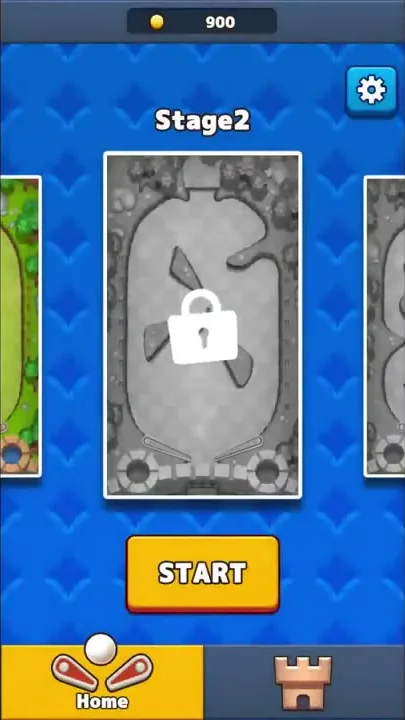
After the Stage 1 victory, the home screen shows a sideways row of stage cards. The center card reads “Stage2” and is grayed out with a padlock, between a green card at the left edge and a gray one at the right, and its small picture matches the table that comes next. That table trades the Stage 1 ridges for triangular grass islands around the middle and a hook-shaped ridge curling out from the upper right wall. Its counter reads “WAVE 1/6”, one wave more than Stage 1, and none of the Stage 1 traps are on it.
Within a stage, traps pile up. The first table held a lone Spike Trap in wave 2 and gained the Bumper before wave 3. The second had a single turret early in its first wave. A Spike Trap went in on the right, then the Balloon Bomb at the lower right, then a second turret, so by wave 3 it held four traps.
Coins are the currency on display. A counter at the top left climbs as monsters are cleared, and coins drop onto the table during waves. The home screen carries the total at the top, while the in-stage counter is low again early in Stage 2. Nothing is bought with coins in either stage, and the “Earned Rewards” panel on the victory screen shows a coin icon beside its figure.
The home screen itself is blue and patterned, with a settings gear at the top right and a yellow “START” button under the stage cards. A bottom bar holds a selected “Home” tab, marked with a flipper-and-ball icon, and a second tab marked with a castle.
Pinball taken apart and rebuilt as a fortress
Pinball Fortress takes classic pinball apart and combines it with an RPG setting and new rules, and the chemistry that results is good. The oval table and its flippers stay, but the grass between them becomes a defense map, with waves of monsters coming down from the top and a fortress holding 5000 health at the bottom. The new rules are free placement, seen when the Bumper moves from the center of the Stage 1 table to its lower left, and the one-from-three card pick in the Archero mold.
As a bouncing-ball RPG, it is a more casual one. We also see it as a casual mobile version of an earlier zombie pinball game.
Unplaced cards and an unseen fail screen
We had no complaints about Pinball Fortress. A few parts of the game stay out of view, and none of them counts against it.
The fortress bar dipped slightly in Stage 1 and stayed full in Stage 2, and no fail screen appeared, so what happens when it empties is unknown. Warp Hole and Cannon were offered only as cards, and the Balloon Bomb never visibly went off, so all three are known from their card text alone. The Refresh and magnifier buttons were never pressed, and what the castle tab and the “AUTO” button do stays unexplained.
Drafting traps while monsters cross the grass
Many of the choices seen in Pinball Fortress are about layout: which of three cards to take when the gem bar fills, and where on the table each trap goes, with the option to move it later. During waves, the placed traps hit monsters as they cross the grass. Someone who enjoys rearranging a tower-defense map between waves, or taking one upgrade from a handful of offers in a run-based action game, will recognize both jobs here, set on a pinball table.
Verdict
Pinball Fortress breaks pinball down and rebuilds it around a fortress under siege, an Archero-style upgrade pick and traps the player sets out and moves around. The new mix works, and it plays as a more casual pinball RPG.