Marble Blitz Review: Peg-Board Pinball With a Monster Team
One ball, a combo that climbs to 96 and a monster team to level up: our Marble Blitz review covers the peg board and the menus around it.
Game at a glance
Marble Blitz
7/ 10
Our score
Pinball plus cards, in the light-play, heavy-progression mold.
In this article6 sections
On screen, Marble Blitz looks like the matching and clearing of games like Royal Match with an RPG fight laid on top, complete with long chains and a monster soaking up damage. Underneath, though, it is a ball bounce game. The chain comes from one ball bouncing through a board of pegs rather than from swapped tiles, and the format is lighter and more casual.
Each shot sends the ball into a dark board of colored pegs while a small team of cartoon monsters fights a single enemy in a forest strip above. Around the battles sit menus for leveling those companions, opening chests and decorating an underwater home. We played through Level 3 and into the start of Level 4.
One ball against a board of element pegs
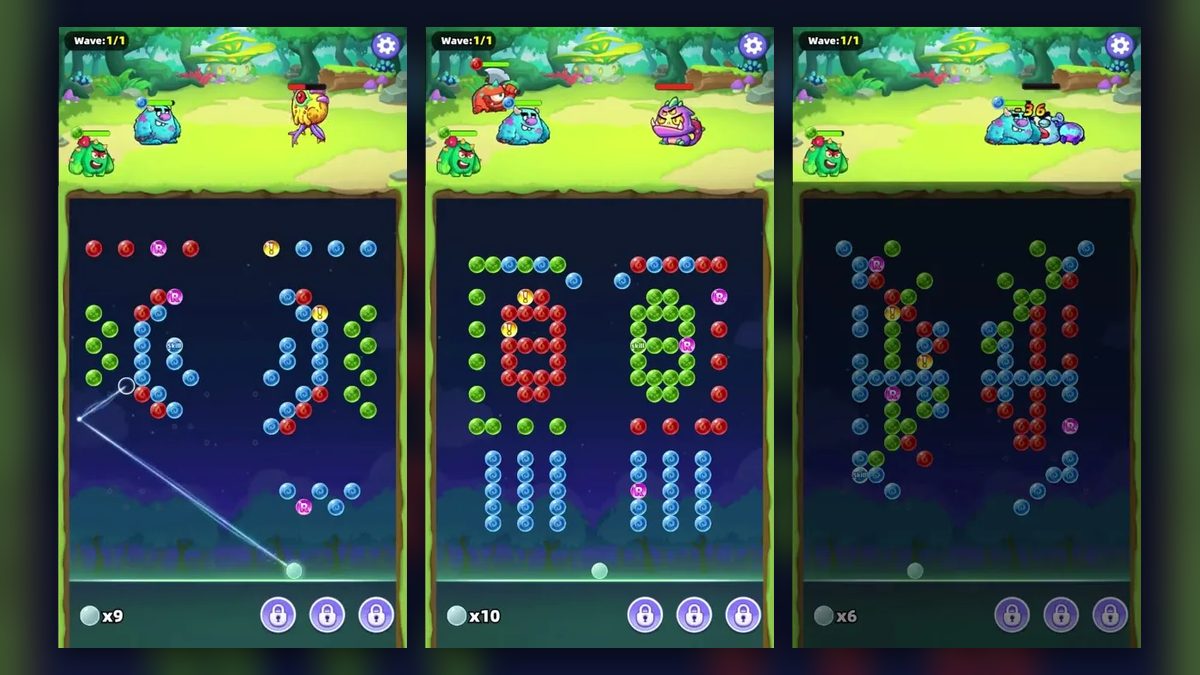
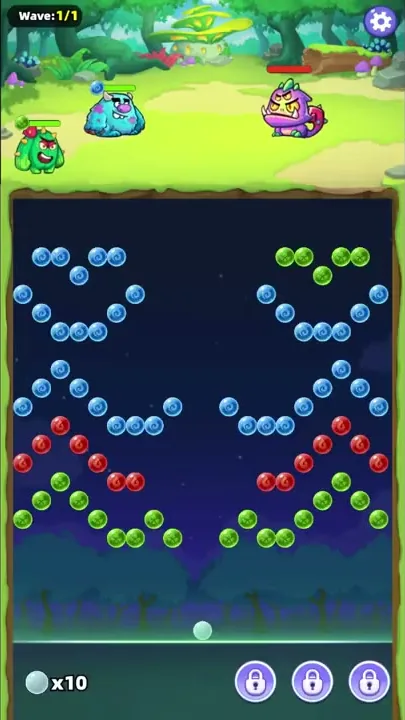
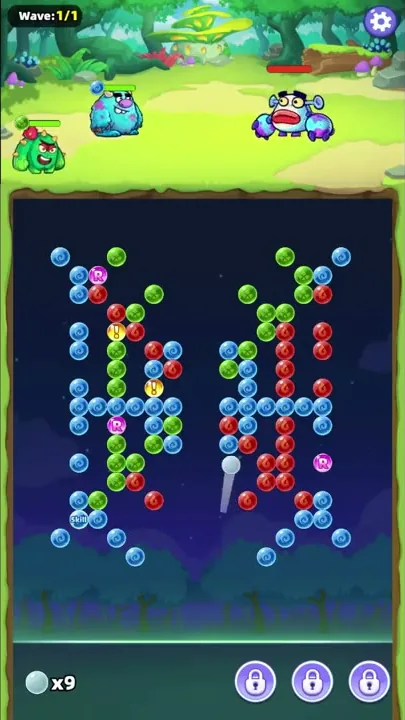
Marble Blitz gameplay splits the screen in two. A bright cartoon forest strip runs across the top, and a dark-blue night-sky board with tree silhouettes along its lower edge fills the rest. All four battles show “Wave:1/1” and a single enemy on the right of the strip under a red health bar. It faces companions on the left, who have green bars. Knocking that enemy out ends the level.
A ball counter at the bottom left starts at x10 and drops by one per shot. Three round slots with padlocks sit beside it.
Each shot begins with the ball resting on a glowing launch line at the bottom of the board. A dotted guide line runs from the ball to a small ring that marks the first peg it will touch, and the guide can include a bounce off a side wall. The launch point shifts along the line between shots: the first battle’s opening ball left from the center, its second from right of center.
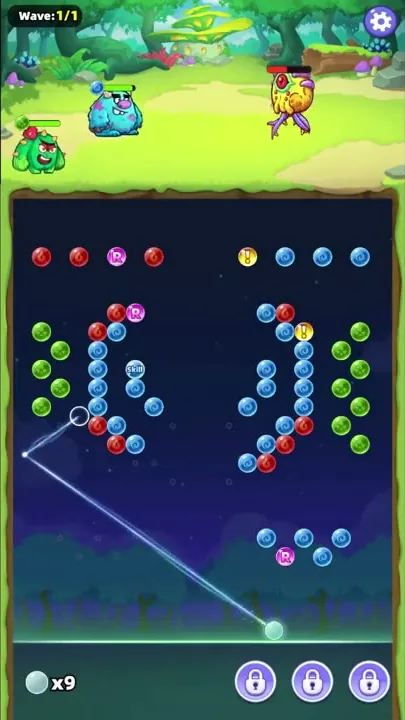
A yellow one-eyed creature with purple tentacles stands on the right of the strip in the first battle, facing a blue furry monster and a green cactus-like one. The board is built from mirrored halves. Each has a curved run of mostly blue pegs with red at its ends and bends, a zigzag of green pegs along the outer edge, a row of four pegs across the top and a small cluster low down. After the first shot several pegs are gone, the enemy shows -36 and the counter reads x9. With x8 left, the creature lies flat and a blue ribbon carrying a cartoon white-haired character sweeps across the board. The game then returns to the home screen for upgrades and the next level.
The plain pegs are red, blue or green, and each color has its own icon: a flame on red, a swirl on blue, a leaf-like symbol on green. The same icons return as element filters on the companion screens, next to an ALL button. A peg the ball hits disappears and leaves a faint dotted outline where it sat. On the Level 4 board, red and green pegs gather in shaped clusters above short columns of blue.
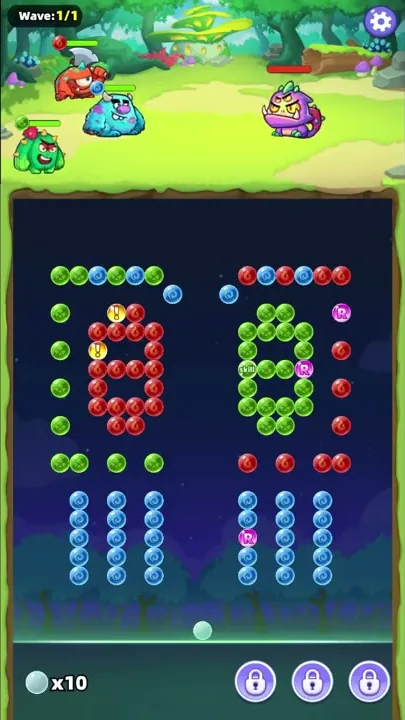
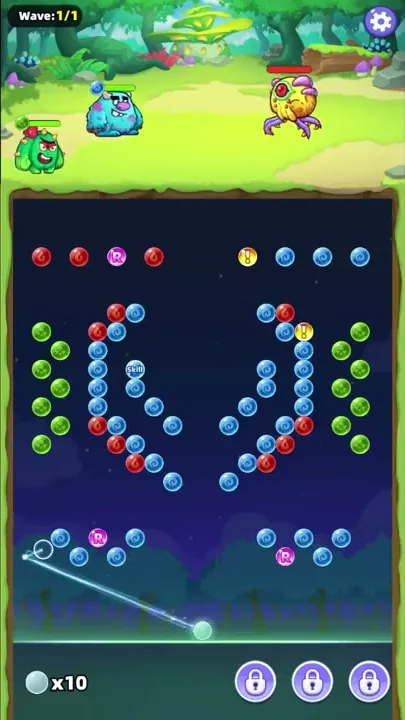
Some pegs carry marks. Magenta pegs show an R and yellow ones an exclamation mark, while a single peg is labeled Skill; it is white-blue in some battles and green in others. The first battle and Level 4 each start with three R pegs and two exclamation pegs, plus the Skill peg, and the same set is in place early in Level 3. Level 2 opens with none of them. By the time its first ball is bouncing, two R pegs and two exclamation pegs are on the board, with a Skill peg among them.
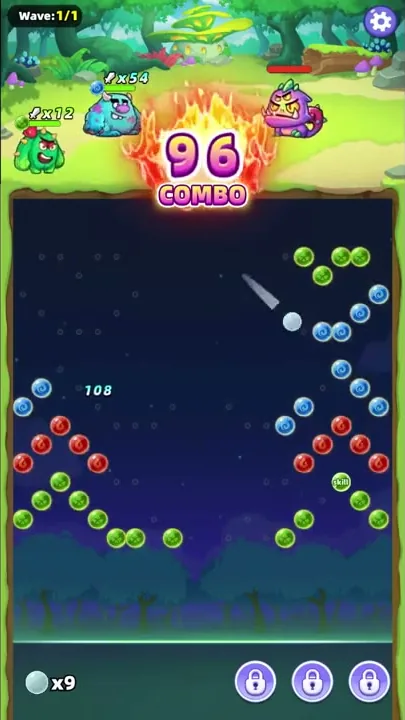
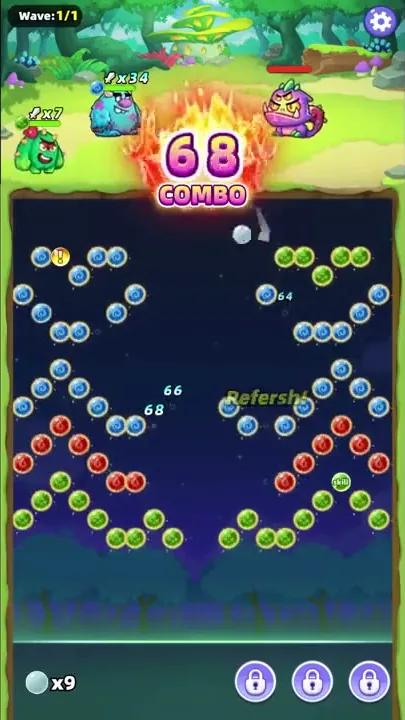
While a ball is in play, a large pink number labeled COMBO climbs over the top of the board and bursts into flame as it grows. Small hit numbers pop up beside the pegs being struck, and a sword icon with a multiplier rises over each companion.
One ball in Level 2 kept a single chain going. At a combo of 20 the blue companion shows x8 and the green one x2, while a glowing purple orb sits low among the green pegs. The same ball pushes the count to 96, with x54 and x12 over the two companions, and the ball counter stays at x9 the whole way.
At 68, partway through that chain, the word “Refersh!” appears across the middle of the board. Pegs knocked out moments before, on the left side and in the red band, are back in their places, and the count carries on to 82 and then 96.
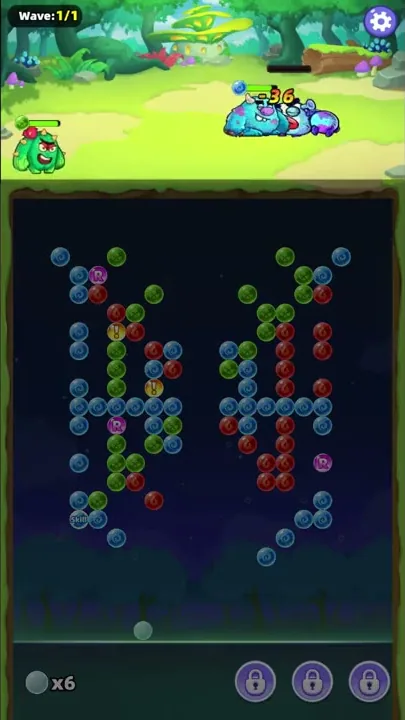
The fighting plays out in the strip above, where damage numbers appear over the enemy. In Level 3 the enemy is a blue crab-like creature with big red lips. The blue companion rushes across the strip to it, and a -36 rises over the two of them.
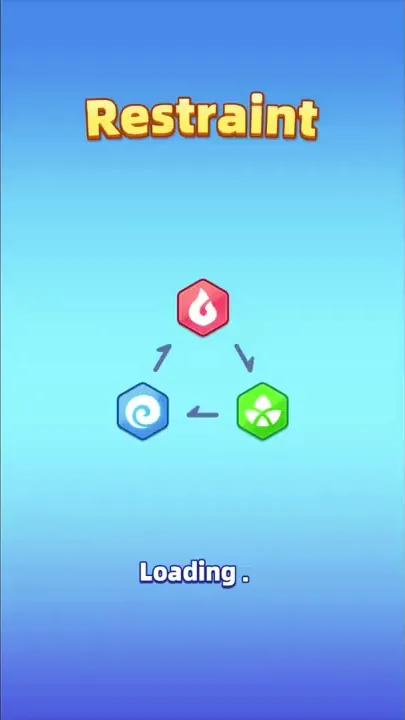
Loading screens between battles carry short tips on a bright blue background under a yellow title. The one titled “Restraint,” shown between the first battle and Level 2, sets the three element icons in a triangle. Its arrows run from red to green and from green to blue, then from blue back to red.
A second tip, titled “Black Hole,” loads before Level 3. A gray cube marked with a purple swirl points arrows toward a hexagon, where a purple vortex sits among smaller colored orbs.

New boards and enemies, then a third companion
Each of the four boards has a layout of its own. Level 2 opens with mirrored V-shaped bands. Blue V’s fill the upper and middle part, with a red band below them and a green band at the bottom. A small five-peg cluster tops each half, blue on the left and green on the right. A pink-purple spiky monster takes over from the one-eyed creature, while the team is still the same two companions with 10 balls.
The pegs are packed tighter early in Level 3. They stand in two blocks of vertical columns that mix all three colors, each block crossed by a row of blue pegs, with single pegs scattered below. The blue crab-like enemy takes the right side of the strip. This fight also took more balls: the spiky monster had gone down to the first shot, while the crab fell only after the counter had dropped from x9 to x5.
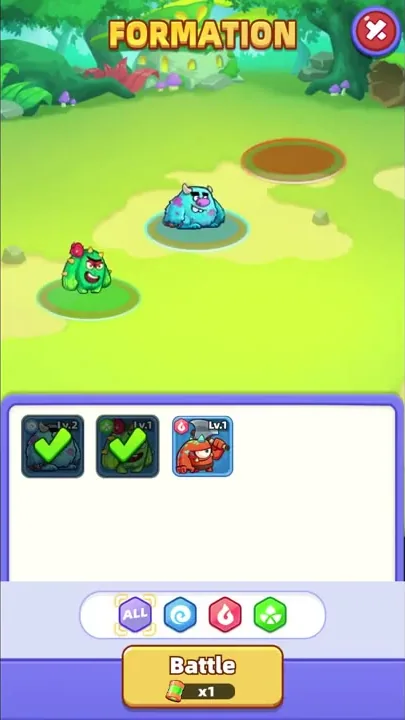
The team grows before Level 4. A Formation screen lists a new red companion marked Lv.1 next to the green Lv.1 and the blue one, which this screen labels Lv.2. In the battle that follows, all three line up on the left of the strip.
That fourth board puts a red figure-eight-like cluster on the left, beside a column of green pegs, and a green ring edged with red pegs on the right, each under a mixed row. Three columns of blue pegs, five tall, stand beneath each side. The enemy is a spiky monster that looks like the one from Level 2.
Between battles the game returns to a painted underwater home screen with light rays and a rock ledge, plus buttons for the next level and for Area 1. Along the top sit a coin counter and a rainbow crystal counter, each with a green plus button, and between them a green energy canister marked FULL. The Challenge button on the level panel and the Battle button on the Formation screen both show an energy cost of 1.
The level panel sets Team Power against a suggested power figure: 60 against 41 before Level 2. It shows the current team as two Lv.1 companions and an empty slot, with a Skip Formation checkbox under the Challenge button. The Formation screen places the team on a forest clearing with three circles, one empty and ringed in red. Below sits a roster of companion cards, with checkmarks on the two in use and filters for ALL and each element.
Companions level up on their own screens. Frost Bear, the blue furry monster, sits under five empty stars, with a blue swirl badge by its name. A shard bar and a small skill card marked Lv.0 sit beside it. Under its level are a heart stat and a second stat, then four slots of crystal-shaped materials, and a tutorial hand taps the Lv Up button beside Max Level. Arrows on both sides switch to the other companions.

The Companion tab sorts the collection with a Level dropdown and the same element filters. Chests live on the Recruit tab, where four chest types run across the top (gray-teal, blue, purple and gold), each with a count badge. Below them come two chest slots with Open buttons and an empty slot with a plus sign. An Open All button and a gray “-30 Min” button marked with a camera icon sit at the bottom. An opened gray-teal chest shows a red creature card marked x1, with “Tap to claim” beneath it and a skip option in the corner.
Coins come in after wins. After Level 2 and Level 3 the board dims, a coin flies across it and a coin counter slides in at the top right; confetti fills the screen after Level 2. More coins float onto the home screen with a +10 label, and after Level 2 a rainbow crystal flies into the home scene.
The Area 1 button carries a progress bar out of 7 and a chest icon. Its “Lost Remains” panel lists Magical Bloom next to a decorate button. As the tutorial hand taps it, a dialog box types “Consume Star S” before the text cuts off. Afterward a large pink flower stands on the rock ledge, and the area bar has moved up a step.
A yellow ticket-like icon with a red exclamation badge and a countdown in days and hours sits at the top right of the home screen. The bottom bar holds five tabs: a shopping cart, a card stack for Companion, a house for Adventure, a shield, and a pink locked chest for Recruit. Red badges pop up on them at times. New screens come with a cartoon pointing hand with a glowing tap ring and a dialog box whose text types itself out.
Pinball combat attached to card battles
Marble Blitz attaches pinball-style combat to card battles. We found the mashup quite fun, with a fresh idea in its form. Both halves share one screen: in the first battle a shot runs through the pegs and the one-eyed creature above takes -36. Off the board, the team is handled as cards in the Formation roster, and a chest pays out a creature card.
The theme and effects resemble chain-clearing puzzle RPGs. In the Level 2 chain, one ball runs the combo up under a flaming counter while multipliers climb over each companion, and the menus carry Team Power and companion stats. Next to that format, Marble Blitz is lighter and more casual, and the experience as a whole is close to Battledoku’s.
Mystery pegs and an untested last ball
We had no specific complaint about Marble Blitz; the points below are limits of the levels played, not faults. We can’t say what the marked pegs do when the ball strikes them, though all four boards carry them. The first three battles ended in wins with balls still on the counter, so the result of spending the last ball stayed out of view.
The three padlocked slots beside the ball counter stayed locked, and the “-30 Min” button on the Recruit screen went untapped. The shop and shield tabs and the countdown event were left closed as well.
Angled shots and a roster to level
On the board, the player picks an angle. The guide line shows where the ball will first land, wall bounce included, and from there the ball runs through the pegs while the combo and the multipliers climb. That loop suits a taste for lining up one shot and then watching a long chain play out.
Between battles the time goes to menus: setting a formation, leveling companions with materials, opening chests and placing decorations in the underwater home. That half lines up with a liking for collecting a monster team and building it up.
Verdict
Marble Blitz ties pinball shots to a card battle, and the pairing struck us as enjoyable and fresh in its form. It borrows the look of a puzzle RPG but keeps a lighter, more casual touch. Around the fights sits a heavy layer of companion progression. Light play paired with heavy progression is a mature path that many games already take, and Marble Blitz walks it too.