Pixel Mon Review: Pokémon-Style Battles From a Merge Tray
Balls from a six-slot tray become monsters on a winding dirt path: a Pixel Mon review of a merge spin on a Pokémon-style subject.
Game at a glance
Pixel Mon
5/ 10
Our score
Big, old franchises like Pokémon can still find new answers through new ways to play.
In this article6 sections
Fill the open slots of a small tray with balls, and a red-capped trainer throws them onto a dirt path, where each one becomes a monster that marches off to fight a rival trainer’s team. Pixel Mon belongs among the merge games, with light RPG battles layered on top and a Pokémon-style subject of trainers and the monsters they send into the field.
We played Levels 1 and 2 and part of Level 3. Its draw is another new way to play that subject; taken as a whole, the game lands in the middle.
A ball tray feeding monsters onto a dirt path
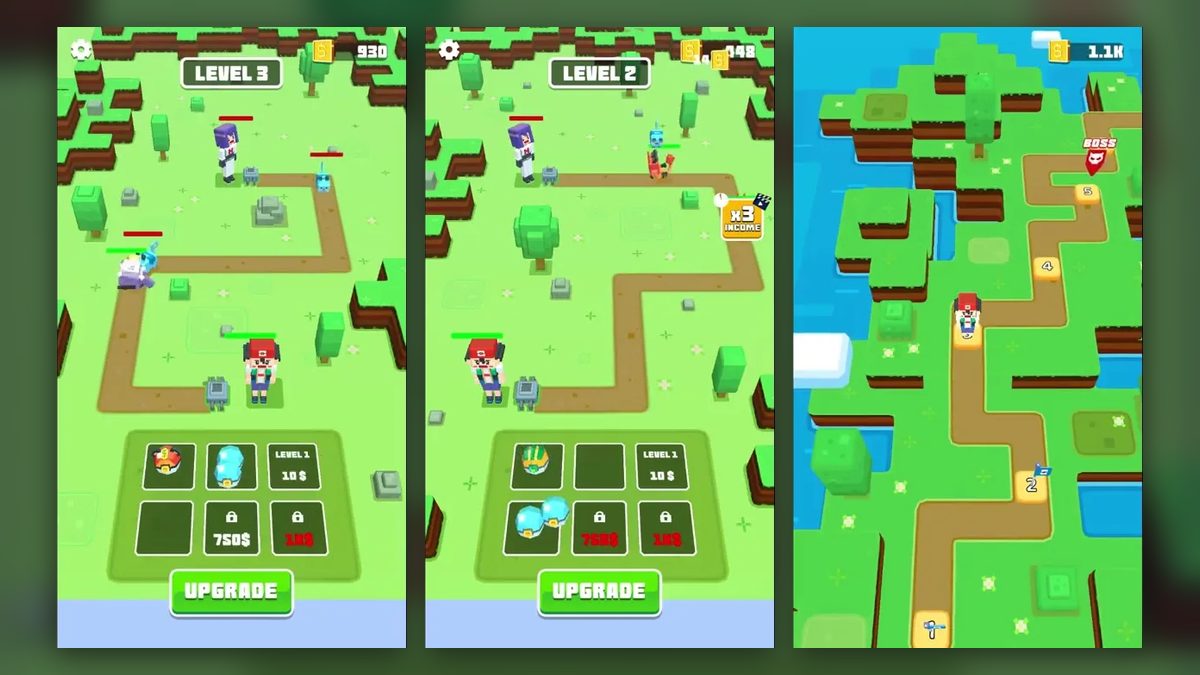
Each level is fought in a single arena, viewed from a fixed, tilted angle above. The arena is a grassy field of cube-shaped trees and blocky tiles with brown dirt sides, with one dirt path winding across it. The player’s red-capped trainer stands beside a gray block at one end, and the rival, a purple-haired trainer in white, waits beside another gray block at the far end.
No goal text appears on screen, and both levels that run to completion close on the same picture: the rival trainer knocked flat. The arena shows no timer and no move counter, and no losing screen ever turns up. The trainer’s own green health bar is full every time it is in view.
The tray and the green UPGRADE button under it take up the bottom of the screen, side buttons line the right edge, and a pop-up sometimes carries a button of its own. That is where all visible input happens. Balls leave the tray when the trainer throws: a green-and-yellow ball in the first slot is gone a moment later, and a green monster has joined the path. From there the monsters walk and fight without any input.
The Pixel Mon gameplay loop runs between the tray and the path. Balls appear in the open slots and the trainer throws them, sending monsters toward the rival. The rival throws balls as well and sends small blue monsters the other way. Where the two sides meet they stop and trade blows, each monster under its own health bar: green on the player’s side, red on the rival’s. Coin amounts pop up near the fights while coin icons fly to the counter at top right, and those coins pay for more balls and for padlocked tray slots.
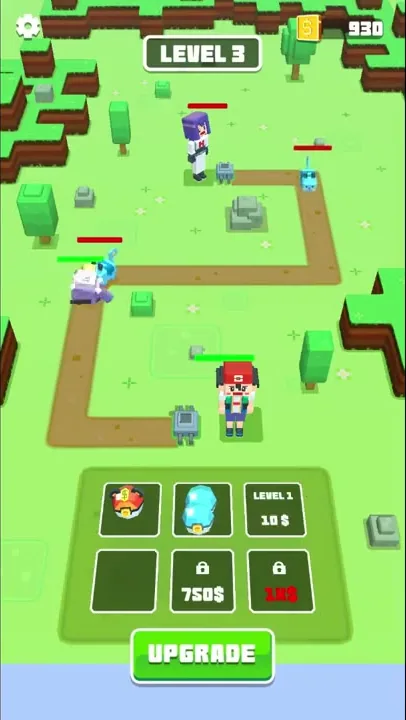
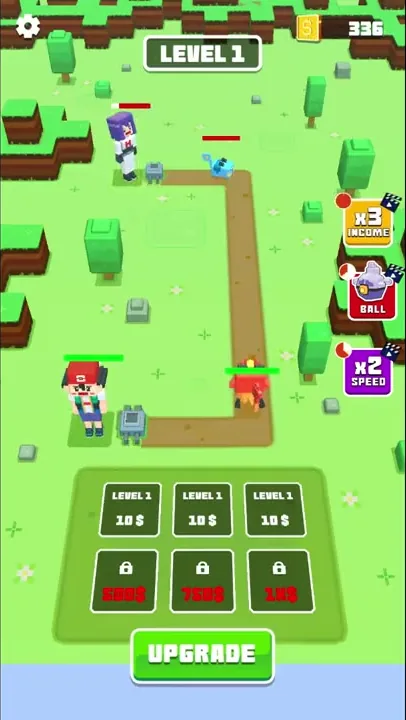
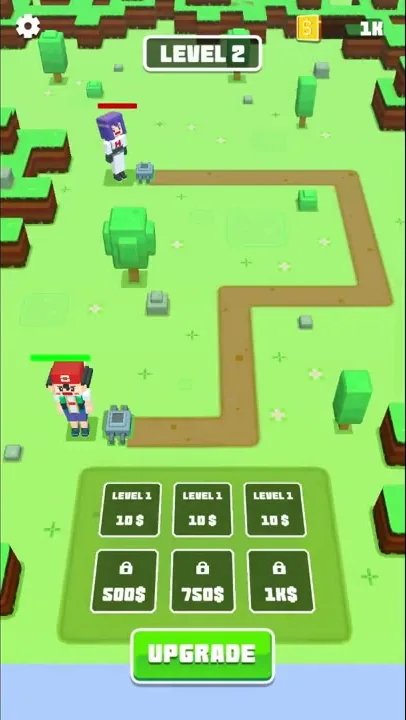
The tray under the arena is a grid of six slots in two rows of three. An empty open slot reads LEVEL 1 above 10 $, and a filled one holds a single ball. The rest are padlocked, with a price printed under each lock. In Level 1 the whole bottom row is locked, and all three prices there are red.
Blue balls have a cyan top, and green ones have yellow stripes. Red balls carry a yellow emblem, and a fourth kind is purple and white. A ball that has just landed in a slot is ringed with sparkle lines. Late in Level 2 all four open slots are filled at once, two of them with blue balls and the others with a red ball and a green-and-yellow one.
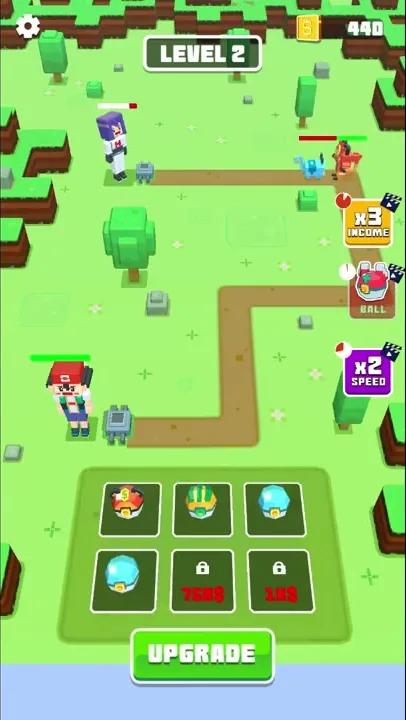
Merging, where two matching items combine into a stronger one, is the system Pixel Mon is built around, and the tray is where it shows. In Level 2 two blue balls sit stacked on top of each other in one slot while another slot stands empty for a moment. Shortly afterward a purple-and-white ball ringed with sparkle lines appears in a different slot, the same ball a NEW BALL panel had shown earlier in that level. What the blue pair itself turns into is never shown.
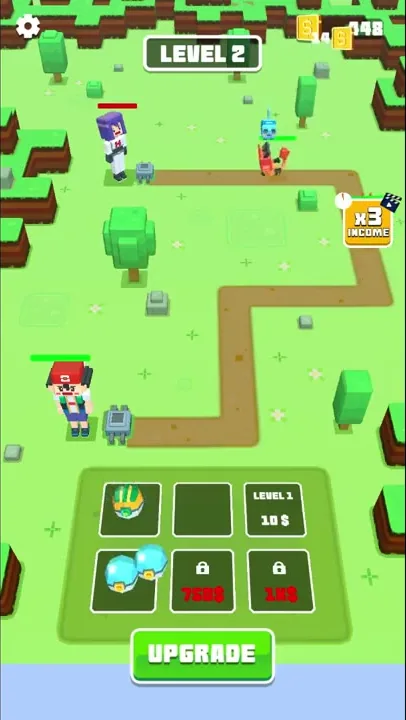
Every throw plays out in the same steps. The trainer swings an arm with a ball in hand, and a monster appears in a column of yellow light on the gray block before setting off along the path. On the player’s side, a red monster and a green shell-backed one take the path first, joined later by a purple-and-white, bird-like one.
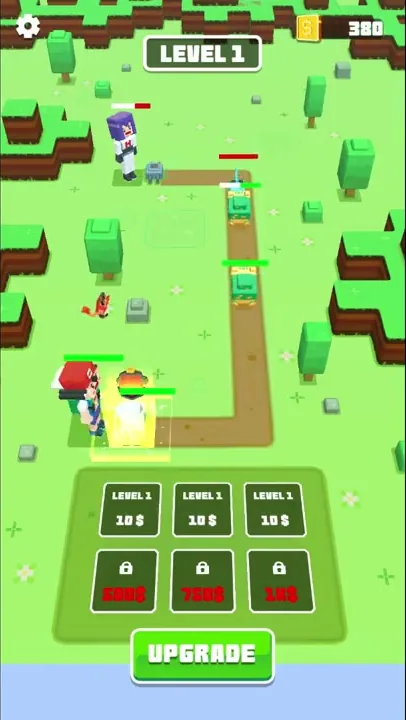
The rival works the far end the same way, throwing balls and sending small blue monsters down the path. That trainer’s health bar is red and picks up a growing white section as a level goes on. Once the bar is entirely white, the rival lies on the grass at the top of the path, which closes the level.
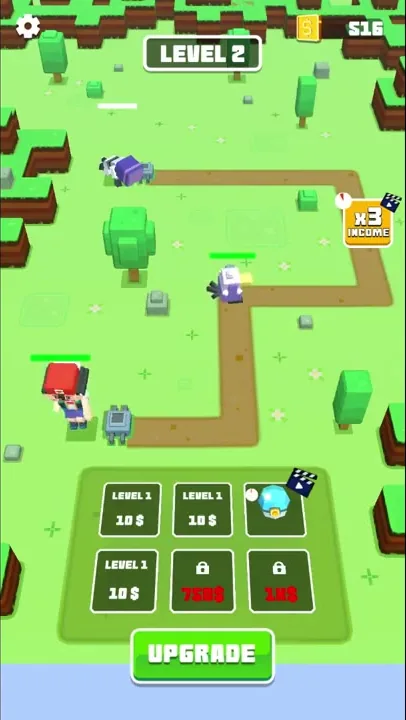
Two turns separate the trainers in Level 1. From the trainer’s block the path runs right, then climbs the right side before bending left along the top to the rival. Near that top bend a red monster is locked in a fight with a blue one while a green shell-backed monster comes up the path behind it, and coin pop-ups reading 12 rise from the fighting. In the tray below, a blue ball marked with a clapperboard icon sits between two slots showing 10 $. The level ends with the rival knocked down.
From two-turn paths to a boss marker
The path gains turns after Level 1. Where the first path bends twice, the one in Level 2 bends four times. From the block it heads right and turns up. It then runs right again to the edge of the field and climbs a second time before running left along the top to the rival. That level opens on an empty field with three open slots.
The trainer switches sides for Level 3, standing to the right of the gray block, and the path leaves to the left before winding up the field to the rival at top center. It again turns four times.
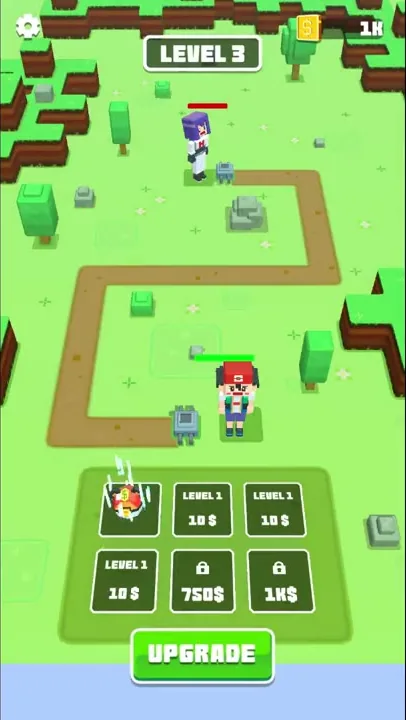
New pieces arrive along the way. The purple-and-white ball first turns up in Level 2, with the bird-like monster soon following it onto the path, and by Level 3 several of those monsters share the field at once. The tray grows too: Level 3 opens with four open slots, leaving two behind padlocks.
Between levels, a black screen gives way to an island map. Grass islands sit on blue water, joined by a dirt trail of yellow numbered tiles, and a red marker labeled BOSS waits past tile 5. A flag tracks progress: it stands on tile 1 after the first level, with the trainer on the next tile, and on tile 2 after the second, with the trainer one tile further on, just below tiles 4 and 5.
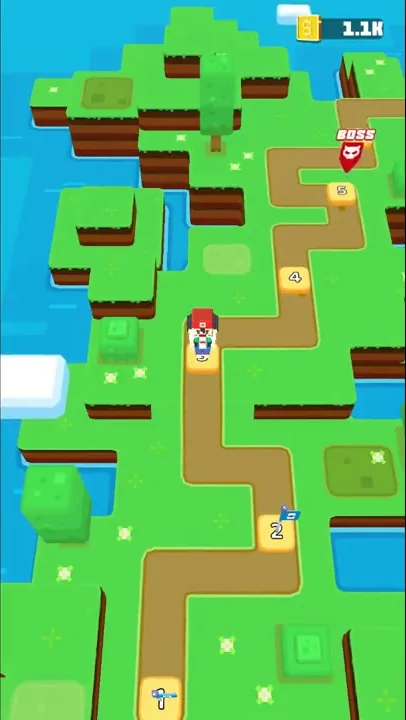
Coins are the only currency on screen. The counter at top right, marked with a coin, shortens large totals to 1K and 1.1K, and coin icons fly up to it during play. It also jumps between levels: the total on the map after the first level is more than double the reading at the moment the rival fell.
Spending happens in the tray. Each empty open slot shows 10 $ under its LEVEL 1 label, and balls fill those slots during play. The padlocked slots cost 500$, 750$ and 1K$. Early in Level 2 the 500$ slot opens with a ball already inside and coin sparkles around it, while the counter drops from 1K to 482. From then on it behaves like any other open slot.
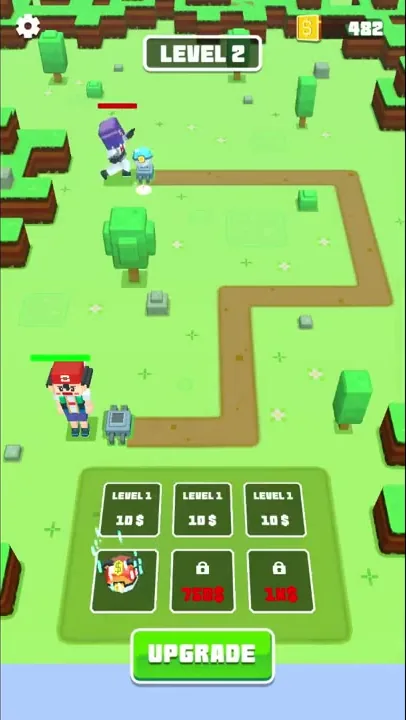
The locked prices change color as well. They are red all through Level 1 and white as Level 2 begins, then red again right after the 500$ slot is bought. Level 3 opens with both remaining prices in white, and a moment later 1K$ has turned red while 750$ stays white. The green UPGRADE button stays under the tray in every level.
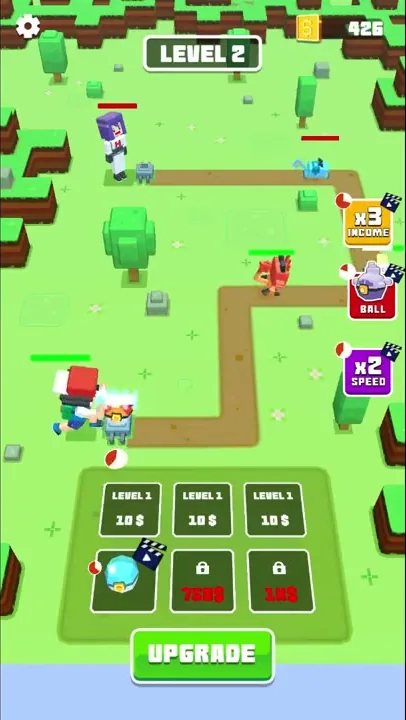
Three more buttons stack along the right edge: a yellow x3 INCOME, a red BALL with a ball pictured on it and a purple x2 SPEED. Each carries a clapperboard icon and a small red-and-white round icon. They come and go, with only BALL showing at one point and only x3 INCOME at another, and the ball pictured on BALL changes between appearances. The same two icons sometimes mark a blue ball sitting in an open tray slot.
Early in Level 2 a panel titled NEW BALL appears over the arena. It shows the purple-and-white ball, with a portrait of a purple, bird-like monster in one corner. Under the line DO YOU WANT 1 MORE? sits a green CLAMP button that also bears a clapperboard icon.
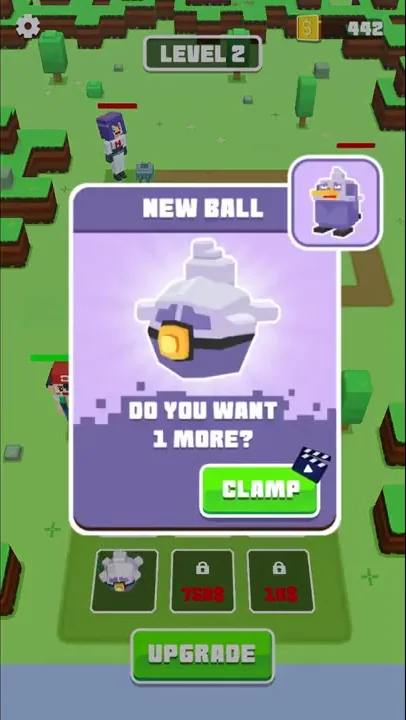
No full-screen ad or banner shows up at any point, and the clapperboard icons are the only ad-style markers on screen.
Trainers and monster balls in a merge tray
We liked the different route Pixel Mon takes with a Pokémon-style subject. Trainers are here, and so are balls that release monsters, but the play itself runs through a merge tray of priced slots. The player keeps those slots stocked and opens up the locked ones, while the monsters settle the duel on the path by themselves.
It also fits a broader belief of ours. A franchise as big and as old as Pokémon makes it easy to get boxed in by habits of thinking, and many older franchises can find new answers through new gameplay and new ideas. In Pixel Mon the ball still releases a monster, but before that it is a piece sitting in a tray slot, waiting to be thrown.
Unexplained buttons and an unreached boss stop
There is no specific criticism to make of Pixel Mon. What remains are gaps in what the levels show. The screens never reveal what UPGRADE, x3 INCOME, BALL, x2 SPEED or CLAMP actually do. On the island map, tiles 4 and 5 and the BOSS stop still lie ahead of the trainer, and no level ends in a loss.
Tray management and automatic lane battles
Most of the player’s attention goes to the tray, keeping its slots stocked and spending coins to open the padlocked ones. Above it the battles run unattended, with monsters walking the path and clashing under their health bars. That split suits a liking for tending a small grid of items while a fight plays out by itself. The dressing, with trainers throwing balls that release monsters, speaks to a fondness for the Pokémon-style setup.
Verdict
Rebuilding a trainer-and-monster setup around merging is the move that earns Pixel Mon its praise, and it supports the case that a long-running franchise can be opened up from a fresh angle. Judged as a whole, the game settles at the midpoint of the scale.