Bubble Buster 2048 Review: Merging Balls Through Brick Walls
From a lone 512 goal to boards with three targets, this Bubble Buster 2048 review follows numbered balls through bricks, barrels and chains.
Game at a glance
Bubble Buster 2048
7/ 10
Our score
Build the levels well and many bite-sized ideas can go mid-core. Not every one, though.
In this article6 sections
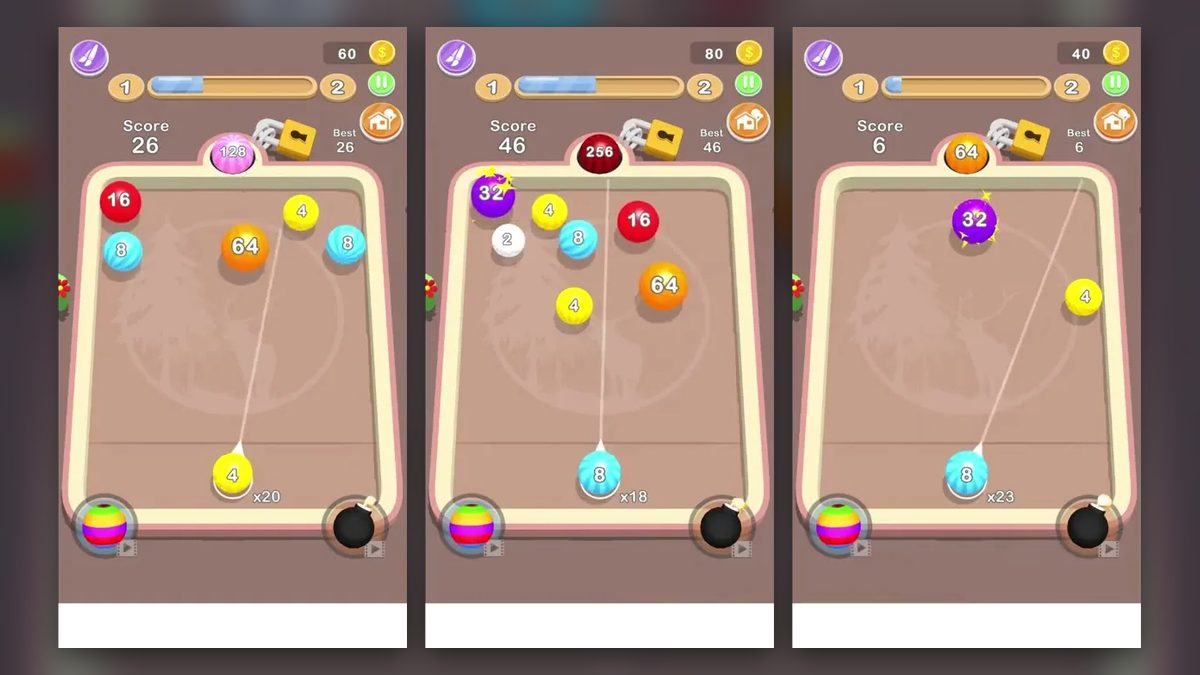
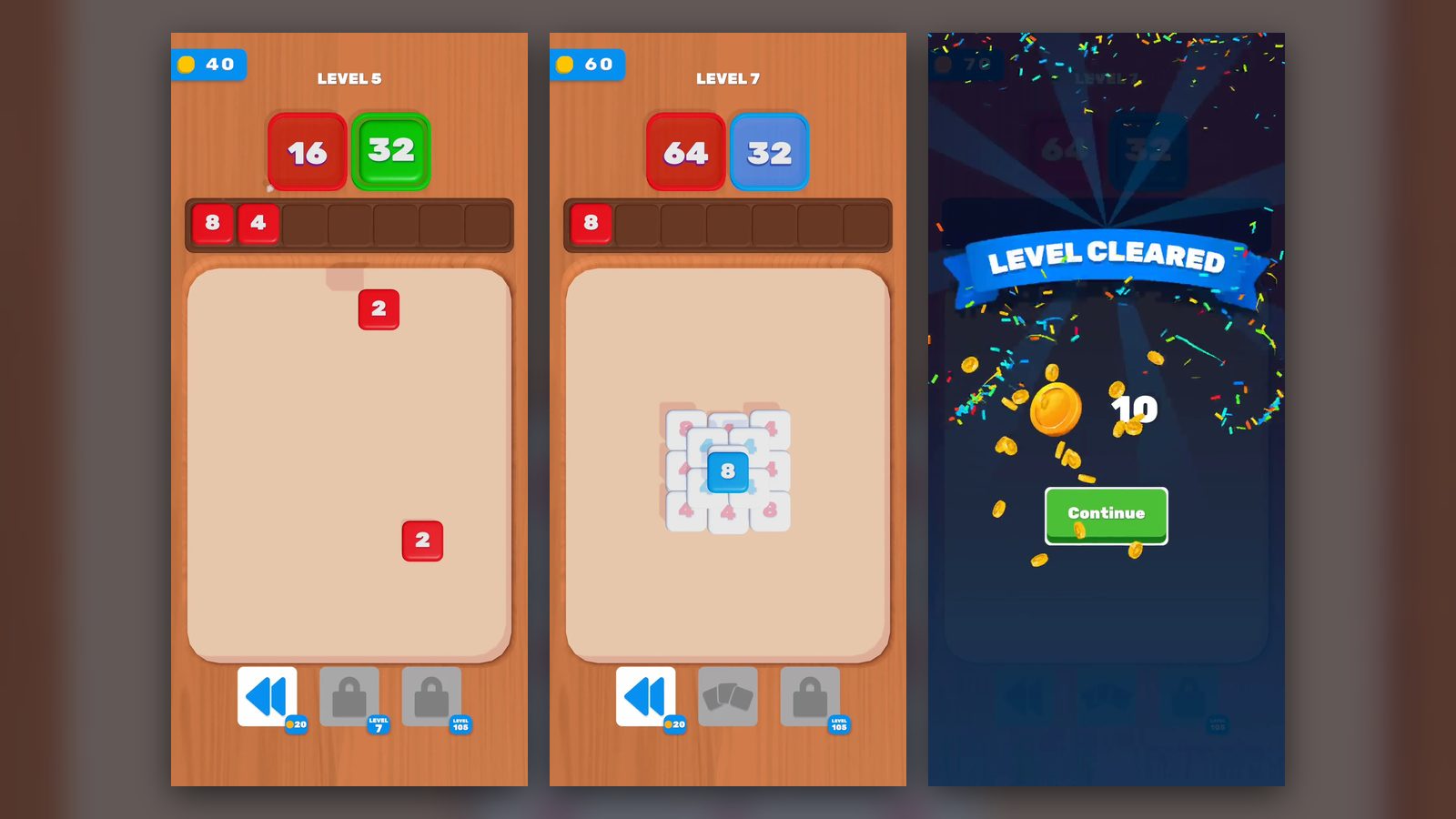
Pick a spot along the top of a brown well and let a numbered ball fall. Then keep feeding the pile until its values climb toward the target in the corner. That loop is the base of Bubble Buster 2048, one of the merge games built on 2048-style numbers. Its shaded 3D balls merge into bigger values on boards that fill up with bricks, barrels and padlocked chains as the levels go on.
Its structure follows Royal Match, the castle-restoring match-3, which puts it among games like royal match: level goals, a booster bar under the well, up to three stars per level and a town that grows between levels. We played Levels 1 through 20. What we liked is the way it rebuilds a bite-sized merge-to-upgrade mechanic through level design. The game has since been copied by at least one newer title.
Numbered balls under a tower dispenser
Goals sit in a box at the top right of the screen. Level 1 asks for nothing more than a single 512 ball. Later boards set a count of bricks, barrels or trophies, often paired with a ball value such as one 64 or two 128s. Each goal earns a green check once it is met, and a level is won when every goal in the box is checked.
The waiting ball can be lined up anywhere along the top edge, from the far left to the right side. A translucent column runs down from it and ends in a faded copy of the ball that marks where it will land. Level 1 shows a white hand icon beside the board, and a gear button occupies the upper-left corner of the level screen.
A tower-shaped dispenser at the top center holds the next ball. In Level 1, a 16 waits to drop while the dispenser already shows an 8, and an orange box with a padlock sits below the board. Its label rises from 64 to 256 before the box disappears. The values seen in the dispenser run from 2 to 16, yet the pile at the bottom builds far past them, up to the 512 that Level 1 asks for.
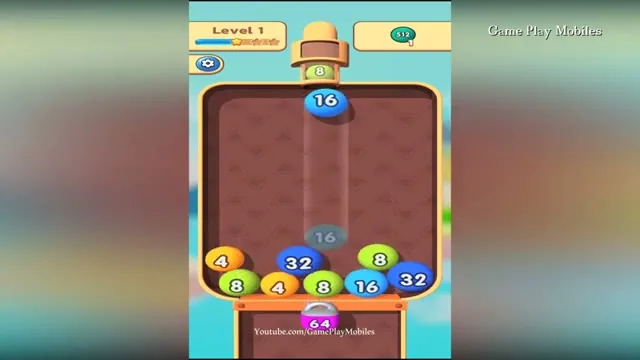
Balls are colored by value, from a red 2 and a lime-green 8 to a purple 128 and an orange 256. A freshly formed ball swells larger than the rest for a moment. Merges throw white puffs while words like “PERFECT!” or “SUBLIME!” pop up over the board.
In Level 1 the dispenser shows only the next ball. From Level 2 on, a plaque on it counts the balls left. With 10 balls left in Level 16, a “Last 10 balls!” banner crossed the board. When the counter hit 0 there with one trophy still needed, a “NO BALLS LEFT” panel offered a jar of balls marked “+5” and a “Keep playing” button marked 100; the five extra balls then went onto the counter, and the level ended in “Level Complete!”
That message appears on a purple ribbon beneath a star and a striped rocket, with fireworks behind it. A “Tap to skip” screen follows, in which dark boxes and balls keep dropping into the board, and in Level 17 the ball counter emptied during this finish. During a level, a bar under its name fills toward three star marks, and the results panel awards up to three stars above a “You collected:” row of checked goal icons and a “Continue” button. Level 2 earned two stars and Level 6 earned three.
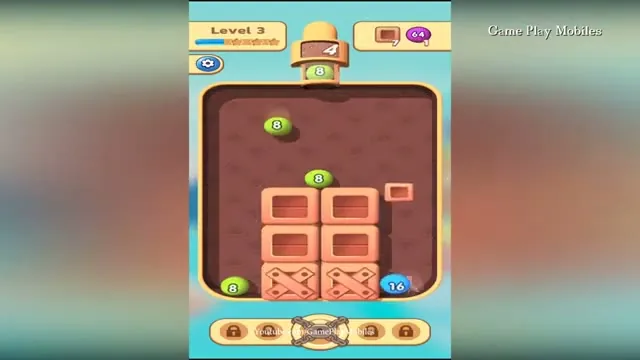
Bricks arrive in Level 2. They are square terracotta blocks that break apart into flying shards while the brick count in the goal box goes down, starting from 18 in that level. Some blocks carry an X or a diagonal line across the face. Early in Level 3, a stack two blocks wide and three high stands mid-board, with two rows of plain bricks over a row of X-marked ones and an 8 resting on top.
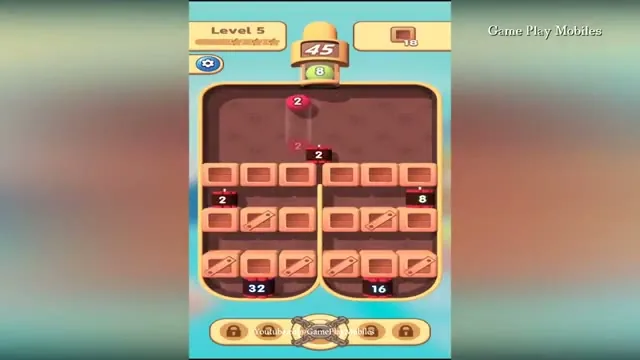
Dark numbered boxes first appear in Level 5. They are small, red-topped crates printed with a ball value, seen from 2 up to 32, and on the split board that opens Level 5 they sit under the top rows of bricks and along the bottom. At times, a dashed circle centered on a box appeared while a ball was aimed beside it, and in Level 15 the bricks around one box were gone shortly after its circle showed. More dark boxes drop in from the top during the “Tap to skip” finish.
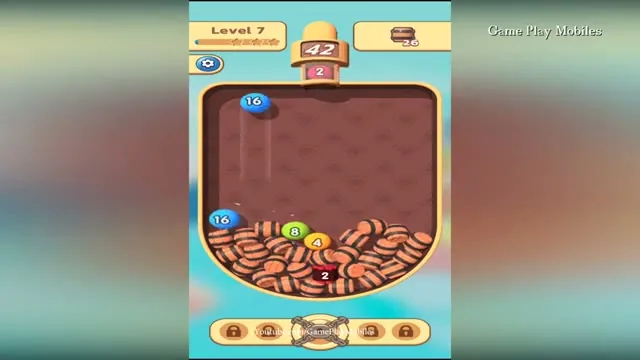
Barrels show up in Level 7, heaped in loose striped piles that fly apart when hit. The goal box counts them the same way as bricks. Level 7 asks for 28, with the barrels filling the bowl-shaped bottom of the board around a dark 2 box, and Level 8 asks for 44 alongside two 64 balls.
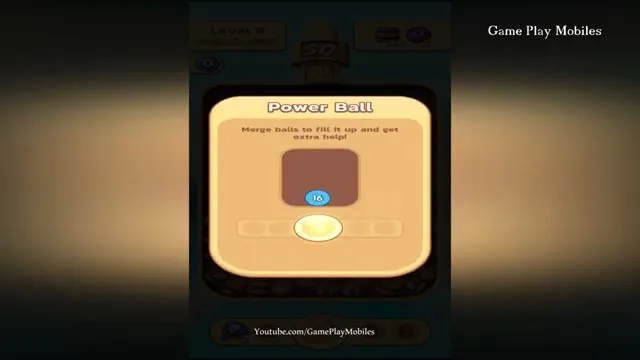
Level 8 places the Power Ball meter, a round dial, in the center of the bar under the board. Its tutorial panel reads “Merge balls to fill it up and get extra help!” The meter changes color during play, pink at one point and purple at another. In Level 11 it glowed, and right after, a dark box labeled 16 appeared mid-board in a puff.
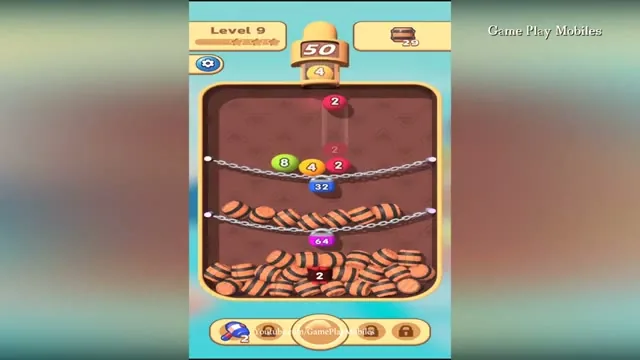
Chains first stretch across the board in Level 9, holding balls and barrels above the floor. There the upper chain carries a padlock labeled 32 with small balls resting on it, and the lower one carries a padlock labeled 64 under a layer of barrels. The upper chain was gone not long after the level began. In Level 15 a chain with a padlock labeled 16 hangs under a brick pyramid and vanished soon after a large 16 ball graphic showed on screen; Level 10 slings one between brick blocks on the side walls, and in Level 17 one runs through the middle of a pyramid with no padlock in view.
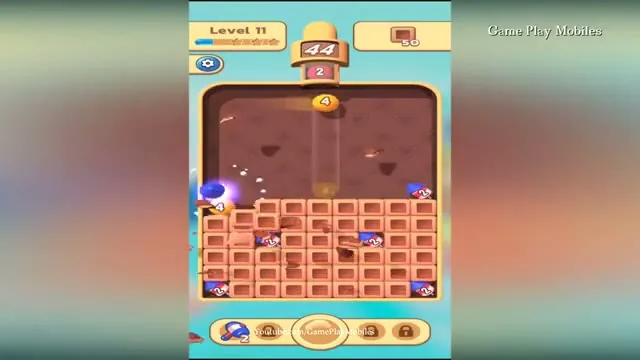
Rockets join in Level 11. A “ROCKET” panel reads “The Rocket can fly and hit obstacles!”, and in Level 12 the rockets streaked across the board trailing purple light. They sit inside brick walls and, in Level 14, on ledges. Level 11 sets them into the corners and inside of a brick wall that fills the lower half of the board, under a goal of 50 bricks.
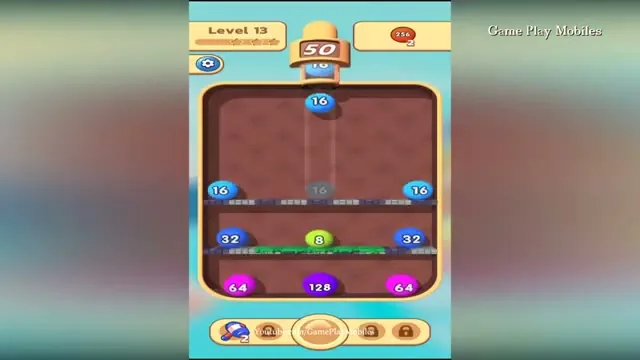
Two gray ledges span the board as Level 13 begins, the lower one patched with green. A 16 sits at each end of the upper ledge, the lower ledge holds two 32s around an 8, and two 64s flank a 128 on the floor. The goal box asks for two 256 balls, with 50 on the counter. A “SUBLIME!” pops up early, and the 256 goal already carries its green check when the “Tap to skip” screen appears.
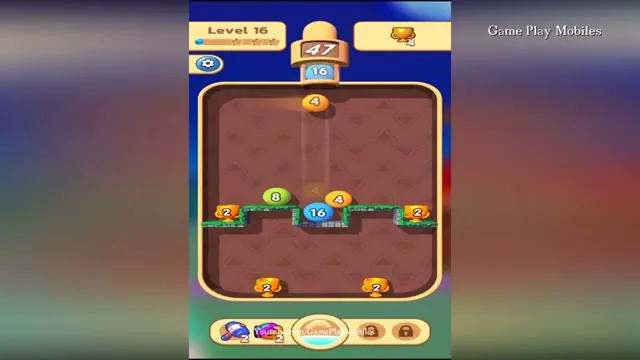
Ledges are gray stone shelves, some trimmed with green or grass, that carry whatever the level places on them, from balls to trophies. They shrink during play. Early in Level 14, two full ledges hold barrels and rockets, and later only a short piece of one is left. The stepped ledges of Level 16 were partly gone soon after it began.
Trophies are gold cups labeled 2. Level 17 tucks them between the bricks of a pyramid and asks for 9 of them plus a 128 ball. In Level 16 the whole goal is 4 trophies, one at the outer end of each stepped, grass-edged ledge and two more on the floor, and the trophy count went down as the level went on.
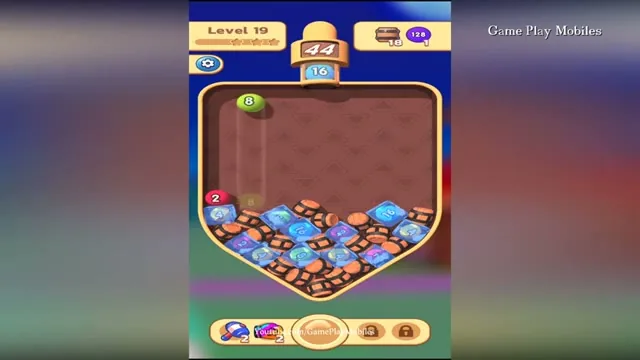
Translucent blue cubes that look like ice appear in Level 18. Two sit in the bottom corners beneath a dense pile of balls on a green-edged ledge, and partway through the level the right one was gone. In Level 19 they pack the pointed bottom of the board together with barrels, and some have a numbered ball visible inside.
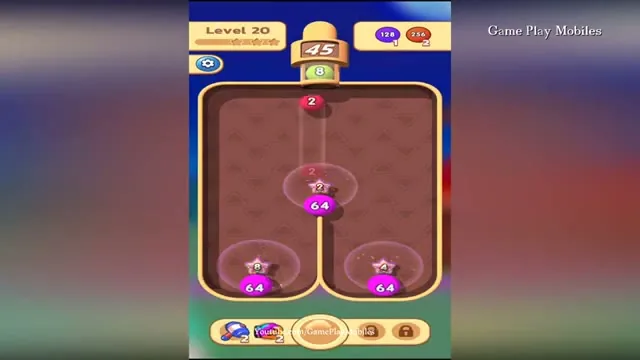
Level 20 opens on a split board with three 64 balls, each inside a translucent bubble topped by a star badge. The badge reads 2 on the bubble above the divider, while the two below read 8 on the left and 4 on the right. The goals are one 128 and two 256s, with 45 balls on the counter. Moments later the bottom-left bubble was gone and a 128 sat in its place, with the 128 goal already checked.
From one 512 to three goals at once
The goal box gets longer as the levels go on. The first board asks for a single 512 ball in a plain rectangular well, and the ball counter and the booster bar both turn up in Level 2, along with brick goals. A ball value joins the bricks in Level 3. Three goals share the box for the first time in Level 15: 12 bricks, 15 barrels and one 256 ball, set around a brick pyramid with a chained padlock below it.
Board shapes change too. Balls already sit on the board when Level 4 starts, stacked beside brick columns and down a channel in the middle, with a 64 under its opening. A divider splits the well in two in Levels 5 and 12 and again in Level 20, and the bottom narrows to a point in Levels 6 and 19. The floor curves into a bowl in Level 7. Ledges first cross the board in Level 13, and Level 18 opens with a dense pile of balls from 2 to 32 already resting on a green-edged ledge.
A new piece joins the board every few levels, from the dark boxes of Level 5 to the starred bubbles of Level 20. The backdrop around the board changes as well, turning from light teal to dark blue in Level 16.
The booster bar under the board opens up one slot at a time. At first its four side slots are all padlocked around a center slot showing crossed tools. A rocket icon labeled 2 fills the left slot in Level 8, the same level where the Power Ball meter takes over the center. The next slot gains a pink-and-purple icon, also labeled 2, in Level 15, while the two right slots were still padlocked in Level 20; we can’t say what either booster does.
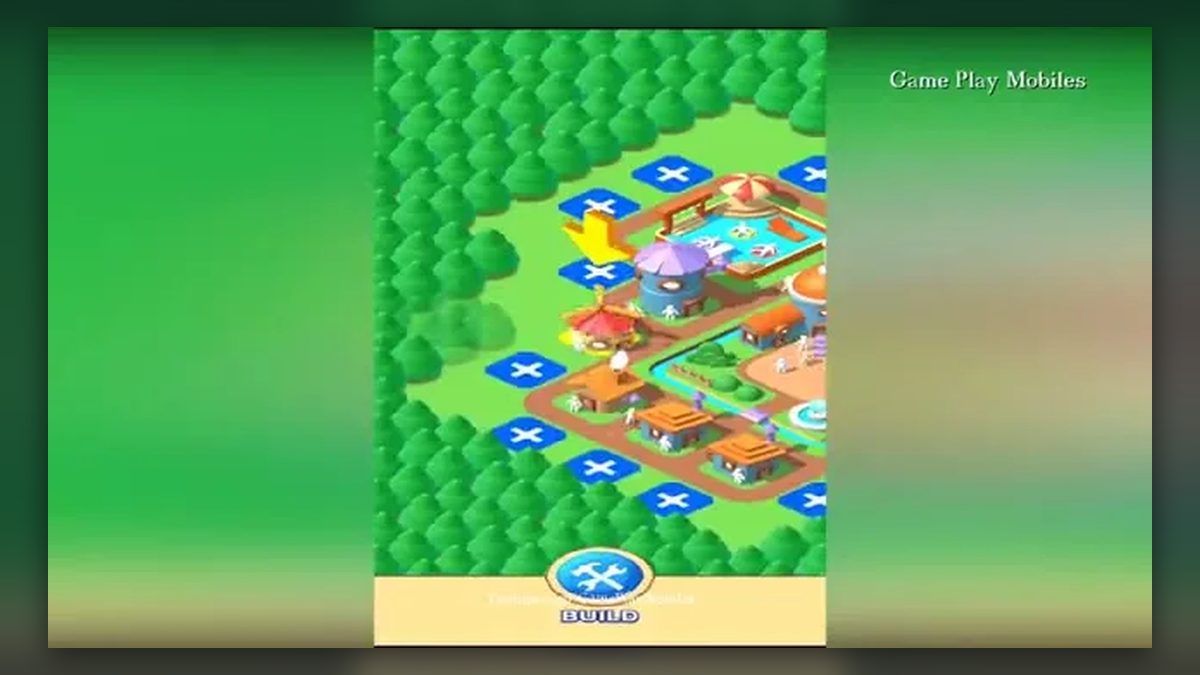
Between levels the game cuts to an isometric town ringed by forest. The first visit, right after Level 1, shows a banner reading “Your new residents need Home. Let’s build one!” and then a yellow arrow pointing to a new house on one of several blue plots marked with a white X. Later builds go through a “BUILD” button with a hammer-and-wrench icon.
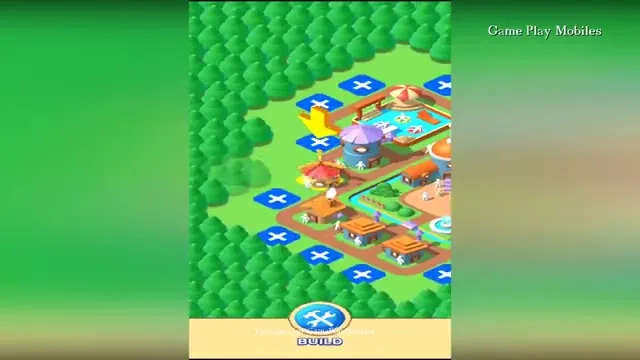
Small white residents walk the streets with “+1” markers above them, and one building carries a “?” sign. A banner above “My Town” gives the town’s rank with a resident number, moving from HOMESTEAD to VILLAGE and then TOWNSHIP.
After levels, stars fly into a chest in the town’s upper-left corner, filling a meter that counts to 20. When it is ready, the chest shows “Open” and leads to a chest on a red cushion. One opening paid out 15 coins and a purple “?” card, and a later one showed another large purple “?” card.
The town doubles as the home screen. Its top bar holds the star chest, a lives heart marked “Full” and a coin count with a “+” button. Below sit a gear button and a large play button labeled with the next level, such as “LEVEL 8”. A button with a market-stall icon sits on the left and a cup-shaped one on the right, and we can’t say what either leads to.
Level design rebuilt around a bite-sized merge
The highlight is the way Bubble Buster 2048 takes a bite-sized drop-and-merge mechanic and rebuilds it through level design. Level 1 is the bare idea: a plain rectangular well and one 512 to build. By Level 9 the same drop is aimed at padlocked chains that hold barrels above the floor. In Level 15 a brick pyramid and a chained padlock surround the drop while the goal box asks for three goals at once.
Underneath sits a 3D version of watermelon-style merging, named for a viral puzzle game in which dropped fruit combine into bigger fruit. Here, numbered 3D balls take the place of the fruit. Around that base, the boards change shape and fill with new pieces, from shrinking ledges to bubbles around 64s, and some start with balls already placed. That fits a broader view of ours: many bite-sized and light casual mechanics can grow into mid-core games, the more involved middle ground of casual play, when their levels are built with care. Not every one of them can.
No complaints, a few open questions on boosters
We have no complaint to make about Bubble Buster 2048. What the levels did not show is what the two unlocked boosters do, what the Power Ball’s extra help is, how the padlocked chains open and what the star numbers on the Level 20 bubbles mean.
Picking drop spots for a target number
Most of the play is placement: choosing where along the top edge the next ball falls, then watching where it lands and what it merges into. The goal box keeps a target in view, whether a 512 ball or a count of barrels, so the merging has something specific to build toward.
As the levels go on, the aiming turns toward obstacles: barrels to scatter, chains holding loads above the floor, ledges that shrink and bubbles wrapped around 64s. Between boards there is a town to fill plot by plot and a chest that collects stars. These mechanics play to a taste for building numbers toward a printed goal and for layouts that change from one level to the next, with some town building on the side.
Verdict
Bubble Buster 2048 takes a drop-and-combine idea from the bite-sized end of mobile gaming and wraps it in a level-based puzzle game with a town on the side. That reworking through level design is its strong point. Taken together, it is a good game.