Pressure Washer Fever Review: Merging Water to Blast Mud
A dot grid of merged water pieces, up to +4, powers the nozzle that strips mud off an SUV; a Pressure Washer Fever review of an idle merge car wash.
Game at a glance
Pressure Washer Fever
7/ 10
Our score
Mud blasting stops being the whole game and turns into the payoff for a merge grid.
In this article6 sections
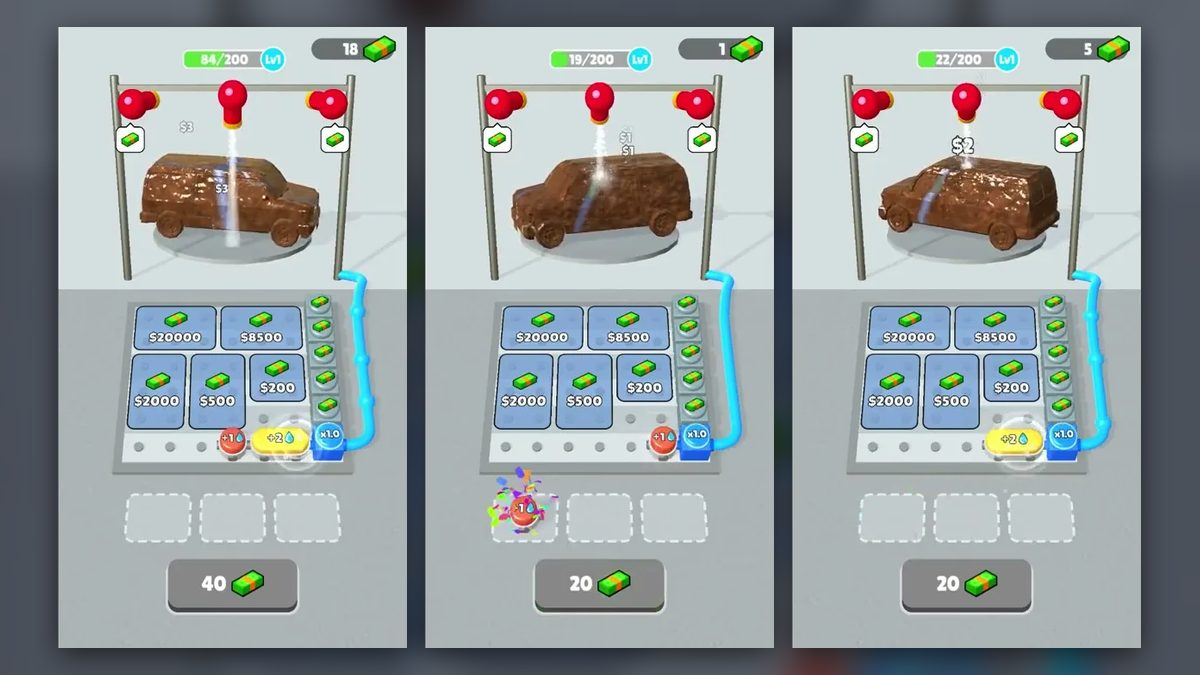
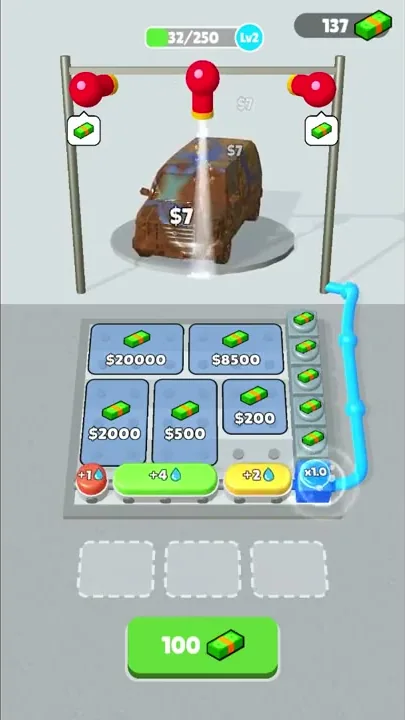
Eight open dots are all the room Pressure Washer Fever gives its water pieces through Level 1: a row of six, plus two more above the row’s right end. Five blue panels with price tags cover the rest of the grid, while a mud-caked SUV waits under a nozzle in the top half of the screen.
It’s an idle game for phones and one of the merge games. It runs on merging, where two matching items combine into a stronger one, and whatever sits on the grid powers the car wash above it. We played Levels 1 to 3 on a single continuous board and found it pretty enjoyable.
Feeding one nozzle from a dot grid
The screen is split in two. On top, a 3D car-wash frame holds three red nozzles over a gray turntable, where a boxy SUV sits under thick, glossy brown mud. Below sit the merge grid, a tray and a wide buy button on a light gray floor.
There’s no stage to clear in the usual sense. A green bar at the top center fills toward a target shown next to a blue level badge, and when it fills, the badge moves up a level and the target grows. There’s no timer or move counter, and no lives or fail screen either. The one real limit is room on the grid.
Pressure Washer Fever gameplay runs on a single loop. Cash from the wash buys a new water piece for the grid, where pieces line up beside a blue x1.0 block at the end of the hose. The center nozzle keeps spraying, and the dollar figure floating off the SUV grows with what’s on the board: “$3” with a +1 and a +2 in place.
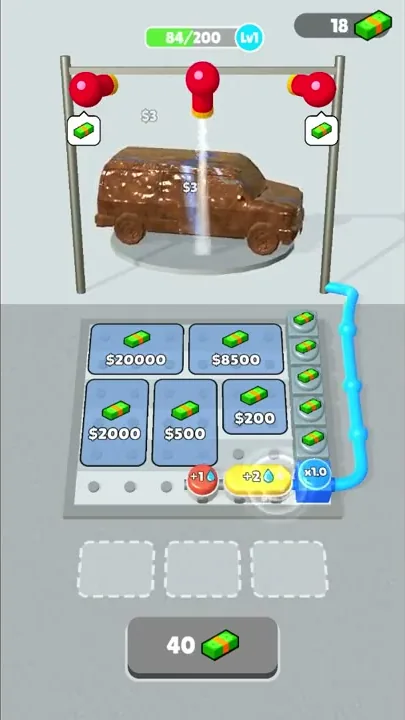
Using the buy button at the bottom drops a new piece into the tray, and from there pieces are moved onto the grid. A piece lifted out of the tray has a green square under it, and one being set down on the board glows green. Up top, the turntable shows the SUV from different sides as play goes on.
The tray has three dashed slots under the grid, and each new piece arrives in a burst of confetti. Most of the new arrivals were +1s, though one +2 landed there too. The price on the button rises with every purchase.
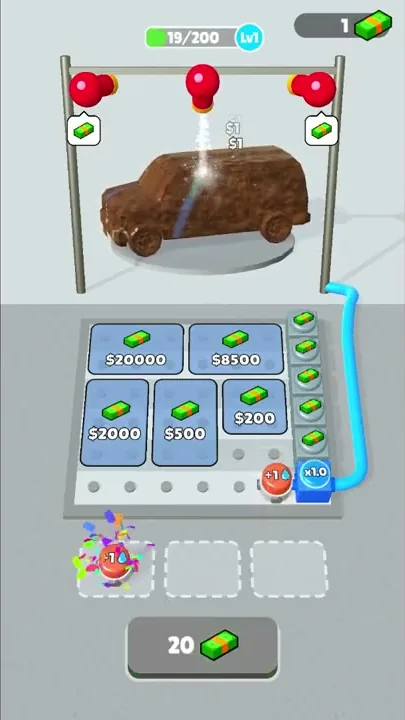
Merging works in pairs: two equal pieces become one piece of the next tier. A +1 from the tray joins the +1 already on the board, and a single yellow +2 glows in its place while the tray empties. Two +2 pieces later combine into a green +4 the same way.
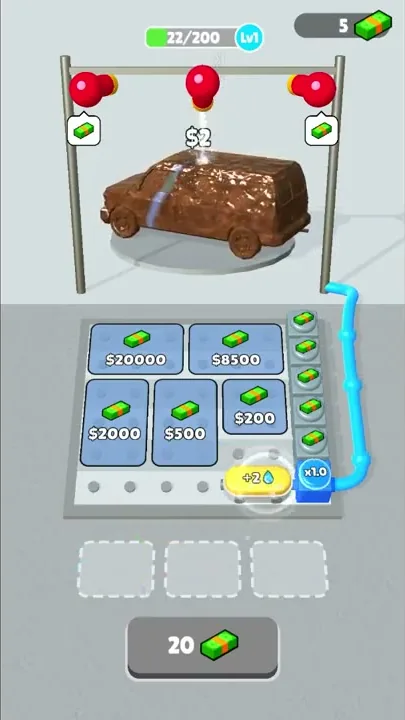
Each tier has its own shape and color. The red +1 is round and covers one dot; the yellow +2 is a pill two dots long; the green +4 is a longer pill that stretches across three.
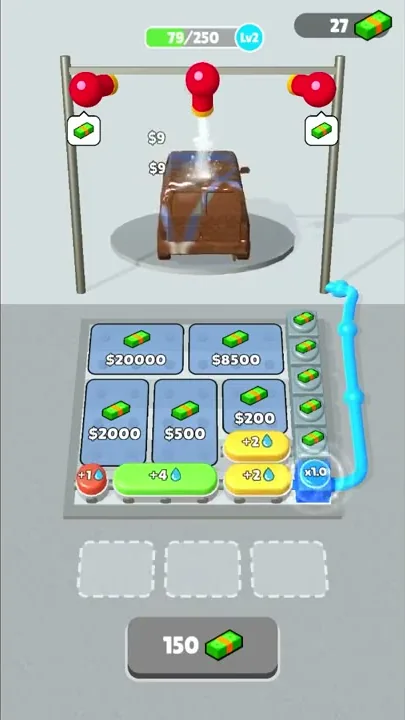
Only the middle nozzle sprays, and it is spraying in every moment of play we saw. Dollar amounts drift up off the car as the jet hits it, and they grow with the board, reaching “$7” once the bottom row holds a +1, a +4 and a +2.
A single red +1 sits on the board early in Level 1, while the payout reads “$1” and the button asks 10. A second +1 from the tray merges with it into a +2. Another +1 joins the row, then pairs with a newly bought one to form a second +2, so the level closes with two yellow pills side by side. By the time the bar nears its target of 200, the payout has climbed to “$4” and the button asks 50.
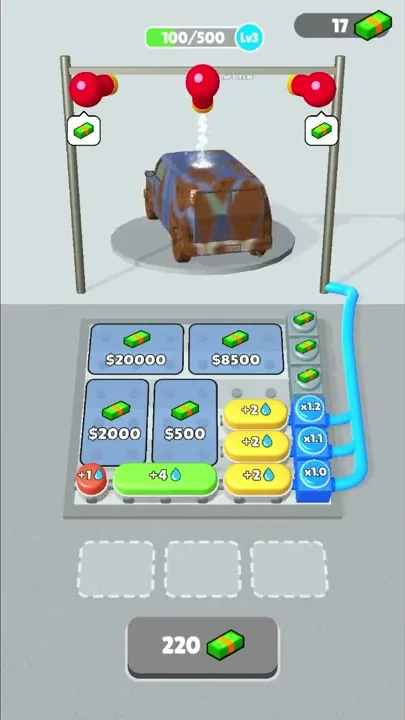
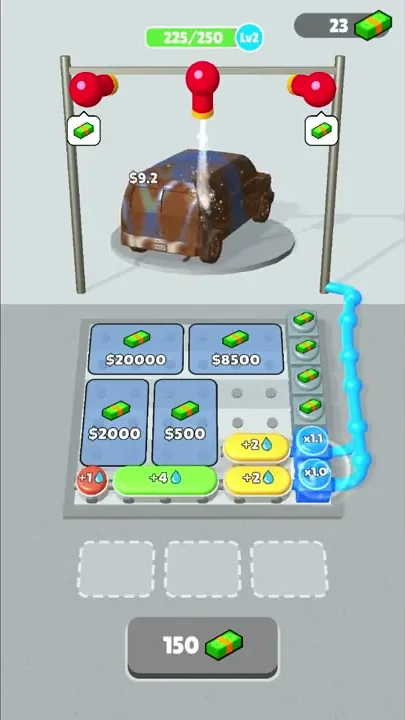
A blue hose runs from the right post of the car-wash frame down to the x1.0 block, and above that block stands a column of slots marked with banknote icons, five of them at first. Later the slot just above x1.0 turns into a blue x1.1 block, and the payout goes from “$9” to “$9.2” with the same pieces on the board. An x1.2 block follows above it, leaving three banknote slots, and the hose now runs down beside the blue blocks with branches reaching toward them.
Most of the grid is covered at first. Blue panels with banknote icons sit over it, priced from $200 for the cheapest to $20000 for the priciest. Paying for one clears it away: once the $200 panel goes, four empty dots in a 2x2 block show where it was.
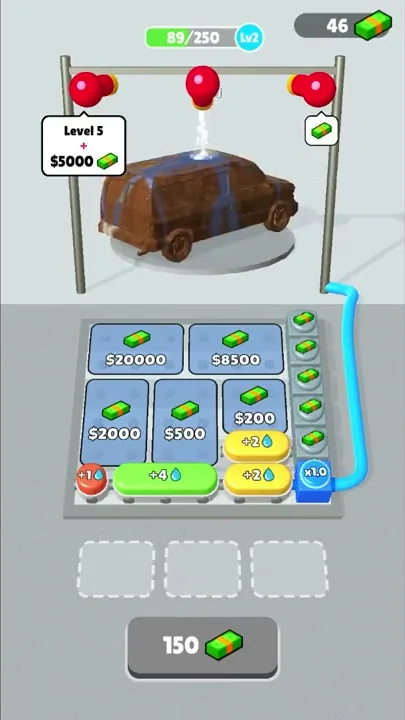
The left and right nozzles stay dry. Each has a small white bubble with a banknote icon beneath it. At one point the left bubble gives way to a tooltip that pairs a level number, higher than any reached here, with “$5000”, a plus sign between them.
Rising targets on one continuous board
The levels change the target, not the board. When Level 2 begins, the bar’s target rises from 200 to 250, and the board carries over exactly as Level 1 left it, two yellow +2 pieces and all.
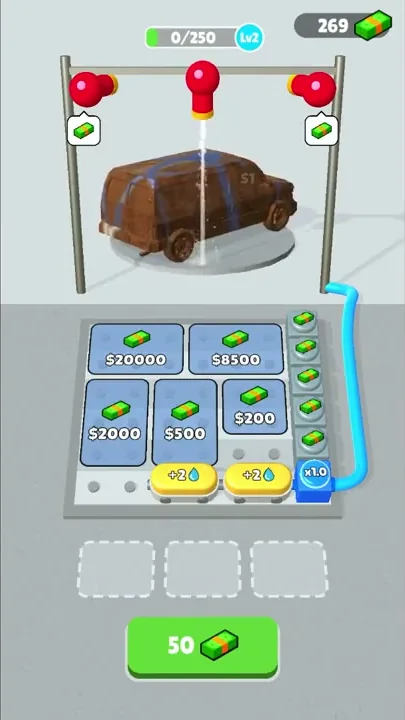
The next step up doubles the target to 500. The board waiting at the start of Level 3 is the one Level 2 left behind, with both multiplier blocks in place and four empty dots where the cheapest panel used to be.
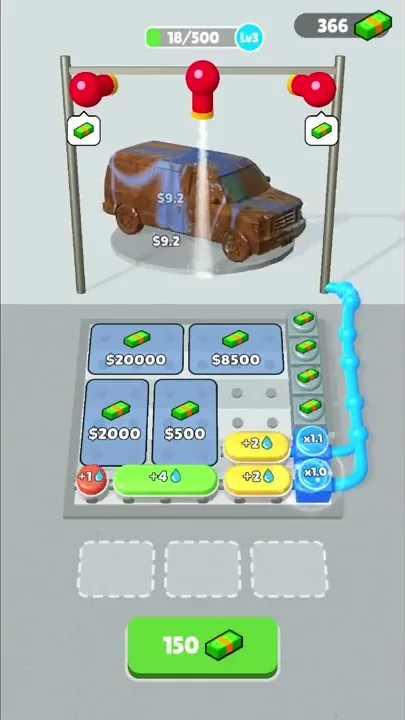
New tiers and blocks turn up as the levels rise. The first +4 and the x1.1 block both appear in Level 2, and x1.2 joins them in Level 3.
Space gets tighter along the way. The bottom row is full early in Level 2, and the next +2 goes into the two dots above its right end. The $200 panel opens just before that level ends, and in Level 3 a third +2 fills part of the freed patch, stacking three yellow pills on the right.
All of this shows in the payout floating off the car, which keeps climbing and reaches “$11.2” once five pieces share the board in Level 3.
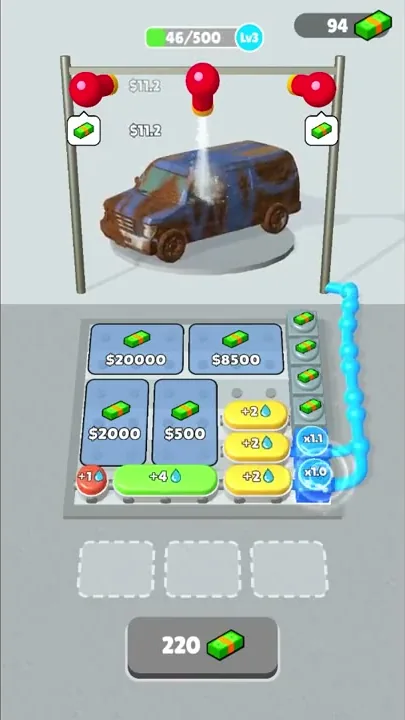
Cash pays for every purchase and is counted at the top right beside a green banknote icon. Washing fills it and buying draws it down. The buy button follows it: gray while cash falls short of the price, bright green once there’s enough. That price keeps rising, past 100 in Level 2 and up to 220 early in Level 3.
Finishing Level 2 calls up a “LEVEL UP!” screen that tints the whole scene pale blue under a green banner. A 3D stack of banknotes sits in the middle, with “+250” in cash above a green “Claim” button.
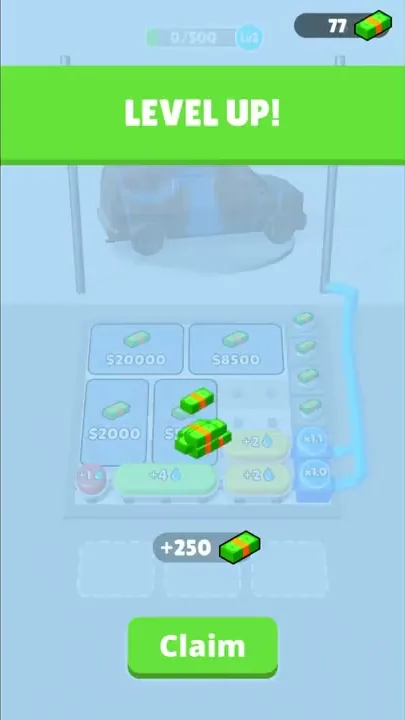
That screen is the only overlay that appeared. No shop or ad offer came up, and no settings or other menu was opened.
Mud-blasting as the payoff for merges
In bite-sized games built on it, relaxing sensory feedback is the whole game. Pressure Washer Fever turns it into the payoff for the board below, snappy and rewarding, and crosses the car wash with merging and light grid planning, systems with more play in them. Every change the player makes happens on the board below, and the wash above answers the first +4 with bigger dollar figures.
Bite-sized games are generally rather flat, without much depth to keep playing for. Handled well, pairing the sensory side with a core game deep enough to support it is another way to give it a longer life, and that’s the approach taken here. Anyone curious about bite-sized games for their own sake can give this one a try.
The wash is a stress-buster in how it’s dressed up. Thick, glossy brown mud comes away from the SUV in streaks and patches that uncover blue paint underneath, while payout numbers float up in white, several at a time.
Down in the bottom half, the mix has a fair amount of play in it. All the planning happens on one small grid, where pieces one to three dots long compete for space with priced panels that still cover most of it.
Locked nozzles and panels left shut
We have no specific complaint about Pressure Washer Fever. What follows are only the parts of the game that stayed out of reach.
The two side nozzles never sprayed, and the left one’s tooltip is all that was shown of them. The four pricier panels never opened, so what lies under them remains unknown. The same mud-covered SUV stayed on the turntable throughout. How multiplier blocks are earned, and whether cash keeps building while the game is closed, did not come up either.
Fitting pills of water into a cramped grid
Play here comes down to small, steady jobs. The player waits for the cash counter to turn the buy button green, then pairs equal pieces and fits shapes up to three dots long into a grid with few open spots. Meanwhile the numbers over the car and on the bar keep rising in plain view, with no timer to beat and no fail screen to avoid. That routine lines up with a taste for tidy spatial fitting and for watching small sums grow, with a car wash as the scenery on top.
Verdict
Spraying mud off a car serves as the visual reward here, while the decisions sit in a small merge-and-placement puzzle underneath. The spray up top is easy on the nerves, and the grid below gives a reasonable amount to do. Put together, the two halves are fun to play.