Rainbow Web Review: Spell a Phrase on a Spider-Web Board
Colored balls sit on a spider web, and this Rainbow Web review follows how matched chains release the letters of a hidden phrase.
Game at a glance
Rainbow Web
6/ 10
Our score
A new direction for small match-3 twists: rethink the board and the goal.
In this article6 sections
Swap a ball with its neighbor along a strand of spider web so that balls of one color join into a chain. The chain bursts, and any letters on those balls float up to a bar in the top-left corner to fill in a hidden phrase. Rainbow Web is built on that loop. It belongs with match 3 games, but it trades the usual grid for a round web and the usual quota of cleared pieces for a phrase.
We played two levels, finishing the first and stopping partway into the second with its phrase one letter short. The twist has real thought behind it, though it heads somewhere a little niche.
Swapping balls along a spider’s strands
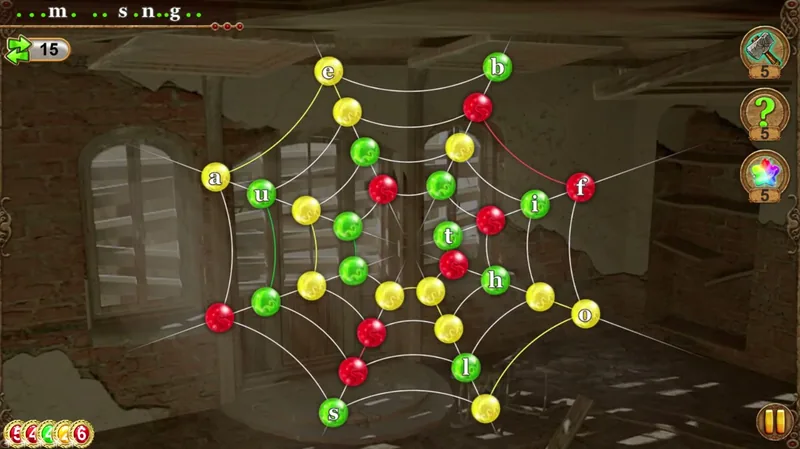
Each level hides a phrase. The bar in the top-left corner starts as rows of dots, each one a blank, and letters replace the dots as they are collected. Once the whole phrase is spelled out, a “Level completed!” panel appears.
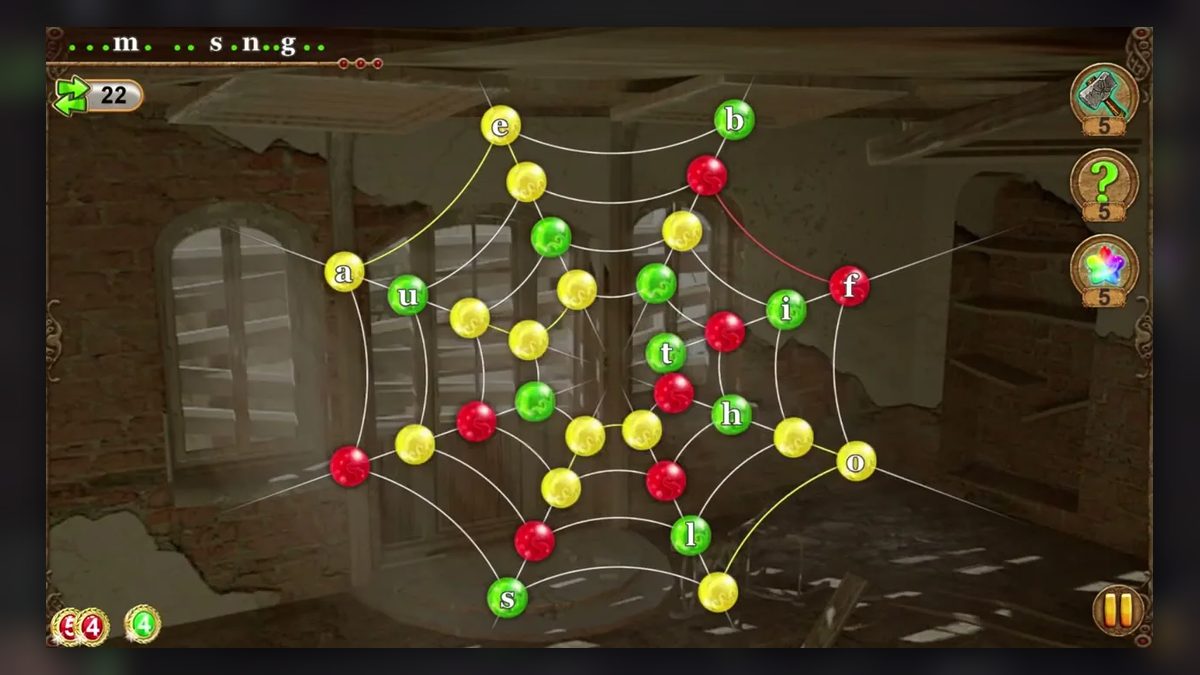
The board is a spider web in the middle of the screen. Balls sit where its spokes cross its rings, so they form rings around a center point rather than rows and columns. When two neighboring balls share a color, the strand between them takes on that color. A yellow strand links the yellow e and a balls at the upper left, and a red strand runs from a red ball to the red f on the right.
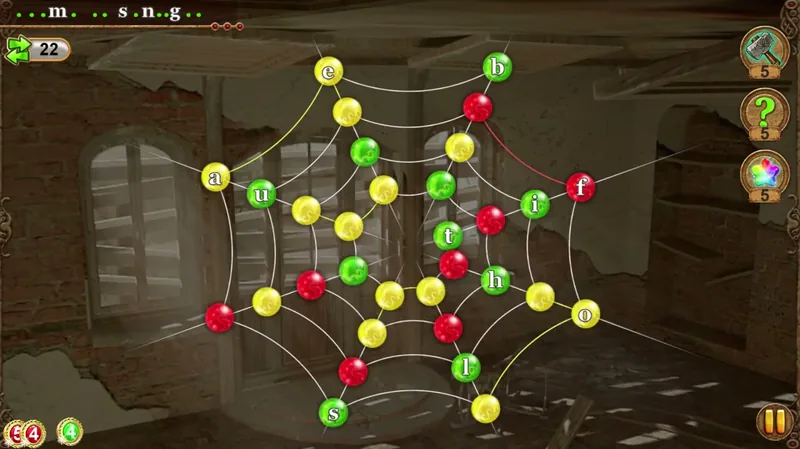
A move trades a ball with a neighbor along one strand. While it travels, the moving ball sits inside a see-through bubble tinted like the ball and looks squashed. Booster buttons run down the right edge, and an orange pause button sits in the bottom-right corner.
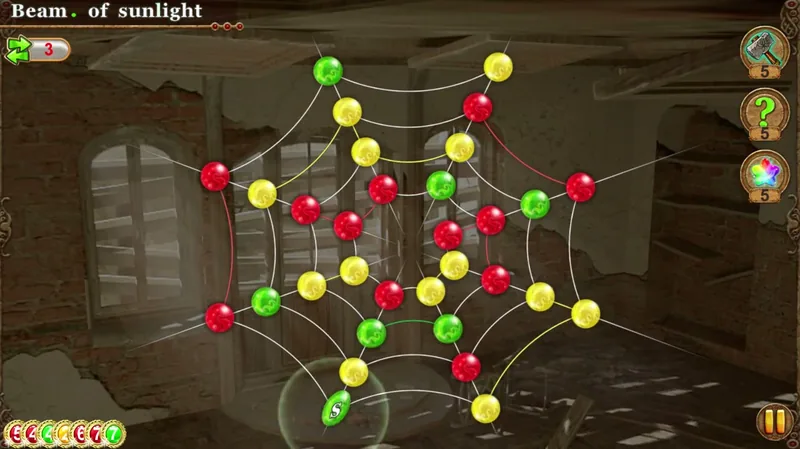
The aim of each swap is to join balls of one color into a chain, which then bursts into glowing shards of its own color. Chains of four green balls and of three both clear in the first level. After some matches a word flashes over the board in large type, from “Brilliant!” and “Perfect!” to “Double” and “Superb!” The Rainbow Web gameplay is that loop, repeated until the phrase is complete.
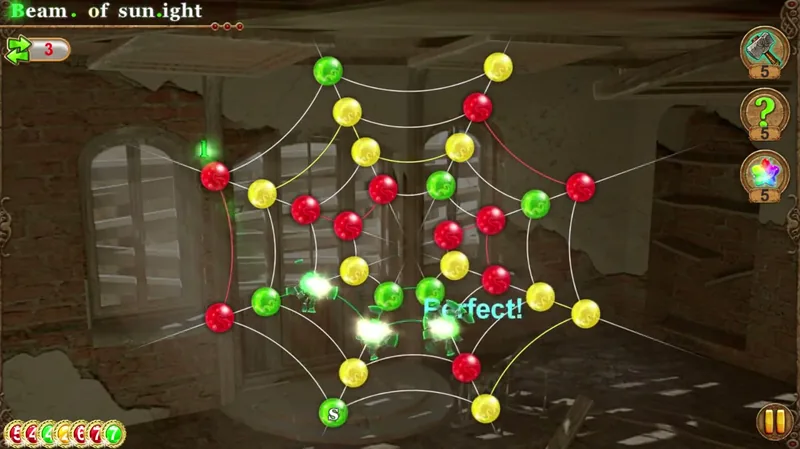
Some balls carry a white lowercase letter. When one is cleared in a chain, its letter floats off the board in the ball’s color and drops into its blank in the bar: a green u rises from the web, and moments later the last word reads “sun.ig.t” with the u in place. A plain ball then takes the cleared spot. The top outer ball that carried an e, for one, is a plain green ball shortly after.
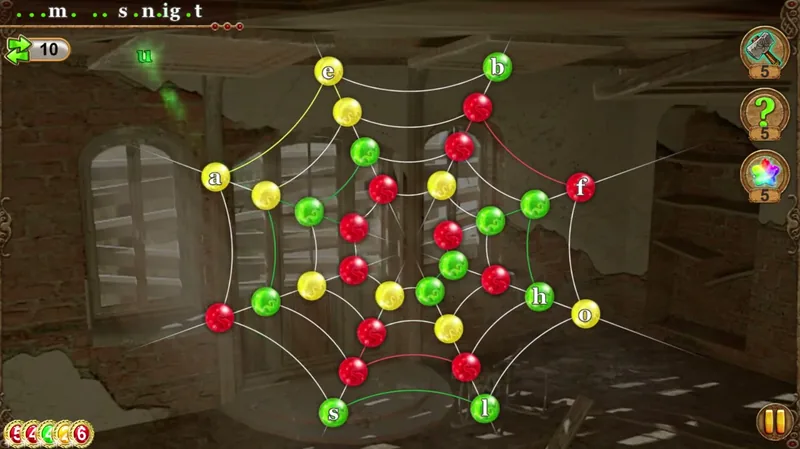
Three ball colors fill the first level’s web (red, yellow, green), with letters scattered across both the outer and inner rings, and the bar already shows an s and a g when its opening tip appears. A move counter with a green two-arrow icon sits at the top left and counts down as the level goes on. Its number turns red near the end, at 3 and then 1, and “Beams of sunlight” falls into place with that single move to spare.
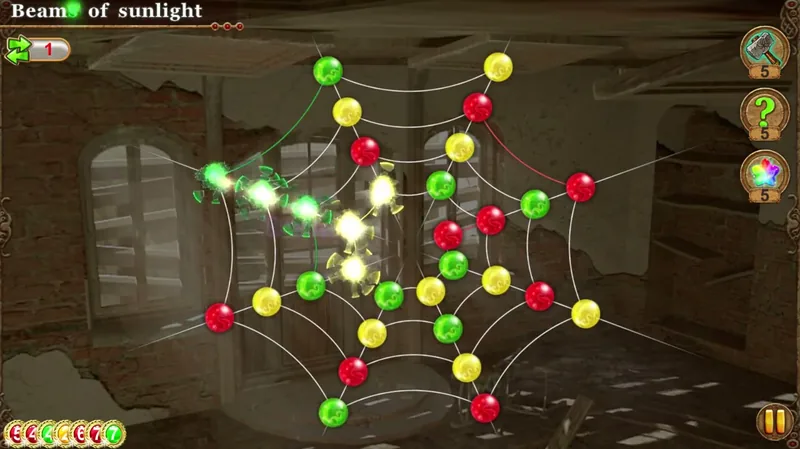
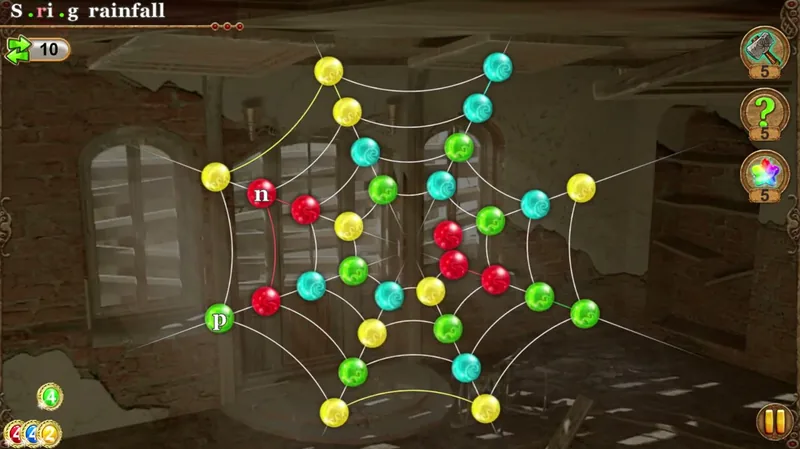
A row of tokens in the bottom-left corner fills up during a level. After some matches a round, gold-rimmed token with a number on it appears over the web in red, blue, yellow or green, then joins the row. The row is empty when the second level begins and fills again from there. Nothing in either level shows what the tokens mean.
A fourth color and a spider’s warning
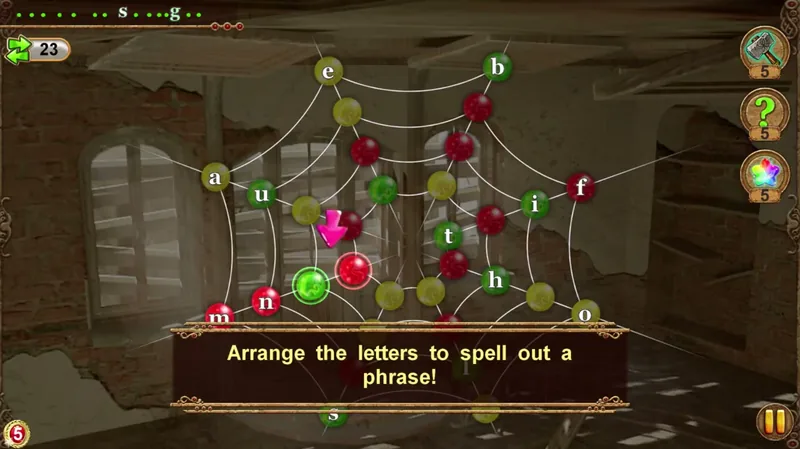
Both levels open with a tip banner laid over the web. The first one reads “Arrange the letters to spell out a phrase!” and covers the lower middle of the board. A pink arrow above it points at a ball, and a green ball and a red ball nearby are each circled by a ring of their own color.
The board’s palette grows in the second level, which keeps the same web shape but adds cyan as a fourth ball color. Its phrase has two words where the first level’s had three, and the second word, “rainfall,” fills in before the first one does. Later the bar reads “S.ring rainfall” with one blank left and a green p ball still on the board.
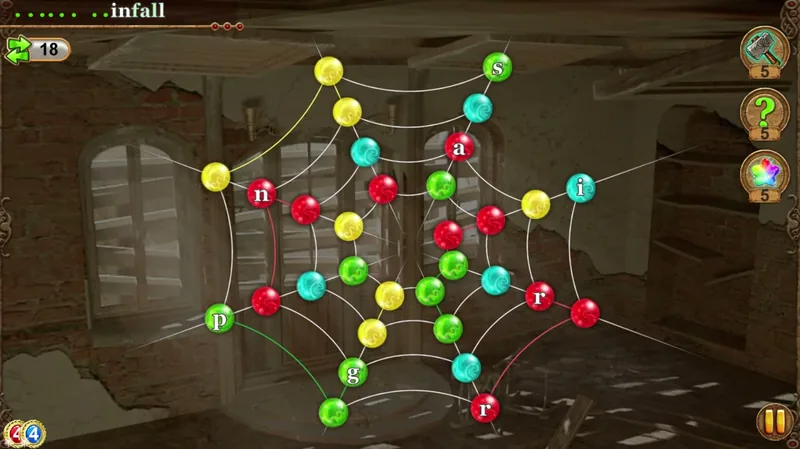
That second tip carries a warning: “The evil Spider is trying to block your mission by cutting strands of his web. Watch out!” The Spider itself was never seen on the board in the moves that followed. The room behind the web changes as well: two brass wall lamps beside the central doors show behind this board, where the first level had none.
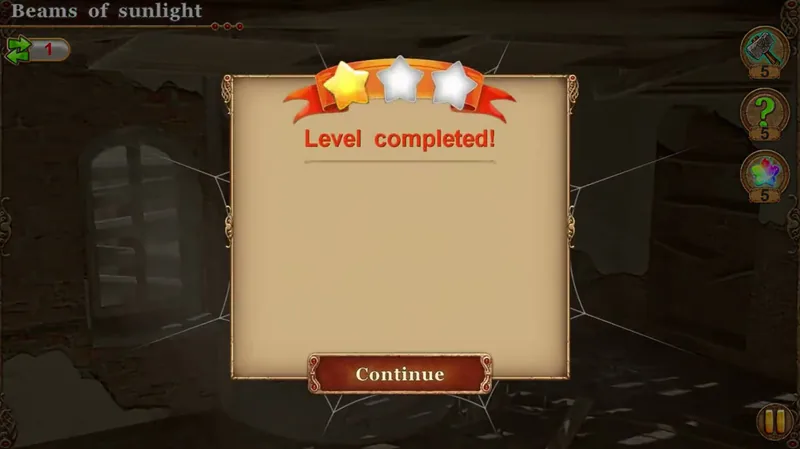
A finished level closes on a parchment “Level completed!” panel with three stars across a ribbon and a “Continue” button. After the first level, one star is gold and the other two are silver-white.
Three round booster buttons line the right edge of the board screen: a hammer, a green question mark, a rainbow star. Each shows a 5 beneath it, and all three still read 5 late in the second level, so none has been used.
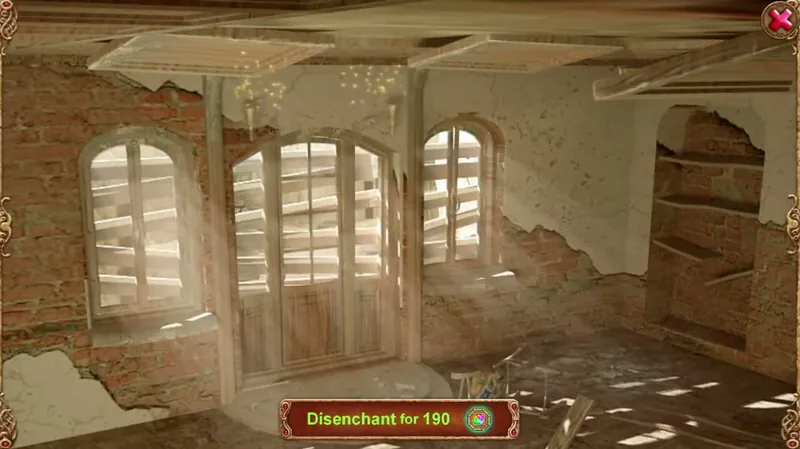
After the panel, the room behind the board appears at full brightness with the web gone. A “Disenchant for 190” button with a rainbow gem icon sits at the bottom and a red X at the top right, while gold sparkles circle two wall lamps beside the central doors.
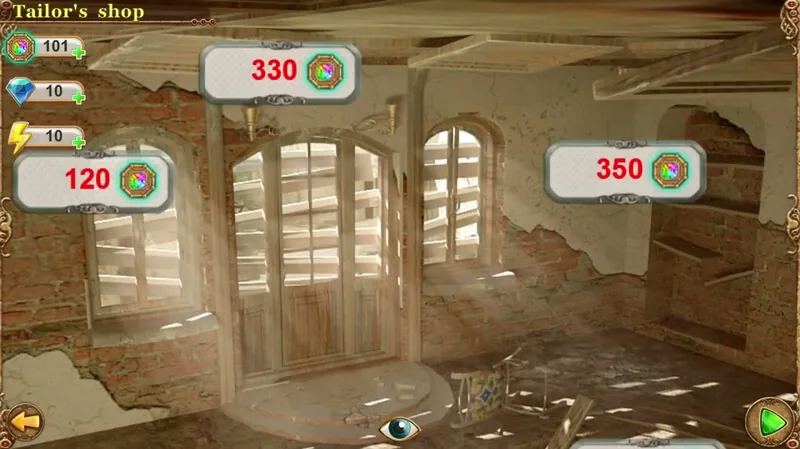
The screen after that is titled “Tailor’s shop.” Three counters with green “+” buttons run down its top-left corner: a rainbow gem on top, then a blue diamond, then a lightning bolt. Price tags of 330 and 120 hang over the left side of the room and 350 over the right, each with the rainbow gem icon, while a fourth tag is cut off at the bottom edge. An orange back arrow and a green play arrow sit along the bottom with an eye icon between them, and no ad turns up on any of these screens or during either level.
A round board with a phrase to finish
This minor new wrinkle on match-3 is full of ideas. It takes small changes to the formula in a new direction, aiming them at the board itself and at the form the goal takes.
Standard match-3, the kind found in games like royal match, sets its pieces out in rows and columns. Rainbow Web spreads them in rings from a center point instead, and the colored strands that link same-color neighbors trace curves around the web, like the yellow one bending from the e ball down to the a.
The goal changes too. A level asks for letters rather than a count of cleared pieces or board elements, and they arrive from lettered balls in cleared chains, like the green u that floats up into “sunlight.”
The match-3 play underneath is the kind that makes puzzle and casual fans really want to get their hands on it. On the board, that means a green chain breaking into shards while its letter drifts to the bar in the same green.
A niche direction inside a run-down room
The direction this new spin on match-3 takes, with a web for a board and a phrase for a goal, looks a bit niche. Both changes sit at the center of play, from the first level’s opening tip that asks for a phrase to the “Level completed!” panel that appears once it is spelled out. Whether the play stays interesting over the long run is still unproven.
The artwork is not to our taste. Glossy balls with swirl marks sit on a web over a dim, run-down room whose plaster has cracked down to the brick and whose arched windows have broken shutters. Between levels the same room returns at full brightness.
Letters pulled from chains of color
Most of the thinking happens on rings rather than rows. Each swap moves a ball along a strand of the web, and the colored strands mark which same-color balls already touch. That suits a taste for match-3 laid out off the grid.
The phrase bar speaks to another taste. Watching “Beams of sunlight” build up from rows of dots is close to letter-tile word play, except that the letters arrive through color matches instead of being placed by hand. Over all of it, a move counter counts down and turns red near the end.
Verdict
Replacing the grid with rings and the usual clearing target with words to complete is an inventive pair of changes. The direction they take looks a little niche, though. Add artwork that didn’t win us over and staying power that is still unproven, and the overall result stays modest.