Capybara Land Review: Chubby Fruit and a Capybara Island
Fruit boards pay out carrots, and our Capybara Land review follows them to a 90-carrot capybara that floats in under three balloons.
Game at a glance
Capybara Land: Match & Design
7.5/ 10
Our score
Chubby fruit on the board, laid-back capybaras on the island.
In this article6 sections
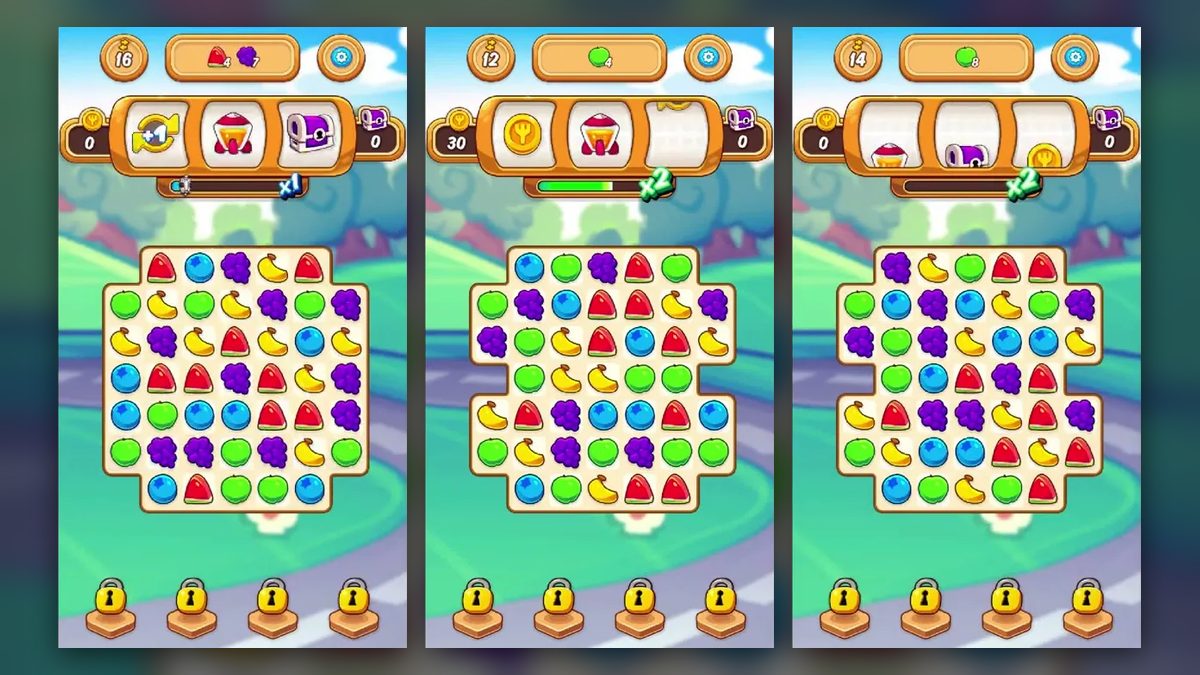
On the board, Capybara Land plays like classic match 3 games. Lines of same-color fruit burst while a goal card counts down crates or grass, and there is a limited number of moves to do it in. Around the board, finished levels pay out paw coins and carrots, and the carrots go toward capybaras that drift down onto a cartoon island where unlocked decorations wait to be placed.
Its premise shares its animal with Capybara Go!, the event-by-event roguelite starring a capybara. Anyone browsing games like Capybara Go will find capybaras all over the island screens here, but the roguelite events give way to fruit boards and decorating. We played Levels 2–4 and left the last of them a single grass tile from done.
Fruit boards with crate and grass goals
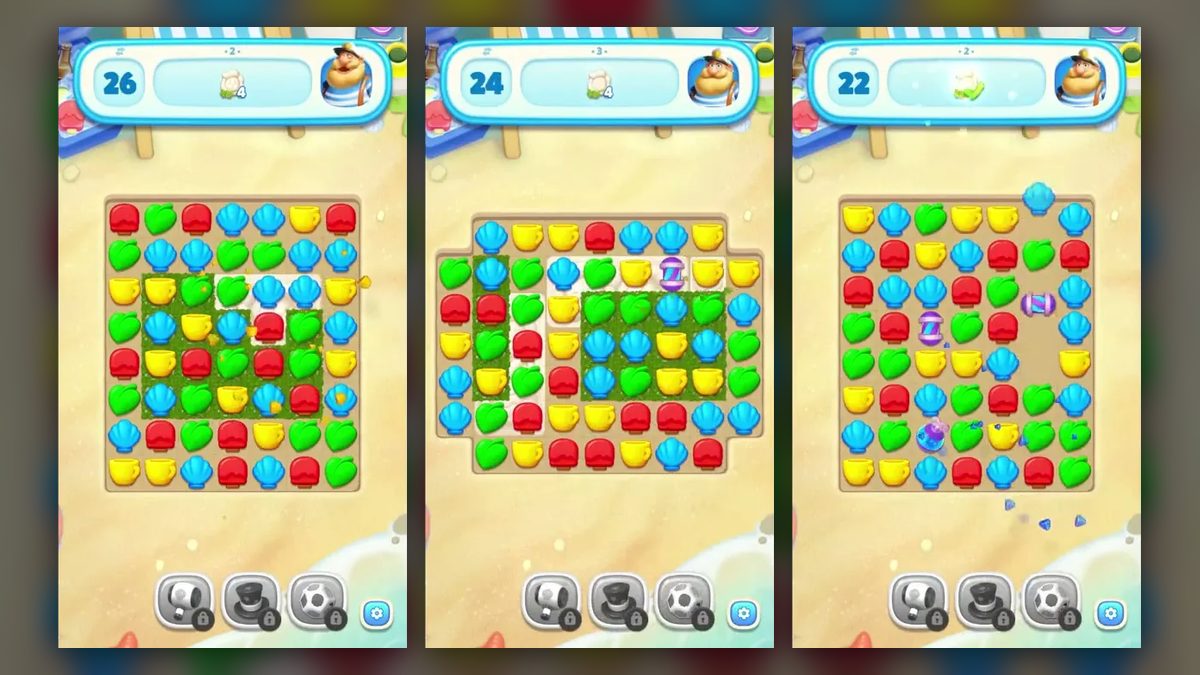
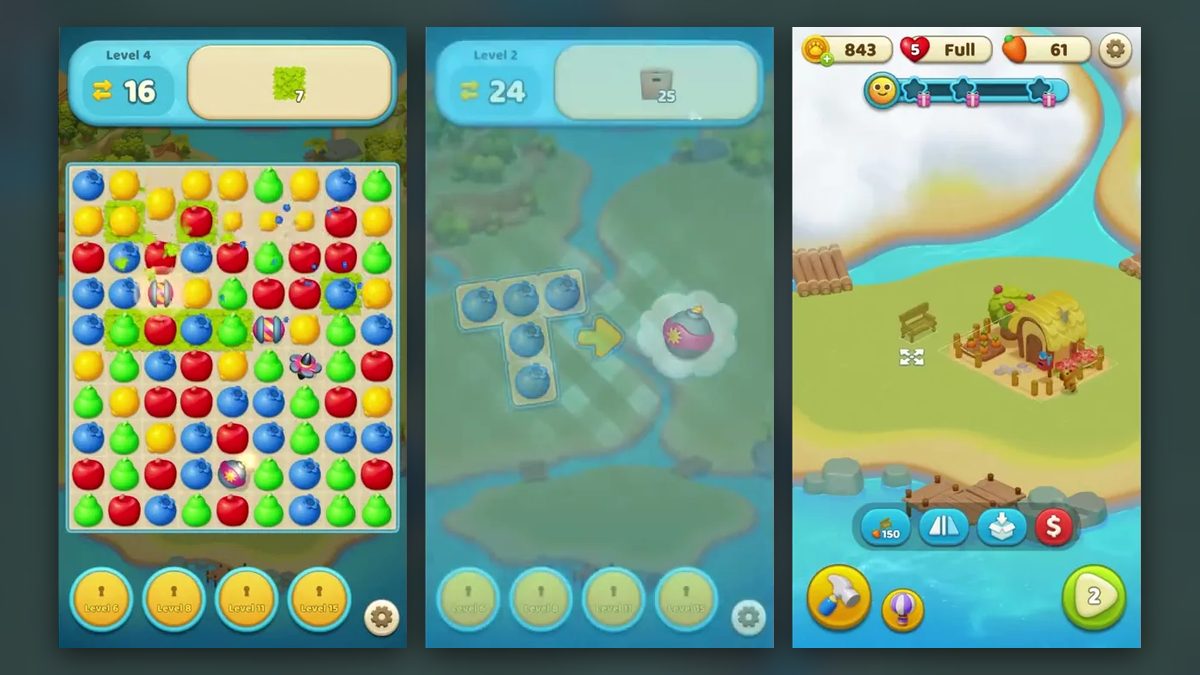
Each level is a grid of glossy fruit on beige tiles inside a pale blue border, with the island blurred behind it. Fruit of one color lined up together pops in sparkles and flying debris, as when three blue fruit burst in a row near the end of Level 2. The bursts wear down the goal on the card at the top, and clearing it before the moves run out wins the level. Afterward the game returns to the island, where carrots from the level pay for capybaras and unlocked decorations get placed on the map.
The level card shows the level number, and a pair of opposing arrows sits beside the moves counter. On the island, the placed bench came with a move icon underneath it and a bar of edit buttons below, and a placed capybara gets an edit bar too.
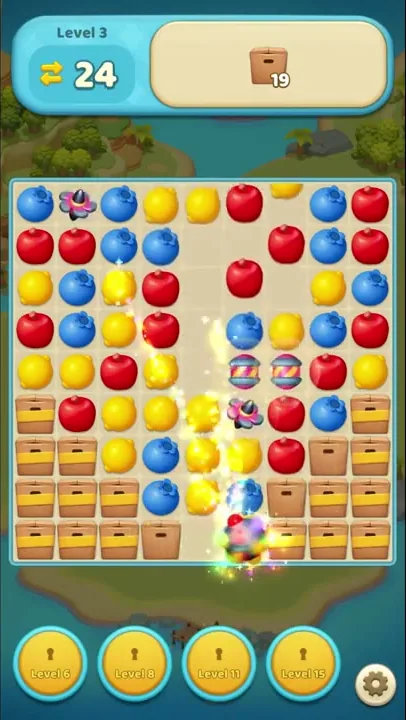
The bomb is a round dark piece with a fuse on top and a pink band bearing a yellow star. A tutorial card in Level 2 shows five blue fruit in a T shape with an arrow pointing to it, and the card before Level 3 does the same with five pink fruit in an L. During play, dark round pieces with a pink starburst sit among the fruit.
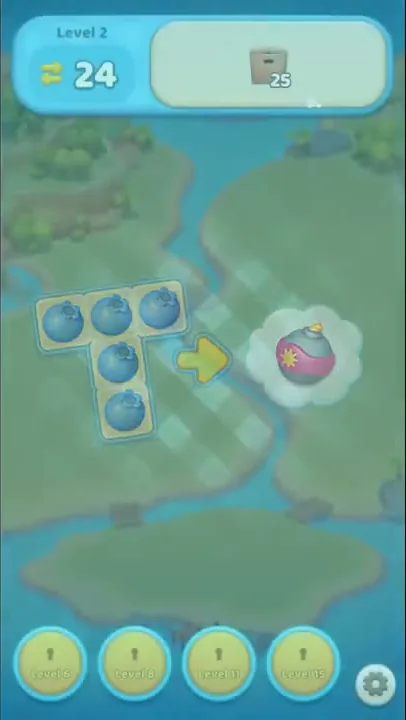
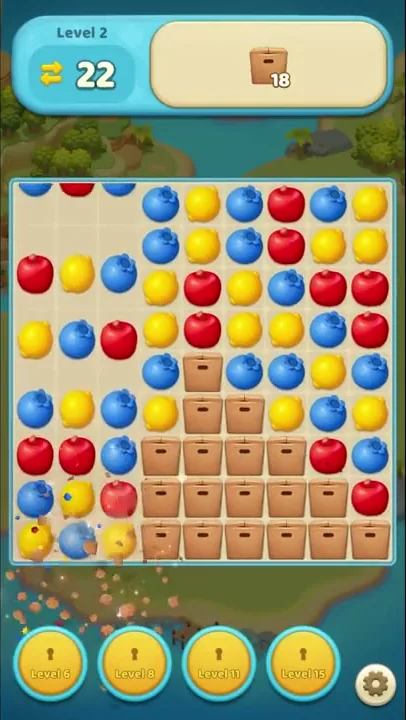
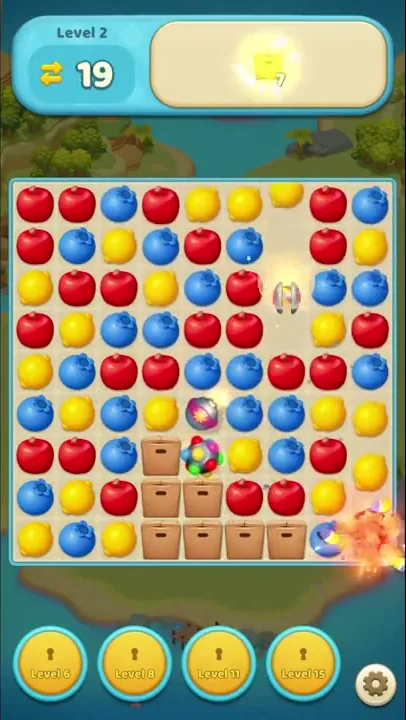
Wooden crates are the goal in Level 2: the card asks for 25 of them and gives 24 moves to clear them. They fill board cells in place of fruit. Two moves in, they form a staircase in the lower right of the 9-by-9 board, widest along the bottom row, and the card reads 18. With 19 moves left the count was down to 7, and a check mark replaced it with 18 moves still unused.
The striped barrel is a special piece shaped like a small barrel and painted with diagonal stripes of pink, yellow and blue. It turns up among the fruit, often several at a time. In Level 4, a sideways streak of flame with one at its tip crosses part of a middle row next to a large starburst.
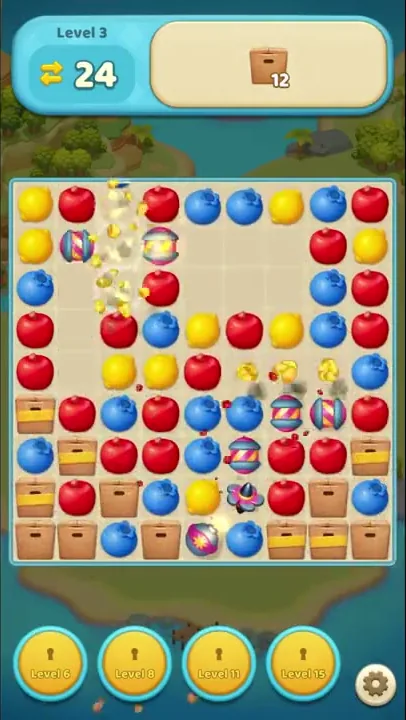
The cone is a dark, pointed piece standing on pink petals. It turned up in each level, and late in Level 4 three of them stood on the board at once. At times one spins on a pink disc with streaks around it.
The bead ball is a sphere of small beads in several colors that takes up a fruit cell like any other piece. In Level 2 one sat beside the remaining crates, and another glowed on the Level 3 board.
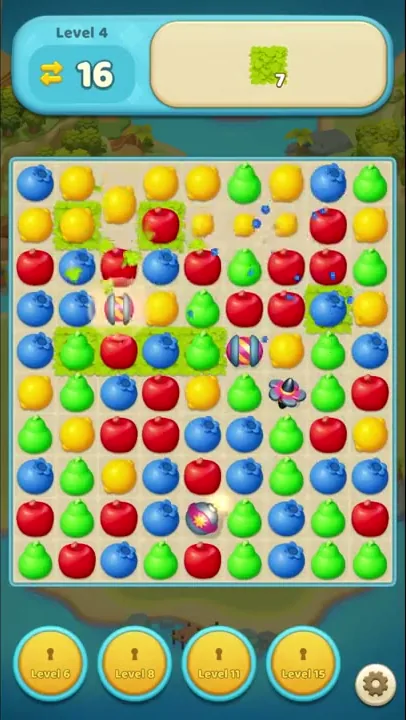
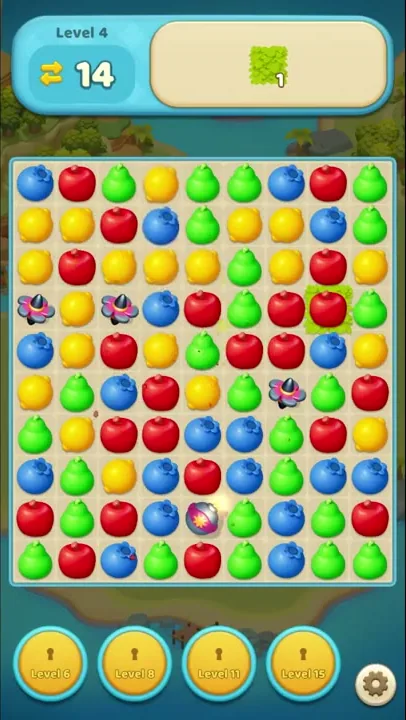
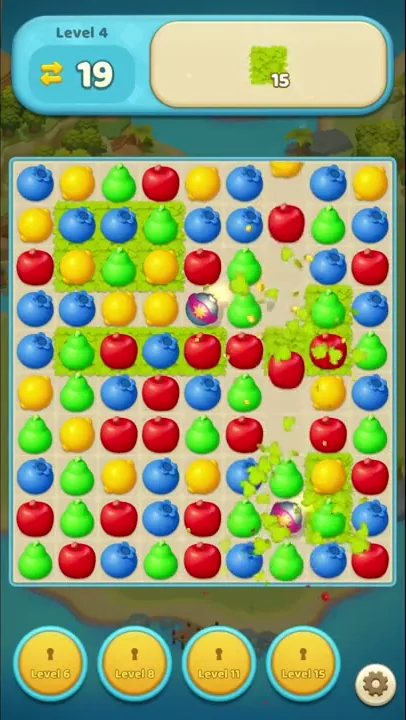
Grass covers board cells underneath the fruit, and any cell without it shows the plain beige board. It is the goal in Level 4, where the card started at 56 and fell to 38 after three moves, then to 15 and 7. With 14 moves left it stood at 1.
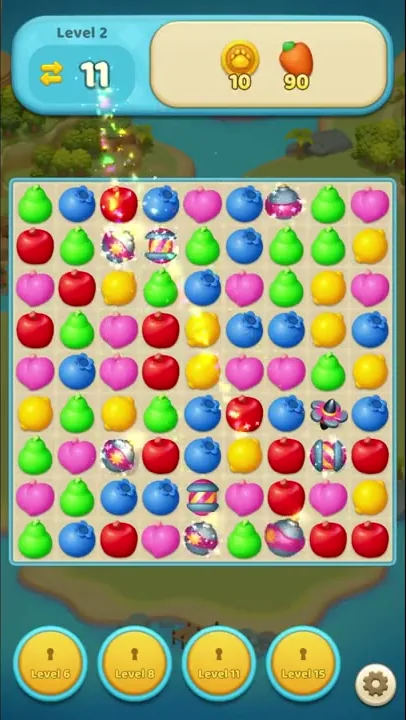
Meeting the goal in Level 2 did not end the level. Once the check mark appeared, the board held five fruit colors instead of three, with green and pink now among them, and the goal card switched to a paw-coin counter and a carrot counter. Bombs, striped barrels and cones then filled the board and went off while the moves ran down to 0, with carrot icons flying toward the card, which finished at 84 paw coins and 212 carrots. Level 3 ended on a similar screen, a dimmed five-color board covered in special pieces, with the card reading 84 paw coins and 226 carrots.
From crate stacks to a capybara collection
Between Levels 2 and 3 the board and the fruit stay the same: 9 by 9, in the same three colors. The crates are what change. Early in Level 3 they stand in both bottom corners, highest along the outer edges, most of them wrapped in a yellow band and a few left plain.
Level 4 changes several things at once. Before it starts, a panel shows the grass goal and a “Choose Booster” row of three locked slots above a green “Play” button, each slot labeled with the number of the next level. The board grows a row taller, to 9 columns by 10 rows, and green fruit joins the other three colors. Grass covers everything except the outer ring, a block 7 cells wide and 8 tall, and the moves counter starts at 24, the same as in Level 2.
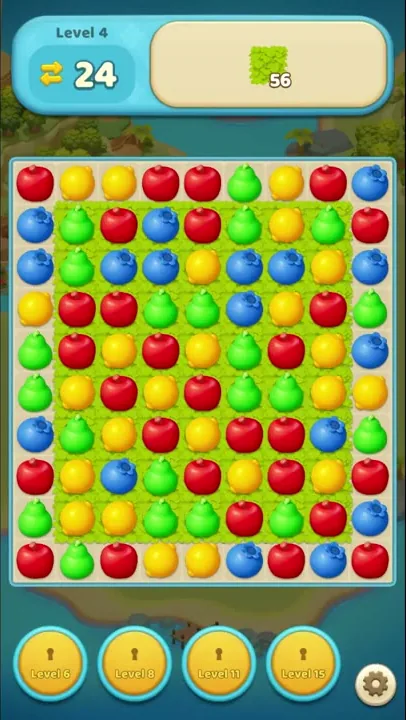
Other slots stayed shut on every board. Below the board sit four round yellow slots with keyholes, each labeled with a later level number, next to a gear button.
Between levels the game returns to a cartoon island of grass and sand in a turquoise sea, where a thatched hut stands in a fenced garden near a wooden dock. Log bridges lead off toward the clouds that cover the edges of the map. A hammer button and a hot-air-balloon button sit at the bottom left, across from a green play button that shows the next level number, with a gear at the top right. Before Level 2, a card with a 3x3 grid of fruit and the words “Clear Levels!” appeared over the island.
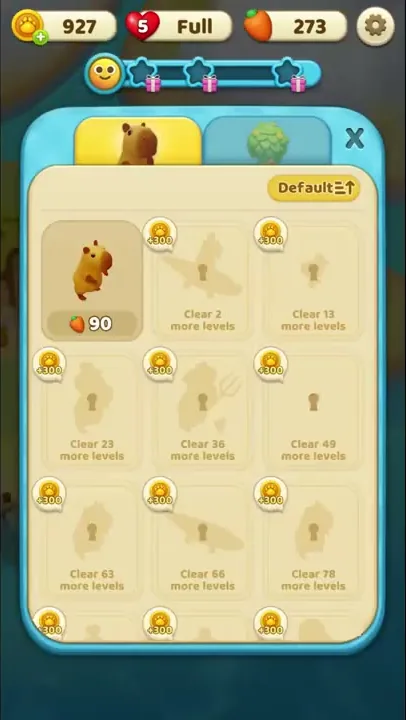
Paw coins and carrots sit at the top of that screen, with a red heart for lives between them that read 5 and “Full” every time it appeared. Paw coins carry a paw print, and a green plus sign sits beside their total, which went up by exactly the 84 shown on each level’s end card. Carrots are the price on the collection panel, and their total fell in steps of 90, with a “-90” carrot label showing as a capybara floated in.
New decorations arrive through an unlock pop-up. The bench’s pop-up reads “Congratulations!” and “Unlocked New Deco!” above a green “Purchase” button, with “Tap to close” at the bottom.
On the island the bench stood beside the hut. The mascot, a capybara with a small red ornament on its head, appeared in a blue-edged panel with the line “Oh, no! The bench is blocking the entrance!” A move icon sits under the bench, and the edit bar below holds four buttons: first the bench with a carrot icon and 150, then a mirror icon, then a box with a down arrow, and last a red “$”.
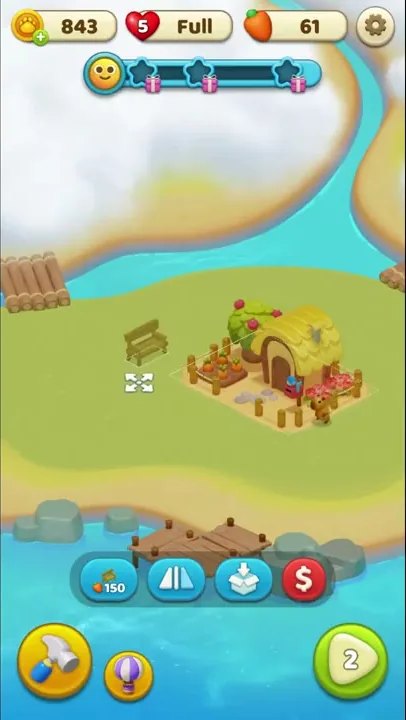
A Happy Points bar runs under the currencies: a smiley face followed by three star markers, each with a gift box. Its tooltip reads “Collect 1416 Happy Points to get a Star!” and lists the rewards as 300 paw coins, an infinity heart marked “1h” and a striped barrel marked “30m”. The mascot’s panel adds “Fill up your Happy Points and earn Stars…” The bench’s unlock card showed a smiley with “+38”, and smiley faces float up from items as they are placed.
Capybaras come from a collection panel with two tabs, one showing a capybara and one a tree, plus a “Default” sort button and a close X. The first card offers a capybara for 90 carrots. The rest are pale silhouettes with keyholes, labeled “Clear 2 more levels”, “Clear 13 more levels” and so on, up to “Clear 78 more levels” among the cards in view, each wearing a paw-coin badge that reads “+300”.
A new capybara floats down onto the island under three balloons. Once on the ground it gets an edit bar of its own: a button showing a capybara with 90 beside it, followed by the same box and red “$” buttons the bench had. After Level 3 a capybara on the beach said “That was amazing!”, and before Level 4 began, more had joined it there.
A capybara premise and a laid-back island
The capybara premise is fairly fresh, built around an animal that was a hit not long ago. The mascot in its blue-edged panel is a capybara, and so is every resident that floats in by balloon. Even the collection panel opens on a capybara tab.
We liked the island’s visual style: cartoonish and casual, lazy in mood and lighthearted in its humor. Round brown capybaras walk the sand or float down from the sky, and smiley faces pop up from items as they are placed. One of the mascot’s first lines frets that the bench is blocking the entrance.
The pieces on the boards are very rounded, chubby all over. Each fruit is glossy and plump with a leaf or stem on top, and the bomb is just as round.
The systems around the puzzles lean toward simulation building, with some free placement and light management on top of the matching. The bench came with a move icon and an edit bar that includes a mirror button, and its unlock card showed a smiley “+38”, the same smiley that heads the Happy Points bar.
Booster slots still locked by Level 4
We have no criticism to report. What these levels could not show: the three booster slots on the pre-level panel and the four slots under the board all stayed shut.
Levels 2 and 3 were both won with moves to spare, so no lost level ever appeared on screen and the hearts stayed full. The tutorial cards explain only the bomb, so the effects of the other three special pieces stayed unclear. The hammer and balloon buttons on the island and the tree tab on the collection panel were never opened.
Fruit matching that pays for capybaras
Each board asks for one thing: a single count on the goal card, crates or grass, brought down to a check mark before the moves run out. That fits a liking for puzzles with one clear target and a payout of paw coins and carrots at the end.
The other half is collecting and arranging. The capybara on offer costs 90 carrots, and the locked silhouettes beside it show how many more levels each one needs. The placed bench came with a move icon and an edit bar, and a placed capybara gets an edit bar too, which fits a taste for gathering animals one at a time and arranging a small map between puzzles.
Verdict
Capybara Land stands on its animal and its art. Capybaras make a fairly new subject for a match-3 game, and the island is drawn with an easygoing, joking cartoon touch. Even the fruit on the boards is as plump as the residents.
Off the boards, the game leans toward building and arranging, with room to place items freely and a light layer of management. That fits a broader pattern in match-3 games, where the layer around the levels keeps getting wider and deeper.