Survival Defense Zombie World Review: Turning Canada Blue
Coins from fallen zombies build towers on hex pads, and every flag taken turns red ground blue: a Survival Defense Zombie World review.
Game at a glance
Survival Defense Zombie World
6.5/ 10
Our score
Again: in a blend, weigh how tone, controls, craft and experience complement and resemble.
In this article6 sections
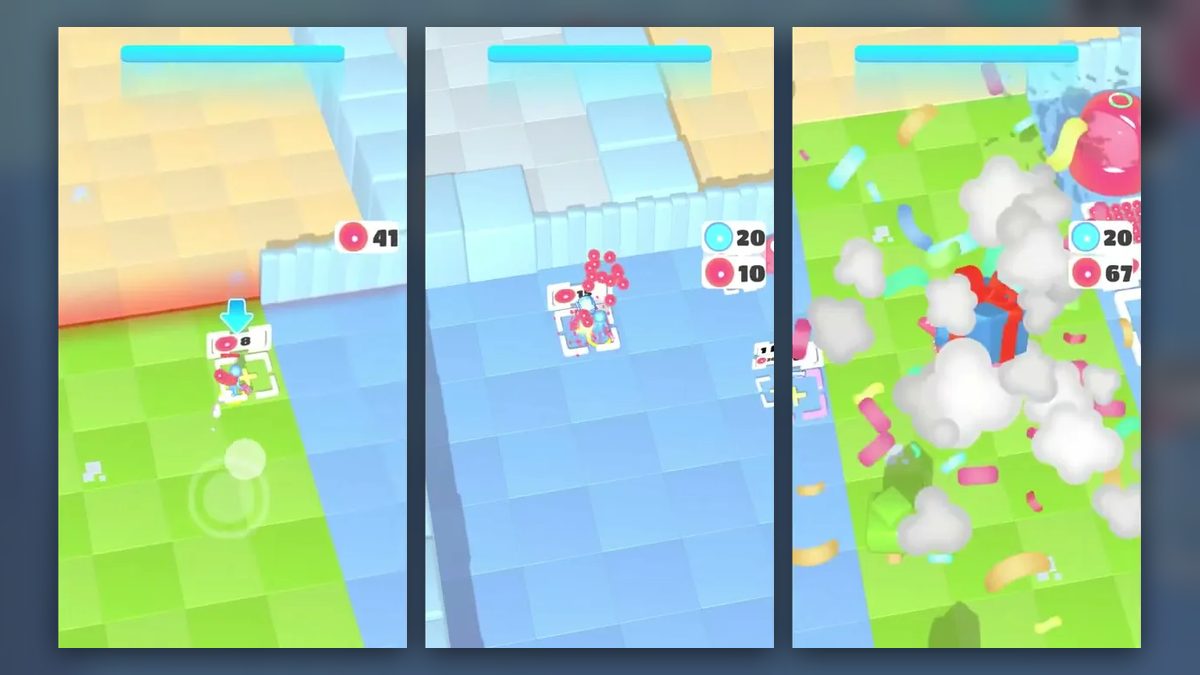
Walk a small cyan gunner onto a hex pad beside a zombie path, and the price printed on the pad counts down as coins go in until a tower stands in its place. Survival Defense Zombie World takes that walk-on building from idle tycoon games and combines it with hold-the-line defense, a hero who shoots, and a map that turns from red to blue one flag at a time.
The gunner owes something to games like Archero, where a lone hero shoots through waves of enemies, while the zombie waves marching past towers echo Orcs Must Die!, the trap-and-fight defense game. We played two full sections of a map labeled “Canada” and the start of a third. Many borrowed parts share the screen without turning into a mess, and what counts against the game is timing: it landed in a week crowded with big releases.
A cyan gunner on the zombie path
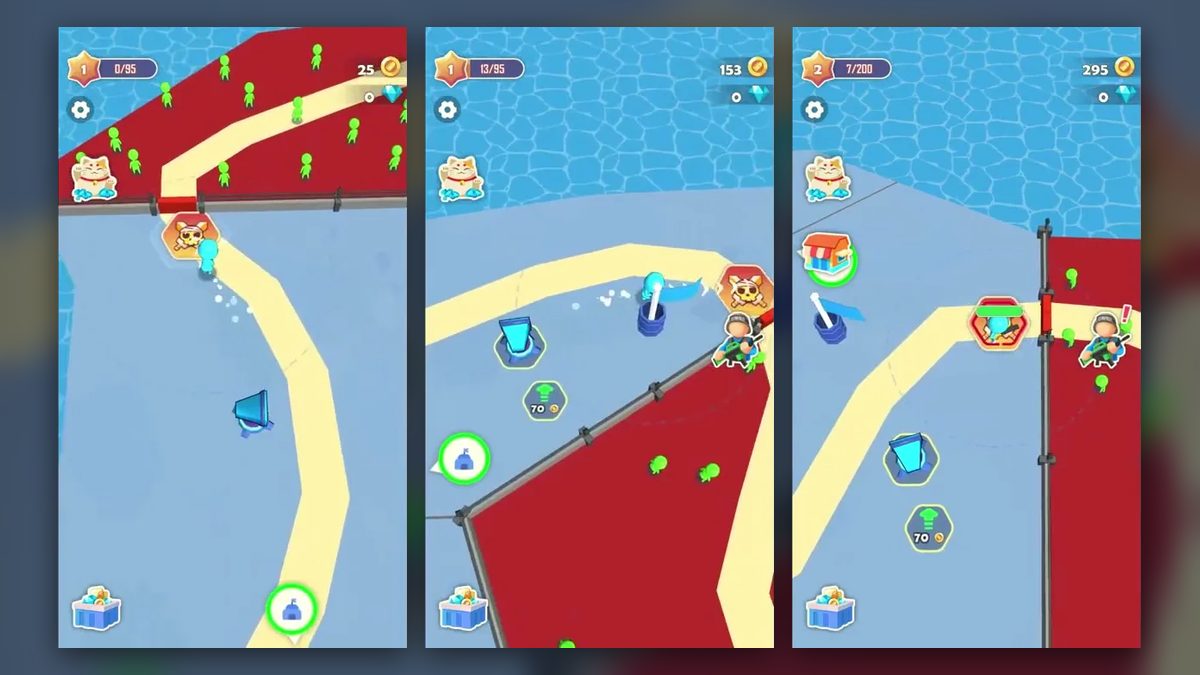
Every section splits the ground in two: deep red on the enemy side and light blue on the player’s, with gray rail fences between them and a pale-yellow path winding across both. Zombies walk that path from the red ground toward the blue. A bar at the top headed “Canada” runs to a red flag icon and fills with blue over the waves, with the current wave written beneath it.
Once the bar is full, the hero heads for the flag, a red flag on a red stand inside a red ring on enemy ground. Walking into the ring claims it. Afterward the flag is blue and the ground around it has turned light blue.
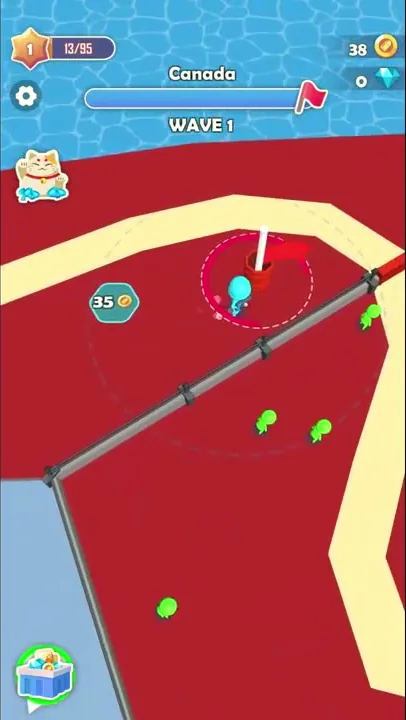
The hero moves freely over the map, on and off the path, and a tilted top-down camera follows it. A faint dashed circle around it marks its working range, and it fires at zombies inside that circle: a yellow tracer runs out to them, and small health bars pop up over their heads. Rows of white chevrons point to the next pad or target. Icons around the screen edge can be tapped too, as a tutorial hand on a dimmed screen shows.
The look is bright, low-poly 3D in portrait, with blue tiled water around the land and red block-shaped structures on the enemy ground. Shots show up as yellow tracers and yellow-white flashes, and hits leave red splatter. Pop-ups switch to flat 2D cartoon art.
Fallen zombies leave coins on the path, and numbers such as “+7” or “+8” float up beside the hero. Those coins are spent on pads that turn into towers, and the towers keep firing at each wave alongside the hero.
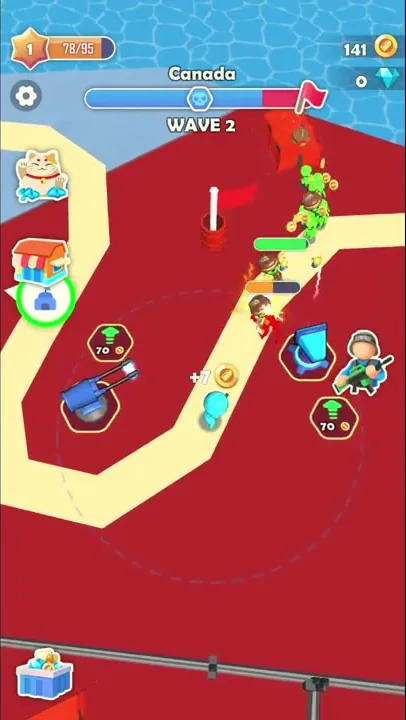
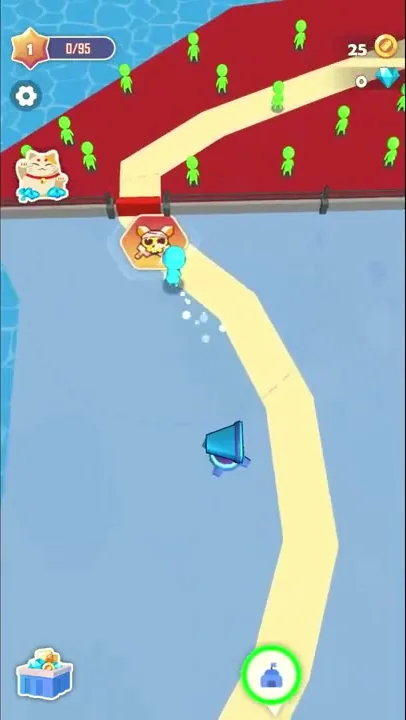
On the opening stretch of “Canada”, the hero starts on light-blue ground beside a pad priced 35, with a skull pad at the red gate above and green zombies dotted over the red ground beyond the fence. Paying off the pad raises the first cyan tower. After a stop on the skull pad, “WAVE 1” appears, and the hero fights the zombies on the path with the tower at its side until the bar has filled. A walk into the flag’s ring then ends the section with a “STATE CLEARED” panel and a reward of 110 coins.
Build pads are teal hexes beside the path, each showing a coin price of 35 or 30. Standing on one gives it a green outline and counts the price down. One 30 pad on the red ground was down to 10 with the hero standing on it, and shortly afterward a twin-barrel turret stood in its place.
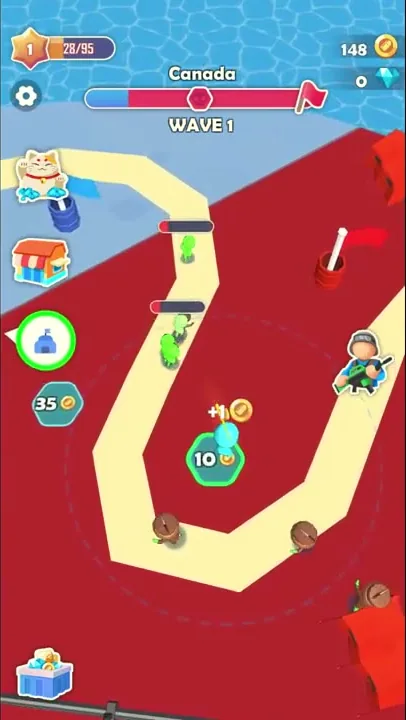
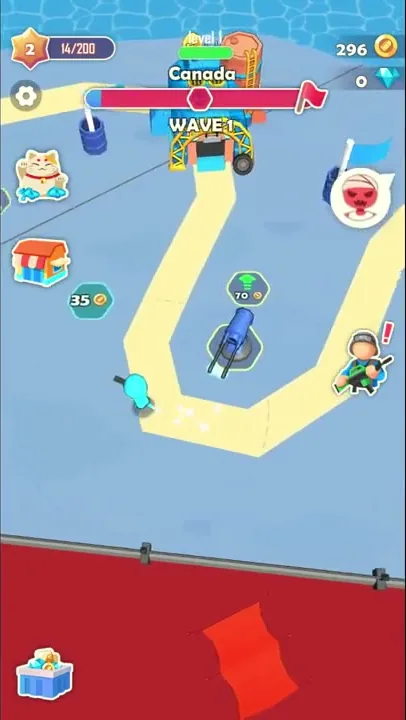
The first kind of tower is cyan and funnel-shaped, set on a hex base beside the path. It rose where the 35 pad had been, and the coin counter fell by that price. More of them line the path as the map opens up. In the second section, a pink beam and a cyan flash appear at one of them as zombies pass close by.
The second kind is a blue gun turret with two barrels, also on a hex base. The one built from the 30 pad sits inside a bend of the path, and its barrels glow as zombies go by.
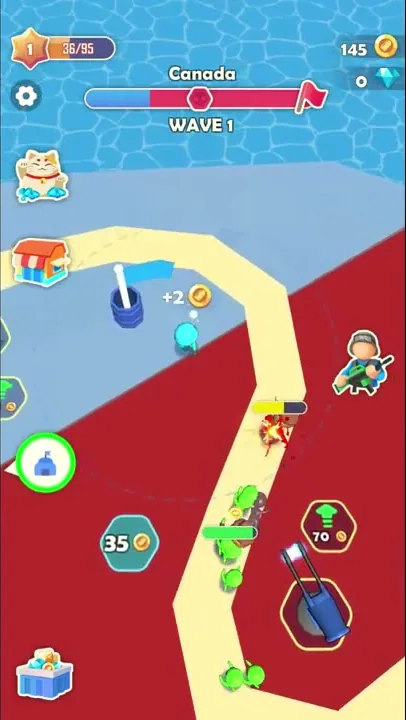
From the second section on, a smaller hex with a green upward arrow and a price of 70 sits beside the towers. Every one of these pads still read 70 well into the third section. None was bought, so what one does for its tower never shows.
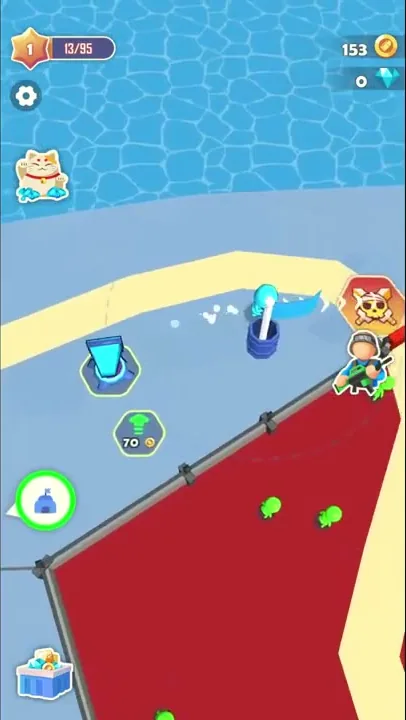
Where the path passes through a fence there is a red gate, and an orange hex with a skull and crossbones sits on the path in front of it. When the hero stands on it, a green bar fills above the pad, and “WAVE 1” follows a moment later.
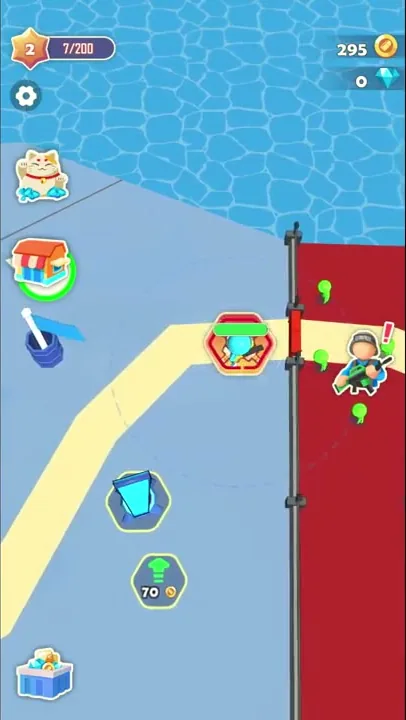
A level tag over a green bar rides on a blue vehicle by the path. Just after the first flag, the tag is on a blue pickup on the path at the edge of the red ground. In the third section the same kind of tag sits on a much larger blue vehicle with an orange tank and yellow latticework, standing where the path ends on light-blue ground. A green-ringed blue house icon with a small pointer often hangs at the screen edge, and it is absent while the big vehicle is in view.
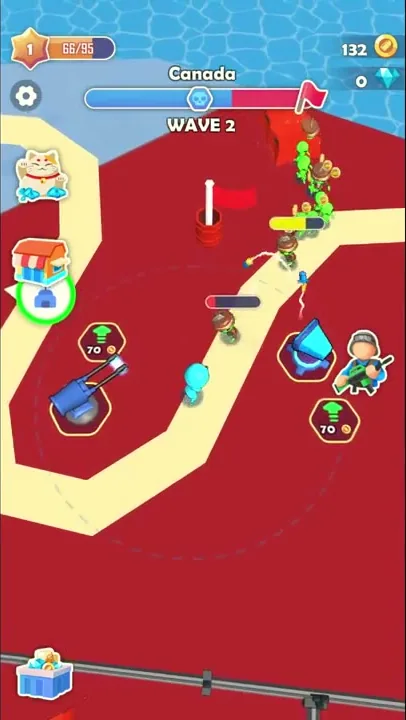
The enemies start as simple green stick figures. In the second section a second kind joins them: zombies with brown heads on green bodies, walking the path among the green ones with health bars of their own.
Canada, one fenced section at a time
The number of waves changes from section to section. The opening section runs a single wave, and its bar shows no marker. The next one puts a hex marker partway along the bar, red while the label reads “WAVE 1” and blue once it reads “WAVE 2”. After the second flag, the bar starts over in red, marker included, with “WAVE 1” beneath it.
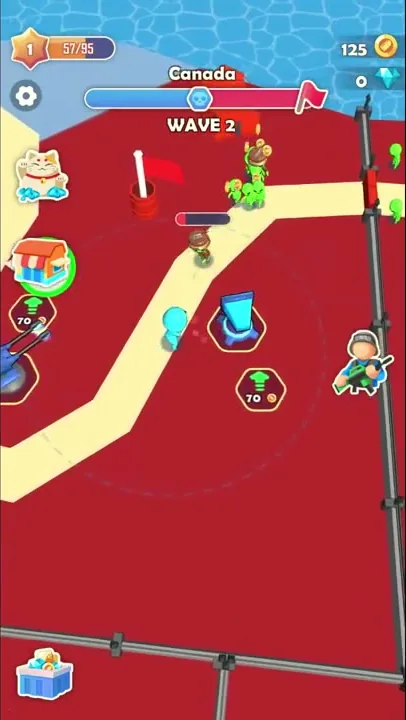
New pieces arrive with the second section: the 30 pad that becomes the twin-barrel turret, the 70 arrow pads, and the brown-headed zombies. More cyan towers go up during the third section’s first wave. Fresh 35 and 30 pads lie on the next stretch of red ground, where a long column of green zombies fills the path beside a red block-shaped structure.
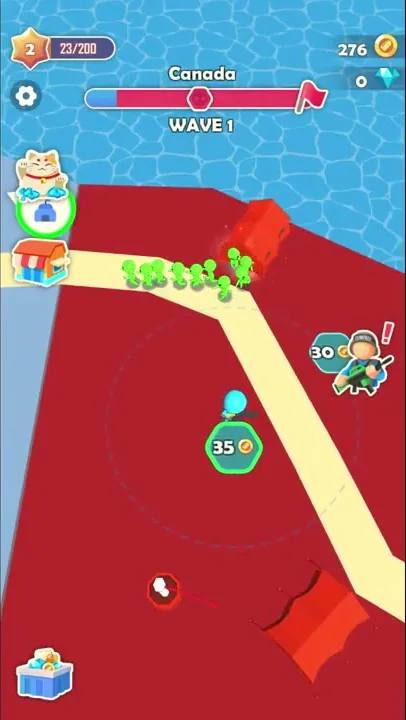
Each flag also moves the front line. After the first, play crosses into the next fenced area beyond a new skull pad, where the path winds over red ground in S-shaped bends. After the second, the big blue vehicle waits at the head of the path on ground that has just turned blue.
Taking the first flag also opens a “STATE CLEARED” panel: a gold-winged badge over a purple card showing the region cut into many tiles. Nearly all of them are red, and one blue tile at the left end flies a blue flag. A reward of 110 coins sits underneath.
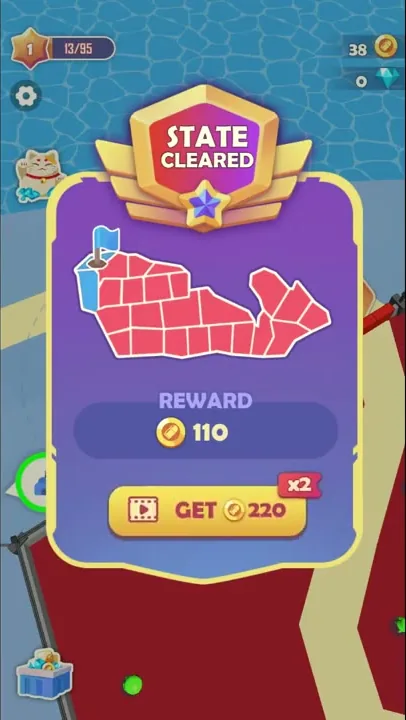
Below that reward is a yellow “GET 220” button with a film-strip play icon and a red “x2” tag. No ad appears anywhere in these sections, and that icon is the only sign of one. Once the panel is gone, 110 coins have been added to the total.
Coins pay for the priced pads: build pads cost 35 or 30, arrow pads 70. The coin total is kept in the upper right of the screen, and a blue gem counter just below it never moves off zero.
A lucky cat with blue gems sits on the left of the screen from the start. After the first flag it pops up large, with a “+300” gem bubble over its head. Under it is a gem bar running from 0 to 1800, and a red close button below that. The cat pops up again on a dimmed screen after the second flag.
A shop icon with a striped awning joins the left side early in the second section, and a blue box full of items sits at the bottom left throughout. Neither is opened.
At the top left, a star badge sits next to a counter that climbs toward 95 as zombies fall. When the badge turns from 1 to 2, the counter starts over with 200 as its target.
From the second section on, an icon of a helmeted soldier holding a green gun stays fixed at the right edge of the screen wherever the camera goes. It gets a red “!” at the moment the star badge changes. Later the screen dims while a white tutorial hand points at it. A red angry-zombie-face icon also turns up at the screen edge now and then.
Borrowed formulas that share one map
The blend makes sense: a lot is stitched together, and it still doesn’t get messy. Around the second section’s S-bends, the hero stands between a cyan tower and a twin-barrel turret as brown-headed zombies come down the path and a “+7” floats up, with a 70 pad beside each tower. Shooting, coin pickup, building and the wave all happen on one stretch of path.
This is a mashup with brains behind it. For any hybrid, the question is how well the source games’ tone, controls, craft and experience complement and resemble one another. Here the underlying formula picked for each part, from the shooting and the towers to the tiled map and the star badge around the fights, complements the others very well in temperament. As a hybrid built on ultra-simple pick-up-and-play, it is a fine piece of work.
A zombie hybrid in a week of big releases
The criticism is relative. Survival Defense Zombie World showed up in a week packed with big releases that had pushed our expectations very high, and next to them it made less of an impression.
A few systems never come into play across the three sections. None of the 70 arrow pads gets bought, and neither the shop nor the box of items is opened. No timer appears, and no defeat screen either, even though the hero wears a green health bar at times, so what losing looks like is unknown.
Hands on the hero, eyes on the pads
Nearly everything happens on foot. The hero fires at zombies inside its circle, stands on a pad until a tower rises, steps onto the skull pad at the gate to set off “WAVE 1” and walks into a flag’s ring to close the section. That sits close to arcade-style idle management, where standing on a spot does the work, and to hold-the-line defense, with towers set along one winding path.
Territory is the longer thread. Each flag turns a patch of enemy ground blue, and the “STATE CLEARED” panel lays the region out as tiles. That speaks to a taste for filling in a map piece by piece.
Verdict
Survival Defense Zombie World stitches a shooting hero and path towers onto walk-on building and a tiled map, and the result keeps its head, with borrowed formulas picked to suit one another. It is a fine hybrid. What keeps the impression modest is when it arrived: alongside heavier hitters that had already raised the bar.