Battle Factory Review: Archero Fights Feed a Walk-On Base
Shoot red cubes in walled sand arenas, then spend the coins on pads back at base: a Battle Factory review of a stripped-down Archero.
Game at a glance
Battle Factory
7.5/ 10
Our score
A by-the-book template for recasting a genre as walk-around management.
In this article6 sections
Set Battle Factory beside Archero, the archery roguelite, and the fights line up: one small hero shoots its way through a walled arena, stage after stage. While the shooting lasts, it sits squarely among games like Archero. Everything else moves to a grassy base laid out like idle tycoon games, the walk-around management where standing on a spot does the work.
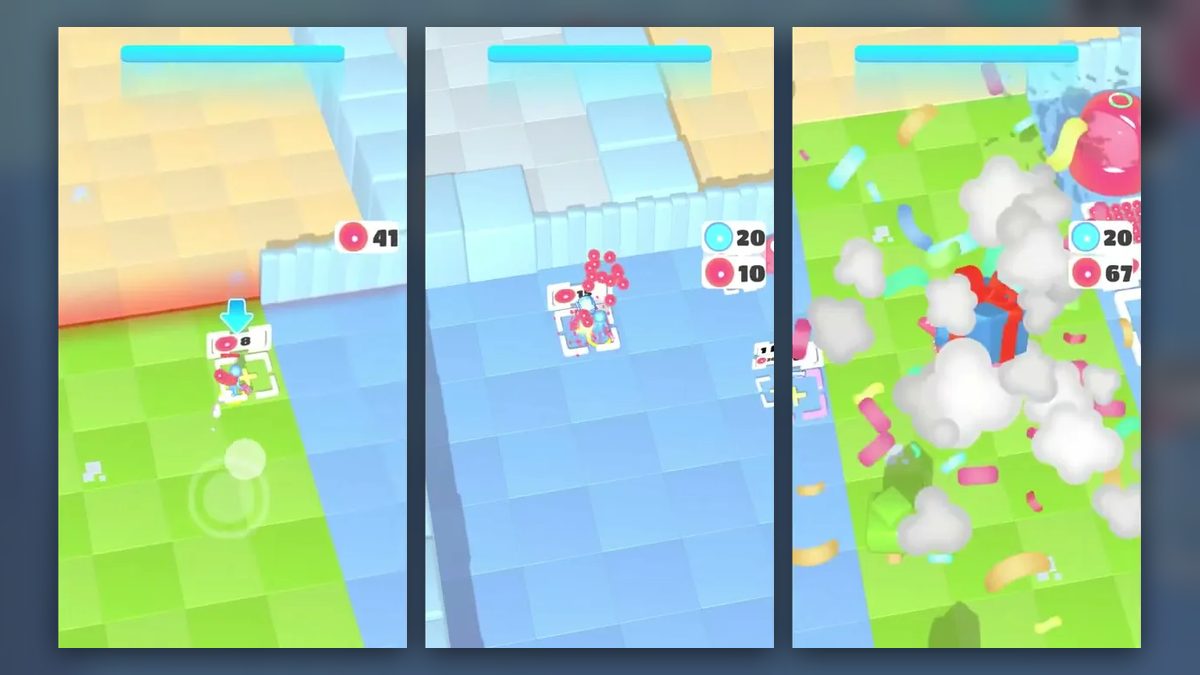
Back on the base, the hero walks onto a plus-marked pad and a stream of red coins flies into it; soon a building stands there. The drawing style is reworked too: a rubbery little hero, enemies made of plain geometric shapes, the look of ultra-simple pick-up-and-play games. We played the Training stage, Chapter 1 and the opening part of Chapter 2, with stops at the base in between.
Shooting red cubes inside the light-blue walls
Every battle is a stage with its name on a red banner at the top of the screen. Under the banner sit two white boxes marked 1 and 2, joined by a red bar. Partway through a stage, box 1 turns into a green checkmark, and after the second step the hero is back on the base, with no results or victory screen in between. At the base, the top of the screen shows only a plain cyan bar.
No move counter, timer or fail screen appeared, and the hero never lost a fight in the stages played. Walls of translucent light-blue blocks enclose the sand. A short red bar floats over the hero’s head through every battle; it was never seen getting shorter.
The controls take one finger. A drag calls up a translucent white joystick under the thumb, a ring with a knob, and the hero walks the way it is pushed. No fire button, or any other button, shows on screen, yet the hero fires, with a yellow flash at the muzzle of its pink gun. The camera looks down at an angle and follows the hero, keeping it near the middle of the portrait screen.
A blue arrow handles the teaching at the start. It hangs over a plus-marked pad at the edge of the grass, with a sign asking for 8 red coins, while the hero stands on that pad. Moments later a small pink round object with a white top stands on the spot, and the arrow points at the sand arena instead.
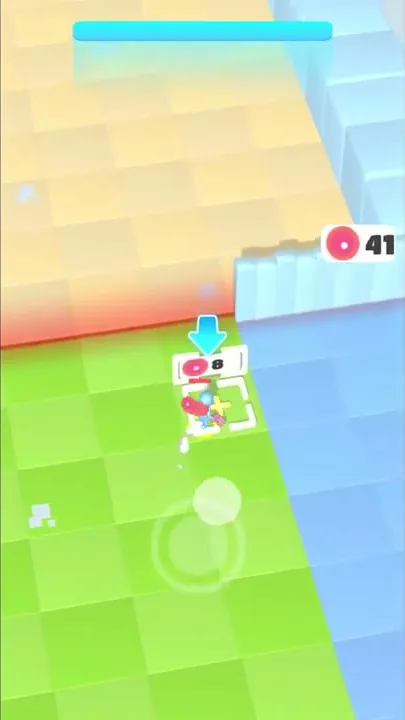
Each round of play runs in a loop. The hero leaves the green base for the beige sand arena just above it and fires at red cubes, which burst into flat splats in their own color and leave small red discs scattered around. The red-coin counter on the right edge climbs while a fight goes on. Back on the base, the hero stands on plus-marked pads to spend those coins on buildings and machines, then walks into the next stage.
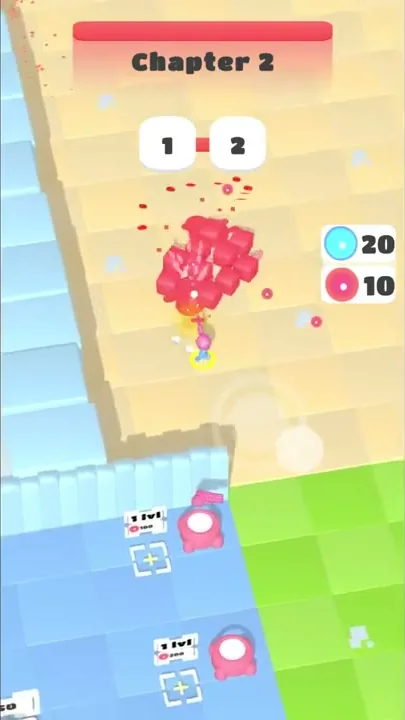
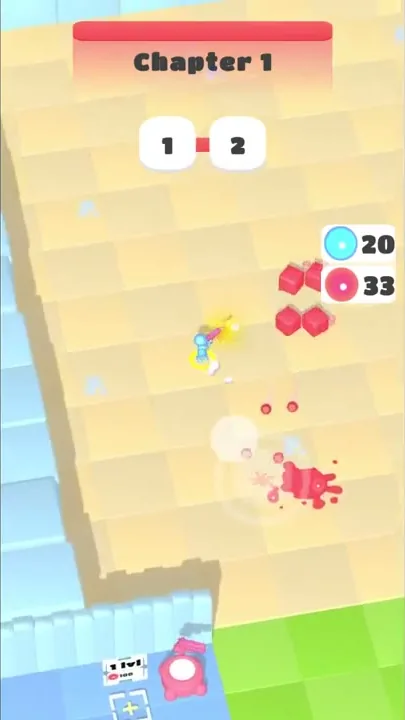
Red cubes are the enemy in every stage. They stand on the sand in groups, and a group that gets hit breaks into a red splat with cube fragments, small red discs spraying out around it. In Training and Chapter 1 they come in pairs; in Chapter 2 they gather in big clumps.
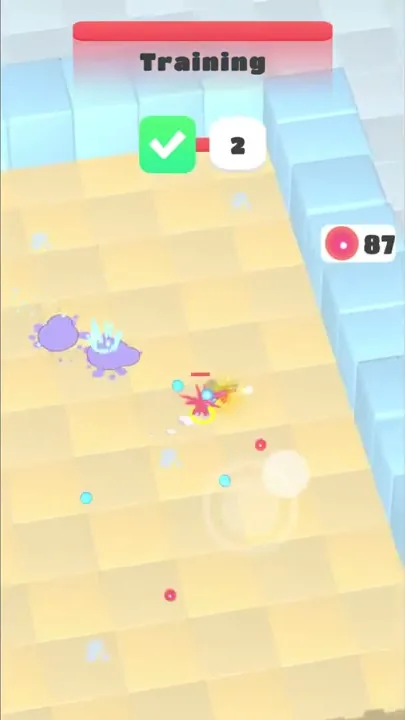
Purple blobs show up only in Training’s second step. They are rounded purple shapes on the sand, and one of them wears cyan crystal spikes on top. Earlier in that step a flat purple splat lies beside two small cyan discs, and once the pair of blobs appears, cyan and red discs lie close by while the hero fires.
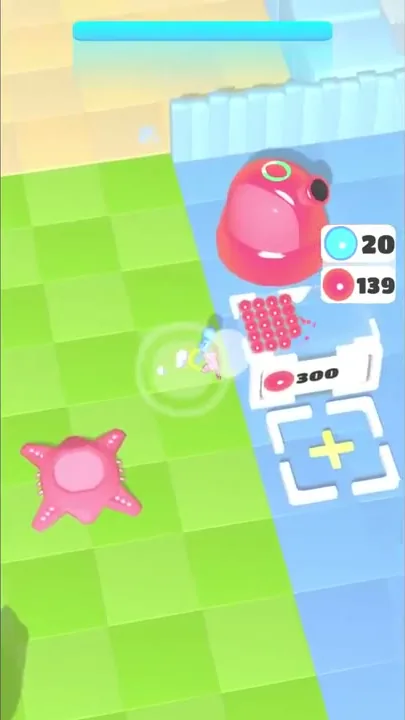
The base also holds a flat pink star with a raised octagonal center, lying on the grass from the first stop after Training onward. The hero stands on its center at one point. In the view just before the star appears, a tall pink figure wrapped in cyan lightning stands on the grass beside the hero.
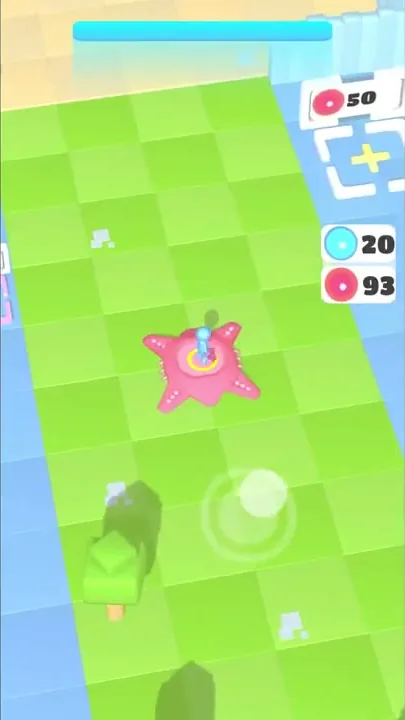
Bigger cube swarms and a base full of pads
Every stage keeps the same setup. The first battle, labeled Training, sits directly above the base’s grass. A gap in a wall of light-blue blocks leads in, and an orange-red glow runs along the grass edge. Its banner already carries the two-box tracker that every later stage keeps.
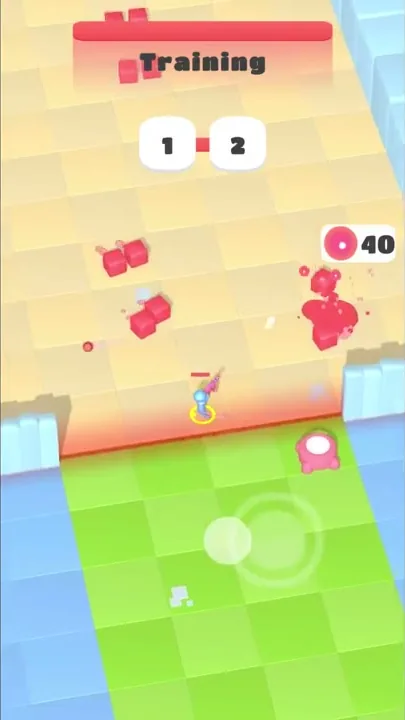
The chapters that follow reuse that setup under new names on the banner, Chapter 1 and then Chapter 2, each again in two steps. A chapter opens with the hero just inside the sand and both tracker boxes still white, and at the start of Chapter 1 a large black 2 sits on the grass behind the hero.
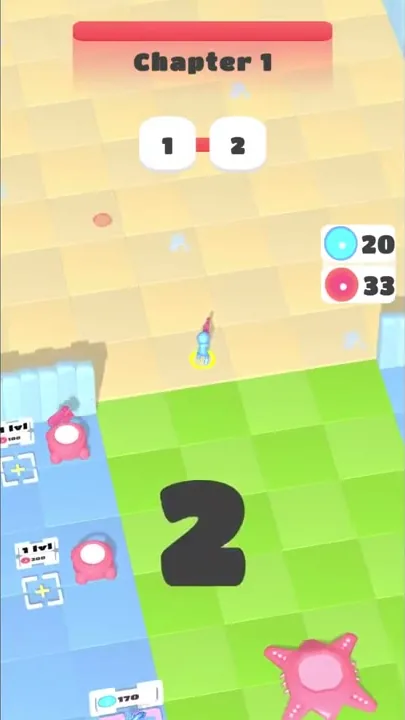
Nothing but red cubes fills Chapter 1, set out in pairs across the sand. Partway through, box 1 on the tracker turns into a green checkmark, and a large black 2 is printed on the floor once more. Two more pairs then stand ahead for step 2, and after that the view is back on the base.
Enemy variety narrows after the opening stage. Purple blobs turn up only in Training’s second step; after that every enemy is a red cube. What grows is the size of each group: pairs in the first two stages, then dense clumps in Chapter 2, several spread across the sand at once and one already bursting beside the hero early in the stage. Chapter 2 also runs longer than the two stages before it.
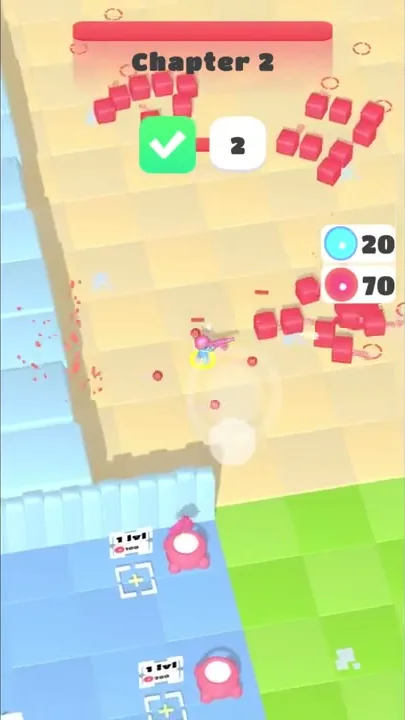
The base’s main currency is red coins. Their counter, a red disc icon beside a number, sits on the right edge of the screen at all times. Small red discs matching that icon lie on the sand after each burst, and the counter climbs during fights and drops at the pads.
A second counter, with a cyan disc icon, joins it after Training, right after the step in which small cyan discs lay on the sand. Its number never changes through the later stages, and a gun pad on the base is priced in it.
That gun pad has a pink border. A blue gun model rests on it under a sign showing the cyan icon and 170, far more than the cyan counter ever holds, and it is never bought.
Next to the arena wall, two pink round machines with white tops stand in a row on the base’s blue strip, with pink gun-shaped parts on or beside them. Each has a sign reading “1 lvl” over a small red-coin price, with a plus-marked pad in front, and both signs read “1 lvl” every time they come into view.
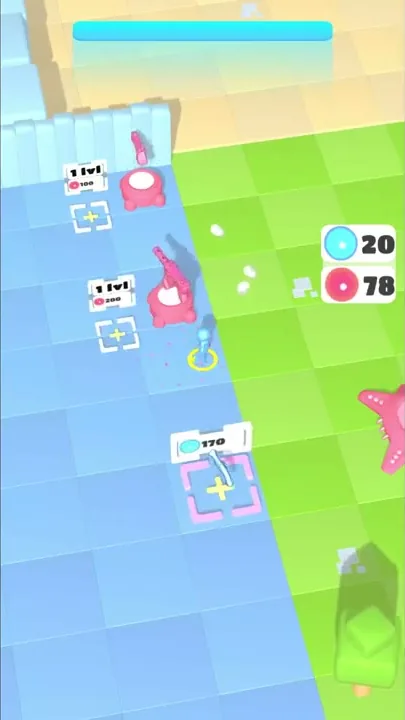
New buildings come from pads: square outlines with a yellow plus, each under a white sign showing a price. Standing on one sends a stream of red discs from the hero into it. A pad signed 50 near the arena wall gives way to a large pink dome. At another pad, which holds a small blue figure and a partly hidden sign, most of the hero’s coins go in at a single stop.
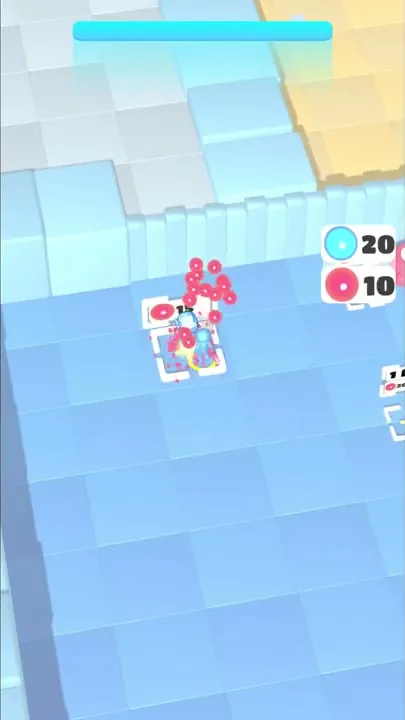
The dome is glossy pink, with a ring on top and a dark spot on its side. In front of it sits a white tray with a sign showing the red-coin icon and 300, and a plus-marked pad below. Red discs spray around the tray during one stop at the base, and shortly afterward it holds a neat block of them. When it comes into view during Chapter 2, it holds a neat block of discs.
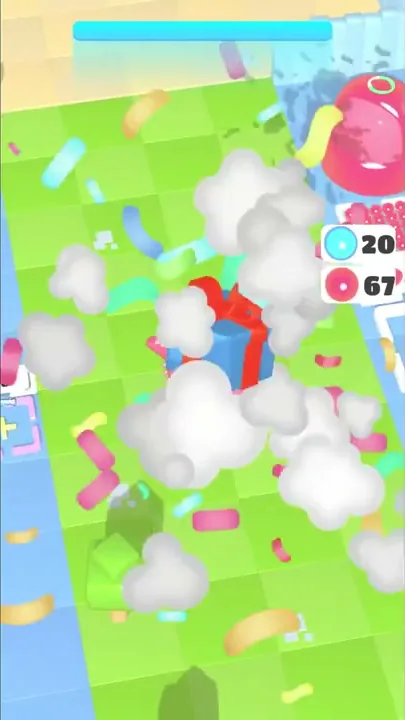
The first view of the base after Chapter 1 has one more arrival: a blue gift box with a red ribbon, appearing on the grass near the dome in a burst of gray smoke and colored confetti. We never saw it opened.
Archero’s upgrades rebuilt as buildings you walk to
We liked how Battle Factory takes the systems that sit outside Archero’s fights and spreads them across a walk-around map, where each upgrade belongs to a building the hero walks up to. The base makes this concrete: the pink dome with its coin tray, the two “1 lvl” machines and the cyan-priced gun pad each stand on the map with a sign and a pad of their own. Paying means standing on that pad.
The fights keep Archero’s in-stage play. A lone hero works through a walled sand arena stage by stage, shooting red cubes and purple blobs under a banner that names each stage.
The drawing style changes the rest. The hero is a tiny light-blue figure with a pink gun and a yellow ring at its feet. Enemies are plain cubes and blobs that leave paint-like splats, and the world is made of blocks, from the checkered grass to the cube-shaped trees and the translucent light-blue walls.
Put together, these changes follow a very standard, by-the-book pattern for recasting a game’s play in the walk-around mold. They also show one way to take apart and rebuild a game whose core play is strong when the right look for it is hard to settle.
What the “1 lvl” machines never revealed
We had no complaints about Battle Factory; the limits below are only what the three stages left unshown. In those stages, the buildings and machines on the base showed no upgrade effect in a fight, and the two machines carried “1 lvl” signs from start to finish. The arena had a lone hero shooting through stages, and no Archero-style ability picks or room choices appeared in them. Each of the three had two steps, and the hero never lost one.
Drag-to-move fights and pad-to-pad base walks
The arena half is drag and steer: one thumb moves the hero toward pairs or clumps of red cubes, and they burst into splats and coins while the two-box tracker shows which step is under way. Between stages the job turns into a walk from pad to pad, standing still while coins pour in and then finding a pink dome or a small pink machine where the pad was. Those two halves suit a taste for short, simple arena clears that feed straight into a base growing one building at a time.
Verdict
Battle Factory leaves Archero’s fighting as it found it and gives that game’s upgrade side a physical home in buildings on a map, all drawn in the plainest shapes. That makes it a textbook case of turning one kind of game into another, and a model for reworking a strong core when its look is still in question.