Age Builder China Review: Ancient China, Built With Care
Xiangyang starts as an empty river valley, and this Age Builder China review follows the first five tutorial goals and every building card they bring.
Game at a glance
Age Builder China
7/ 10
Our score
An ancient-China SimCity whose setting catches the eye; play and fun have room to grow.
In this article6 sections
Age Builder China is a city builder with an ancient Chinese setting that catches the eye and is handled with care and seriousness. The play itself still has room to become more fun.
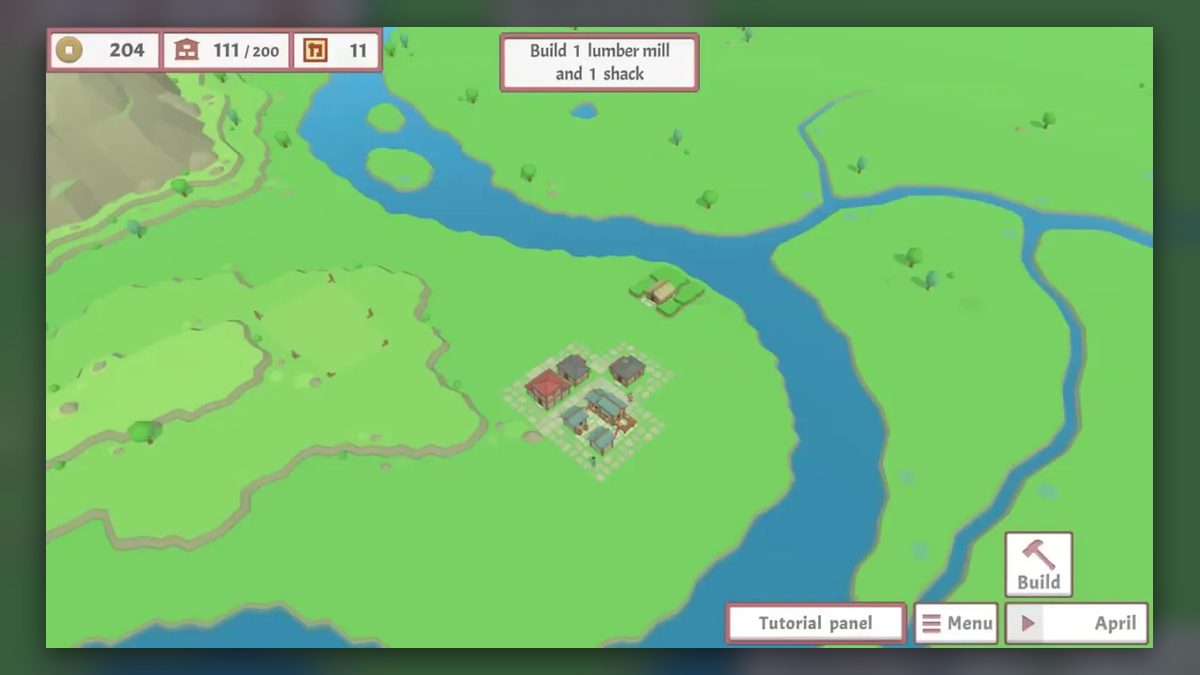
Underneath is a mobile city-building management sim, related to idle tycoon games and played in landscape. The map is a low-poly river valley that the tutorial calls Xiangyang. Every market, home and workplace costs coins and usually wood or stone, then takes in-game months to go up. The tutorial’s goals stand in for its first levels, and we played four of them plus part of the fifth.
Placing buildings on the Xiangyang valley
A banner at the top of the screen names the current goal, starting with “Build 1 market.” There are no numbered levels and no win screen. Building what the banner asks for clears it, and the next goal takes its place. No game-over screen shows up, and nothing runs against a move limit or a countdown. The limits on screen are prices, build times, a worker for each workplace and, for the farm, fertile land.
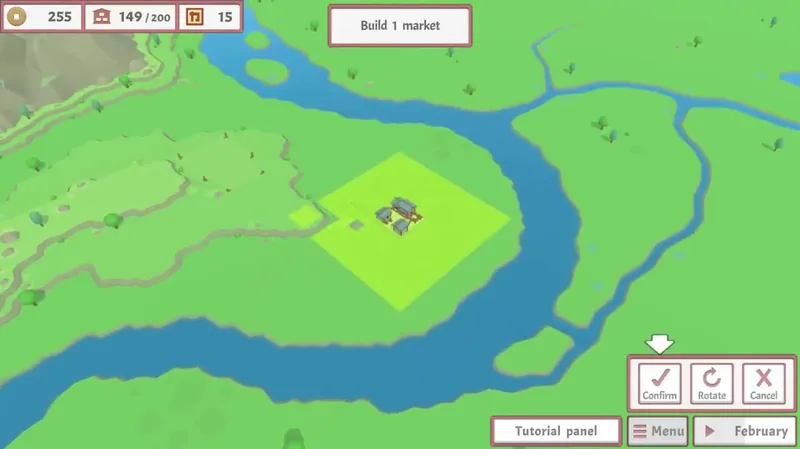
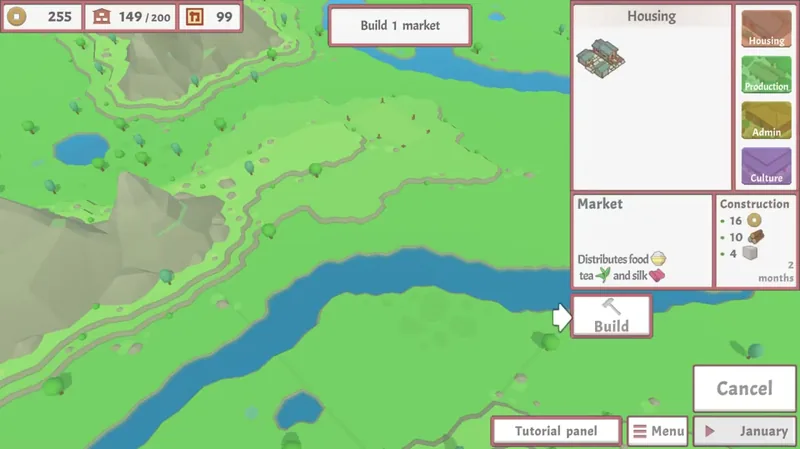
Play runs on taps. The hammer-shaped Build button in the lower right opens a white side panel with maroon-pink borders and four tabs (Housing in rust, Production in green, Admin in gold, Culture in purple); the first three each hold the icons of their buildings. Tapping an icon shows that building’s card, with its effects on one side and its cost and build time on the other. Pressing Build drops a preview onto the map inside a lime-green square, and three buttons in the corner confirm, rotate or cancel it. During the tutorial, a large white arrow points at the next button to press.
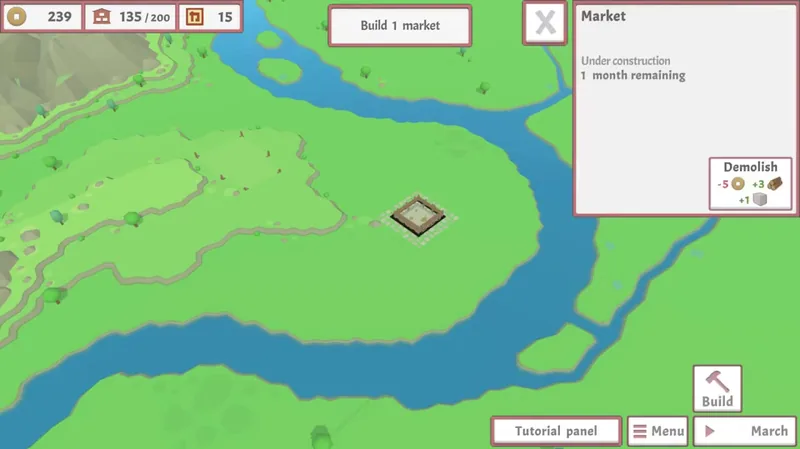
Tapping a building already on the map opens an info panel with a Demolish button, and an X closes it. The current month sits in the lower right beside a small play triangle and moves forward on its own. While a tutorial card is open, the triangle becomes a pause sign and “Game paused…” appears nearby. The view also pans across the valley and later shifts to a different valley altogether.
Moment to moment, Age Builder China gameplay is a loop steered by the banner: pick a card, confirm a spot, then wait while the building stands as a fenced plot for a month or more. Homes supply workers who eat food and need jobs, and each of the three workplaces seen needs 1 worker. Each finished goal leads to a tutorial card or straight to the next goal.
An empty valley and a single icon in the Housing tab make up the first goal. The market’s card asks for 16 coins plus 10 wood and 4 stone, with 2 months to build. Once confirmed in February inside a bend of the river, it appears as a fenced dirt plot. In March, tapping the plot shows “Under construction” and “1 month remaining.” Its Demolish button would cost 5 coins and hand back 3 wood and 1 stone.
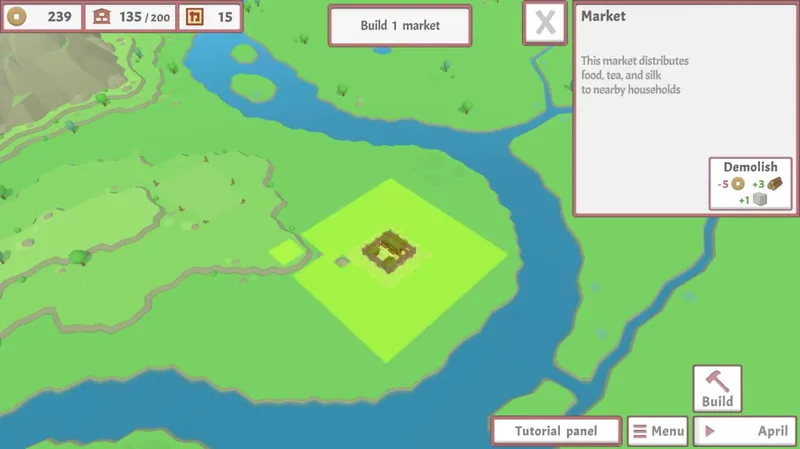
By April the market is finished: a small compound of gray-blue roofs with a lime-green square drawn on the ground around it. Its panel now reads “This market distributes food, tea, and silk to nearby households.” Every later building passes through the same fenced stage, which lasts 2 months for the shack and 3 for each of the three workplaces that follow.
The shack is the basic home, and the second goal is “Build 2 shacks.” Its card gives “+1 worker” and “+1” coin every 12 months, and the shack “Consumes 1” food. A “-2” also sits beside the orange square icon of a counter at the top of the screen. It costs 5 coins and 4 wood and takes 2 months, and once built it is a small house with a gray roof.
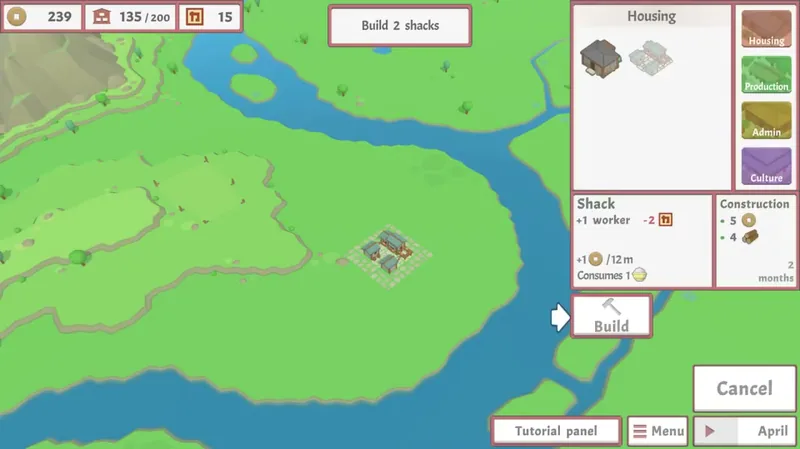
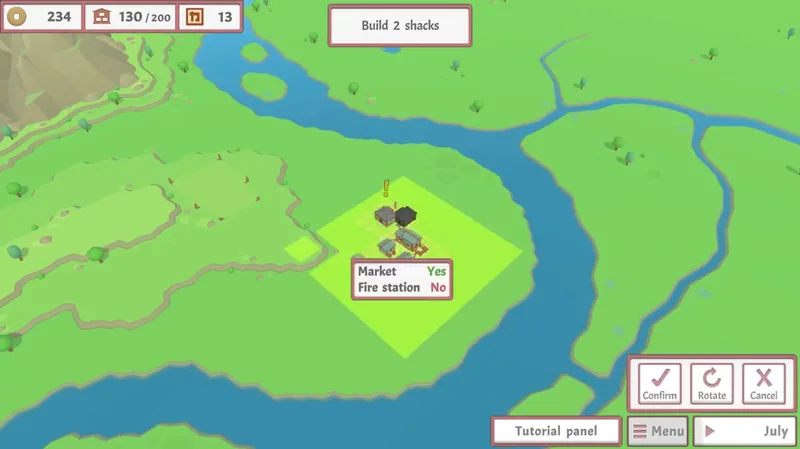
Placing a home comes with a check. While a shack is being positioned, a tooltip under the preview lists “Market” and “Fire station,” each followed by Yes or No. Beside the market, the second shack read “Market Yes” and “Fire station No,” with a lime-green square drawn around the town. A preview set much later on an open plateau away from the town read No for both, while cyan and lime areas covered the town.
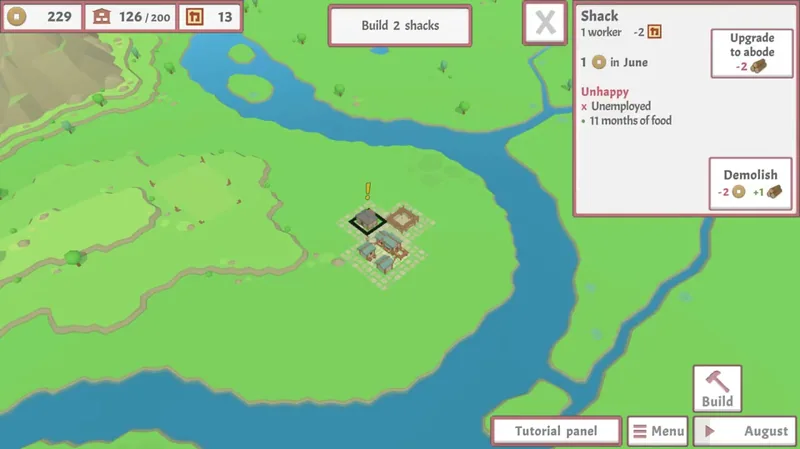
Tapping a finished shack outlines it in black and opens a panel that repeats the worker and the “-2” and shows “1” coin “in June.” Below that comes a status: “Unhappy” in red, with “Unemployed” marked by a cross and “11 months of food” by a dot. On the right sit “Upgrade to abode,” priced at 2 wood, and “Demolish,” which costs 2 coins and returns 1 wood. Yellow exclamation marks come and go over the shacks throughout the tutorial.
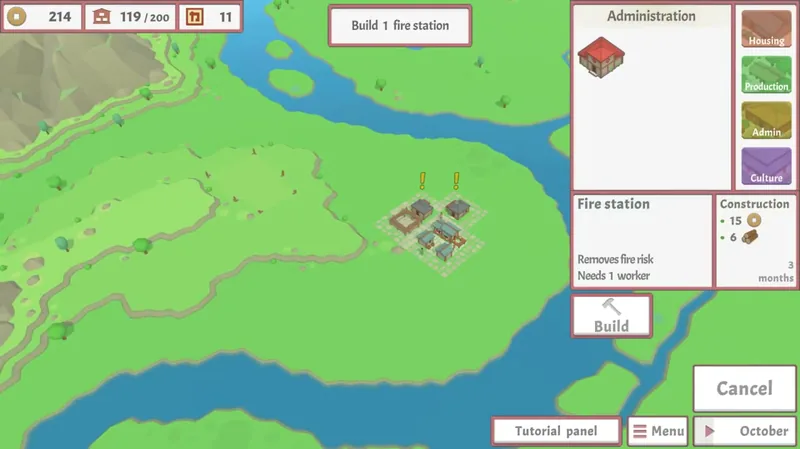
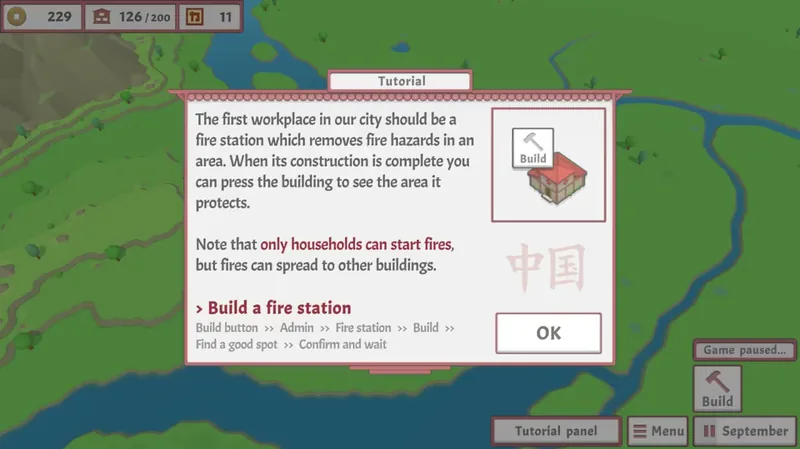
The fire station is the first workplace and, for now, the only building in the Admin tab, under the heading “Administration.” Its card reads “Removes fire risk” and “Needs 1 worker,” for 15 coins and 6 wood over 3 months. The tutorial explains that it clears fire hazards in an area and that pressing the finished station shows the area it protects. Once finished, it is a red-roofed building beside the shacks, and no fire appears during these goals.
Food comes from the farm, the first building in the Production tab. Its card lists “+6” food every 12 months and “Needs 1 worker,” for 10 coins and 8 wood over 3 months. The tutorial notes that farms can only be built on fertile land. While the farm is being placed, dark green patches appear near the town and a lime-green square marks the chosen spot by the river. Once finished, it becomes squares of green field around a straw-roofed hut.
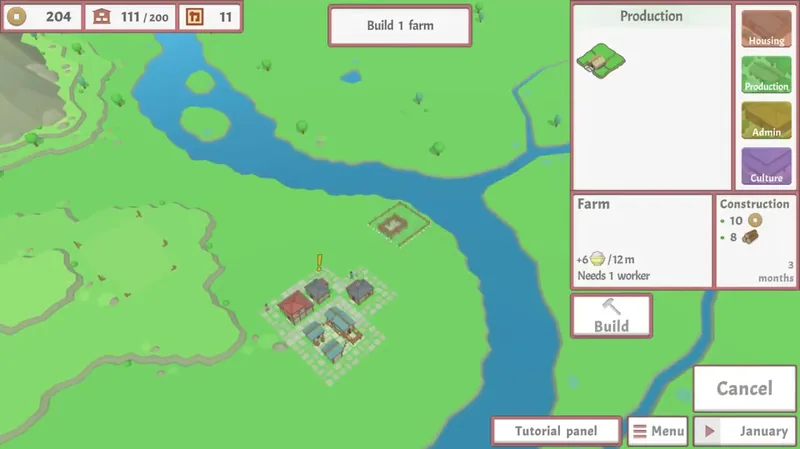
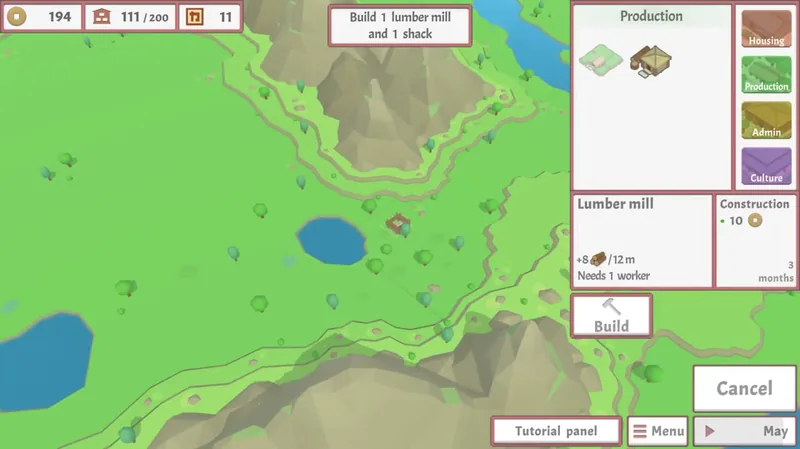
The lumber mill is the second Production building and the only one of the five that asks for no wood. For 10 coins and 3 months it yields “+8” wood every 12 months, and like the other workplaces it needs 1 worker. It goes away from the town, into a wooded valley where a lake sits between two mountains.
Tutorial goals that lead out of town
The valley starts with nothing built on it. It has green plains at several heights, a winding blue river with small islands and ponds, and faceted gray-brown mountains ringed by terraced ledges, all dotted with small round trees. The first two goals stay inside the Housing tab, with the market and then the pair of shacks clustered in a bend of the river.
New systems arrive on tutorial cards that pause the game. One, in September, presents the fire station as the city’s first workplace and warns that only households can start fires, though fires can spread to other buildings. It also spells out the path to build one, from the Build button through Admin to “Confirm and wait,” and the goal becomes “Build 1 fire station.”
A second card follows in December. It opens with “Great job!” and says the other citizen can now be put to work, then turns to food. Xiangyang has rich soils, so a farm is the next goal, and the Production tab comes into play. Once the farm is finished, the banner asks to “Build 1 lumber mill and 1 shack,” the first goal that names two different buildings.
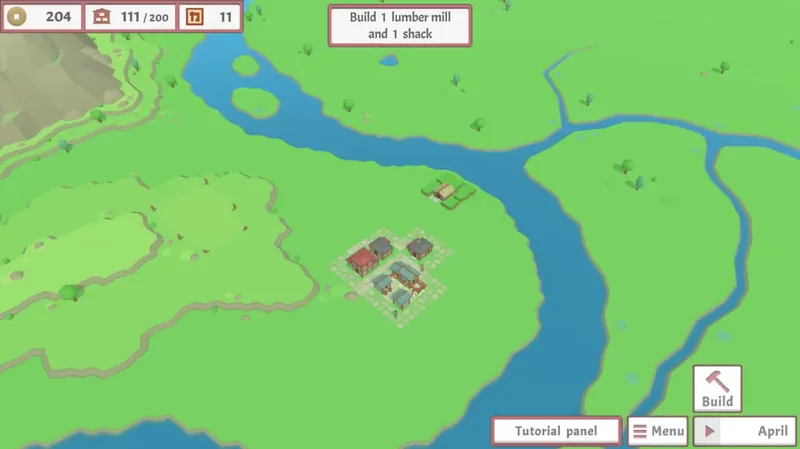
The town also stops being a single cluster. Everything up to the fire station shares a paved patch in the river bend. The farm goes in up and to the right of it along the water, and the lumber mill lands in a separate valley. The closing shack goes right beside the town. The fifth goal is still open once the calendar, which began in January, reaches July of the following year.
Parts of the build panel stay out of play in these goals. The Culture tab is never opened, and no shack is upgraded to an abode.
Coins sit in the top-left counter, marked by a round coin with a square hole. Every card’s price starts with coins, and the counter drops by exactly that price once a building goes down; demolishing costs coins too. Among the five cards, only the shack lists coin income, and late in the tutorial a bubble with “1” and a coin icon floats over the town. The coin counter itself only went down across these goals.
Wood, drawn as a log, and stone, drawn as a gray block, fill out most prices. The market takes both and the lumber mill takes neither, while every other building takes wood alone. Demolish buttons hand part of it back. When the market card came up again the following June, its stone line carried a red × where the other lines had green dots.
Two more counters sit beside the coins. One, with a building icon, shows a value out of 200; it is never named and fell as the town went up. The other has the square orange icon that appears next to the shack’s “-2.”
Food and workers link the buildings. A shack eats 1 food and gives one worker, and the farm grows 6 food every 12 months. Each workplace takes a worker, and a shack without a job reads “Unemployed.” Tea and silk appear only as goods the market distributes, and no building that makes either turns up.
No shop, ad offer, premium currency, lives or energy appears during these goals. Besides the build controls, the only buttons on screen are Tutorial panel and Menu, and neither is opened.
An ancient Chinese city taken seriously
The dressing catches the eye at once. Age Builder China is the first reasonably complete and serious mobile city builder about ancient Chinese architecture that we have come across, and that serious handling of the theme comes across as careful and impressive.
On screen, the setting shows in a few places. The tutorial names the city Xiangyang and credits its rich soils for the farm, and the market deals in tea and silk as well as food. Tutorial cards carry a scalloped top edge and a faded red watermark of Chinese characters. The small building models range from the market’s compound of gray-blue roofs to the red-roofed fire station and the straw-roofed farm hut.
It also has the air of an ancient-China SimCity. The studio behind it has made the same game in new clothes twice more, with versions set in ancient Greece and ancient Egypt. This one wears China.
Building the town could be more fun
How Age Builder China plays and how much fun it offers could both go further.
The five goals played did not show every part of the game. In them the Culture tab never opens, no shack is upgraded to an abode and no fire appears.
Laying out a riverside town month by month
Part of the play is reading. Each card spells out what a building produces and what it costs, and each finished house reports its job and its food. The rest is placement: choosing where on the valley each building goes, with a Yes or No for market and fire station under each new home.
Those habits fit a taste for planning a town on paper rather than quick reactions. No timer or move limit appears, and every order turns into a fenced plot that becomes a building only months later on the running calendar. The town grows one goal at a time as a Chinese river town named Xiangyang, with tea and silk among the goods its market hands out.
Verdict
Age Builder China is a decent game, and its theme is what shines. We had not met ancient Chinese architecture treated this seriously in a mobile city builder before, and it feels like an ancient-China SimCity. Its play and its fun both still have room to improve.