Ball Merge Attack Review: Pinball Luck Powers a Sword Fight
A blue ball lands in a yellow sword bin and the hero's sword flies: a Ball Merge Attack review of merging pillars, coins and three monster areas.
Game at a glance
Ball Merge Attack
6/ 10
Our score
Use pinball as the combat engine and there's a lot left to combine it with.
In this article6 sections
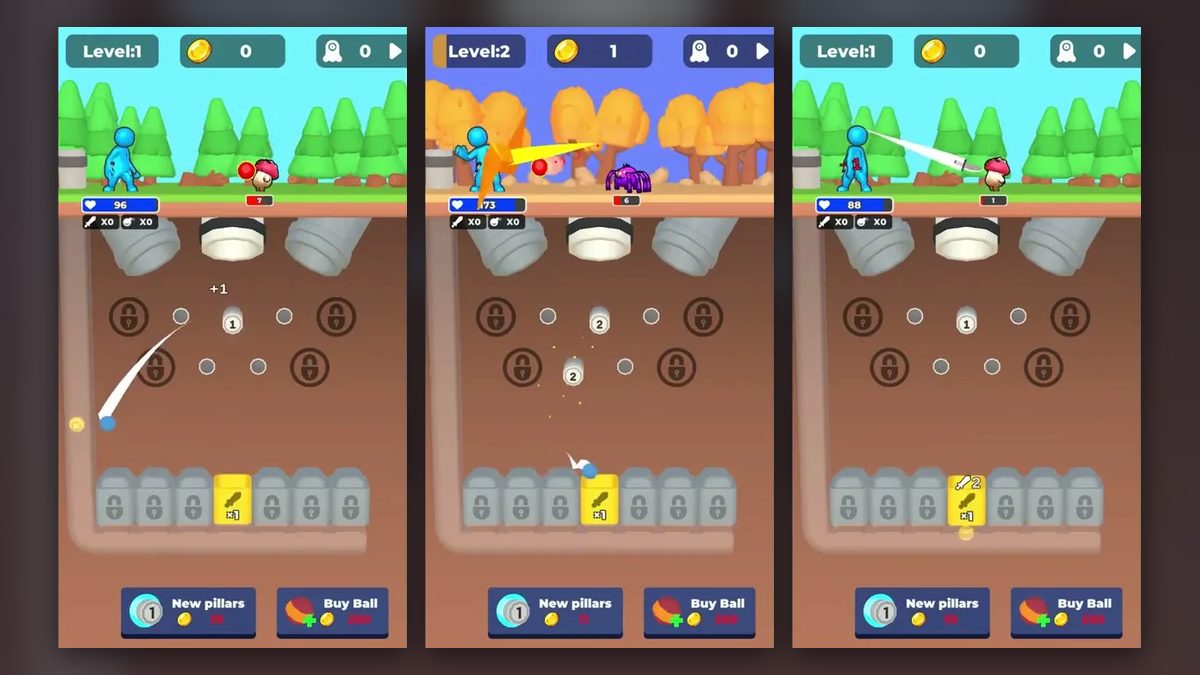
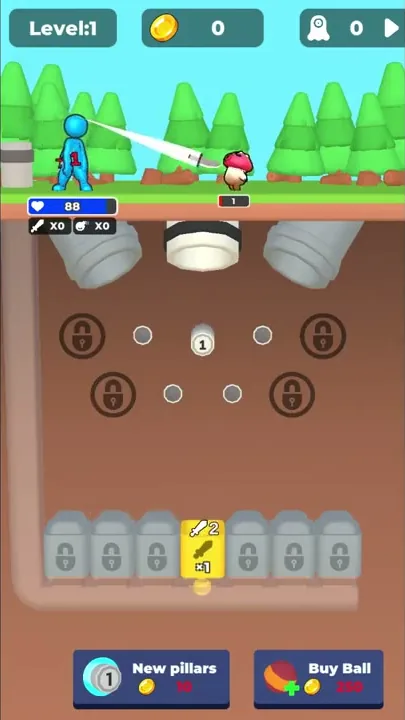
Watch a blue ball bounce down a board of gray pegs and numbered pillars: every time it lands in the yellow sword bin, the blue hero in the strip above throws a sword at the monster in front. Ball Merge Attack is a mobile ball bounce game built as a pinball RPG, with a side-on monster fight across the top quarter of a portrait screen and a brown pinball board filling the rest.
Coins from fallen monsters pay for new pillars, and pillars with the same number merge into higher ones. We played Levels 1–3 across three battle areas, stopping partway through a fight. Its highlight is the attempt to tie a pinball board’s randomness to deeper systems.
Numbered Pillars Above a Yellow Sword Bin
The ball comes out of a white launcher at the top center of the board and leaves a white streak as it falls, glancing off pegs and pillars until it drops into the row of bins at the bottom. Meanwhile, the monsters in the strip above fire red balls at the hero, and the number on the hero’s blue HP bar keeps going down. The rest of the Ball Merge Attack gameplay is built around that drop.
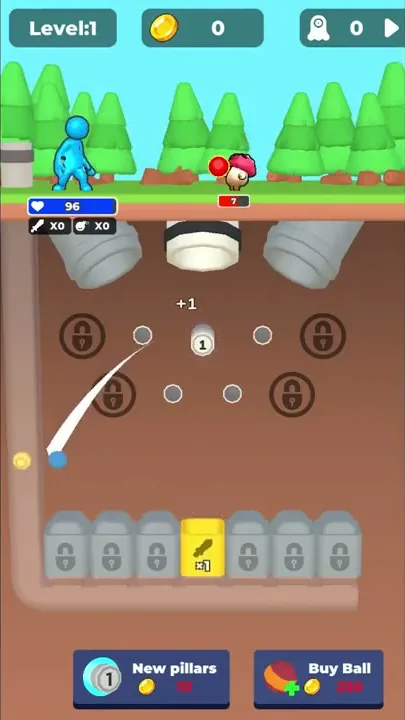
There is no goal card and no screen that announces a finished level. Monsters are fought one at a time: the one at the front of the line takes the hits until its red HP box reaches 0, and once an area is empty the hero walks right into the next one. The Level box in the top-left corner ticks up in the middle of the fighting, with no screen of its own.
No finger or tap marker shows at any point, and the ball keeps coming out of the launcher with nothing visibly pressed. The buttons at the bottom of the screen are New pillars and Buy Ball; a white arrow also sits in the top-right box. Pillars do change spots: the two 1s standing in the top row as Level 2 begins are in the bottom row moments later, and no gesture that moves them appears.
Pillars are white cylinders with a number on top. Whenever the ball bounces off one, a “+N” with the same number floats up from it, so a pillar labeled 3 sends up “+3”.
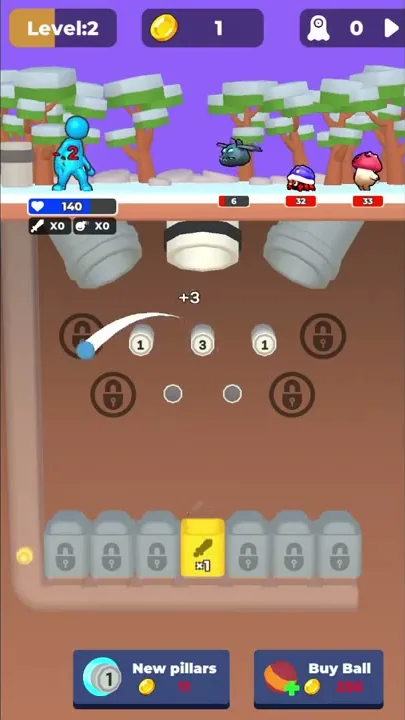
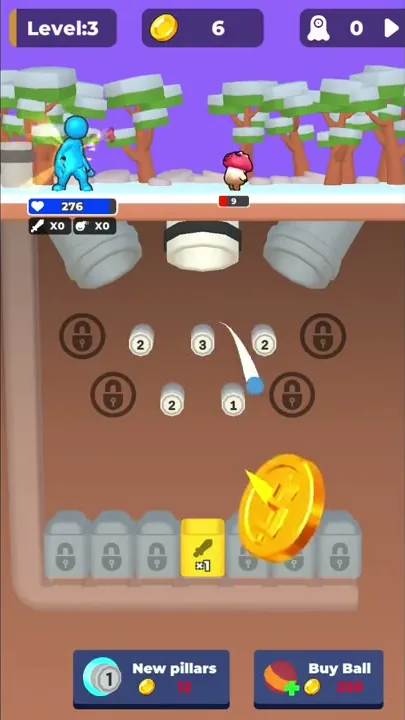
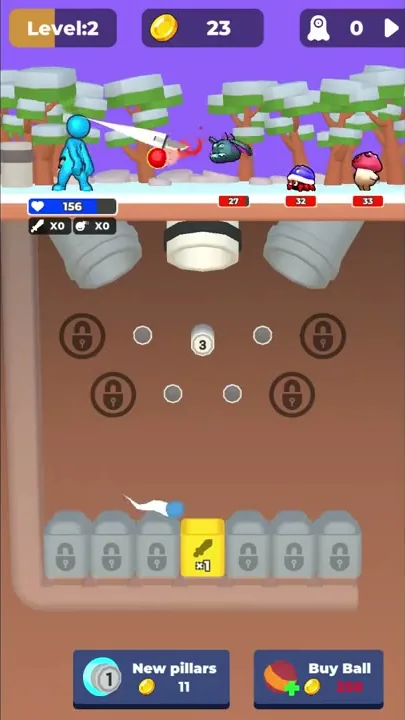
In Level 2, pillars with matching numbers twice give way to a single pillar with the next number up: the two 1s in the bottom row turn into a second 2, and shortly after, the two 2s are replaced by one 3. On two occasions a pillar labeled 1 shows up with a second, smaller 1 overlapping it, and later in Level 3 the board reads 2, 3, 2 across the top and 2, 1 below.
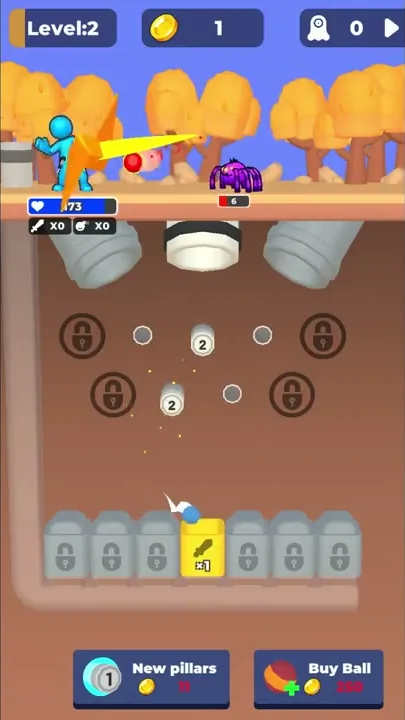
The pillars stand on two staggered rows of spots, five in the top row and four below. The end spot on each side of both rows carries a padlock, leaving five open spots that each hold a small gray peg while empty. Once all five open spots held pillars, the words “No More Space!” showed up under the bins as Level 3 began. The board had already been full for a while without them.
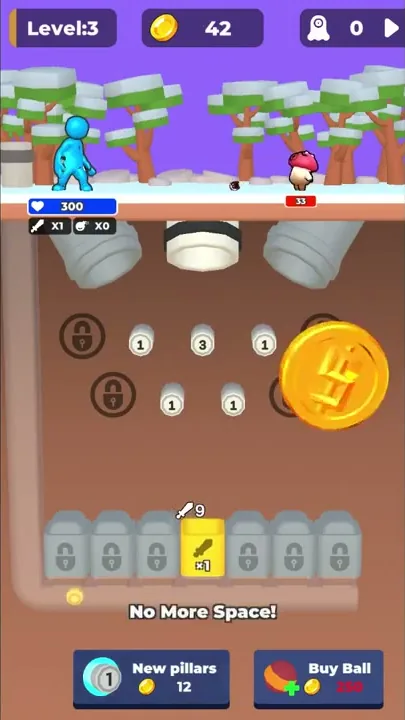
Seven bins line the bottom of the board. Six are gray and padlocked; the center one is yellow, marked with a sword icon and “x1”. After the ball drops into it, a sword icon with a number pops up above the bin and a sword flies from the hero at the front monster. A beige tube runs under the bins and up the left edge of the board, with a small glowing yellow dot traveling along it.
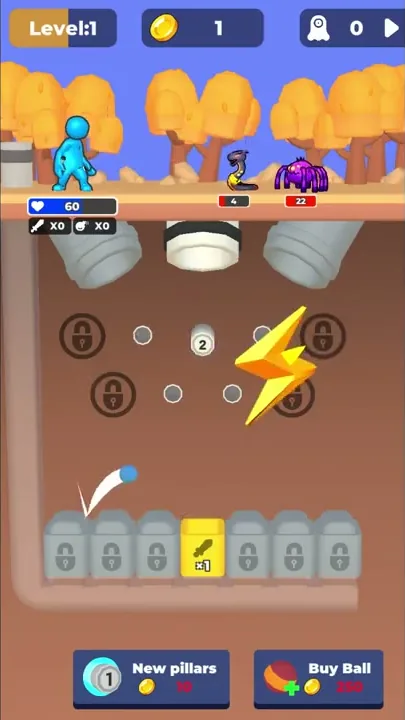
A large yellow lightning bolt sweeps across the board late in Level 1 and early in Level 2. On one pass, a bolt comes down on the spider in the battle strip.
Level 3 has a visitor of its own: a big spinning gold coin with a dollar-sign-like symbol that drifts over the pillars and the bins the whole time. Nothing on screen shows what it does.
Monsters stand in a line on the right side of the battle strip, each with a red HP box underneath. Only the front one loses HP, and when it falls the others step forward. They fight back by firing red balls at the hero, and red damage numbers pop up beside the hero and the monsters.
The purple spider, at 22 HP, is the only monster left in the autumn grove when the Level box turns to 2, and the hero’s HP now reads 200. The lightning bolt hits it, and by the time the spider goes down with a “+22” coin popup, the pillars have paired off into a single 3 in the top row.
In the snowy wood that follows, three monsters wait in line: a dark gray flier with 27 HP, a red creature in a white-and-blue striped cap with 32, and a pink-capped mushroom with 33. A new pillar labeled 1 is bought partway through the fight, and once the flier falls the other two step forward. By the end of Level 2 all five open spots hold pillars, and Level 3 opens with “No More Space!” under the bins.
From Pine Forest to Snowy Wood
Each cleared area sends the hero walking right while the camera pans into the next low-poly scene, and every new scene holds more monsters with more HP. The green pine forest under a pale blue sky has a single pink-capped mushroom, whose HP box reads 9 when play is first seen. The orange autumn grove under a blue-violet sky brings a dark snake with 19 and the purple spider with 22, and the snowy wood under a purple sky lines up three monsters whose HP runs from 27 to 33.
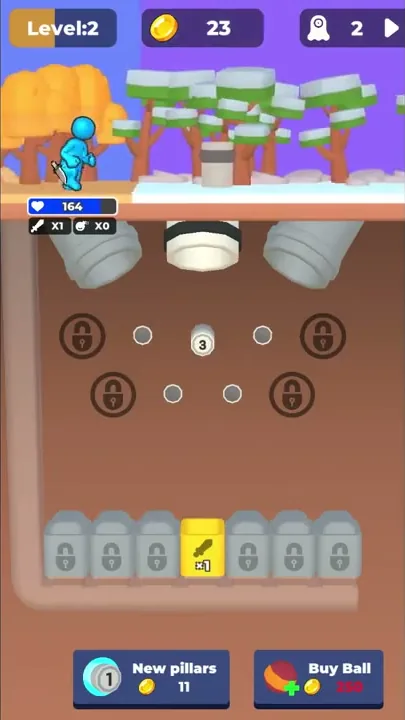
Level-ups happen mid-fight. An orange fill grows from the left side of the Level box as monsters fall and shrinks back to a thin sliver each time the number goes up. The hero’s HP reading jumps at the same moments, from 56 to 200 as Level 2 arrives and from 105 to 300 for Level 3.
The board grows over the same stretch. Early in Level 1 a lone pillar stands in the top row, changing from a 1 to a 2 partway through. Between the end of Level 1 and the start of Level 2, two more pillars labeled 1 appear beside it while the coin count stays the same. By the time Level 3 starts all five open spots are taken, and most of the 1s then give way to 2s.
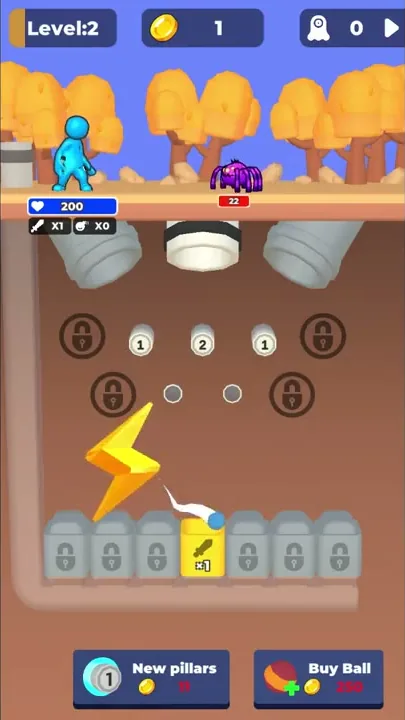
Coins come from defeated monsters. A counter at the top center keeps the total and jumps when an enemy falls. The spider, for one, went down with a “+22” coin popup rising over it.
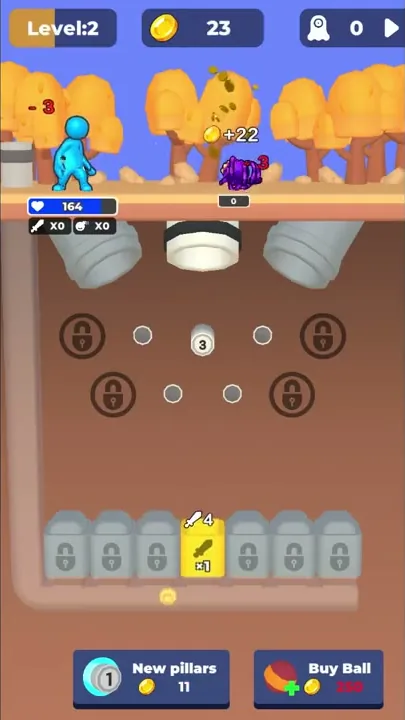
They are spent through the New pillars button at the bottom left, which shows a pillar labeled 1 and a coin price. The price is printed in white when the coins cover it and in red when they don’t. It reads 11 when the spider falls and 12 by the start of Level 3. A purchase adds a pillar labeled 1 to the board, and in Level 3 the coin count keeps falling while the board fills with 2s.
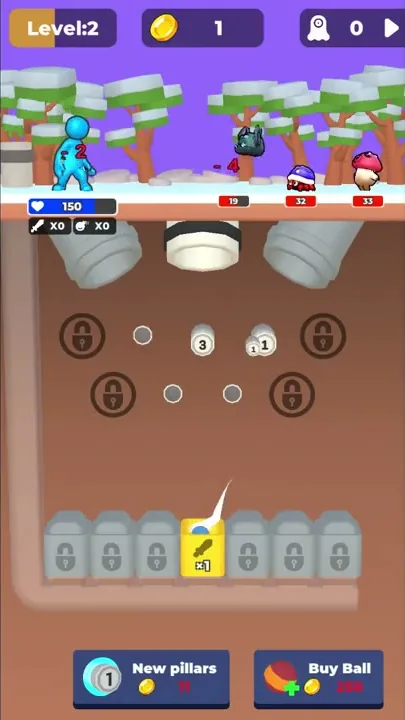
Beside it, the Buy Ball button shows a ball with a green plus and a coin price printed in red every time. It goes unused, and no more than one ball is ever seen on the board.
Under the hero’s HP bar sit a sword counter and a bomb counter. The sword counter switches between X1 and X0, while the bomb counter stays at X0 throughout.
The top-right box holds a ghost icon with a number, next to a white arrow button. The number sits at 0 most of the time and rises to 1, and later 2, only while the hero walks into a new area; the arrow is never seen pressed.
No ads or offers appeared at any point, and no shop screen or daily reward showed up either; no pop-up window covered the single battle-and-board screen, which stayed in view throughout.
Pinball Randomness Wired to a Hero’s Sword
We liked the attempt to fuse pinball’s randomness with deeper gameplay. Where the ball lands decides when the hero’s sword flies. Around that chance the game builds coin-bought pillars and merges that turn two 2s into a 3, plus hero levels that lift the HP reading.
A pinball board is a random generator that comes with its own visual show, and Ball Merge Attack uses it as its combat mechanic. It pairs the ball’s drops with sword throws in the fight above and with coin-bought, merging pillars on the board below. Used this way, the board leaves a lot of room: many more fight effects and growth systems could be fused onto it and tried.
Padlocked Bins and Bombs That Never Appear
We have no specific criticism of Ball Merge Attack. Some parts simply never came into play: the hero’s HP never reached 0 and no fail or revive screen appeared, while the four locked spots and six padlocked bins stayed shut. We can’t say how they open or what the locked bins would do.
Bombs never turned up, and Buy Ball stayed unpressed. Neither the big gold coin nor the ghost counter showed what it is for. No gesture for moving pillars appears on screen, and there is no sign yet of how hard later levels get.
Watching a Ball Pick the Next Attack
These mechanics fit a taste for watching a ball find its path through pegs and pillars and seeing each landing play out in the fight above, where a drop into the yellow bin becomes a sword throw. The other half is the board, where coins buy pillars and matching numbers become the next one up until all five open spots are full.
They also fit an interest in RPG numbers that rise over a run: monsters carry more HP in each new area, and the hero’s HP reading jumps at every level. That split, with a board below deciding the fight above, is what games like Ball Merge Attack are built on.
Verdict
Ball Merge Attack lands a little above the middle of the scale, and the attempt itself is its bright spot: the luck of a bouncing ball decides when the hero strikes, and merging pillars and hero levels are built around that luck. The formula still leaves plenty of pairings open, since other battle effects and growth systems could share the same board.