Battledoku Review: A 9x9 Block Grid Under a Running Battle
Row and box clears on a 9x9 grid go with a hero's sword strikes, and this Battledoku review also covers the spell draft and unlockable heroes.
Game at a glance
Battledoku - Block Puzzle RPG
9/ 10
Our score
Make the fighting casual, pair it with a block puzzle, and it all clicks into place.
In this article6 sections
Battledoku is a mature block-puzzle RPG, and its puzzle half and its fighting half fit together very smoothly. This mobile game crosses block puzzle games with RPG monster fighting. To us, the result looks like a format with the makings of a hit.
You place pieces on a 9x9 grid while a cartoon hero above it fights enemies one at a time. Around that puzzle sits traditional RPG character growth, with stat upgrades bought with coins and heroes to unlock, plus a light roguelike choice of spells between fights. We played Level 1 twice and the first two fights of Level 2.
Row clears and sword strikes on one screen
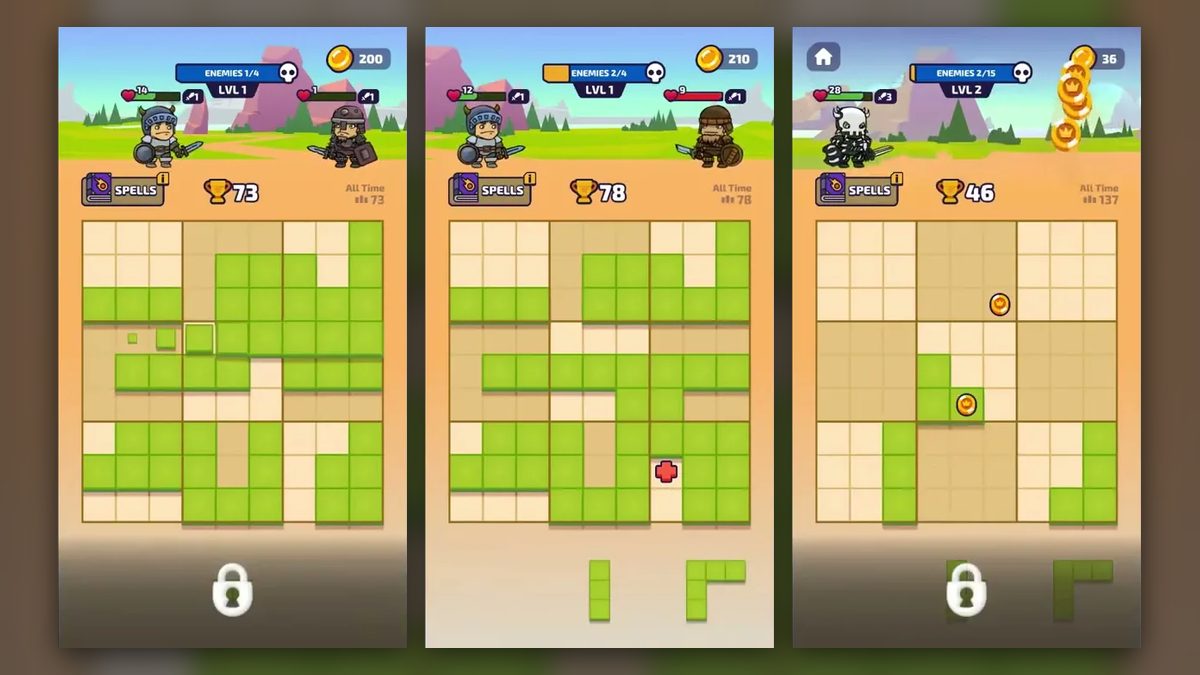
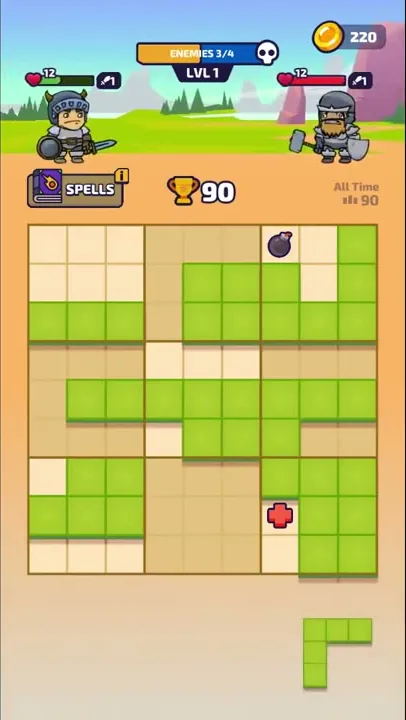
Battledoku gameplay splits a portrait screen into a battle strip on top and a puzzle board below it. In the strip, the hero stands on the left and one enemy on the right. Each fighter has an HP bar with a heart and an HP number beside it, plus a sword badge with a second number.
The core is a block puzzle, the same family as games like block blast. It’s played on a beige 9x9 grid whose nine 3x3 boxes alternate light and darker tan like a checkerboard. Bright green pieces go from a tray under the board onto the grid, and a completed row or a completed 3x3 box clears. A level’s goal is a wave of enemies, counted by a banner with a skull icon at its end, and the clears go along with the hero’s attacks.
Level 1 has four enemies, and the banner reads “ENEMIES 1/4” until the first one falls. Early in the first run, Sir Small Knight stood at 23 HP with a sword number of 1. When the bottom row cleared, the first enemy’s HP fell from 10 to 1. With that enemy still on 1 HP, another row broke up cell by cell as the knight stepped forward to strike.
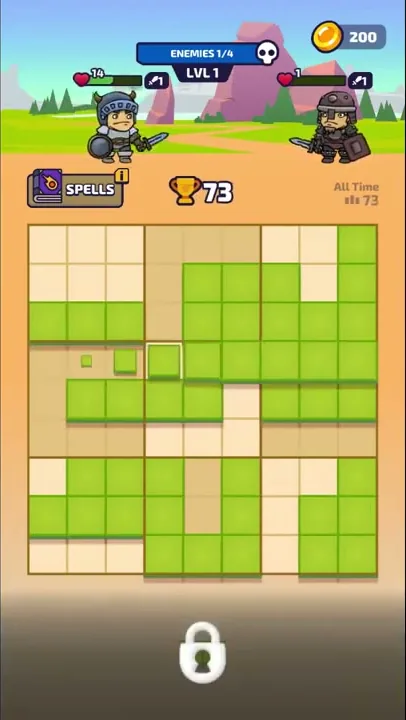
A beaten enemy falls and coins fly to the counter at the top right before the next one comes in. In the first run, the second enemy was a warrior with 9 HP and the third had 12, both with a sword number of 1. The enemies hit back. Against enemies with a sword number of 1, a red “-1” floated over the knight, whose HP went from 23 early in the run to 12 during the second fight. Against the second run’s dark knight, whose badge read 2, the hit showed as “-2.”
Pieces move from the tray onto the board, floating over the grid off the cell lines while they are being placed, and each one we placed went down in the shape the tray showed. Menus work by tapping. During tutorial steps the screen dims and a large white hand points at the button to press, and a green START button begins a run.
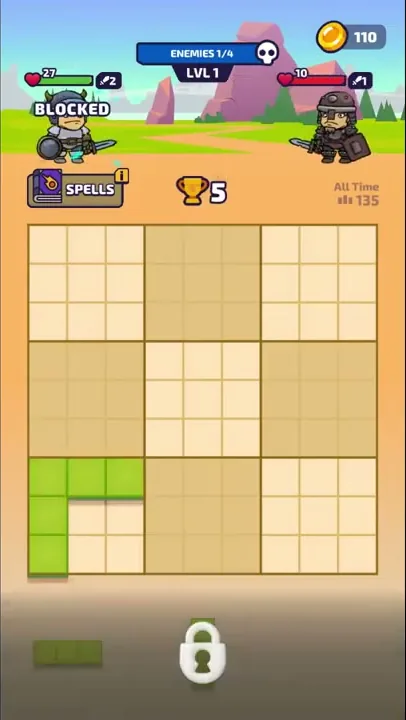
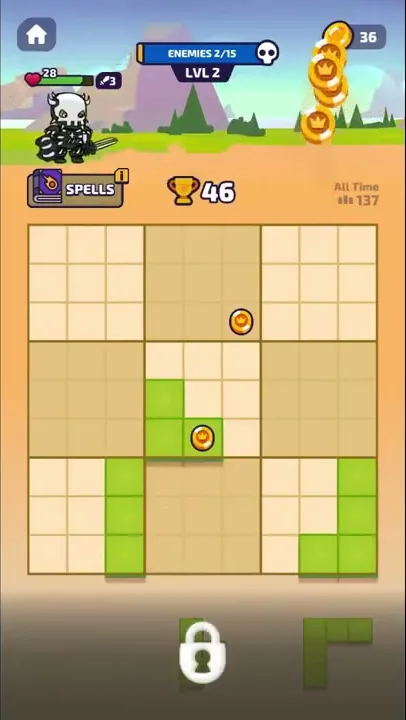
The tray has three evenly spaced slots, and at times all three hold a piece. Slots empty as pieces go down, and new pieces then fill them. The shapes range from straight three-cell bars and a 2x2 square to small and large corners, and a T and an S turned up in Level 2. A white padlock often covers the center slot while the other pieces dim. That happens at the start of a run and while a hit or a clear plays out in the fight above.
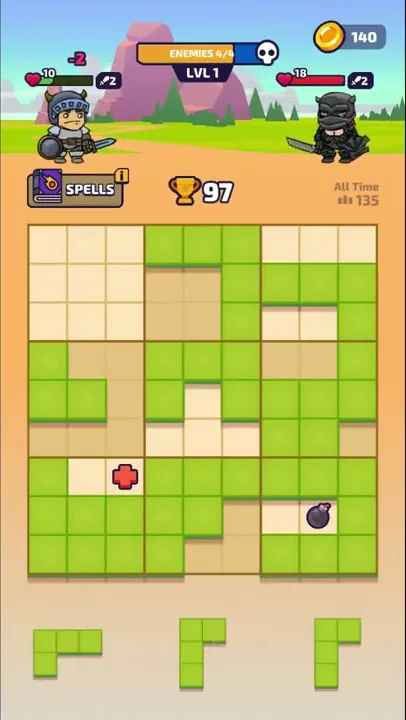
Both playable heroes carry a signature spell. A SPELLS button with a small “i” badge sits under the hero in battle. In the first run, a Spells panel listed Sir Small Knight’s Shield Spell, “5% to block an enemy’s attack,” with one of its five stars filled. Early in the second run, “BLOCKED” appeared over the knight and his HP stayed at 27.
Red cross tiles turn up in single empty cells of the grid. The first appeared while the first run’s second enemy was in the fight. By the time the dark knight stepped in, two were on the board at once.
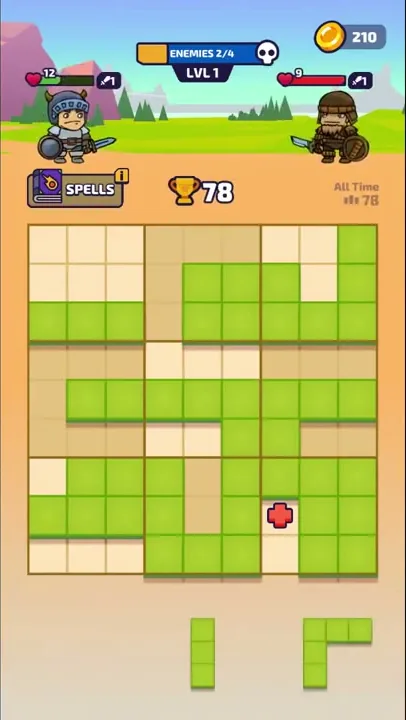
Bomb tiles also sit alone in a cell, each a dark round bomb with a small red spark on top. The first turned up in the top-right box as the third enemy arrived. In the second run, a bomb was in the bottom-right box when that box cleared along with a row.
Level 2 also puts gold coins stamped with a crown on the grid, first one and then two a few moments later. Both were on the board as the second enemy left the field and a stream of coins flew to the counter.
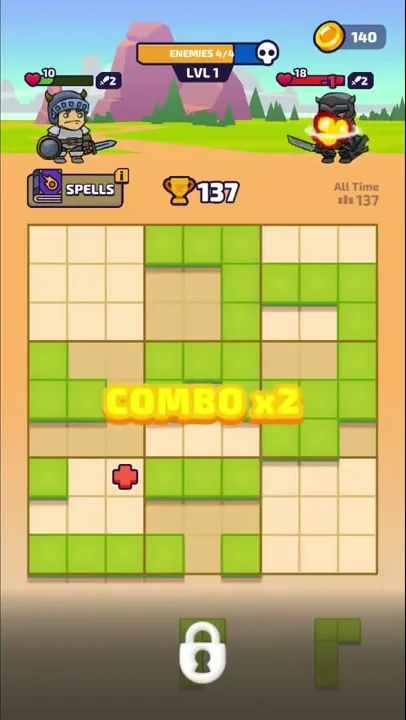
A row and a box clearing at the same moment produced a callout. During the second run’s fight with the dark knight, a row and the bottom-right 3x3 box cleared together. Large yellow “COMBO x2” text spread across the middle of the board, and fire flashed on the enemy.
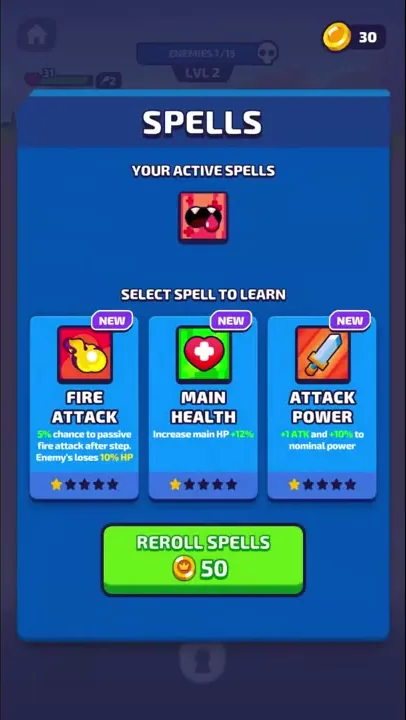
Level 2 adds a spell draft, the light roguelike layer. After an enemy falls, a Spells panel shows “YOUR ACTIVE SPELLS” at the top. Under “SELECT SPELL TO LEARN” are three cards tagged “NEW,” each with a short description and five stars, one of them filled. A green “REROLL SPELLS” button under the cards costs 50 coins.
The first offer was Fire Attack, a “5% chance to passive fire attack after step” that takes 10% of the enemy’s HP; Main Health, “Increase main HP +12%”; and Attack Power, “+1 ATK and +10% to nominal power.” Attack Power joined Vampirism, the signature spell of the Level 2 hero, among the active spells, and the sword badge then read 3 instead of 2. The next offer had Fire Attack again, next to Shield Spell and Heal Booster, which reads “Health boosters restore 12% HP.”
From four enemies to 15, plus coin upgrades
Enemies come one at a time, and the scenery behind them changes with each new one. The first three in Level 1 have between 9 and 12 HP and a sword number of 1, and the fourth is a black-armored knight with red eyes. On the first run, that dark knight showed 200 HP and a sword number of 20.
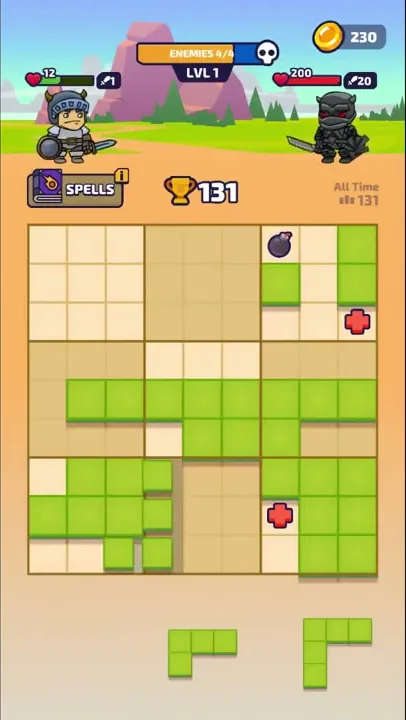
Back in Level 1 after a visit to the hero screen, the knight started at 27 HP with a sword number of 2, up from 23 and 1 early in the first run. The first three enemies returned with the same HP. The dark knight, though, now showed 18 HP and a sword number of 2.
On the first run of Level 1, red cross tiles turned up from the second enemy and bombs from the third; on the replay, a bomb was already on the board during the second fight. A “LOADING…” screen led into Level 2, where the banner reads “ENEMIES 1/15” and a home button sits in the top-left corner. Gold coin tiles join the grid there, and a spell draft came after each of the first two enemies beaten.
The hero there was Vlad Dracula, who took the field at 33 HP with a sword number of 2. The first opponent was a hammer-wielding warrior with 10 HP. The armored knight that came next had a sword number of 2, one more than the first opponent.
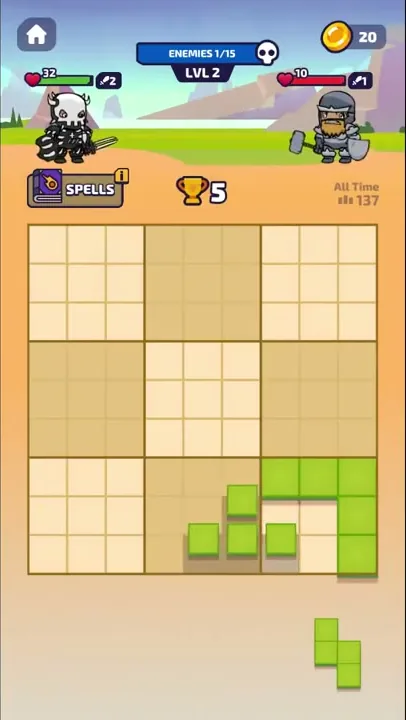
The battle screen keeps a coin counter in its upper right corner. It rose by 10 with each enemy beaten, in both runs of Level 1 and in Level 2, and a burst of gold coins stamped with a crown flies into it as an enemy goes. Coins pay for stat upgrades and hero unlocks on the hero screen, and for the 50-coin spell reroll.
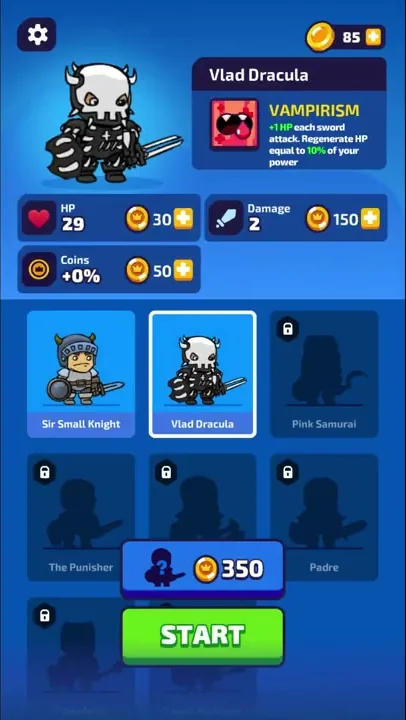
Between runs, the hero screen lists three stat upgrades: HP, Damage and Coins (+0%), each with a coin price and a yellow plus button. On the first visit, a tutorial dimmed the screen and pointed at the Damage upgrade with the tooltip “Increase your power +1 ATK.” That upgrade cost 100 coins, and HP cost 20. On the next visit, Damage cost 150 and HP 25, and the Coins upgrade was priced at 50.
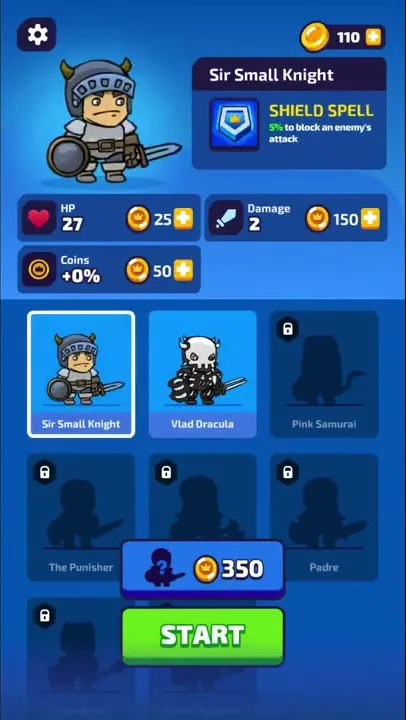
A grid of hero cards sits under the stats. Sir Small Knight and Vlad Dracula are playable. Padlocked silhouettes are labeled Pink Samurai, The Punisher and Padre, and more cards run off the bottom of the screen. A blue button with a question-marked silhouette costs 350 coins; after a tutorial hand pointed at it, those 350 coins came off the balance and Vlad Dracula’s card was unlocked.
The top right of the hero screen shows the selected hero’s signature spell. Vlad Dracula’s is Vampirism: “+1 HP each sword attack. Regenerate HP equal to 10% of your power.” His HP upgrade was priced at 30 coins.
A trophy counter keeps score during a run, with an “All Time” best next to it. The second run of Level 1 started at 0 against a best of 135 and reached 137, and the “All Time” figure rose to 137 with it. The hero screen also has a settings gear at the top left and a yellow plus button next to its coin counter.
Clears and swordplay working as one system
The block puzzle and the monster fighting blend together very harmoniously. The fight runs through the board. In the second run, a 3x3 box cleared while the second enemy was at 9 HP, and right after that the banner moved on to “ENEMIES 3/4.”
There have been a great many attempts to mix casual games with RPGs, and the fighting and the character growth in them always feel strongly split. Once the battle itself is made casual and set on top of a casual core puzzle, as Battledoku does, the two halves fit together far better. Growth lives on the hero screen between runs and is paid for with the coins the fights drop.
The strategy also feels better than in chain-matching RPGs or match-3 RPGs. On the board, the player decides where each tray piece goes on a grid of rows and 3x3 boxes; in Level 2 there is also a pick of one spell card out of three.
The tone follows the casual-RPG route. The characters are chunky and big-headed, from a knight in a horned helmet to a skull-faced Vlad Dracula. They stand against flat, bright scenery of grass and pine trees under pink rock peaks. The RPG numbers on the battle strip stay simple: an HP figure and a sword badge for each fighter.
Taken together, it’s a mature take on the genre, and this format has the look of a hit. It can stand up to Puzzle Survival, and it’s a very good new idea, one other game makers should take a look at.
Board tiles the early levels leave unexplained
We found nothing to criticize in Battledoku. Red cross tiles, bombs and the coin tiles of Level 2 all turned up on the grid, but we couldn’t see what any of them do. The dark knight’s numbers were very different on the two runs of Level 1, and what lowered them on the second run isn’t shown either. The padlocked heroes, Pink Samurai, The Punisher and Padre among them, stayed locked, so only the knight and Vlad Dracula took the field.
Grid planning with a hero to grow
A run is spent reading the tray and fitting pieces onto the 9x9 grid until rows and 3x3 boxes fill and clear, while two fighters’ HP numbers move above. That suits a taste for block puzzles that keep track of something besides cleared lines. In Level 2, each of the first two fights ended with a choice of three spell cards. Between runs there are coins to spend on stat upgrades or a 350-coin hero unlock, which fits a liking for character growth built on top of a puzzle.
Verdict
Battledoku makes block puzzling and monster fighting play as a single game, with the hero screen and the spell draft both tied to the same fights. It comes across as a mature, finished design with a casual-RPG tone. Of the many attempts to mix casual play with RPG systems, this is an excellent new direction, and it has the look of a future hit.