Block War Review: Tetris Pieces That Carry an Army
A Block War review: four-tile pieces carrying little soldiers drop into a Tetris-style well while red-numbered enemies wait at a purple portal.
Game at a glance
Block War - Adventure Master
8/ 10
Our score
Give Tetris an RPG coat and an ad-game look, and it gets interesting.
In this article6 sections
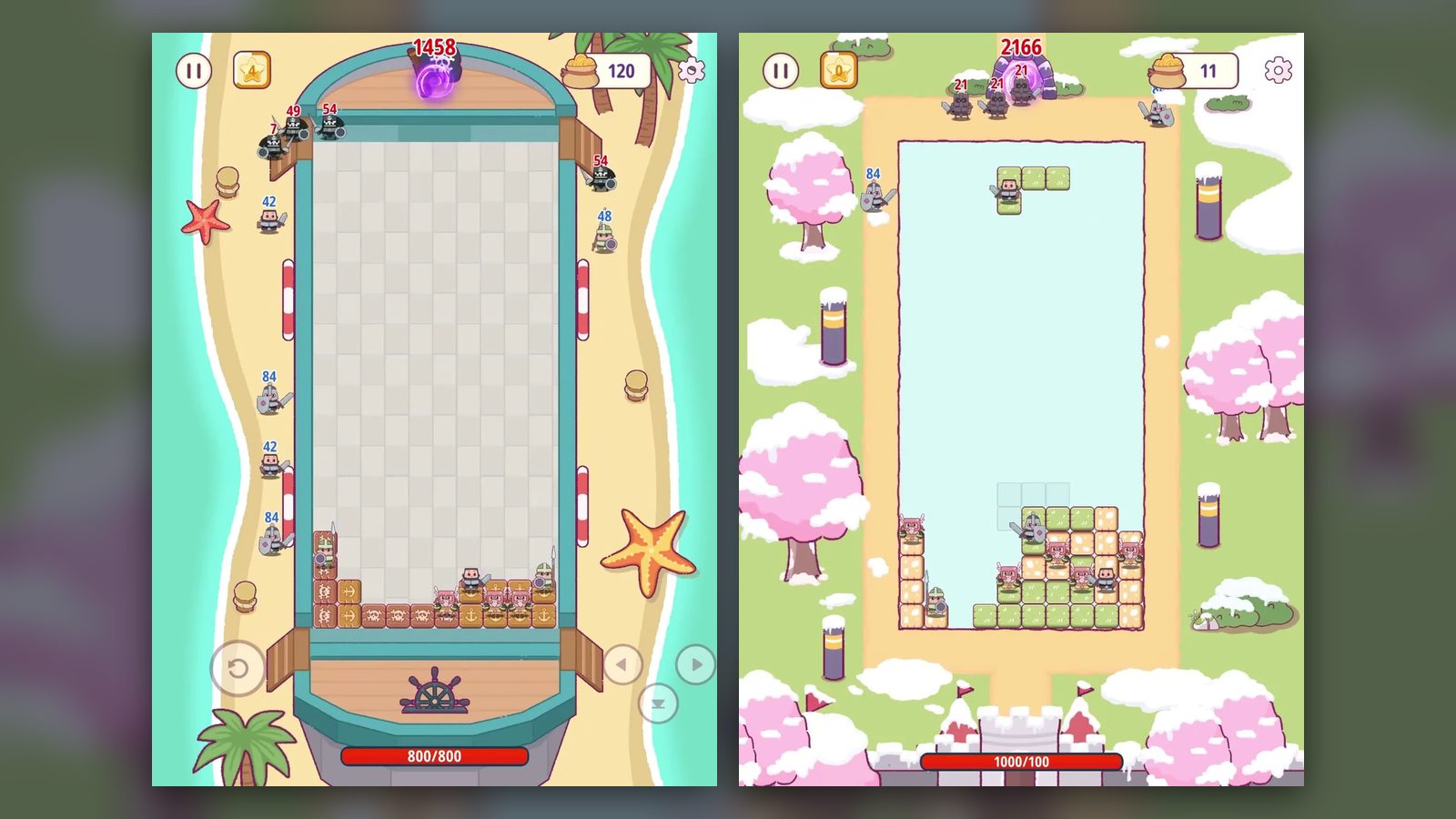
A well 10 tiles wide sits at the center of Block War, and the four-tile pieces that drop into it come straight from Tetris, the original falling-block puzzle. This mobile spin on block puzzle games gives those pieces passengers. Many tiles carry a small soldier, while troops with blue numbers stand around the well and enemies marked in red gather beside a purple portal at the top.
Block War crosses Tetris with the number-based RPG stages of the Hero Wars ads, and the pairing turns out interesting. Across the three stages we played, on a pirate ship and in autumn and snowy fields, it gives the old formula the air of a light, casual adventure challenge. The systems on top are its weak point: their depth is only average.
Soldiers riding four-tile pieces down the well
At its base, Block War gameplay borrows the Tetris well. Pieces of four tiles drop in from the top of the well and stack on whatever lies below them, between fixed walls on both sides. No goal card or results screen appears in any of the stages, and no move counter or clock appears anywhere around the ship or the castles. No stack reaches the top either.
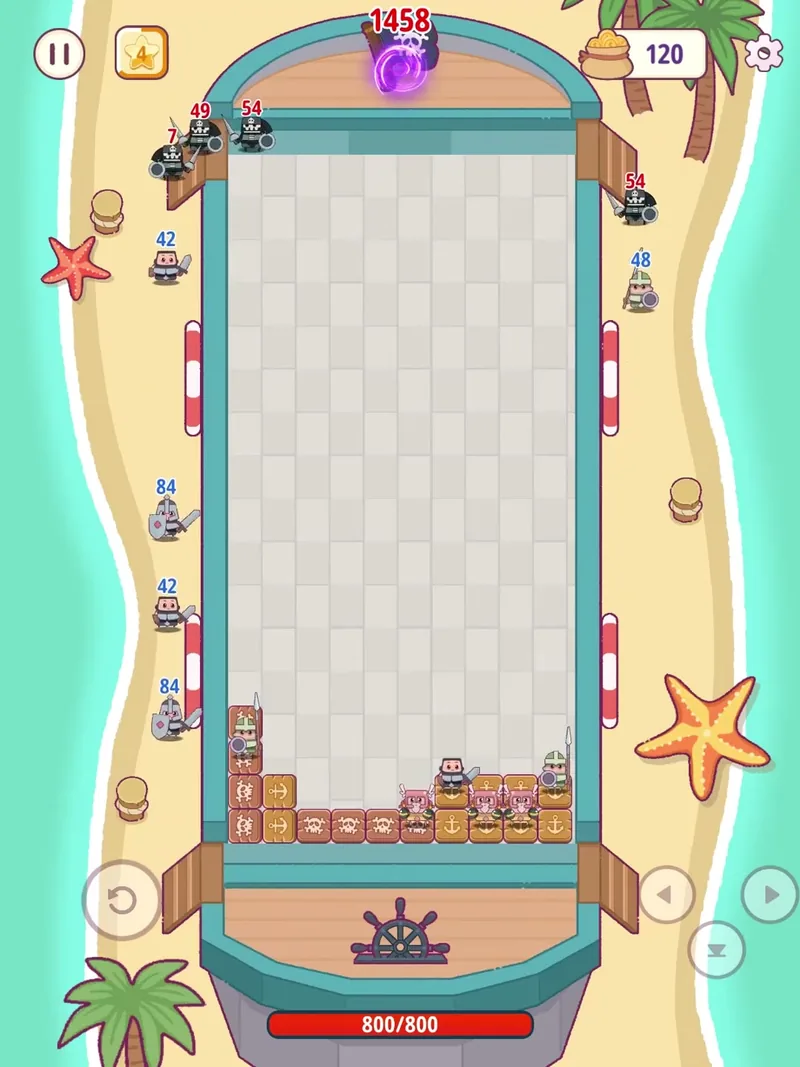
On the pirate-ship stage, where the well is built into the deck of a teal ship, four round, semi-transparent buttons sit beside it. A circular-arrow button takes the bottom left corner. At the bottom right, left and right arrow buttons sit side by side, with a down arrow resting on a line just below them. The autumn and snowy stages show none of these control buttons.
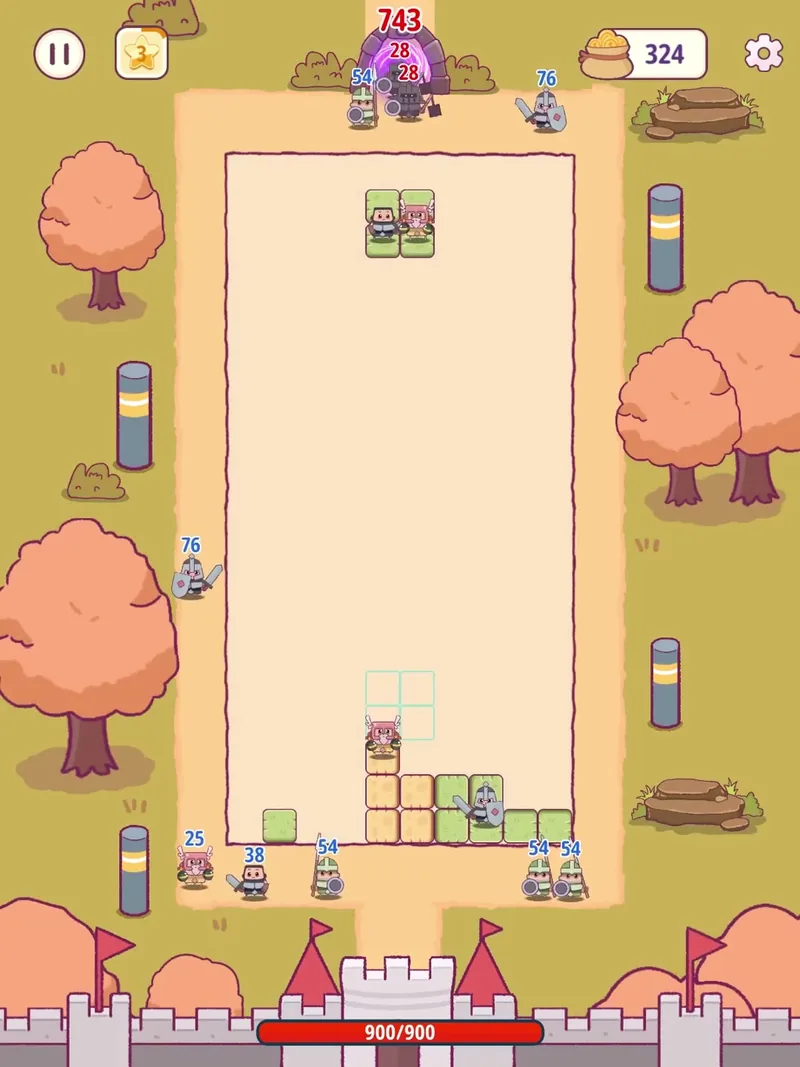
While a piece is still falling, a pale teal outline of the same shape marks where it will land on the stack. It appears under a 2x2 square in the autumn stage and under an L-shaped piece in the snowy one.
Many tiles carry a small soldier, on the falling piece as well as in the stack. Four designs turn up: a pink horned viking, a green-helmeted spearman with a round shield, an armored knight with a sword and a red-diamond shield, and a dark-haired swordsman. The riders on the tiles show no number.
The same four designs stand outside the well, and there each one has a blue number overhead. Within a stage, every soldier of a given design shows the same value: on the ship, every swordsman reads 42 and every knight 84. In the land stages, a few of them stand at the very top of the board, near the enemy portal.
On land, a sandy path rings the well, running from a gap at the castle at the bottom up to the portal at the top, and the blue-numbered troops line it. On the ship, they wait on the beach beside the hull.
The portal itself is a glowing purple swirl with a red number above it. Enemy figures beside it carry red numbers as well: pirates on the ship, where the swirl sits at the bow under a black pirate flag, and dark armored figures on land, where it fills a stone arch.
Along the bottom of each stage, over the ship’s stern or the castle wall, runs a red bar with a number pair, full in all three stages. Neither the bar nor the number above the portal carries a label. From these stages we can’t say what becomes of the riders, how a fight between blue and red numbers is settled, or what wins or loses a stage.
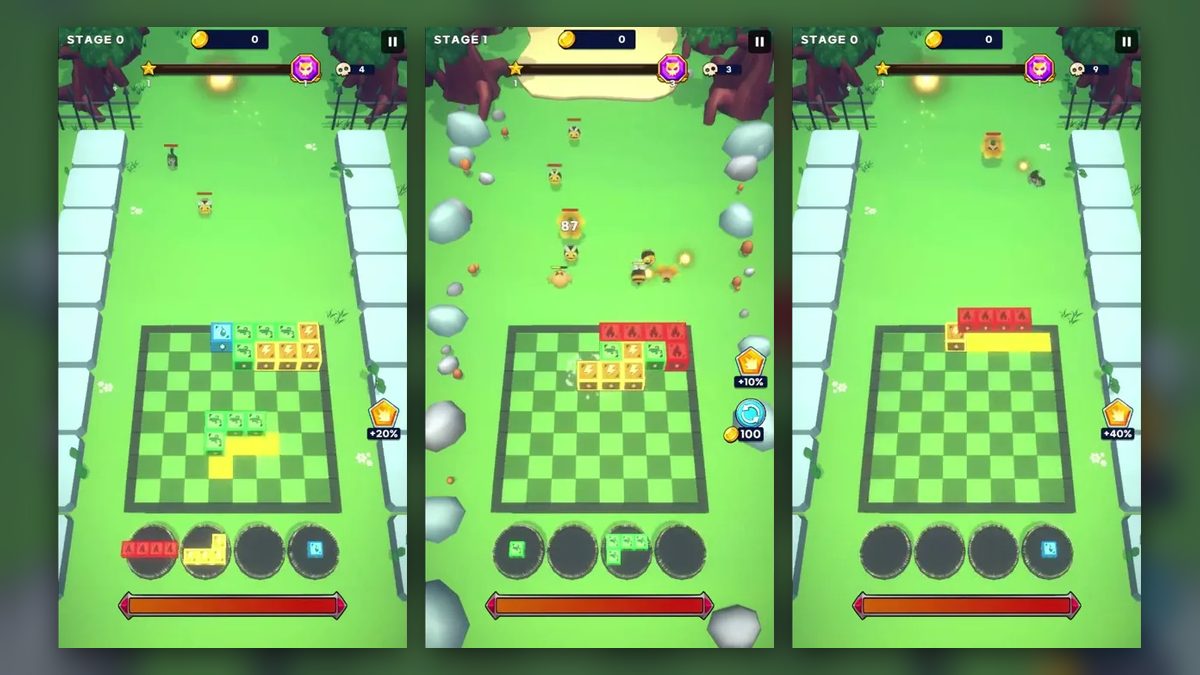
A 2x2 square of grass tiles drops into a pale peach well in the autumn stage, with a dark-haired swordsman and a pink viking riding on it. Its teal outline marks a spot on a short stack of sand and grass tiles right of center, where another viking and a knight already stand, and a single grass tile sits apart in the second column. Out on the path, a viking stands under a blue 25 and the knights under a blue 76, while two red 28s mark the enemies at the portal.
Three settings, each with its own tiles
No level numbers appear, and each of the three stages has a setting of its own, drawn in flat 2D cartoon art seen from above, with chibi soldiers in thick outlines. One is a teal pirate ship pulled up on a sandy beach, with palm trees and starfish on the sand and a ship’s wheel at the stern. Another is an autumn field with orange trees and striped posts, set before a gray castle wall with red-roofed towers and red flags. A third is a snowy field where pink trees wear caps of snow and a snow-covered castle sits at the bottom.
The tiles follow the setting. On the ship, the well sits in the wooden deck over a gray checkerboard, and its tiles are crates: reddish-brown ones stamped with a white skull and crossbones, and orange ones marked with an anchor. On land, the tiles are grass and sand, and the well’s background is pale peach in autumn and pale icy blue in the snow.
The enemies change with the scenery as well. On the ship, four pirates with red numbers stand at the bow and along the right rail. On land, dark armored figures gather at the stone-arch portal; the snowy stage has three of them, each marked with a red 21. The red number above the portal is different in each stage, and so is the number pair on the bottom bar.
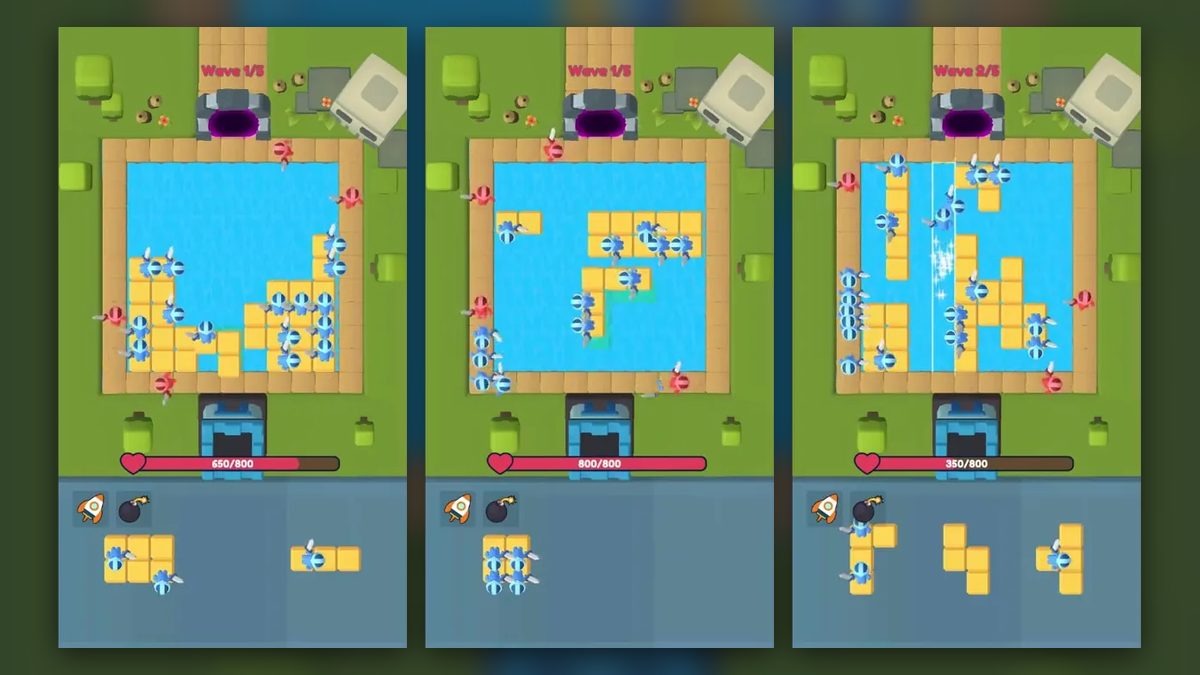
The stacks differ too. At one point on the ship, a low line of crates one to three tiles high runs along the bottom of an otherwise empty well with no piece in the air, and three pink vikings stand on it, joined by two spearmen and a swordsman. At one point in the snowy stage, sand and grass tiles fill most of the bottom, up to five tiles high, with a gap in the third column of the bottom row. Pink vikings, a spearman, a knight and a swordsman stand on them as an L-shaped piece, three grass tiles in a row with one more under the left end, drops in carrying another soldier.
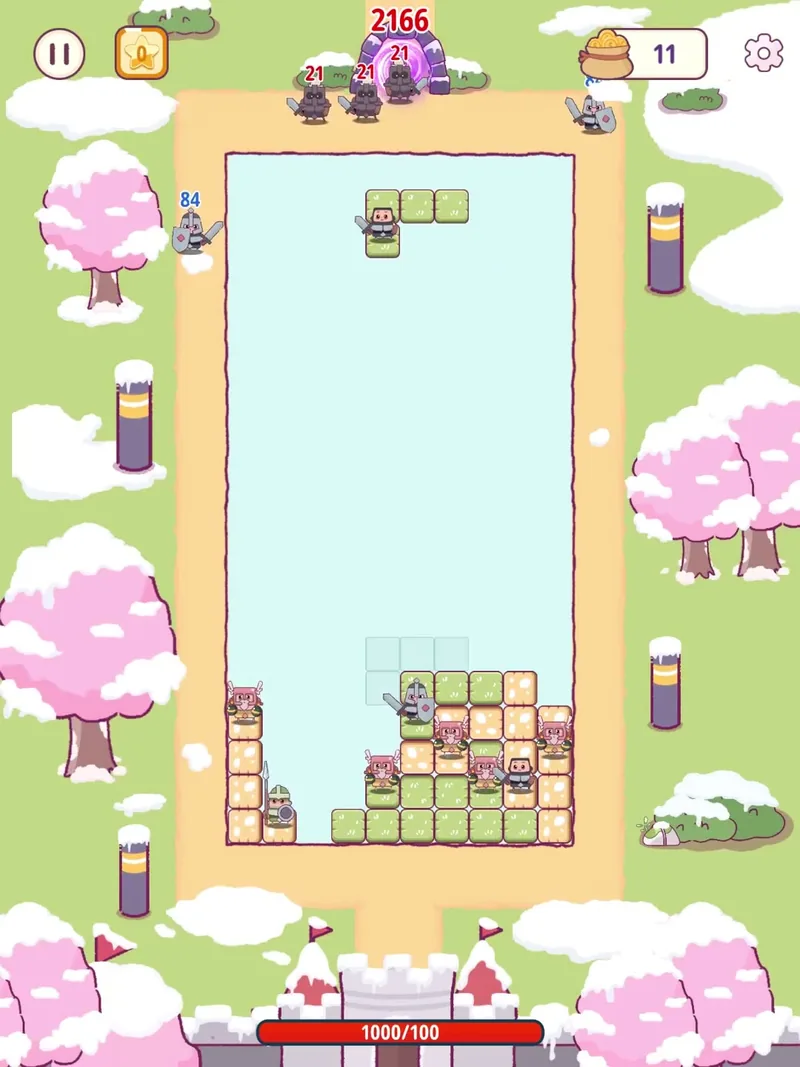
Outside the board, the same few elements frame every stage. In the upper left corner, the pause button shares space with an orange tile showing a star and a digit, and the digit differs between stages. At the top right, a bag of gold coins with a number beside it sits next to a gear button for settings.
Classic Tetris in RPG and ad-game dress
The visual treatment Block War puts on classic Tetris, borrowed from a simple RPG or from the ads for bite-sized games, makes it interesting. Troops with blue numbers face enemies with red ones across the board, and a red bar stretches across the castle wall below the well. It also succeeds in giving Tetris the air of a light, casual adventure challenge.
We liked it, too, as a fresh take on classic Tetris. The well and its four-tile pieces stay recognizable, landing outline included, while the new part rides on top of them: a viking on one tile, a knight on another.
Blue and red numbers that only go so deep
The one shortcoming lies in what Block War crosses Tetris with. Those extra systems have only average depth, and the combination doesn’t stand up to close play. What the stages show of that layer is only a set of numbers, and they don’t show how those numbers play against each other.
Stacking soldiers under an enemy portal
The play comes down to stacking four-tile pieces in a well while numbered troops and enemies gather at the edges of the screen and soldiers ride on the very tiles being stacked. That lines up with a liking for falling-block puzzles that come with a cast of little soldiers. Each of the three stages had its own scenery, so the same stacking happened on a ship’s deck in one and beneath a castle in autumn or snow in the others.
Block War shares a shelf with games like block blast, and its pieces are the four-tile kind that drop into a well from above. Anyone fond of the number-against-number style of bite-sized game ads will find that style here, wrapped around a Tetris well.
Verdict
Dressed in the look of a simple RPG or of bite-sized game ads, classic Tetris becomes something interesting in Block War, and it succeeds in giving the stacking the mood of a light, casual adventure challenge. The flaw sits underneath: the systems paired with the falling pieces have only average depth and wear thin under closer play. Block War is one of a wave of Tetris games that look set to ride the attention Tetris is about to get. Tetris already belongs to the family of clear-the-board puzzling, so a puzzle RPG could in principle run on its pieces; the Tetris license seems to be the tricky part.