Build America 3D Review: A Hole That Builds Cities
This Build America 3D review follows timed hole rounds whose orange bricks and gray blocks fly onto a floating Oregon and stack into a city.
Game at a glance
Build America 3D
6/ 10
Our score
Hole.io-style swallowing plus a U.S. map you assemble state by state.
In this article6 sections
The first half of Build America 3D is a hole game in the mold of hole io games: the hole.io trick of steering a hole that gobbles things up, here in short timed rounds on a tiled floor. The difference is where the swallowed pieces end up. In this mobile game, the bricks and blocks a round collects fly onto a 3D map of the United States and build a small city, one state at a time.
We played the end of Washington’s build, both of Oregon’s rounds and Idaho’s first round. What sets the game apart is how it ties each hole round to a building layer that carries on from one state to the next.
A timed hole that feeds a state
Build America 3D gameplay comes in two halves. In a round, the player steers a black hole across a tiled floor and swallows the building materials laid out on it. When the countdown under the hole reaches 0:0, the view moves to the state, and those materials become buildings.
Rounds show no target count. A bar at the top, beside the state’s name, fills green as a round goes on; it was already full when Oregon’s second round began and empty again at the start of Idaho’s. The state’s own progress is counted in the build phase as a percentage, and at 100% the game announces “STATE COMPLETED !”.
During a round, a faint virtual joystick (a circle with a dot) shows on the lower half of the screen, and the hole follows it around the floor under a tilted top-down camera. Before a round starts, two upgrade cards sit below the hole. On the map, a “PINCH TO ZOOM” hint with a pointing hand comes up, followed by a “CONTINUE” button.
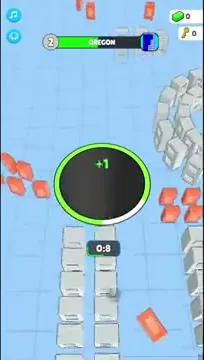
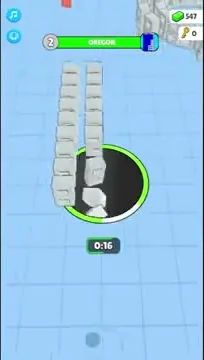
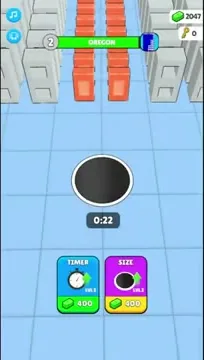
The hole is a black circle with a white rim. Pieces that slide over the opening tip in and fall, and green “+1” or “+3” numbers pop up above it while a green arc along the rim gets longer. “SIZE UP!” flashes over it now and then, and as in games like hole.io, the hole grows as it eats. Each new round starts with a small hole again.

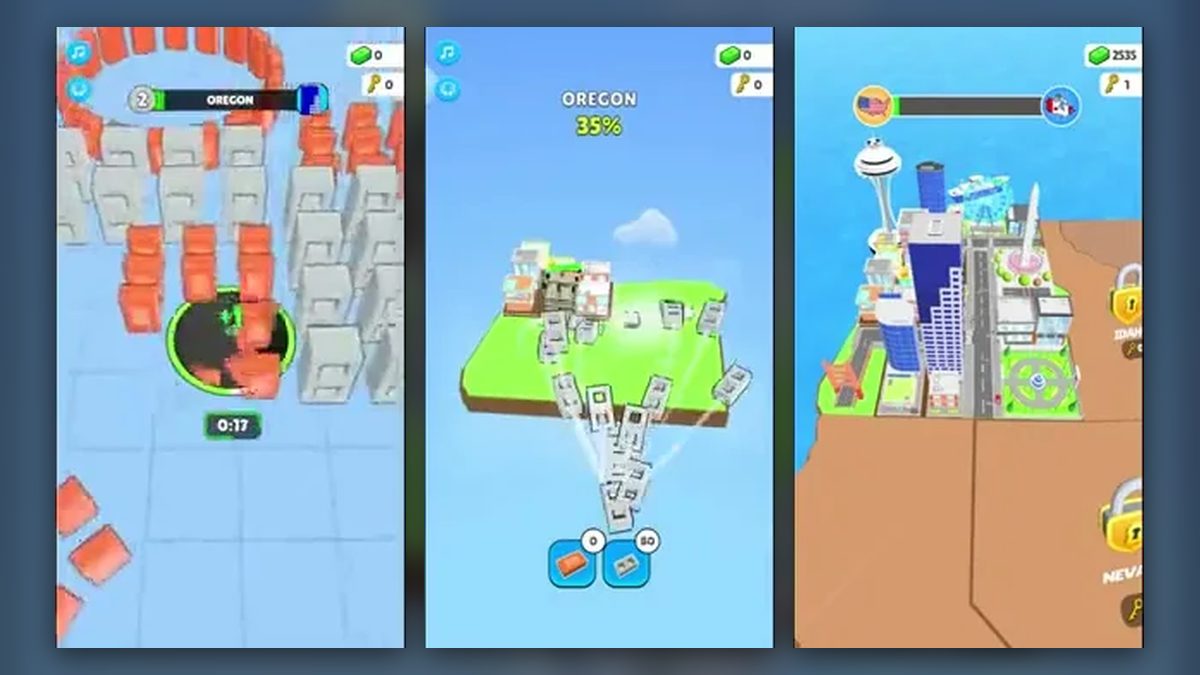
Two long columns of orange bricks run straight ahead of a small hole early in Oregon’s first round, with rows of gray blocks on both sides and 0:22 on the countdown. Farther out, bricks and gray blocks stand in curved lines and rings. By 0:3 the hole is clearly larger than it was at 0:22, and the round ends at 0:0.
Orange bricks are small orange-red blocks. They come in long double columns and curved lines, and elsewhere in rings or grids. The hole takes them in as they slide over its opening. In the build phase they come back as a counter with a brick icon at the bottom of the screen.
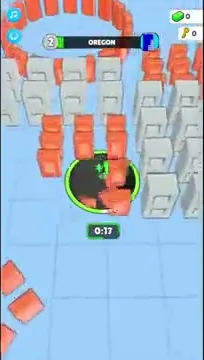
Gray blocks are light gray with a dark inset panel. They line up in rows beside the brick columns, and elsewhere they form grids and double columns or bend into curved lines. The hole swallows them the same way. In the build phase they make up the second counter, marked with a gray-block icon, and fly onto the slab to form the walls of buildings.
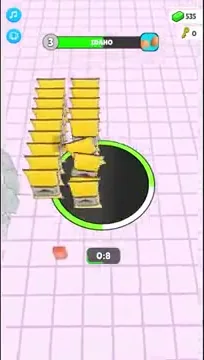
Yellow cement bags join the mix in Idaho. They stand in columns on both sides of the hole’s path and in stacked rows, and they go down the hole like the other pieces.
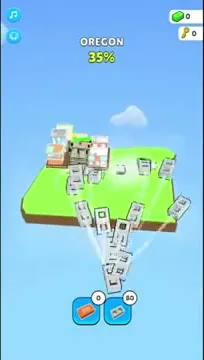
After a round, the state appears as a thick green slab with brown soil sides, floating in a blue sky under its name and a percentage. Along the bottom sits one button per material, each with a count badge. Pieces fly from the buttons onto the slab along white arcs and stack into buildings, the counts dropping as the percentage climbs. Partway through the build after Oregon’s first round, every brick had been used and gray blocks were still flying onto the slab.
Padlocked states across a map of the West
Each state is a stage of its own. Washington’s build ends on a dimmed screen, with “STATE COMPLETED !” above the state’s outline lit in yellow.

A state can take more than one round: Oregon needed two, each followed by a build phase. The second build ended at 100%, leaving a finished city with a tall blue skyscraper, a red bridge and a roundabout ringed in green.

Within a round the arrangements keep changing: in Oregon’s rounds the gray blocks appear as a grid and a double column, then bend into a curved line. Between states the floor changes too. Idaho swaps the light blue floor for pink-lavender tiles and adds the cement bags, with bricks also set out in a grid and a ring. Its countdown reads 0:20 before the start, against 0:22 before Oregon’s second round, and the top bar shows the state’s name beside a number in a circle: 2 for Oregon, 3 for Idaho.

A green banknote counter tracks cash from the top right corner, visible during rounds and on the map alike. It rises when a state or a level is completed, and it drops when a round starts after the upgrade cards have been on screen.
Those cards are a blue “TIMER” card with a stopwatch icon and a purple “SIZE” card with a hole icon, each with a green up arrow and a cash price. Both cost 400 before Oregon’s second round and 250 before Idaho’s. Once play started, the countdown read higher than it had while the cards were showing: 0:26 instead of 0:22 in Oregon, and 0:26 instead of 0:20 in Idaho.
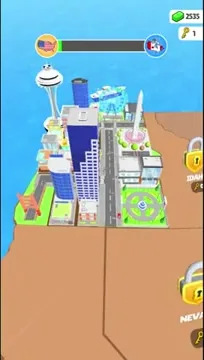
Between states, the camera pulls back to a brown 3D map of the western U.S. beside the ocean, with state names printed on it. Opened states turn green, and finished ones carry their cities. Washington’s has a white saucer-topped tower, a dark blue round tower, a white ship, a light blue Ferris wheel and a white needle-like monument on a pink round plaza. A bar across the top of the map runs from a round U.S. flag icon to a second round flag icon.
New states open with keys. Oregon carried a padlock marked “1/1” with a key icon as the key counter under the cash dropped from 1 to 0, and then the state turned green. Finishing Oregon put a key back on the counter, and padlocks now sit on the neighboring states.
Each “LEVEL COMPLETED !” screen puts a gold star above the banner and a round building icon below it. After Washington the icon was the white saucer-topped tower. After Oregon’s first build it was a blue skyscraper, the same icon that sits at the right end of the top bar during Oregon’s rounds. A tall blue skyscraper much like it stands in the finished Oregon city, while Idaho’s bar ends in a different icon.

Swallowed bricks that turn into skylines
Joining a hole core to an outside layer of long-term building is an original take. Around the timed rounds sit a state map opened with keys and cities raised one after another, plus landmark icons on the completion screens and cash upgrades for the hole. The game combines the two in a straightforward way: what a round swallows is what the next build spends.
In our view, hole play no longer has to stay ultra-simple pick-up-and-play. Attack Hole is still riding high, studios keep trying hole-plus-something designs, and the hole could serve as an all-purpose core to pair with other kinds of games. Build America 3D is one of those pairings.
Watching the blocks put up buildings on the map gives relaxing sensory feedback of its own. Gray blocks arc up from the counter and land on Oregon’s slab as walls, and the nearly bare slab of the first build ends up as streets under a blue tower. Taken as a whole, the game is very easy to unwind with.
Open questions about timers and upgrades
We have no specific criticism of Build America 3D to report. Two things stay open. Rounds end on the countdown alone, and no fail screen appeared, nor lives or a move limit, so we can’t say whether a round can be lost. The TIMER and SIZE cards are the other gap, since what each one changes is not clear from the cards themselves.
Steering one hole through rows and rings
Each round comes down to steering one hole along columns and rings of pieces until the countdown reaches 0:0, then seeing what it swallowed fly onto a state and stack into buildings. That mix suits a taste for clearing lines of objects against a clock, and for watching a map of the United States fill in. Unlocking padlocked states with keys and seeing a new landmark icon on the completion screens give the rounds a goal that outlasts any one of them.
Verdict
Build America 3D gives its hole somewhere to send what it eats: back up onto a map of the United States, where the pieces return as streets and towers, state after state. Joining those two halves is a fresh idea, carried out simply. The building half is calm to watch, and the whole game reads as an uncomplicated attempt at the hole-plus-something pairing that the genre keeps returning to.