Nut Sorting Review: Stacked Wrenches, One Shared Tray
Wrenches leave their bolts for a tray where three of a color clear; this Nut Sorting review covers the stacked hubs that begin in Level 5.
Game at a glance
Nut Sorting
8.5/ 10
Our score
Tile-matching rules can join almost any core gameplay and add longer-range strategy.
In this article6 sections
Nut Sorting is a mashup of the two hottest puzzle formats of the moment, and it puts them together well. Colored wrenches rest on bolts across a metal floor. Each one taken off moves down into a gray tray at the bottom, where three of one color clear away. That lower half is tile matching with a small tray, the rule that tile match games are built around, and here it sits beneath a mobile wrench puzzle.
Against that, the wrench puzzle itself leans slightly too far toward hyper-casual, the simplest kind of quick-play mobile game. We played through to Level 7 and stopped partway into it.
Wrenches off the bolts, into the tray
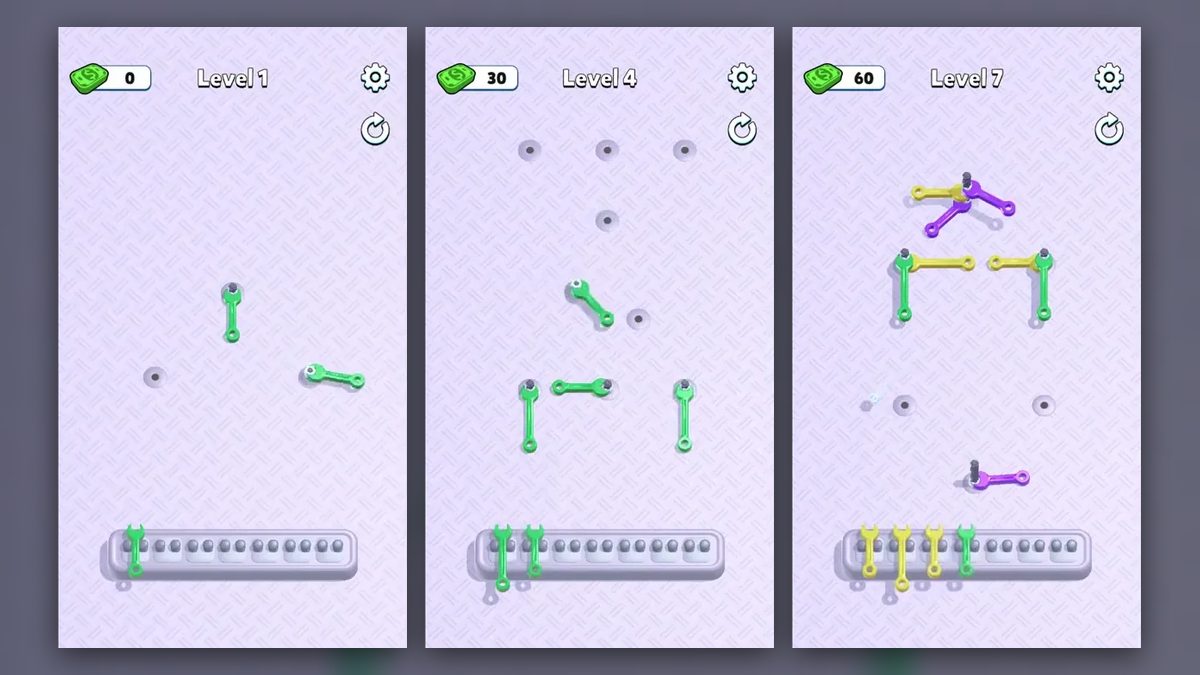
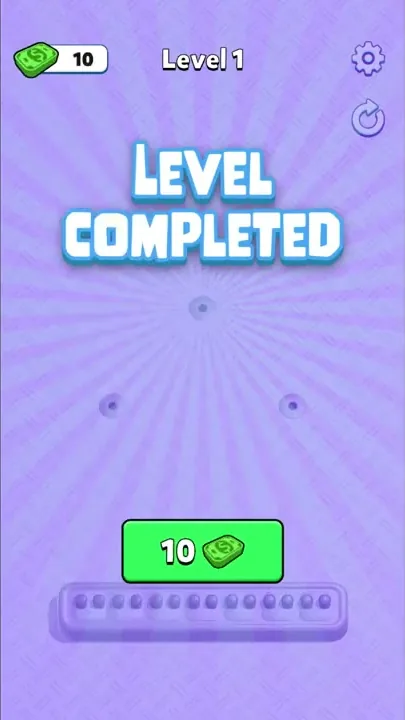
The board is a top-down 3D view of glossy, solid-colored wrenches with soft shadows. Each one rests with one end on a bolt set into a pale lavender diamond-plate floor. A wrench taken off the board moves down into the gray tray, and three of the same color in the tray disappear together. Once the last wrenches have left the board and the final set is clearing from the tray, the board fades under purple rays and LEVEL COMPLETED appears over the empty bolt holes.
Wrenches come off one at a time. A picked wrench swings around its bolt and then heads for the tray. On the way down it is drawn much larger than on the board and casts a big shadow. The HUD stays small: a banknote counter at the top left, the level number at the top center, and a gear button above a circular-arrow button on the right.
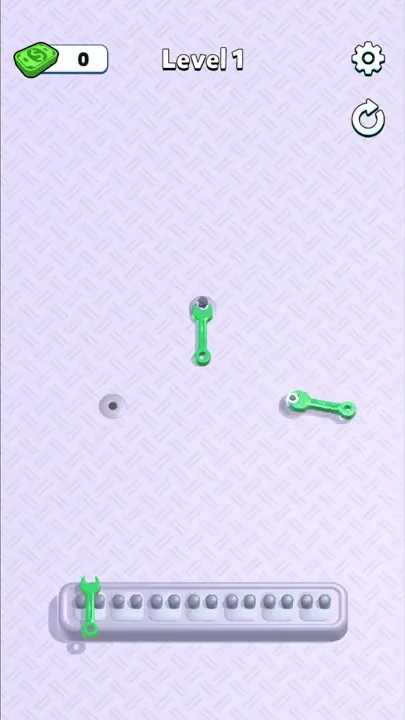
Nut Sorting gameplay repeats one loop until every bolt is empty: a wrench comes off and stands upright in the tray until two more of its color join it. Level 1 holds three green wrenches, one to a bolt. Early in the level, one of them already stands in the tray while the other two wait on the board.
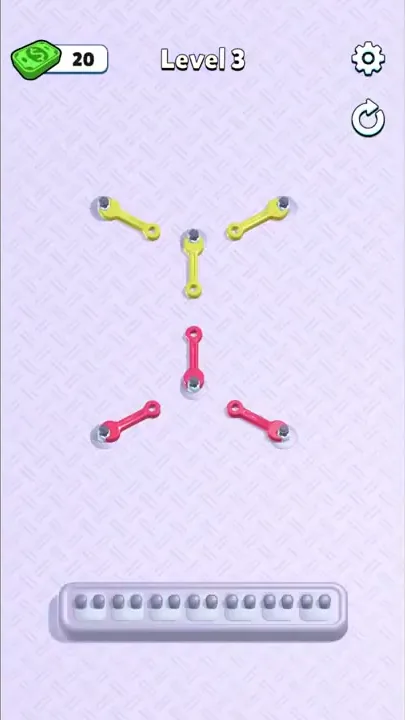
Three yellow wrenches and three red ones make up Level 3, with the yellows in the upper half and the reds in a mirrored group below. The yellows go first. With two of them in the tray, the middle yellow has swung to an angle on its bolt after starting out hanging straight down, and the bolts on either side of it are now empty holes. LEVEL COMPLETED comes up while the reds are still clearing from the tray.
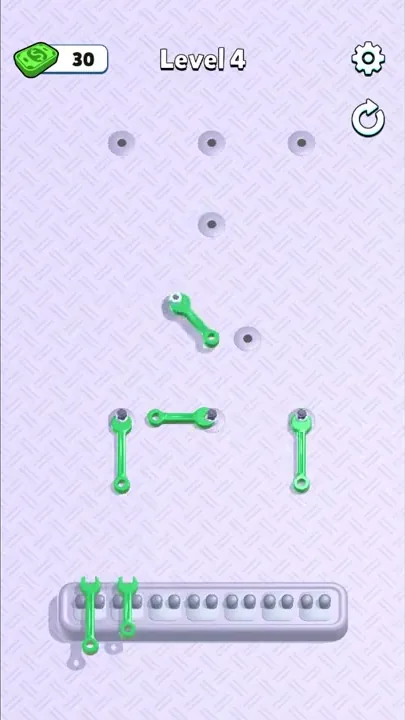
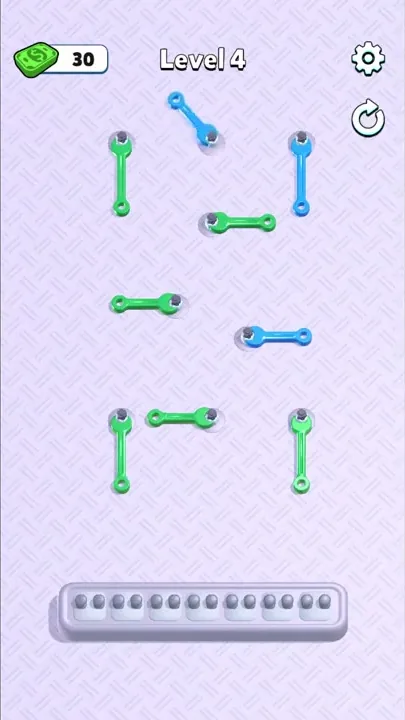
Other wrenches are seen doing the same thing, pivoting to a new angle around their bolts shortly before they leave. A sideways green wrench in Level 4 has tipped downward on its way out. In Level 7, a green wrench turns from pointing down to pointing up-left.
The tray runs along the bottom of the screen and has a row of 14 small studs. Wrenches stand in it jaw end up, with the ring end hanging below its lower edge. They fill it from the left, about two studs apart. Pieces from different bolts and hubs all land in this one tray.
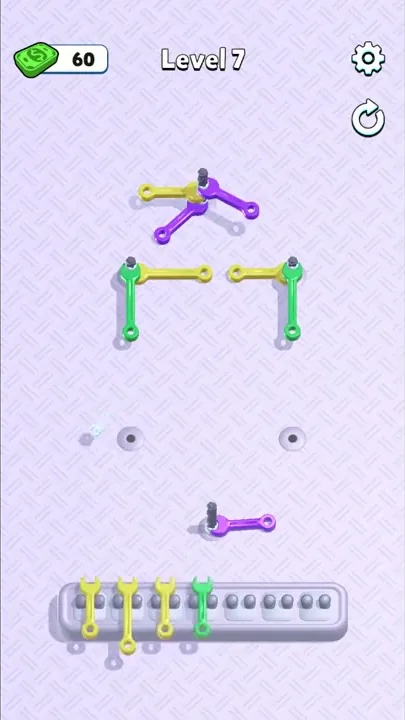
No move counter, timer or lives display appears, and no level reached ended in failure. The tray is the only visible limit, and the most it held at once was four wrenches.
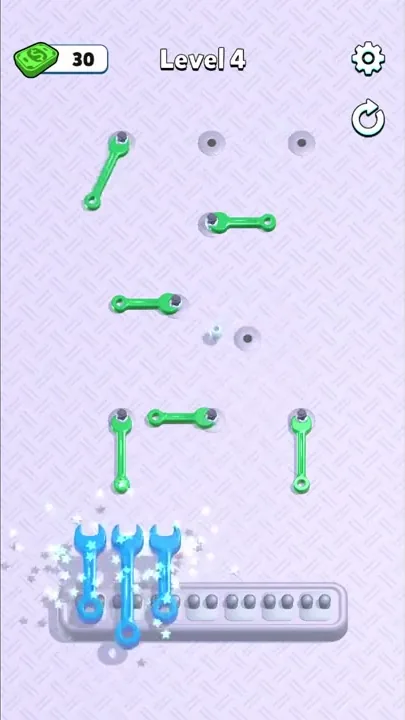
Three wrenches of one color in the tray vanish together in a burst of white sparkles and stars. In Level 7, three yellows standing next to a green clear away and the green stays in the tray. The three blue wrenches of Level 4 go the same way.
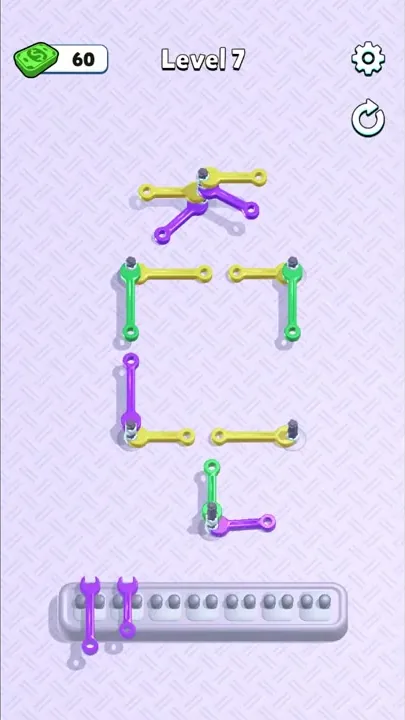
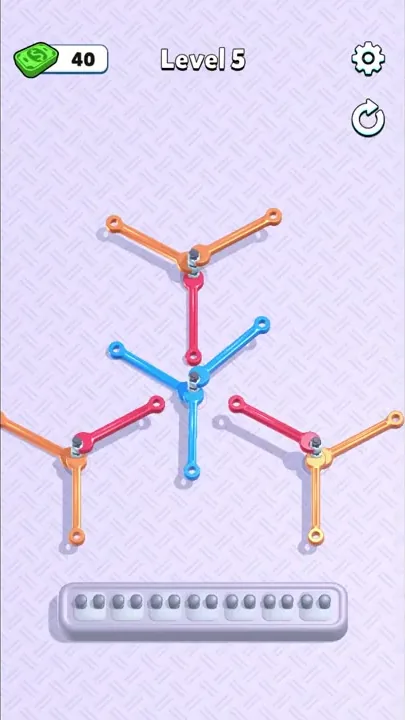
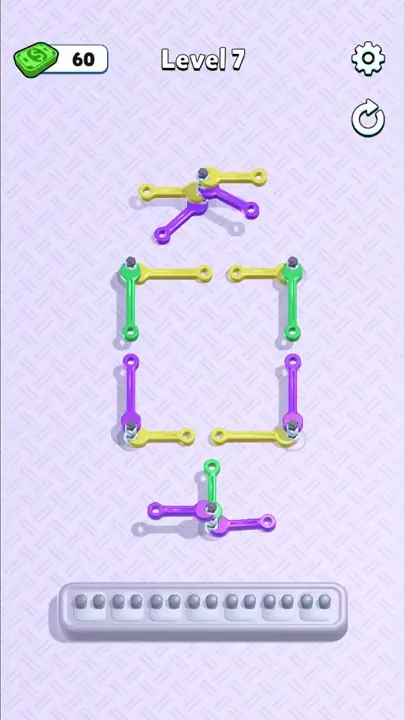
Starting in Level 5, some bolts carry several wrenches drawn over one another in layers. There are three per hub in Level 5 and two to four per bolt in Level 7. As a hub thins out, its bolt shows as a dark threaded post above the wrenches that remain. Once the last one is gone, only an empty gray hole is left, like any other cleared bolt.
From lone wrenches to crowded hubs
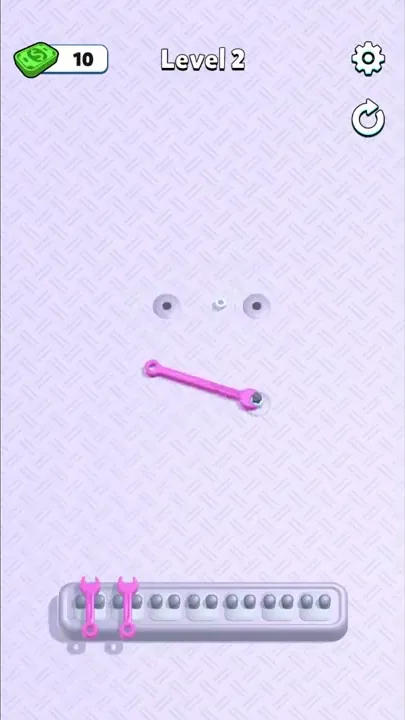
Colors are the first thing to multiply. The opening two levels each hold three wrenches in one color, green and then pink, with one wrench per bolt. Each is over within seconds.
A second color arrives in Level 3, set out as two mirrored groups. Three colors share each board from Level 5 through Level 7.
Layouts change shape as well. In Level 4 there are still only two colors, green and blue, but more wrenches fill a taller layout, each on its own bolt. Early in the level, vertical wrenches mark its four corners.
Shared bolts arrive in Level 5. It opens with four hubs, each one a single bolt holding three overlapping wrenches. The top hub and both lower hubs each hold two orange wrenches and one red, and the center hub holds three blue. The outer oranges reach the edges of the screen.
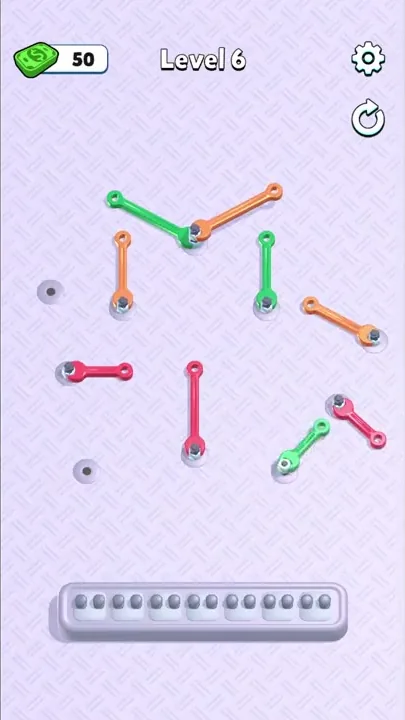
The board in Level 6 is wider than the screen. Partway through, the whole layout sits about a quarter of the screen further left, and wrenches that were beyond the right edge come into view. Most of its wrenches sit alone on their bolts, though near the top a green and an orange share one.
Level 7 builds a square of four bolts with two wrenches on each. It adds a bolt holding four above the square and one holding three below it, all in yellow, purple and green. It is the busiest board seen.
Outside the boards, the one currency seen is cash, drawn as a green banknote with a dollar sign. Its counter at the top left rises by 10 with each level. Every LEVEL COMPLETED screen seen shows a single green button marked 10 with the same banknote, under a large white title outlined in blue.
Stacked wrenches and a board-wide tray goal
Putting tile matching under the wrench puzzle gives the whole board a shared goal. Freeing each wrench is no longer the whole task, because the matching and clearing at the bottom has to happen too. That combines short-term moves with medium- and long-range planning well. In Level 5, an orange from the top hub and reds from the two lower hubs stand side by side in one tray while the blue center hub is still full.
The idea reaches beyond wrenches: tile-matching rules can be combined with all kinds of core mechanics to add longer-range strategy.
We especially liked the layered wrenches, which are part of the visual treatment. A bolt above the square in Level 7 carries two yellows and two purples drawn over each other, and each hub in Level 5 stacks three.
The wrench puzzle itself is calming and light to play. It is straightforward to pick up from the first board, where Level 1 has just three green wrenches. The goal is clear too: empty every bolt, and LEVEL COMPLETED appears over a field of gray holes.
A slim layer around the levels
The wrench puzzle itself leans slightly too far toward hyper-casual play.
We think a more developed building or progression system wrapped around the levels would give the game good prospects. Cash builds up at 10 per level, and what it buys is still unclear at Level 7.
Sorting wrenches by color, three at a time
These mechanics match a liking for building color sets from pieces pulled off a board. The work is choosing the next wrench, watching it pivot on its bolt and drop into the tray, and keeping track of which colors are close to three. Stacked hubs in Levels 5 and 7 and a layout that runs past the edge of the screen in Level 6 put that same work on bigger boards. The bottom half plays like tile matching with a small tray, and the wrenches and bolts on top are the other half of the mix.
Verdict
Joining a wrench puzzle to a tile-matching tray works well here. Quick choices about which wrench to free feed into a longer aim at the bottom of the screen, and the layered hubs are a highlight of the look. Play is light and easy to pick up, and the drawback is that the wrench puzzle leans slightly too far toward hyper-casual. A fuller building or progression layer around it would make its outlook promising.