Cannon Royale Review: Four Cannons Fight Over One Grid
Peg boards, a spin wheel and a card row surround four cannons sharing one tile grid, and this Cannon Royale review covers every piece.
Game at a glance
Cannon Royale
7/ 10
Our score
A big step for the genre, but fairly thin randomness and no strong long-term pull yet.
In this article6 sections
In an auto-battler, the player makes a few decisions and the fight then runs by itself. Cannon Royale puts that idea inside a ball bounce game. Four colored cannons spray streams of glowing balls onto one shared grid of tiles. Each cannon has a peg board of its own beside it, and the colors drop out one at a time.
The name may bring games like Clash Royale to mind, but the “Royale” here means battle royale. Four colors lose ground on a single board until skeletons mark the ones that are out. We see it as a big stride for this type of game, and its artwork looks mature. Its randomness is rather thin, though, and no strong long-term draw has shown up yet.
Four cannons around one tile grid
No level numbers, move limits or match timers appear on any of the boards shown, and no match we saw reached a results screen. The format is a battle royale for four colors. Each color holds an area of the grid, and when that area is gone or down to a few tiles, a skeleton lands on the color’s peg board. The only time limits belong to effects marked for 30 seconds.
The only control on show is a mouse cursor, which mostly rests on the row of cards under the arena. The card under the cursor rises and grows larger, and at one point the cursor moves over the grid itself. The cannons keep firing while the cursor sits on the cards. Nothing on screen shows a cannon being aimed by hand, or what a card does once it is clicked.
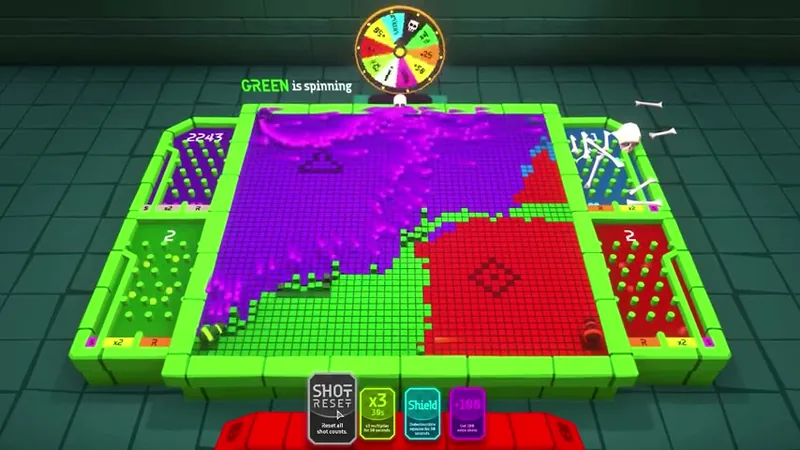
Each color owns a cannon on the rim at one corner of the square grid. The cannons fire long, arcing streams of glowing balls, and the borders between colors move wherever the streams land. Beside each corner, balls drop through a peg board. Above the grid, a wheel spins for one color at a time, and below the arena sits a row of one to four cards. Streams redrawing the map, with those three pieces running alongside, make up the core of the Cannon Royale gameplay.
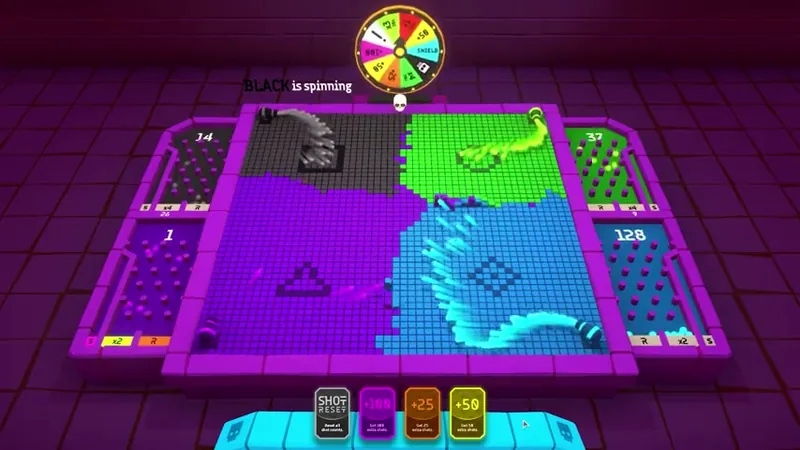
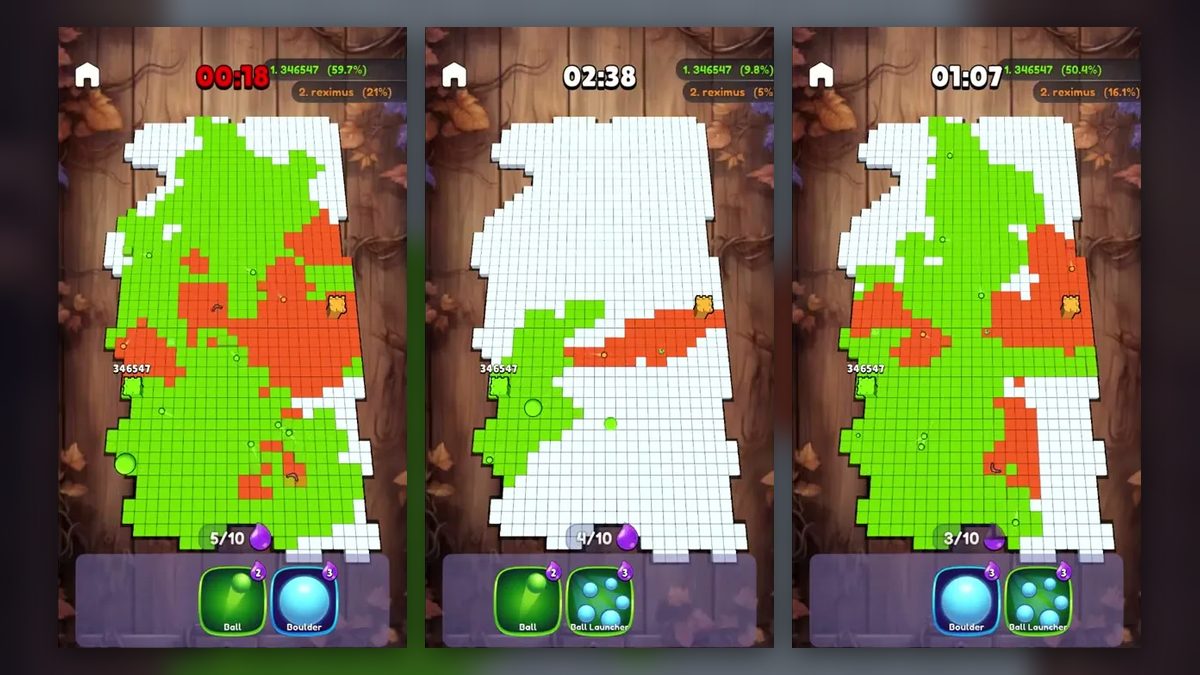
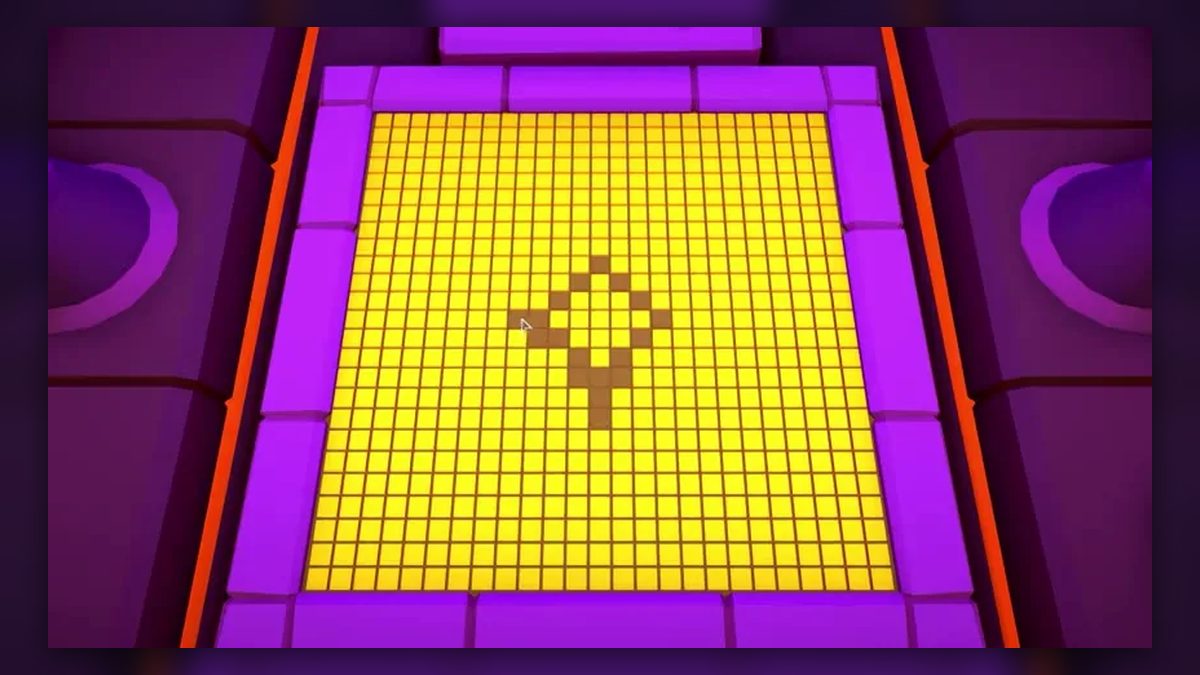
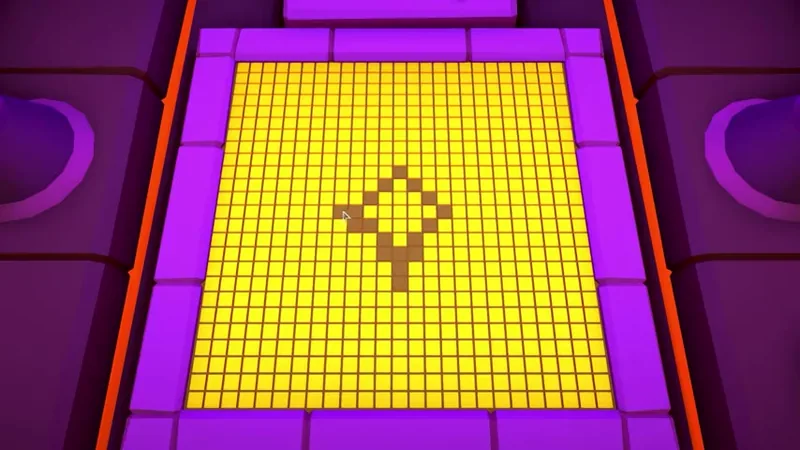
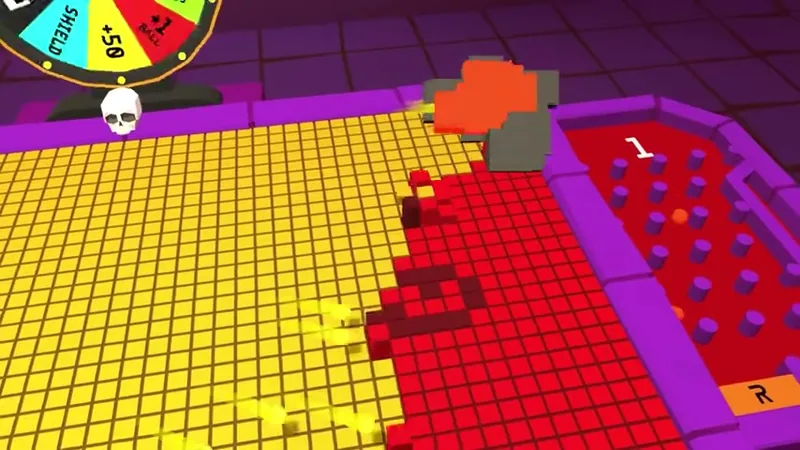
The grid itself is a square of glossy voxel tiles shown in 2.5D, meaning a 3D board seen from a camera tilted overhead. At one point the camera cuts to a straight-down view of a single grid, an all-yellow one with a brown emblem in the middle. Each color’s area carries a pixel emblem in tiles of another shade, from a plain square outline to a skull. Borders are ragged, and the areas grow and shrink from one moment to the next.
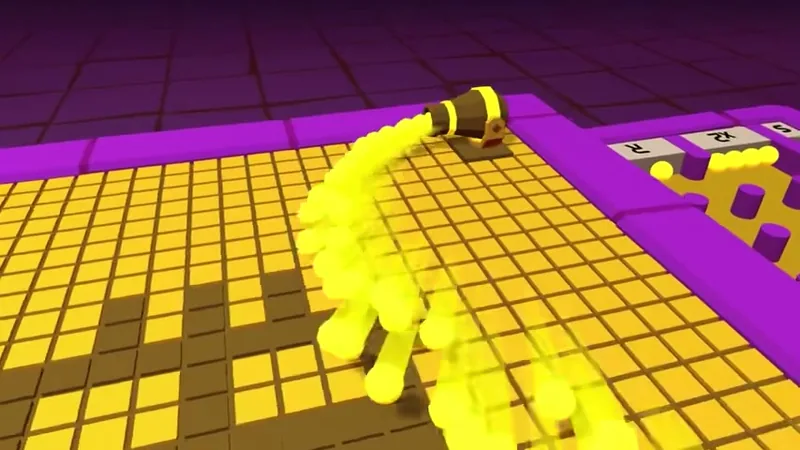
Each cannon is painted in its color’s shade. The streams curve differently from one cannon to the next, and black, green and blue can all fire at the same moment. Up close, a barrel spits a stream of bright balls that rains down across the tiles.
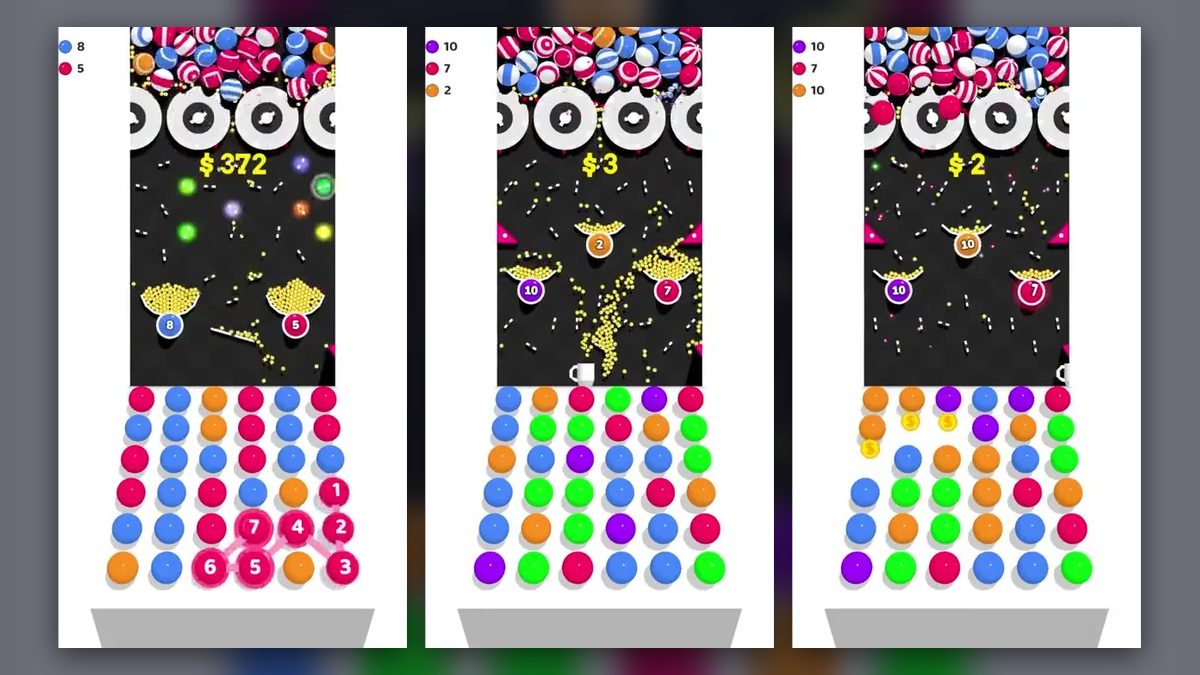
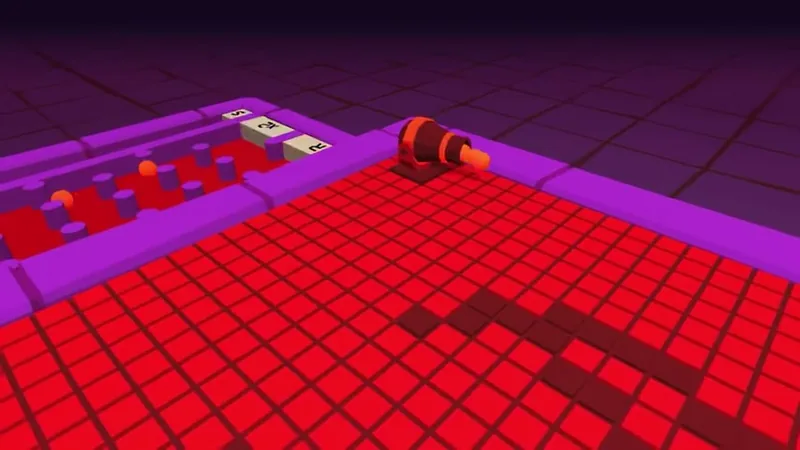
Next to each corner sits a peg board in that color, where colored balls tumble through rows of pegs toward three slots at the bottom. The middle slot is marked x2 (x3 or x4 on some boards), with an R slot on one side and a small slot on the other. On some boards the middle slot is yellow and the two side slots are orange and magenta; on others the labels are plain white. A number printed at the top of each board changes as the match goes on.
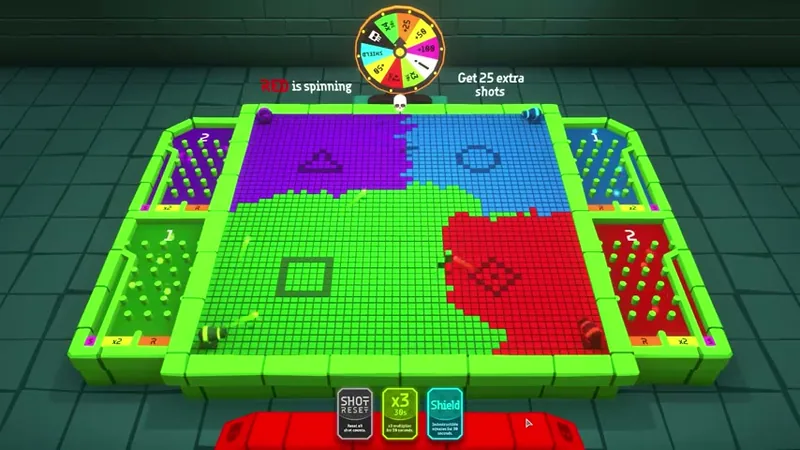
A segmented wheel stands above the top edge of the grid, with a small white skull icon under it. A label to its left names one color at a time, written in that color, from “BLACK is spinning” to “GREEN is spinning.” The segments include SHIELD, +50 and +1 BALL. Sometimes a result appears in plain words on the right, such as “Get 25 extra shots” when the label reads “RED is spinning.”
Whenever the full arena is in view, a gray SHOT RESET card sits at the left end of the card row. Enlarged under the cursor, the card reads “Reset all shot counts.”
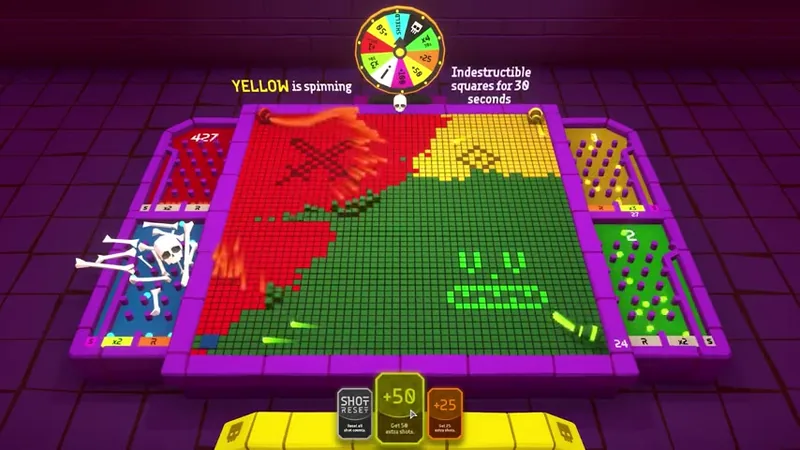
Three cards carry plus numbers: +25 in orange, +50 in yellow and +100 in purple. When the cursor moves onto the +50, that card lifts out of the row beside the +25.
Two cards are marked 30s: a lime x3 and a green x4. A teal Shield card shows up in the same row, next to the x3 in one green arena.
When a color loses its ground, a cartoon skeleton sprawls on or out of its peg board and bones scatter across the arena floor. By then that color has no area left on the grid, or only a few tiles.
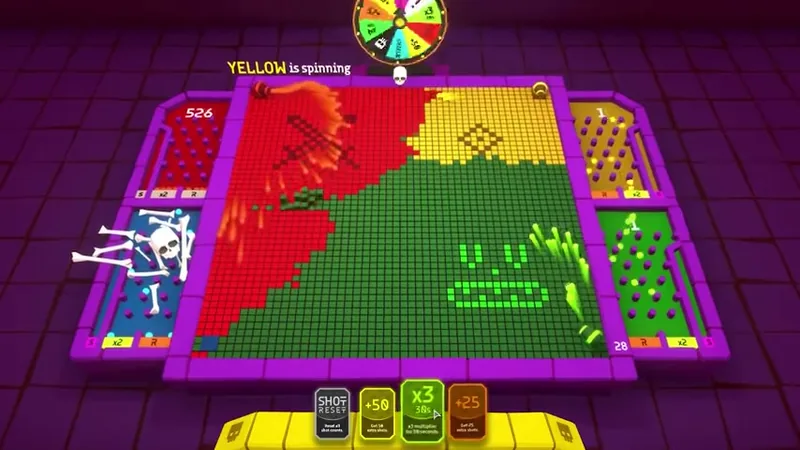
In one purple arena, red holds the top-left corner under an X emblem and yellow holds the top-right under a diamond. A dark green area with a bright green face covers most of the lower grid, and the label by the wheel reads “YELLOW is spinning.” Red’s cannon sprays into the green along their shared border, and the number at the top of red’s board drops from 526 to 427 as it fires. Over the same stretch, the x3 card leaves the card row, and the wheel’s result reads “Indestructible squares for 30 seconds.”
From four colors down to two on the grid
Every grid is square, with a cannon at each corner, and sits in one of two arenas. One has a purple rim on a dark purple floor, the other a lime-green rim on a teal tiled floor. From board to board, the colors swap corners and carry different emblems. One green arena gives purple a triangle and blue a circle, while another gives black a skull and purple a crescent.
In some four-color grids each color holds a large area and the peg-board numbers are in single digits, as in one purple arena where the split is close to even. Black and green share the top half, purple and blue share the bottom, and each quarter has its own emblem.
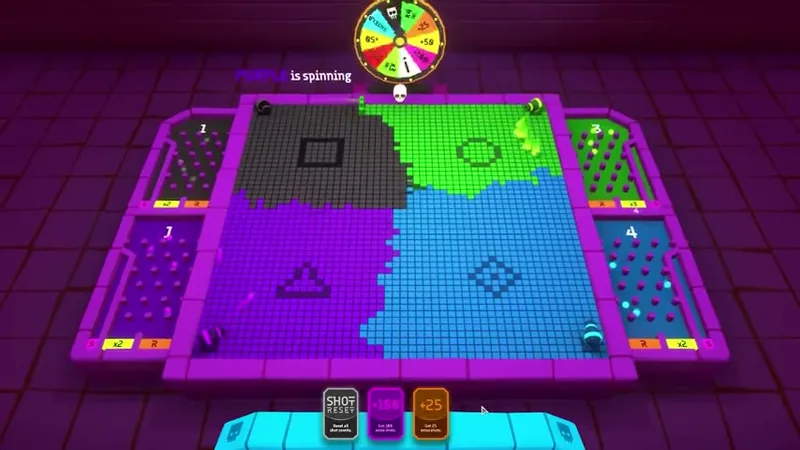
Once a color’s area shrinks to a strip or disappears, a skeleton lands on its board and the other three keep firing. In the purple arena where red has the X, blue’s skeleton lies on the bottom-left board while the other colors split the grid. In a green arena, blue holds on to a few tiles along the top-right edge as bones fly off its board.
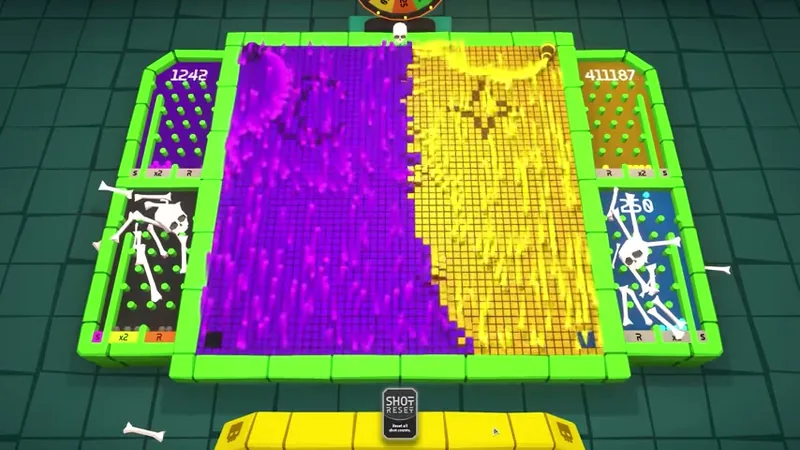
In the one two-color grid we saw, purple holds the left half and yellow the right, their tiles pushed up into spikes, with skeletons on both lower peg boards. The numbers on the two remaining boards run to four and six digits, against single digits on the evenly split four-color grids. The card row is down to SHOT RESET alone.
Outside the matches, the only other screen is the Cannon Royale logo over a dimmed board. Under it are “WISHLIST NOW ON STEAM” and a line of small print that calls itself pointless text. No shop, currency, ad or reward screen shows up anywhere, and what follows a match is never shown.
Peg boards and cannons in mature voxel art
Cannon Royale is the first bouncing-ball idle auto-battler with mature artwork that we have seen go on sale on Steam, and for the category that is a big step forward. All of its parts share one screen, from the peg boards in the corners to the card row under the arena. They frame a battle royale in which every color that falls leaves a skeleton behind.
In the arena, the tiles are glossy voxels in saturated colors, and the ball streams glow as they arc over the grid. Tiles that get hit jump up into spikes and waves, and loose voxels fly off along the borders.
Thin luck from peg boards and cannon angles
We found the random elements fairly thin, and the play doesn’t give the player much depth. Chance comes from two places: balls dropping through the peg boards, which by design set how many shots each cannon gets, and the angle each cannon fires at, which curves one stream one way and the next another. Beyond those, the player’s part on screen is the card row, which is open at any time while the cannons keep firing.
The game also seems to have been in testing for a long time, and no strong reason to keep playing over the long run has appeared yet.
Picking cards while the cannons fire
These mechanics lean toward people who like to follow a fight they do not steer shot by shot. That means watching four streams push borders around the grid and keeping an eye on the peg boards and the wheel. Then it means reaching into the card row for an x4 or a Shield when the moment looks right.
Anyone drawn to last-one-standing contests gets that shape here. A match narrows color by color, and each color that drops out is marked on its own board.
Verdict
Cannon Royale moves the bouncing-ball auto-battler a big step forward, and its voxel artwork looks mature. But the luck it runs on is fairly thin and the play has little depth for the player. After what looks like a long stretch of testing, no strong reason to keep coming back has shown up yet.