CircleBlocks Review: Falling Blocks Stacked on a Ring Tower
A CircleBlocks review of the falling-block puzzle that swaps the flat well for a ring-shaped 3D tower, with pieces up to a 3x3 square.
Game at a glance
CircleBlocks
7/ 10
Our score
Touch-only Tetris feels strange to control. Anyone got a good idea for fixing that?
In this article6 sections
Stack falling pieces onto a ring of cubes instead of into a flat well, and every so often the ring sinks back down. That is CircleBlocks: a cylindrical 3D version of Tetris, the falling-blocks classic, and one of the block puzzle games where every piece drops from above.
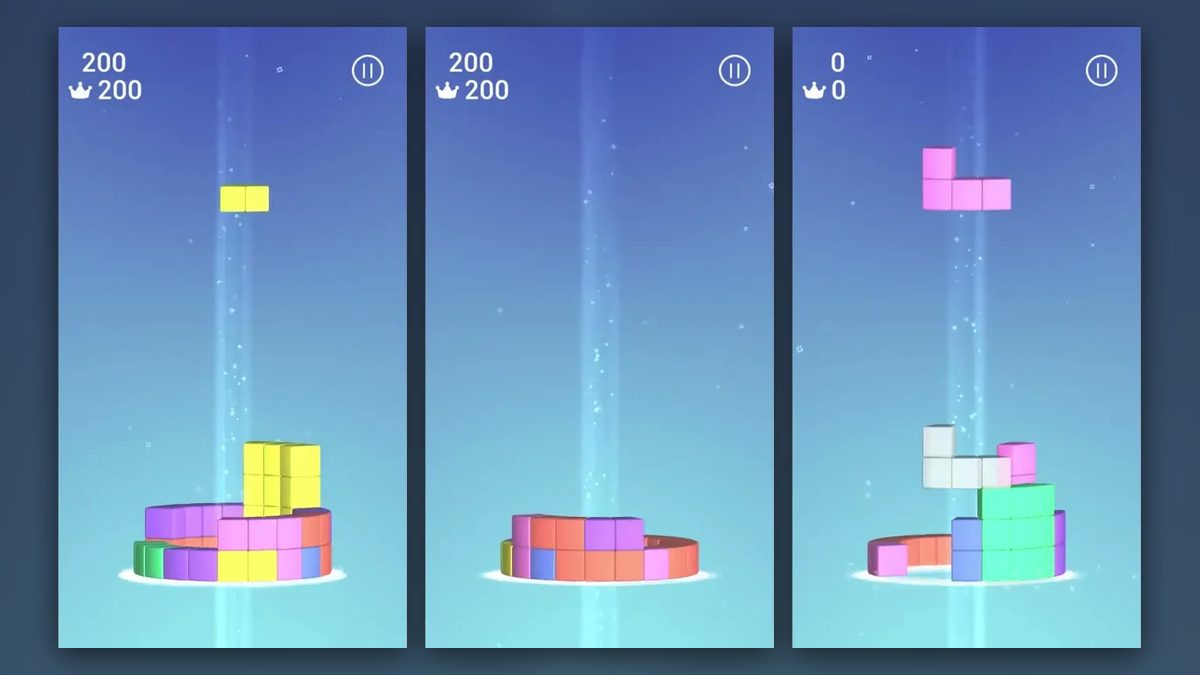
The round board is the new part, built on a straightforward idea that stands out, while everything around it is kept very light. In the single endless run we played, the score climbed from 0 to 500 in steps of 100, and the screen showed nothing besides that score, a crown number and a pause button.
A ring of cubes under a beam of light
There are no levels to win and no target to reach. The game is one endless run scored in points, and no win or game-over screen comes up along the way. Pieces land on top of the ring and build it upward, and every so often the score rises by 100 and the tower comes out lower.
No buttons or arrows appear on screen besides the pause button at the top right. Each new piece appears in the same spot, inside a vertical beam of light at the center of the screen, while the ring below shows a different face from one moment to the next. A mint 3x3 block that hung over its outline is sitting to the right of the beam a few seconds later, which suggests the ring turns under a fixed drop point.
A run moves in a short cycle. A piece appears in the beam and comes down onto the ring. Its cubes join the tower, then the next piece appears in the same place. That cycle is the whole of CircleBlocks gameplay, repeated with a fresh piece each time.
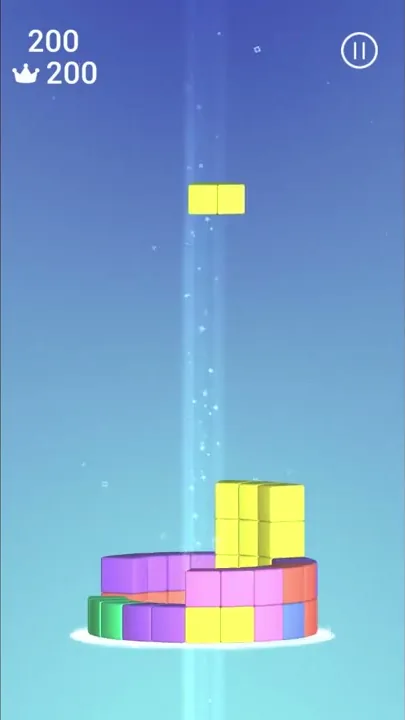
The playfield is a hollow ring of cubes standing on a glowing white disc. The camera holds still, looking at the front of the ring from just above, so the open center and the inside of the back wall stay in view. The cubes are pastel with beveled edges and soft shading, set against a sky that fades from blue at the top to pale cyan at the bottom.
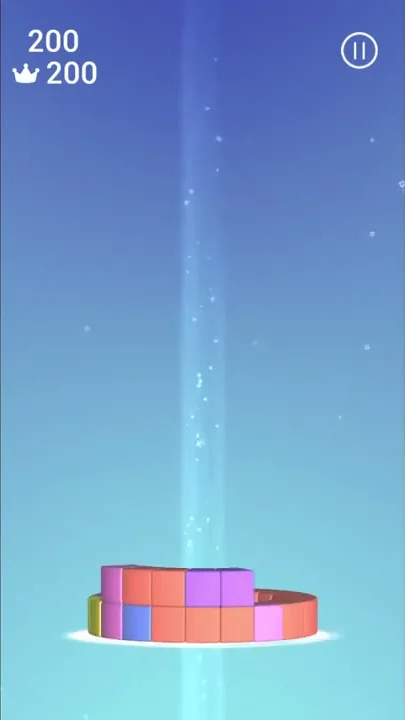
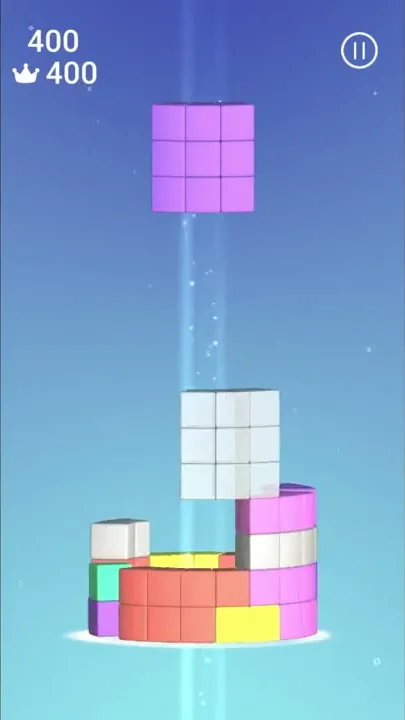
Translucent white cubes in the shape of the falling piece sit on the tower directly under the beam and mark where it will land. The outline copies whatever is coming: a 3x3 square under a 3x3 block, an L under an L, a flat row of four under a flat four-cube bar.
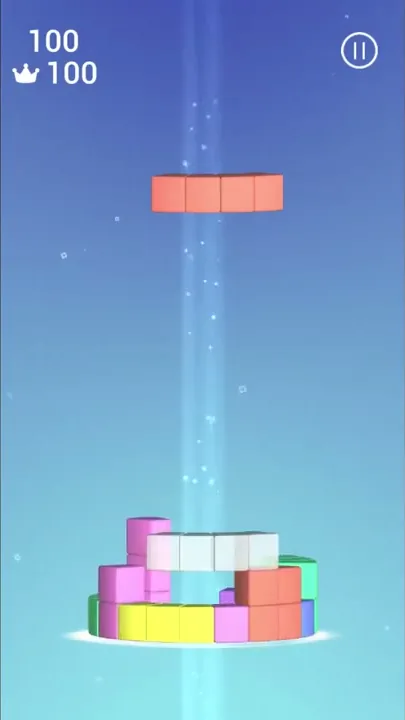
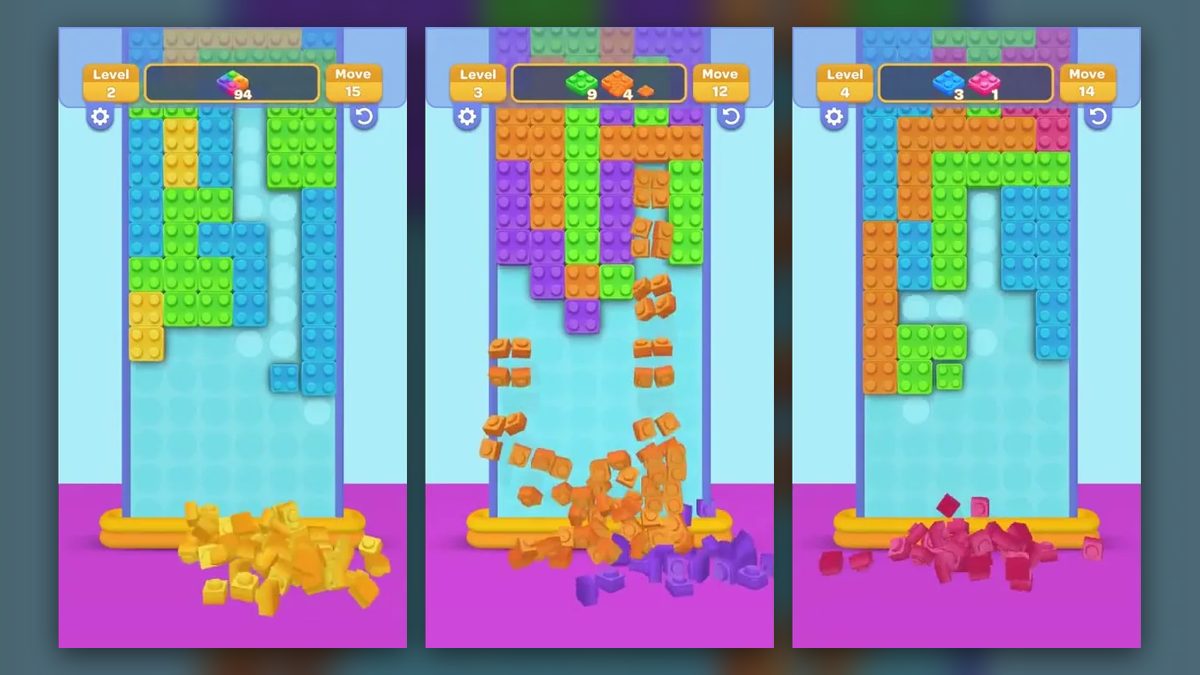
Single cubes and straight bars turn up most often. The bars run between two and four cubes long and appear either lying flat or standing upright. An upright bar gets an upright outline too, a white column standing on the tower.
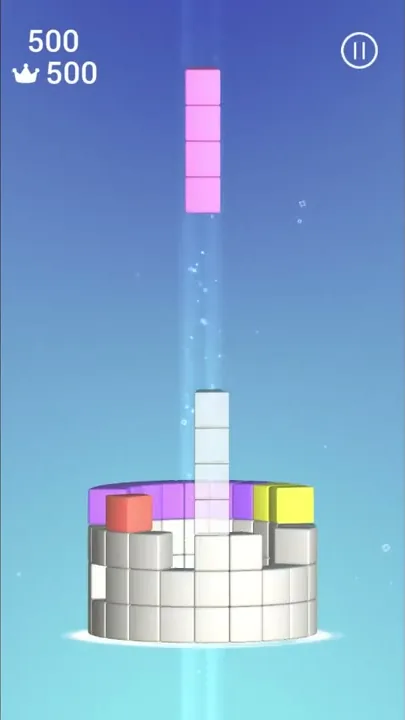
Square pieces come in two sizes, 2x2 and 3x3. The 2x2 appears in several colors and the 3x3 in mint and violet; the 3x3 is the largest piece in the run.
Two L shapes show up. The bigger one is a row of three cubes with a fourth sitting on top of the left end, in pink or mint. The smaller is a three-cube corner: two cubes side by side with a third on top of the left one.
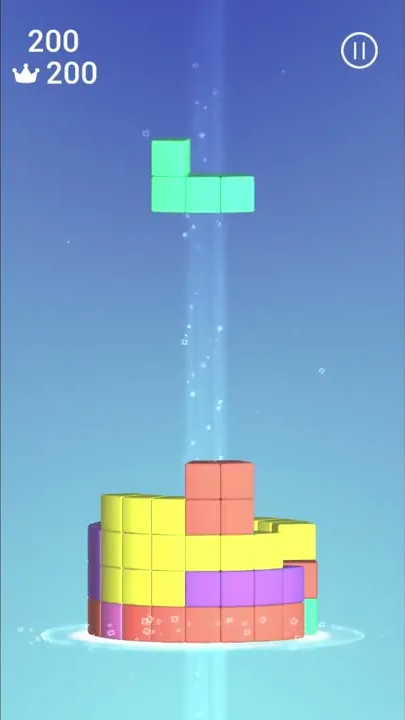
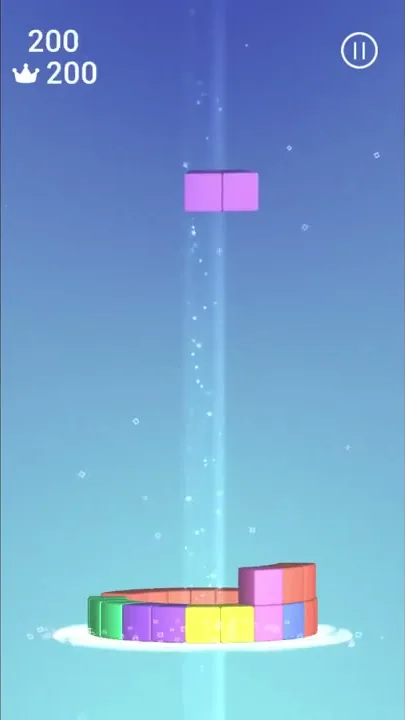
Clearing shows up in two places at once: the score and the height of the tower. A stretch about a minute into the run makes the pattern plain. The score reads 100 while the right side of the ring stands about three cubes high; moments later it reads 200 and the whole ring is down to one or two cubes, with sparkles spreading over the glowing disc at its base. That jump of 100 alongside a lower tower happens five times over the run.
Later on, white-gray cubes start to appear among the colored ones, first near the top of the tower on both sides. None of the pieces that fall from the beam is gray. From there the gray spreads to more of the tower.
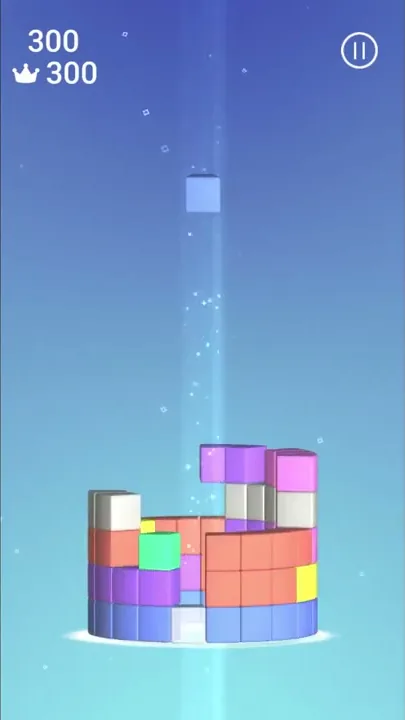
From a low ring to gray rows
Height is what changes most over the run. Early on the tower stays low, between one and four cubes high, with parts of the ring still open, and the score goes from 0 to 200 in that stretch.
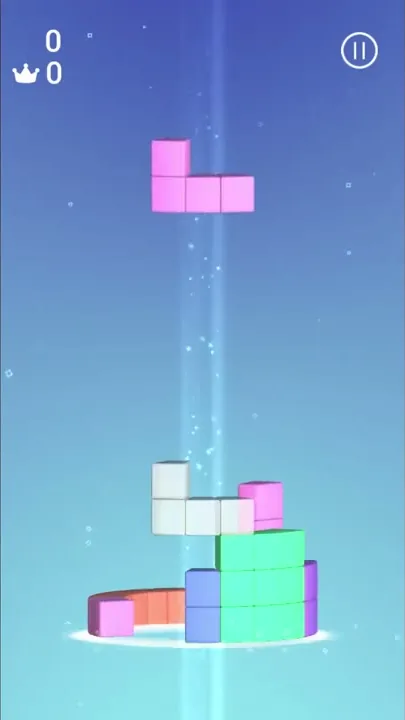
By the middle of the run the stacks have grown uneven, reaching four or five cubes at their highest points. A mostly pink column stands five cubes high at the front, but clears keep the tower from climbing further while the score goes from 200 to 400.
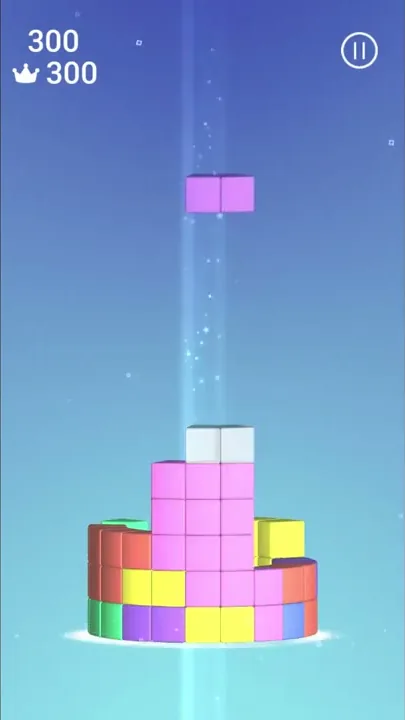
The 3x3 square comes in mint near the start and in violet late on, and the four-cube L appears in pink, then mint, then pink again; the only three-cube corner we saw came late in the run.
The tower’s color shifts toward the end. Its lower rows turn white-gray instead of colored, and colored cubes remain only in the top row or two. The score holds at 500 through this last stretch. Nothing on screen marks a height limit or a game over, so what ends a run remains unknown.
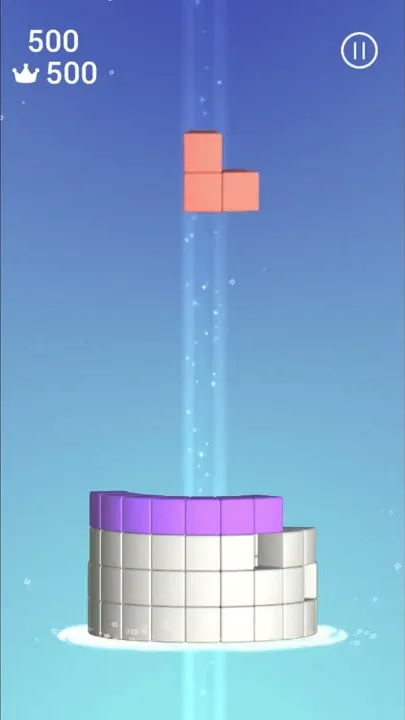
Outside the stacking, the screen holds very little. The score is printed in the upper left corner, with a crown icon and a second number beneath it, and the two numbers match at every point in the run. Rather than jumping, the score rolls up through in-between values on its way to each new hundred.
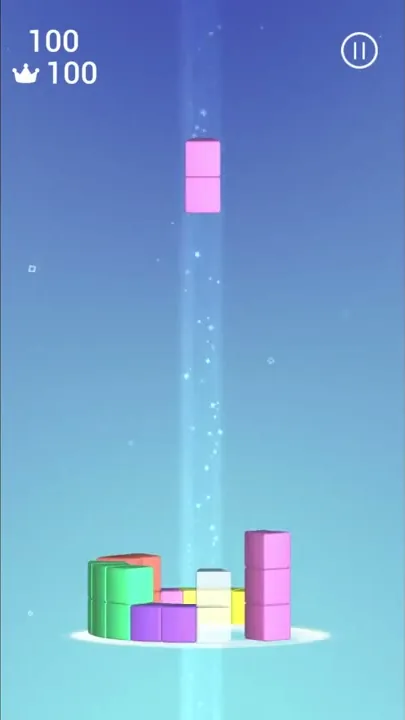
Opposite the score, a white pause icon inside a circle stays on screen from start to finish, though its menu is never opened. Through the whole run there was no economy at all: no coins or other currency, no shop, no boosters, lives, rewards, offers or ads.
Wrapping the well into a cylinder
Changing the shape of the board and the angle of view gives an old formula some fresh life. What’s new is the board itself: instead of dropping into a flat well, every piece lands on a cylinder of cubes, and a block set down under the beam sits off to the side moments later. Shapes as familiar as the four-cube L and the straight bar end up on a curved wall rather than in a flat pit.
The idea behind that is a very simple one: change the shape of the board and the angle of view. It caught our eye.
No goals to chase, awkward touch input
It’s a missed chance that CircleBlocks is built so light. It belongs to ultra-simple pick-up-and-play: a run is a score counting up and nothing more, with no level to finish and nothing to earn on the way.
Some systems around the core game, or levels with goals of their own, would give it more staying power and make the game more fun. As it stands, each new hundred on the score is the only sign of progress.
Control is the other sore point. Steering falling Tetris pieces with nothing but a touchscreen felt very strange to us, and the two make a really awkward match. Every piece, from a lone cube to the violet 3x3, appears at the same fixed spot in the beam, and the screen offers no buttons or arrows besides pause, so touch is all there is to work with. What would work better is an open question.
Stacking on a ring for score alone
A run here repeats one action: a piece appears in the beam and comes down on the ring, and every so often the tower drops lower as the score passes another hundred. The shapes are the single cubes, straight bars, squares and L pieces of the block-puzzle family that also takes in games like block blast, only stacked around a cylinder seen from just above.
The mechanics line up with stacking falling shapes for their own sake and watching one number count upward, with the round board as the novelty. Anyone hoping for levels to clear or goals to meet won’t find them in the run.
Verdict
Bending Tetris into a cylinder is a simple idea, and it makes an old way of playing feel somewhat new. The game around that change stays very thin, though. Without goals or a layer of progression it is less fun than it could be, and touch remains an awkward way to steer this kind of stacking.