Jelly Match! Review: Squishy Pieces Pulled From a Bottle
Toys and desserts squash through a narrow neck into a seven-slot tray: a Jelly Match! review of a puzzle built on soft, squishy pieces.
Game at a glance
Jelly Match!
8/ 10
Our score
Coming up with something new in tile matching is a real fight these days.
In this article6 sections
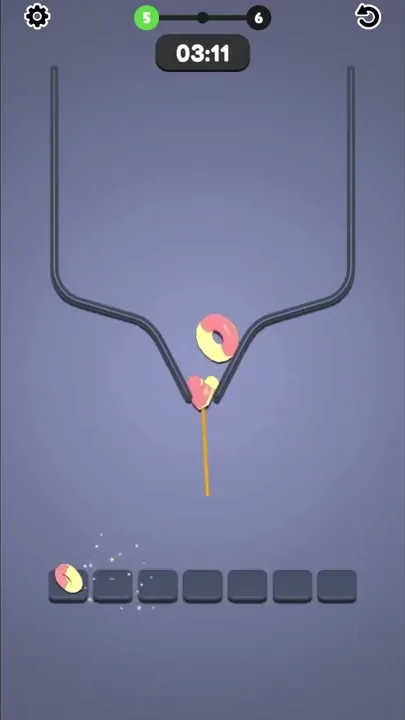
In Level 1 of Jelly Match!, we pulled a multicolored piece down through the narrow neck of a bottle, and it stretched into a long, soft shape on its way out, a thin orange line trailing below it. Three pieces were still waiting above, and the tray at the foot of the screen already held a multicolored ball and a red-and-white one.
This mobile puzzle is one of the tile match games, built on tile matching with a small tray: pieces go into a row of slots, and three of a kind clear. The difference is the pieces themselves, soft 3D toys and desserts piled loose in a bottle, which squash at its neck and press against each other on the way out. We played Levels 1 through 5.
It is the first tile matching game we know of with squishy pieces. Even so, it stays on the ultra-simple side.
Pulling soft pieces through the bottle’s neck
Underneath the jelly, Jelly Match! gameplay follows the same basic rules as Sheep a Sheep. Pieces leave the bottle above and end up in the tray below, where three identical pieces burst and clear. When the bottle has been emptied, a Level Completed screen follows.
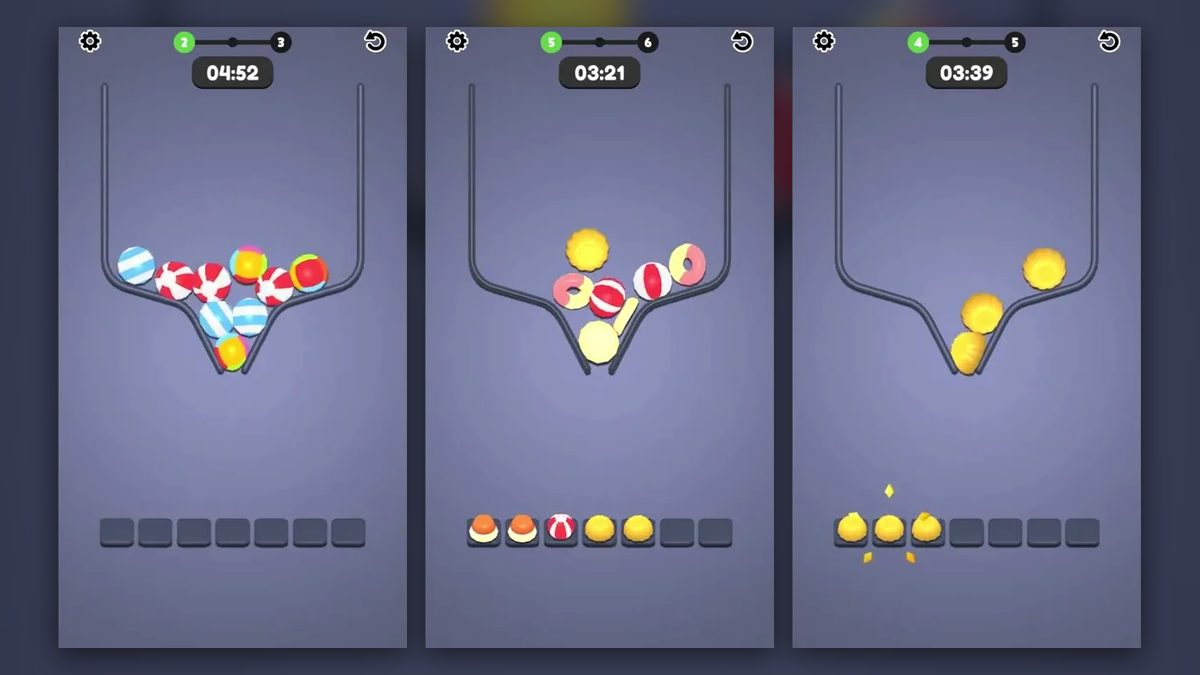
All the pieces sit in one loose pile inside a bottle drawn as a dark gray outline, with straight walls and sloped shoulders above a V-shaped bottom that narrows to a small opening. The top is open, but pieces leave only through that opening at the bottom. They are glossy, rounded 3D models of beach toys and desserts, set against a plain lilac-gray background.
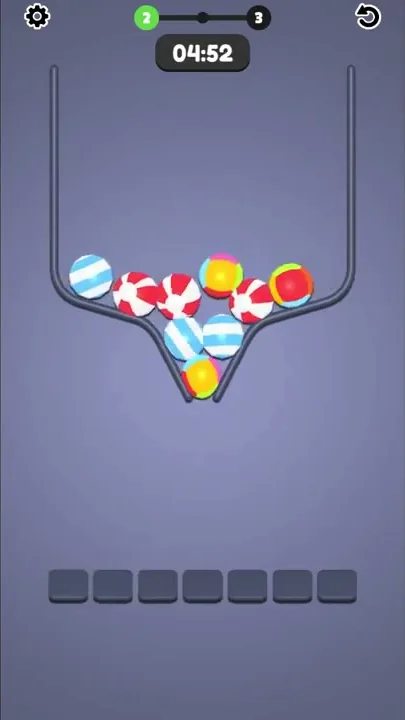
Pieces are dragged out through the opening. While one is on the move, a thin orange line runs from it toward the bottom of the screen. Other pieces are seen in the air between bottle and tray with no line attached.
Rubber ducks crowd the bottle in Level 3, and shortly after it begins the timer reads 03:58, with one multicolored ball already in the tray. Soon two orange-and-cream puddings sit side by side in the slots. Later the tray holds a beach ball, two yellow ducks and two blue-and-white striped balls, with a third duck in the air above it. A few seconds after that, the bottle is down to its last three pieces, two ducks and a beach ball, just before the Level Completed screen.
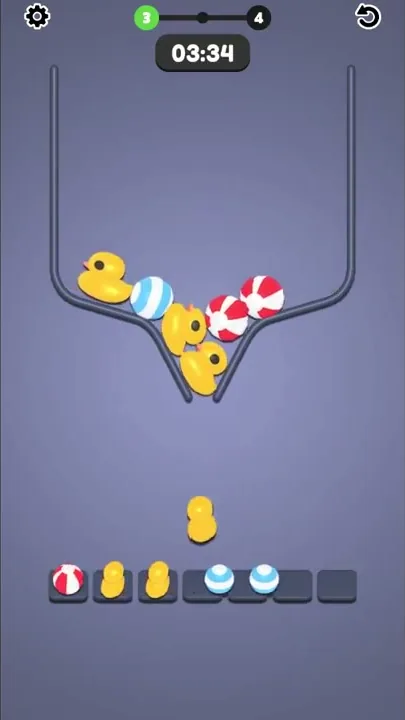
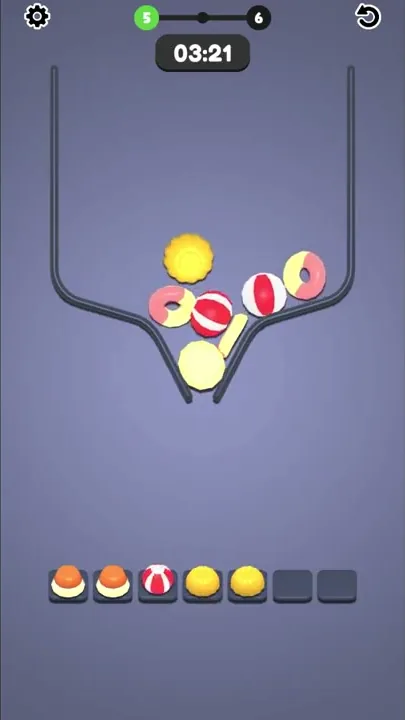
The tray is a row of seven gray slots under the bottle. Pieces in it appear as smaller upright copies, and identical pieces are seen next to each other: in Level 5, two puddings and two ridged yellow jellies line up with a beach ball between them.
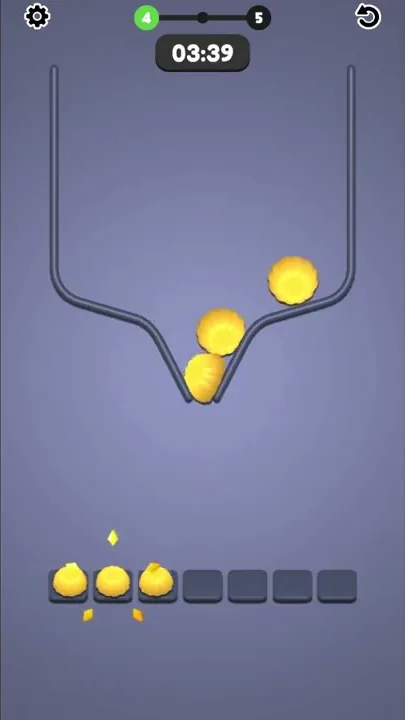
Three identical pieces side by side in the tray break apart in a burst of yellow diamond-shaped shards, and the tray is left with fewer pieces. Three ridged yellow jellies go this way near the end of Level 4, and three puddings in Level 5.
The pieces are soft and change shape at the narrow opening. Besides the stretched piece in Level 1, a pink-and-yellow ring in Level 5 is squashed in the opening as it is pulled out, with one more ring waiting above it.
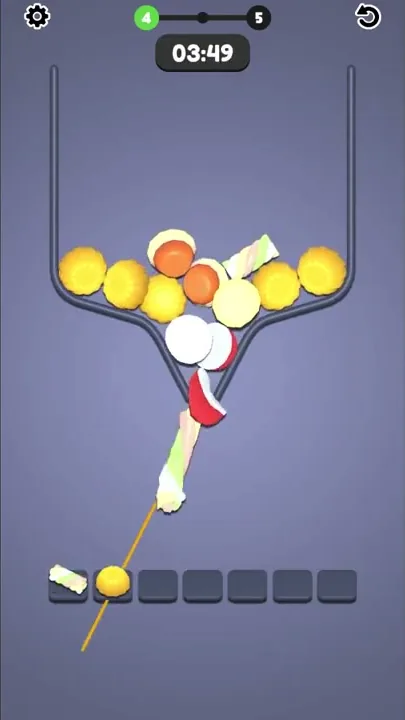
Pieces press on each other too, and a pull can move more than the piece being pulled. In Level 4, a marshmallow twist pulled out below the opening pushes the red-and-white piece beside it down into the opening behind it.
A countdown timer in a dark rounded box under the top bar runs down during play. We can’t say what happens when it reaches zero, or when all seven slots are full.
From beach balls to a packed dessert bottle
A level is one bottle over the row of seven slots, with a countdown above and a Level Completed screen with a Next button at the end. Bigger piles come later. Early in Level 1, a small cluster of pieces sits low in the V, below the straight walls, and early in Level 2 the pile spreads across the sloped shoulders. By the time Level 3 opens it reaches the lower part of the straight walls, and the start of Level 5 has it packed higher up the walls than any earlier bottle.
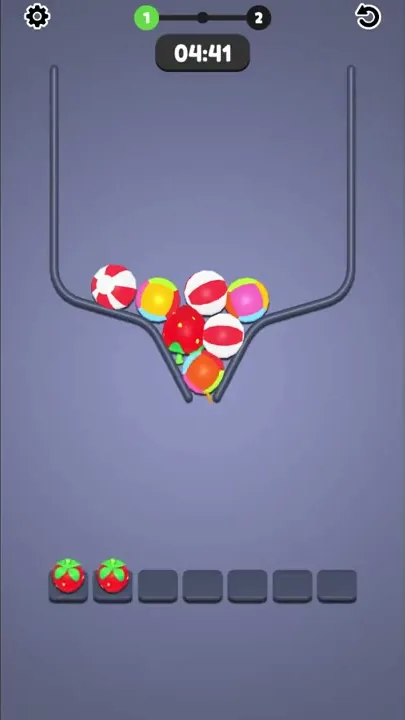
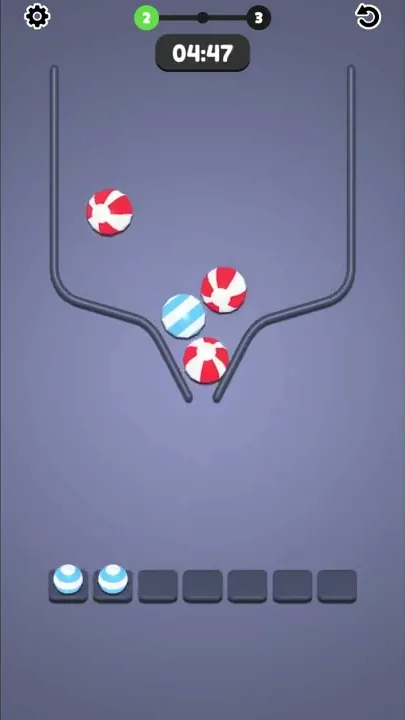
The pieces change along the way. Balls in red and white, blue and white or many colors fill the first two bottles, with strawberries in Level 1. Yellow rubber ducks arrive in numbers in the third bottle, along with red-and-white swim rings and orange-and-cream puddings, and white and pale yellow discs and red domes join them there.
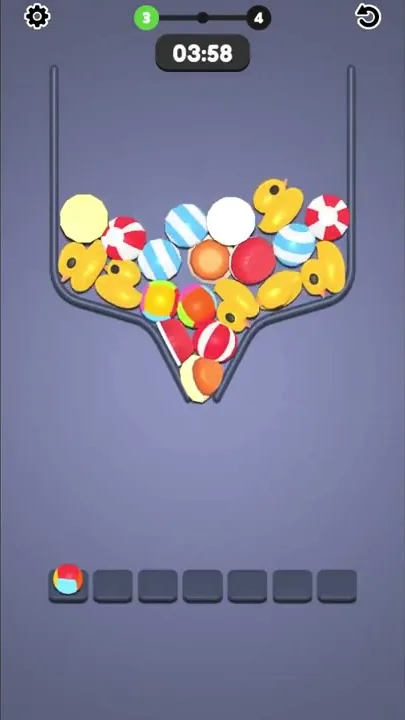
Desserts take over in Level 4. Ridged yellow jellies and pastel marshmallow twists are new here, sharing the bottle with puddings and discs, red domes and a red-and-white wedge. The twists are the first elongated pieces.
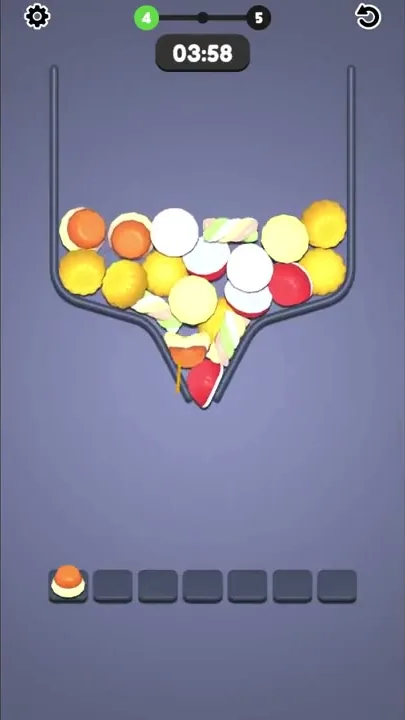
The fifth bottle mixes new pieces with old. Pale yellow rings, pink-and-yellow donut rings and tan ridged cookies appear for the first time, sharing the bottle with ducks and balls from before.
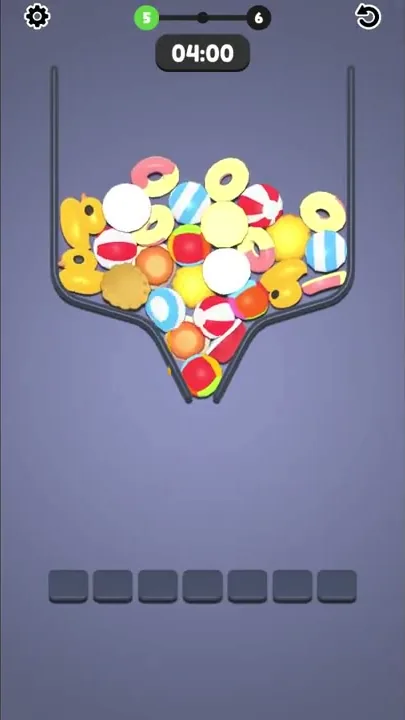
The clock varies as well. It reads 04:57 early in Level 2, 03:58 soon after both the third and fourth bottles appear, and 04:00 as Level 5 begins.
Outside the bottle, a progress bar at top center links a green circle holding the current level number to a black circle holding the next one, with a dot on the line between them: 1 and 2 during Level 1, 5 and 6 during Level 5. A gear icon sits in the top left corner and a circular arrow in the top right. Nothing else turned up during play or between levels: no coins, gems, lives, boosters, shop or ads.
Emptying a bottle dims the board for a Level Completed screen. A smiling yellow face sits above the words while confetti falls, with a green Next button below, and the screen gives no rewards. Between levels, the screen goes fully black.

Jelly pieces that squash and push
The squishy pieces are the highlight, and the idea that sets this game apart from other tile matching. They give at the opening, like the ring squeezed in the neck in Level 5, and they bump and rub against each other in the pile. A pull can even bring a neighbor along: the red-and-white piece behind the marshmallow twist in Level 4 is pushed into the opening, where it sits in the way.
The pile is where the puzzle comes from. Every piece is in plain view, but the pieces stack and squeeze together, so getting the one you want out means thinking about what it will collide with and the route it takes. At the start of Level 5, rings and ducks sit high up by the walls, with a packed crowd of pieces between them and the small opening at the bottom, the only way out.
Still simple, and the bottle could do more
Too bad the game is still a bit ultra-simple pick-up-and-play.
The bottle has room for more. It is drawn as a dark gray outline and seen head-on, and pieces leave it only through the opening at the bottom. A bottle the player could shake, or one built fully in 3D, could make for interesting levels built around those mechanics.
Choosing the right piece from the heap
The play centers on reading a pile. A player scans the open heap for the next piece of a set, pulls it down through the neck and watches what each pull does to the pieces around it, since a piece can come out with company.
The taste it fits is a hands-on one. The rules are standard tile matching, a tray of seven slots with sets of three to collect and a countdown above, but each piece is handled as an object, squashing and stretching as it is pulled through the opening.
Verdict
In a genre where fresh ideas are fought over hard, Jelly Match! has found one: pieces with give, which push each other around while you pull the right one free. It is a good game resting on that idea, even if it stays a little ultra-simple, and a bottle you could shake, or one made fully 3D, could turn the same mechanics into interesting levels.