Foldbox Review: Blocking Puzzles Folded Into Cubes
Six-tile cube nets overlap, hide yellow keys and fold up into cubes; this Foldbox review follows them onto the walls of a hollow box in Level 5.
Game at a glance
Foldbox
7/ 10
Our score
Blocking puzzles move from 2D to 3D here, and the play and the experience change a lot.
In this article6 sections
Many pin-pulling, bolt-unscrewing and coil-untangling puzzles build their boards from one problem: a piece is stuck because something else lies across it. Foldbox, a mobile cube-folding puzzle game, keeps that problem and moves it into three dimensions. Its pieces are flat cube nets, six colored squares laid out the way a cardboard box looks before it is assembled, and the nets overlap one another on the board.
In those games the blocking happens on a flat picture. Here the nets fold up off the board into cubes, and later they wrap the walls of a box seen from changing sides. We played from partway through Level 2 into Level 6 and found a puzzle with a novel perspective inside a game that stays ultra-simple pick-up-and-play overall.
Cube nets, keys and keyhole bars
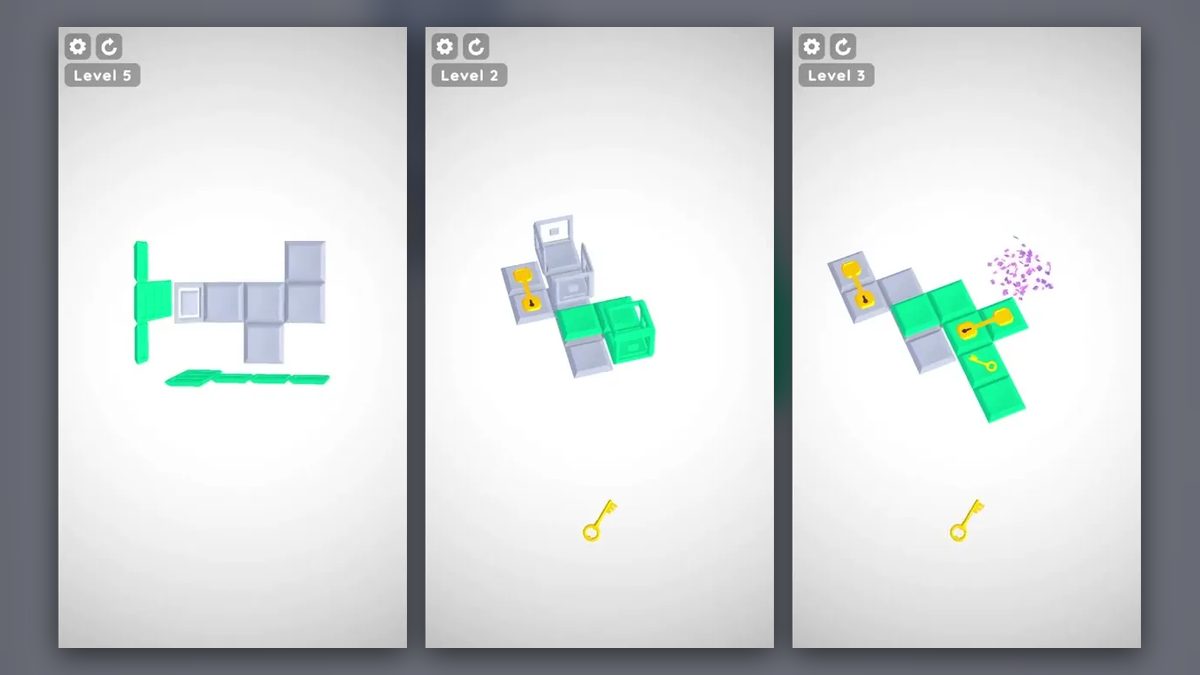
Each level lays out several flat nets, one color to a net. The task is to fold each net’s six faces into its cube and to collect the keys resting on some of the tiles. Once every net has been folded and cleared, the next level appears; the end of Level 2 leaves one closed gray cube alone on a white screen just before Level 3 takes over.
A net is six square tiles of a single bright color, arranged like a cube cut open and pressed flat. The tiles have beveled edges, and the nets seen come in gray, mint green, purple, blue, pink and lime green. The puzzle floats in the middle of a plain white-to-light-gray backdrop with a soft vignette.
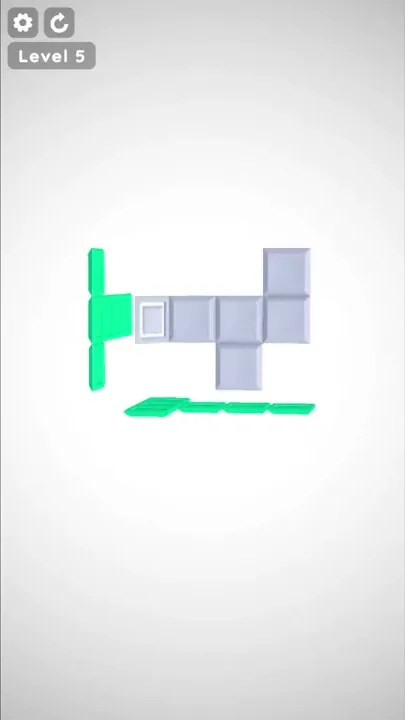
Each net folds up separately, and one can stand partly folded while another closes: in Level 2 the gray net already has two faces up as the mint green one shuts. In Levels 4 and 5 the view of the puzzle turns while the level is under way. A gear button and a circular-arrow button sit at the top left, above a gray label that shows the level number.
As a net folds, its lifted faces turn into see-through hollow frames with a small square at the center, so the inside of a half-built cube stays in view, and in the end the net closes into a cube. When the net under a key folds, the key leaves its tile and a key turns up near the bottom of the screen.
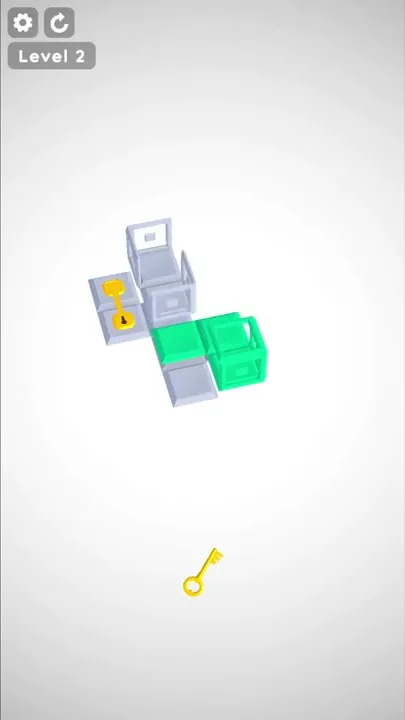
A finished cube bursts into a spray of small fragments in its own color and leaves the board. In Level 3 the purple cube bursts, then the mint green one, then the gray, and the last mint green pieces of Level 5 go the same way.
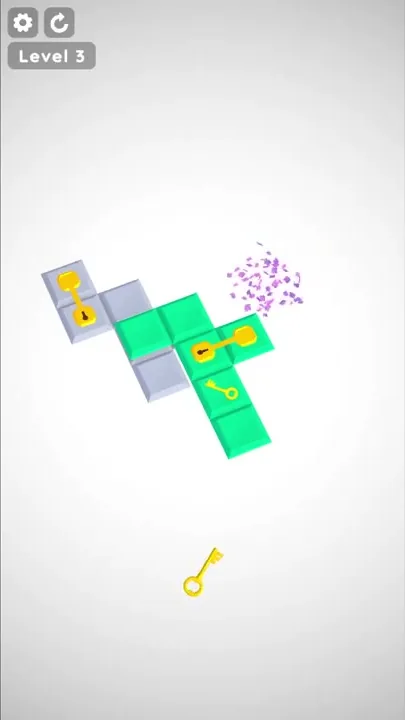
Keys are yellow and lie flat on some of the tiles. Once collected, they line up side by side near the bottom of the screen: in the middle of Level 4, two sit there while a third is still dropping from the board. Seconds later the three keys are gone, and so are two pink lock bars.
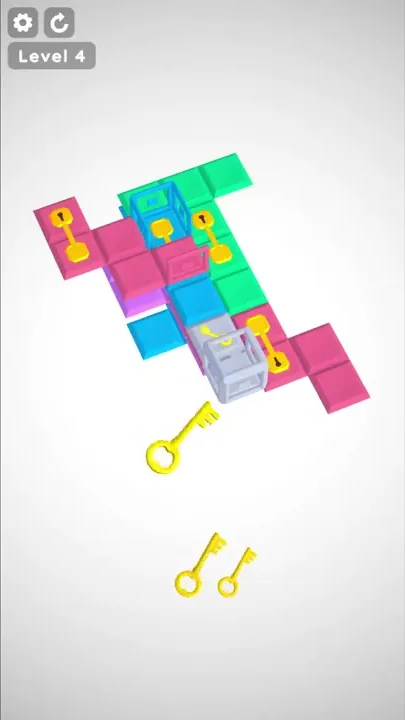
Lock bars share the keys’ yellow. Each is a bar with a rounded square at both ends, laid across two neighboring tiles of the same net, with a black keyhole in one end. They show up in Levels 2, 3, 4 and 6; Level 5 has neither keys nor lock bars, and both return in Level 6. In Level 2 the purple net folds into a hollow cube with its lock bar still inside.
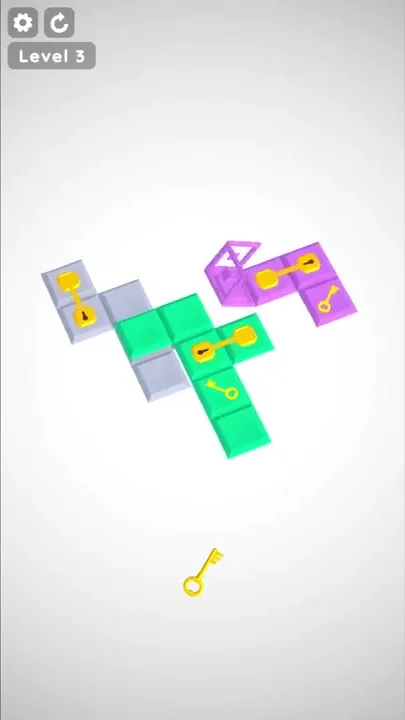
The nets block one another, and Foldbox gameplay is built on that overlap. Faces of one net lie on top of another’s, so tiles, keys and lock bars underneath stay out of sight until the net above folds out of the way. In Level 3, gray tiles come into view where green ones lay. In Level 4, a green lock bar is uncovered once the gray net has folded, and lifting a pink face reveals a blue tile with a key on it.
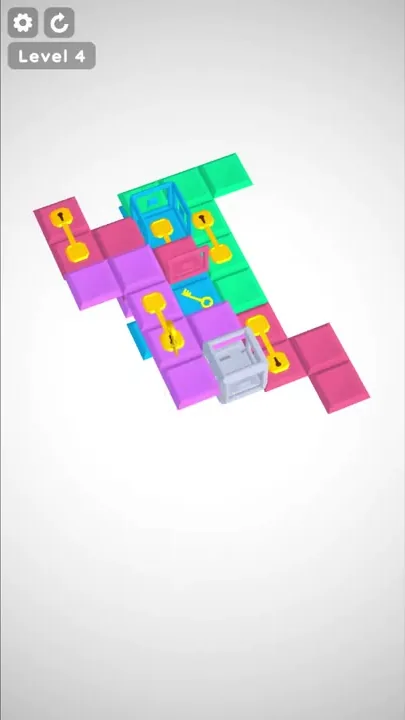
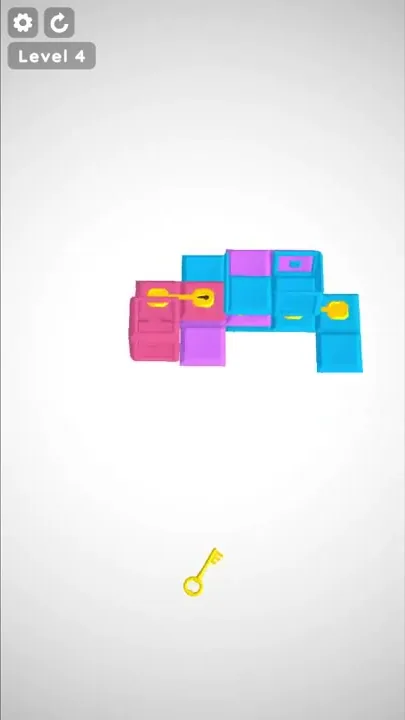
The camera angle changes during a level too. Early in Level 4 the board is seen from a tilted overhead angle; later it has turned, and near the end the remaining nets are seen from low down, almost side-on. In Level 5 the box is shown from one side, then another, then a third.
Partway through Level 2, three nets share one flat plane: gray at the upper left and purple on the right, with mint green running down the middle and lower right, partly tucked under the purple. Two keys rest on tiles, one gray and one green, and two lock bars lie on the gray and purple nets.
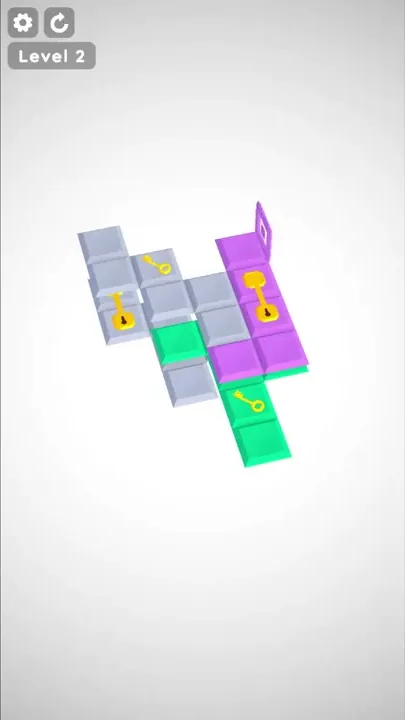
The purple net already has a face standing, and it closes into a hollow cube around its lock bar before leaving the board. The green net then folds around its key and a key appears at the bottom of the screen, while the gray net rises wall by wall. When the gray cube shuts, it is the only thing left on the screen.
From one flat plane to every side
The early boards grow more crowded. The three nets on the Level 2 board give way to a cross of four in Level 3, and three of the four carry a lock bar.
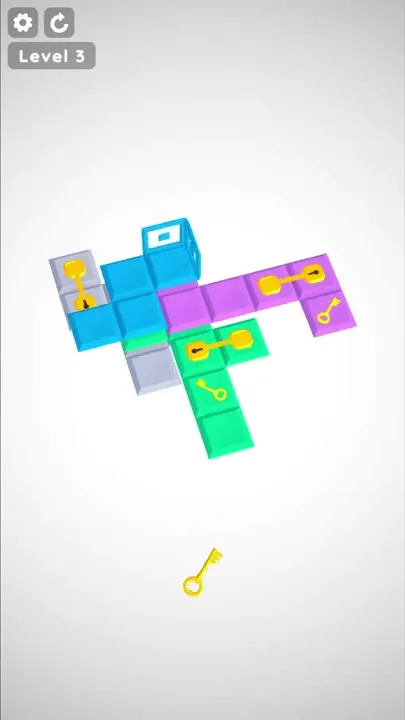
Five colors pack a larger, denser diagonal cluster early in Level 4, with more overlap than before. Keys and lock bars lie hidden under other nets here, and the view turns partway through. The level also runs longer than Levels 2 and 3.
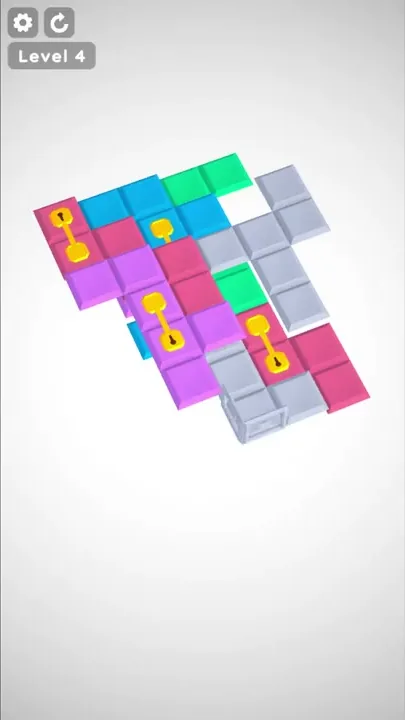
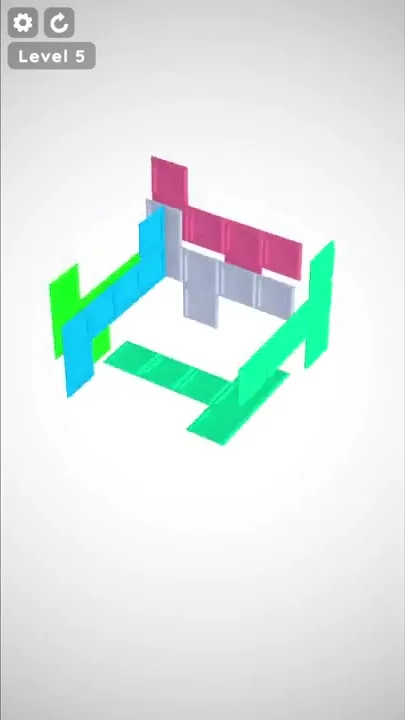
Then the single plane is gone. The nets of Level 5 stand at right angles to one another as the walls and floor of a hollow box, and some are seen edge-on as thin upright strips. On one wall a pink net lies over the gray one, and once the pink has gone, six gray tiles are left uncovered.
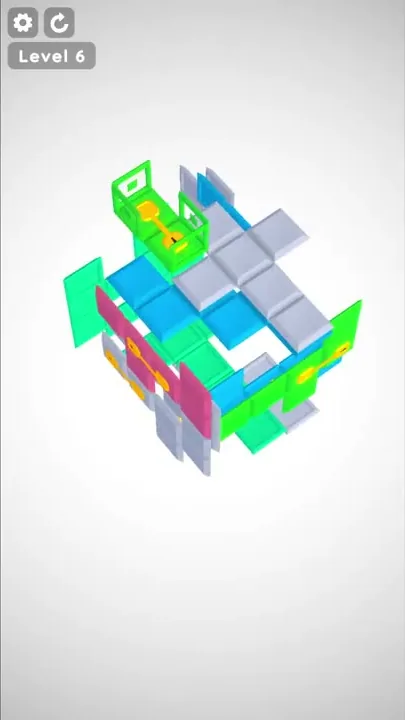
The structure grows again in Level 6, into a larger cube shape with nets on all of its sides. Three lock bars are in view early in the level and a key rests on a blue tile, while at the top a lime green cube folds up around a lock bar.
Around the boards, the gear and circular-arrow buttons and the gray level label are at the top left in Level 2 and still there in Level 6. While a level is being played, they are the only interface on screen: no goal card, move counter, timer, lives, coins, shop or boosters appear in these levels. No results screen comes between levels either; Level 4’s board is on screen within seconds of the gray cube bursting at the end of Level 3, and the Level 6 label shows up within seconds of the final mint green burst in Level 5.
A blocking puzzle with a third dimension
What we liked is the puzzle’s novel perspective. Taking a 2D blocking puzzle into 3D changes both the experience and the play a lot, and the boards trace that shift. In Level 4 a key waits under a pink tile on a single plane; in Level 5 one net covers another on the wall of a box shown from changing sides; in Level 6 nets cover every side of a larger cube.
The cube folding itself closely resembles the 3D puzzles of many indie puzzle games, yet this is the first time we have seen it in a mobile game. Here it takes the shape of a flat net of six squares lifting its faces as hollow frames until it closes into a box, as the mint green net does around its key in Level 2.
Ultra-simple as a whole
Taken as a whole, Foldbox is ultra-simple pick-up-and-play, and that is a pity.
Picturing flat squares as a closed box
Foldbox’s boards suit a taste for shapes in space. The player folds flat nets of six squares into cubes, keeps track of which net lies over which, and follows a box and then a larger cube as the view swings around them. The layering will be familiar from pin-pulling and bolt puzzles; here it sits on the faces of a solid, with keys to pick up along the way.
Verdict
Foldbox’s appeal is its point of view: pieces that hide one another now do it in three dimensions, as nets folding into cubes, and that shift changes a great deal about how the puzzle plays and how it feels. This kind of 3D puzzle is familiar from indie games but new to us on phones. It is a pity that the game built around the idea stays ultra-simple pick-up-and-play.