Swordman War Review: A Sliding Puzzle Turned Monster Hunt
Our Swordman War review follows an armored knight hunting helmeted and skull-headed monsters across floating 3D islands, with bosses in Levels 5 and 10.
Game at a glance
Swordman War
7/ 10
Our score
New packaging gives a classic sliding puzzle something to grow into and stages to clear.
In this article6 sections
Sliding puzzles usually come as a tiny one-mechanic game built from plain geometric shapes on a grid. Swordman War, a mobile puzzle game, keeps the grid but swaps out the shapes. Its moving piece is a small armored knight hunting monsters, and its boards are floating 3D islands ringed by white surf in a flat blue sea.
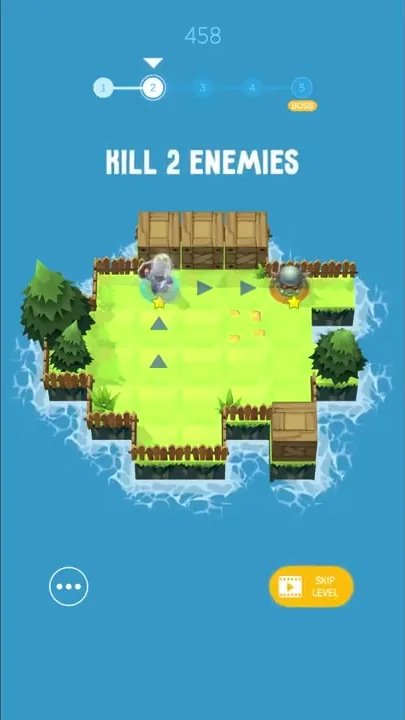
The goal printed over the early islands spells out the job: KILL 2 ENEMIES, then KILL ALL. We played Levels 2 to 11, the last of them unfinished, as the islands moved from grass to icy stone and back again, with a boss in Levels 5 and 10. Under the costume sits a familiar sliding formula, and on top of it the game builds something that feels like a light puzzle RPG.
One knight against a printed kill order
Each level sets the knight and a few enemies on a small tiled island, shown in portrait from a fixed camera angled down from above. The early boards print the goal over the island: KILL 2 ENEMIES in Level 2, KILL ALL in Level 3. Once no enemies are left, SCORE: and the level’s points burst onto the screen in large white numerals over a shower of colored stars. A plain blue card reading LEVEL with the next number follows.
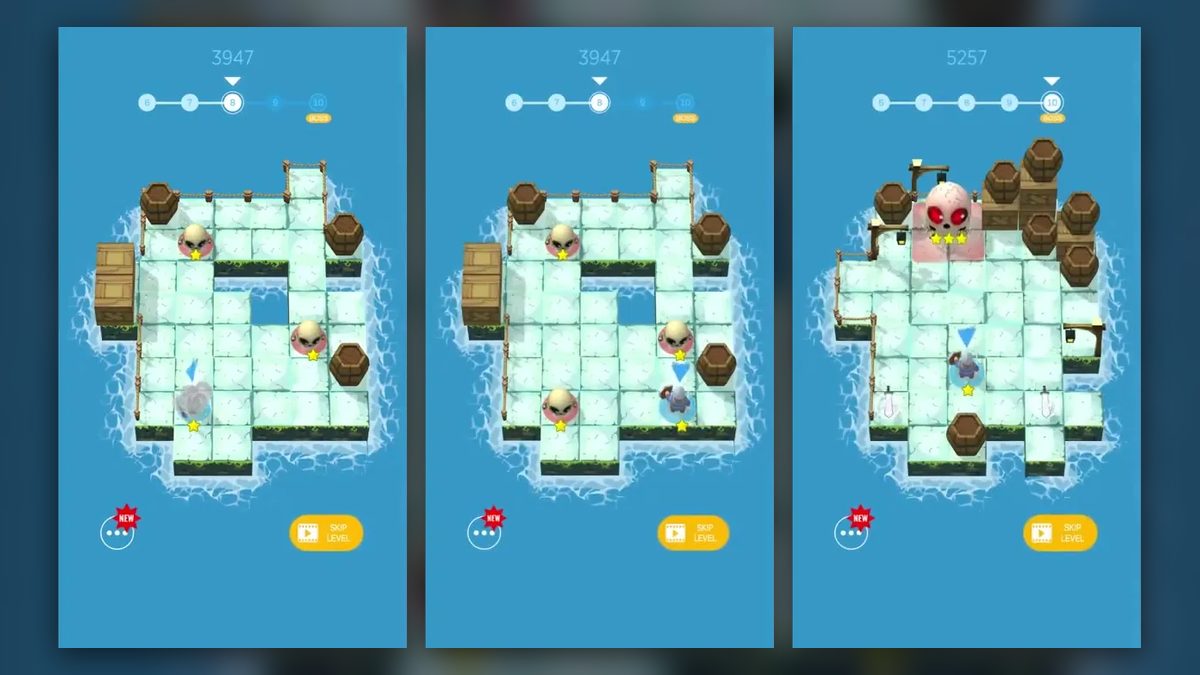
The knight has a blue ring at its feet and a blue arrow above its head, and it moves from tile to tile. The guide arrows drawn on the first boards point only up, down, left or right. On the Level 11 board the knight turns up at the bottom edge, then in the top-right corner, then in the bottom-left corner and finally on the right edge.
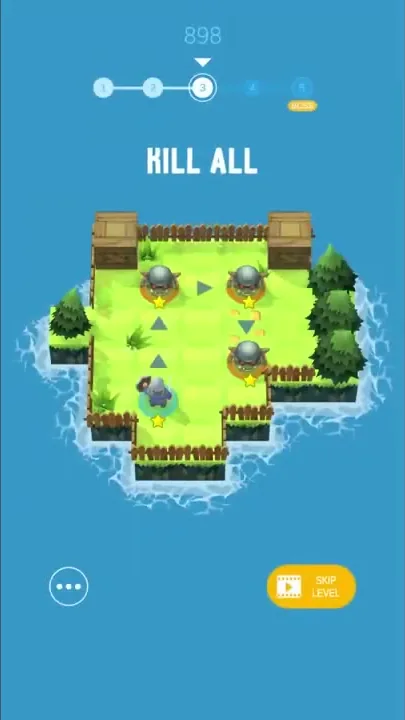
Those gray triangle arrows mark the early grass boards, up to the Level 4 clear, and trace a straight-line route from the knight through the enemies. In Level 2, two arrows below the knight point up, and two more between the knight and the helmeted enemy in its row point right. The Level 3 arrows climb toward the top-left enemy, turn right toward the top-right one and drop down to the third.
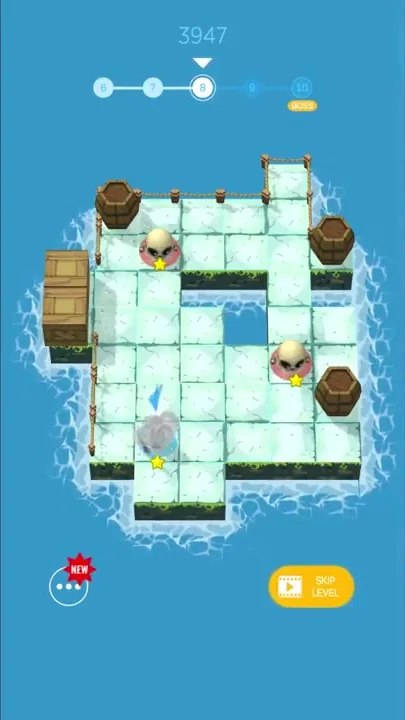
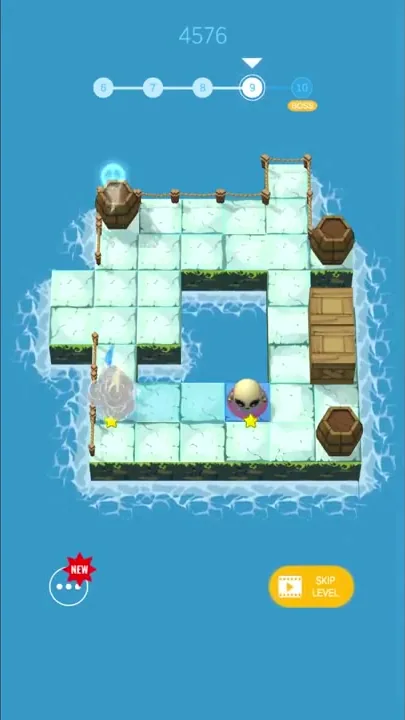
The Swordman War gameplay loop is a hunt across the island: the knight moves toward the enemies, and they disappear from the board. In Level 8 the knight’s marker sits over a gray puff of smoke on the tile where a skull enemy stood, while the other two skulls still wait on the ice.
Helmeted enemies appear on the grass islands. They are small figures in gray dome helmets, each standing on an orange ring with one yellow star beneath it. Level 2 shows one at the top right, in the knight’s row, and Level 3 spreads three across a fenced board with a crate in each top corner: two in the top row and one just below the right-hand one.
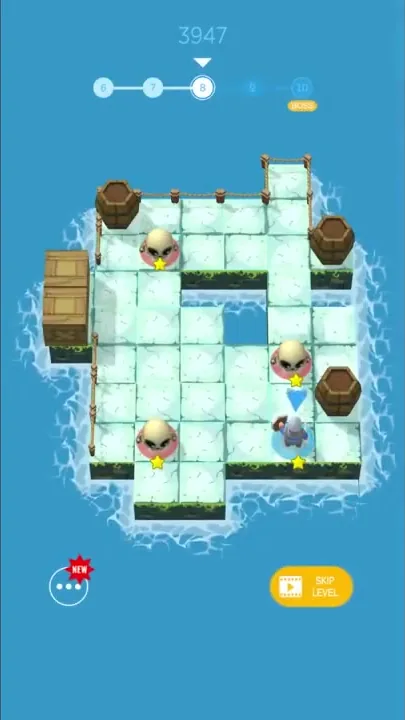
Skull enemies take over the icy boards from Level 6. They are pale skull-headed figures on pinkish rings, again with one star apiece. Three of them share the board in Level 8: one in the upper left, one on the right just above the knight, one in the lower left.
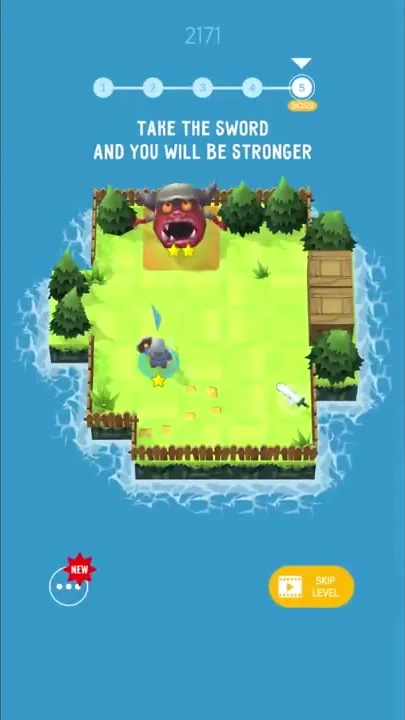
Swords lie on the tiles of the boss boards. Level 5 puts a red horned boss with two stars on an orange-tinted tile at the top center, with the knight at the center left and a sword on the grass at the lower right, all under the header TAKE THE SWORD AND YOU WILL BE STRONGER. At the clear, the boss and the sword are both gone, and the knight stands near the boss’s old spot with two stars beneath it.
A giant skull with red eyes and three stars sits on a red-tinted square at the top of Level 10, the second board the progress bar tags BOSS. Two swords lie lower down, one on the left and one on the right, and the one-star knight stands between them in the center. Barrels sit on stacked crates in the top-right corner, single barrels stand at the top left and on the bottom row, and lamp posts and rope fences line the edges.
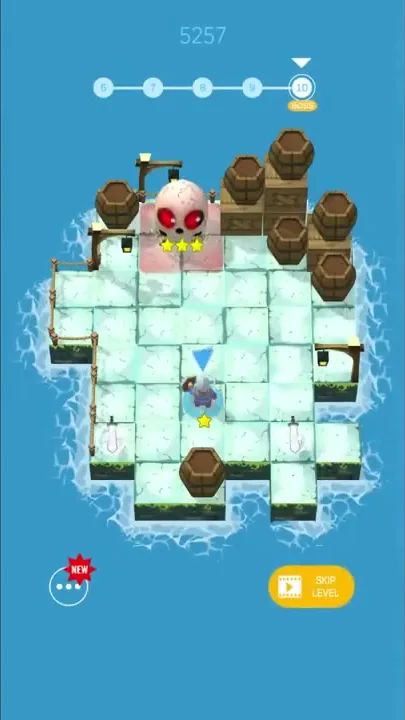
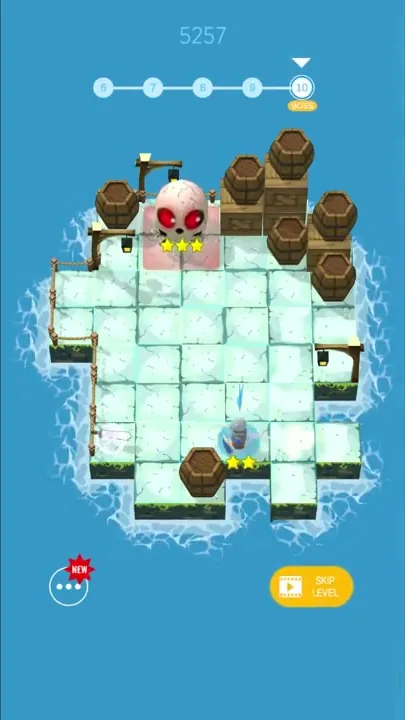
Yellow stars sit under the characters. The knight and the ordinary enemies carry one each; the Level 5 boss carries two, the giant skull three. The knight’s own count changes on the boss boards: once the right-hand sword in Level 10 has disappeared, the knight shows two stars, while the other sword still lies at the lower left.
Wooden crates and barrels stand around the island edges, among pine trees and wooden fences on the grass and rope fences and lamp posts on the ice. On the Level 7 board, four barrels huddle in the top-right corner with one more at the lower right. Two crates are stacked on the left edge and a lamp post stands at the top left. Three skulls wait on the stone, one in the upper left and two on the bottom row on either side of the knight.
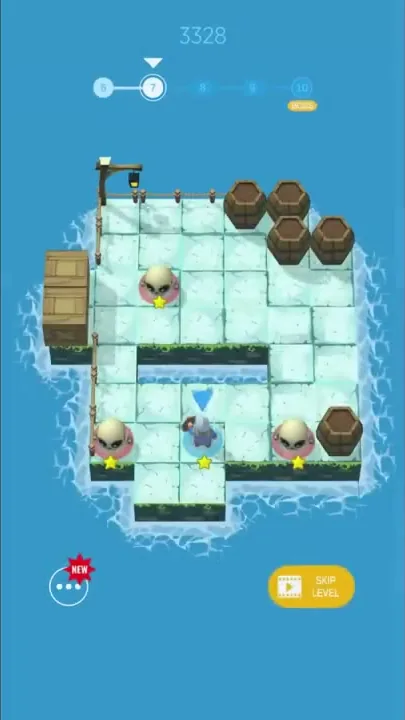
Missing tiles open some boards to the water below. In Level 7 a strip of water cuts across the middle of the board, and Level 8 has a one-tile hole in its center. Level 9 opens a large square of water in the middle with one skull below it, and Level 11 runs two channels across its upper area with a small gap in the center.
From grass islands to icy stone and back
The setting changes twice in this stretch. After the first boss, the bright green grass gives way to pale, cracked icy stone with lamp posts and rope fences, and skulls replace the helmeted enemies. The progress bar starts a new group at the same point, running from 6 to a boss at 10.
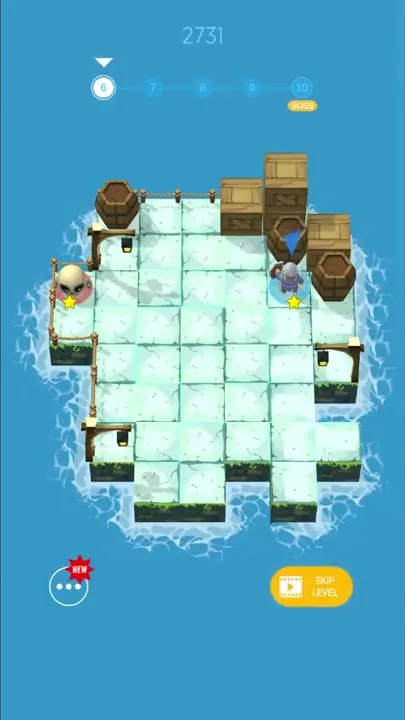
The icy boards are larger than the grass ones before them and begin to open water gaps, and Levels 7 and 8 each hold three skulls. The two boss boards get their own markings, an orange-tinted tile under the horned boss and a red-tinted square under the giant skull, and both carry swords.
Level 11 brings back the grass, now crossed by two water channels, and the progress bar opens a third group running from 11 to 15, with the BOSS tag under 15. Both enemy types share this island: two helmeted figures and two skulls.
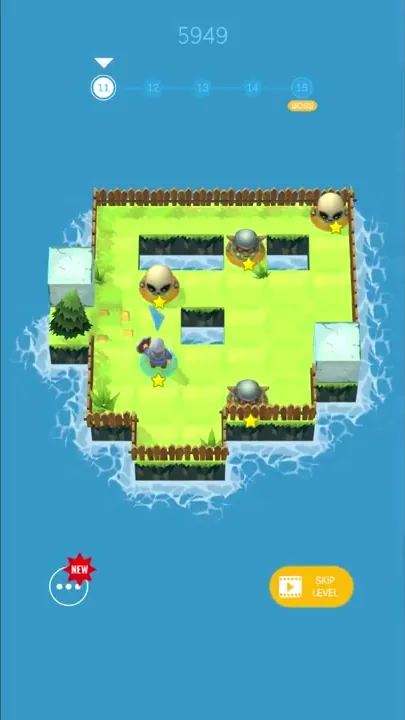
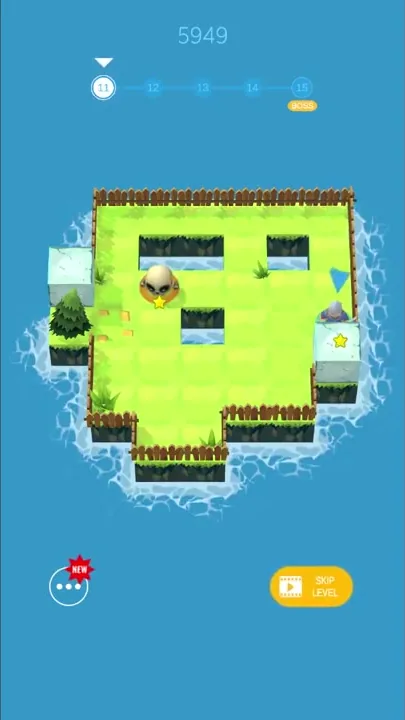
Two pale cyan cubes join the scenery here, one on each side edge, with a pine tree next to the left one. Later in the level the knight reaches the right-hand cube, with a single skull left on the board.
Outside the board itself, the play screen keeps a pale running score total at the top, which grows from one level to the next, with the progress bar just below it. The bar shows five numbered circles per group and a small arrow over the current level. The fifth circle carries an orange BOSS tag, and the bar moves on to a new group after the bosses of Levels 5 and 10.
Besides the score total and the progress bar, the play screen holds only two buttons, both below the island. During play, a yellow SKIP LEVEL button with a film-strip icon sits at the bottom right and a round “…” button at the bottom left; from the Level 4 clear onward, that round button wears a red NEW burst badge.
Monsters where geometric shapes used to be
The grid and its straight routes are the familiar part, and what sits on them is the change. An armored knight takes the place of a geometric shape, and the targets are helmeted and skull-headed monsters to hunt under orders like KILL ALL. Played this way, Swordman War feels less like a puzzle made of shapes and more like a light puzzle RPG, and we found that repackaging a very interesting new spin on the sliding puzzle.
The same dressing hands a traditional mechanic some growth and a run of stages to clear. The Level 5 header promises that the sword will make the knight stronger, and the knight finishes that board with two stars under it, while Level 10 raises the boss to three stars and lays out two swords. The levels come in groups of five on the progress bar, each group seen ending in a circle marked BOSS.
Star counts and a Level 11 reset
We had no criticism to make of Swordman War. The bosses carry more stars than the knight has on arrival, two for the horned boss and three for the giant skull against its one. We can’t say what happens when the knight meets an enemy holding more stars than it does.
Partway through Level 11, with one enemy already gone, the screen dims and the board returns to its starting layout: the knight back on the left and all four enemies in their places. What set off that reset is unclear. On that board, the first after the second boss, the knight carries a single star again.
Route plotting for a lone armored knight
The work here is spatial: plotting straight paths for one knight across a small island, reaching each monster in turn and, on the boss boards, going for the swords, which the Level 5 header says will make the knight stronger. That matches a taste for small grid puzzles with a plain goal printed above the board, where an island is cleared once its last monster has vanished.
The costume speaks to a second taste, for puzzle pieces with faces. Helmeted figures and skulls stand where plain geometric shapes usually would, with a horned boss and a red-eyed giant waiting at the end of the first two groups.
Verdict
Swordman War dresses an old sliding grid in an armored hero, two kinds of enemies, sword pickups and boss stages, and that dressing turns a plain geometric puzzle into something closer to a light puzzle RPG. We liked the idea a lot. It gives a traditional mechanic a sense of building strength and working through stages.