Gamble Battle Review: Slot Spins That Power Pirate Cannons
A Gamble Battle review of a yellow-versus-blue pirate duel where three-reel slot results build cannons, drop bombs and fire a nuclear shot.
Game at a glance
Gamble Battle
7.5/ 10
Our score
A few random pieces, put together well, can carry a whole idle game.
In this article6 sections
In an idle bouncing-ball game, balls tumble through a field of pegs on their own and drop into slots at the bottom. Gamble Battle, a ball bounce game, keeps that self-running pegboard and parks a three-reel slot machine right under it. Each of two pirate crews gets one of these columns, and the spins set off cannon shots and bombs in a one-on-one fight over a shared grid.
In the one match we played, about 11 minutes long, the lead changed hands twice before yellow covered every cell. The parts are few, and they are combined well.
Two pegboards stacked on two slot machines
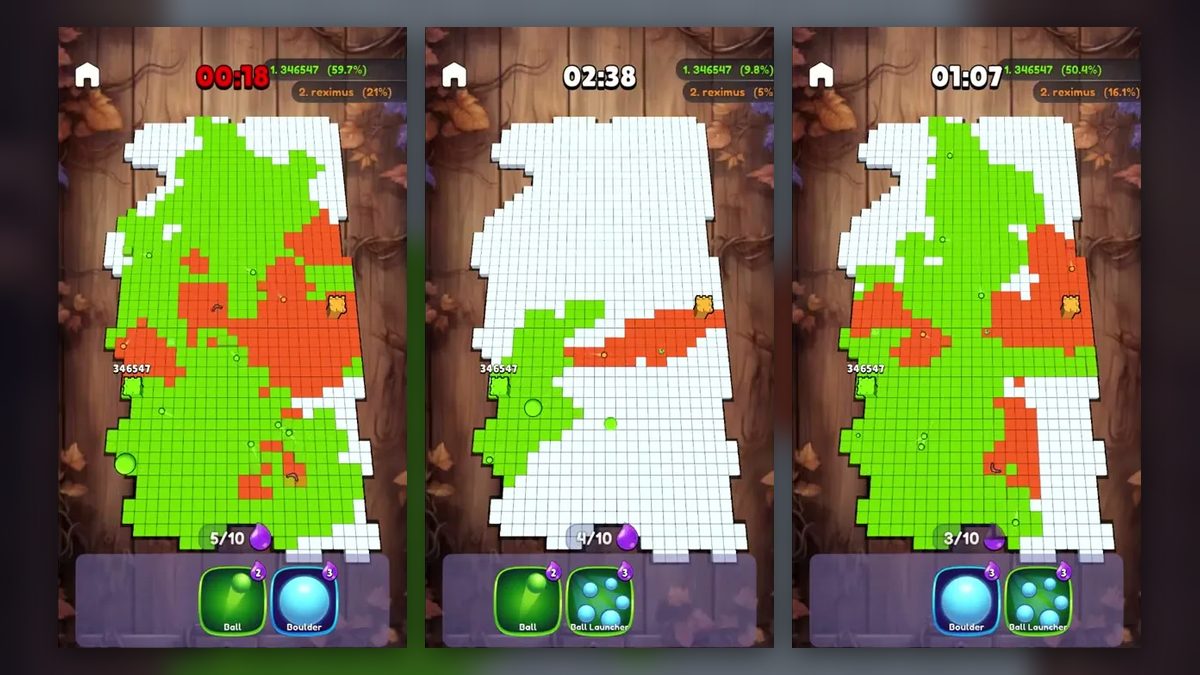
Yellow and blue share one square grid. Yellow starts in the bottom-left corner and blue in the top-right; the gray cells between them belong to neither side. Shots and effects recolor cells as they land, so the border between the two colors keeps sliding back and forth. No goal or timer appears on screen, and nothing counts moves or lives.
The match also runs without input. No finger or button shows up at any point, and the machinery keeps going on its own from the first ball to the last.
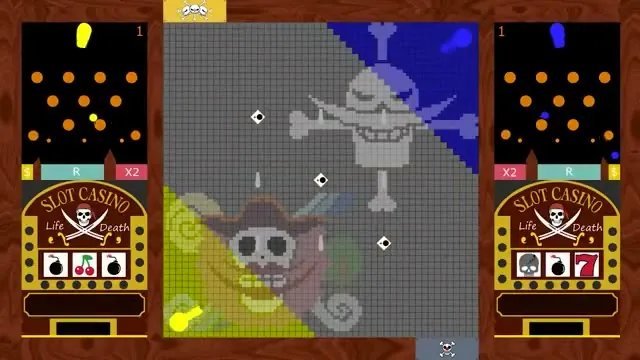
Each side owns a column at its edge of the screen, yellow on the left and blue on the right. Balls fall through the pegboard at the top of the column, and below it a ‘SLOT CASINO’ machine spins three reels. Some results put an effect label under the reels. All the while, each side’s cannon fires into the grid from its corner.
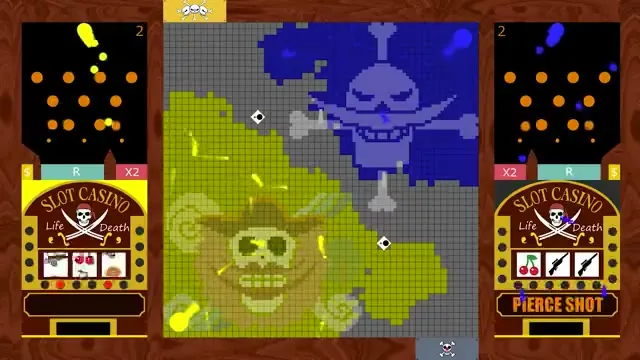
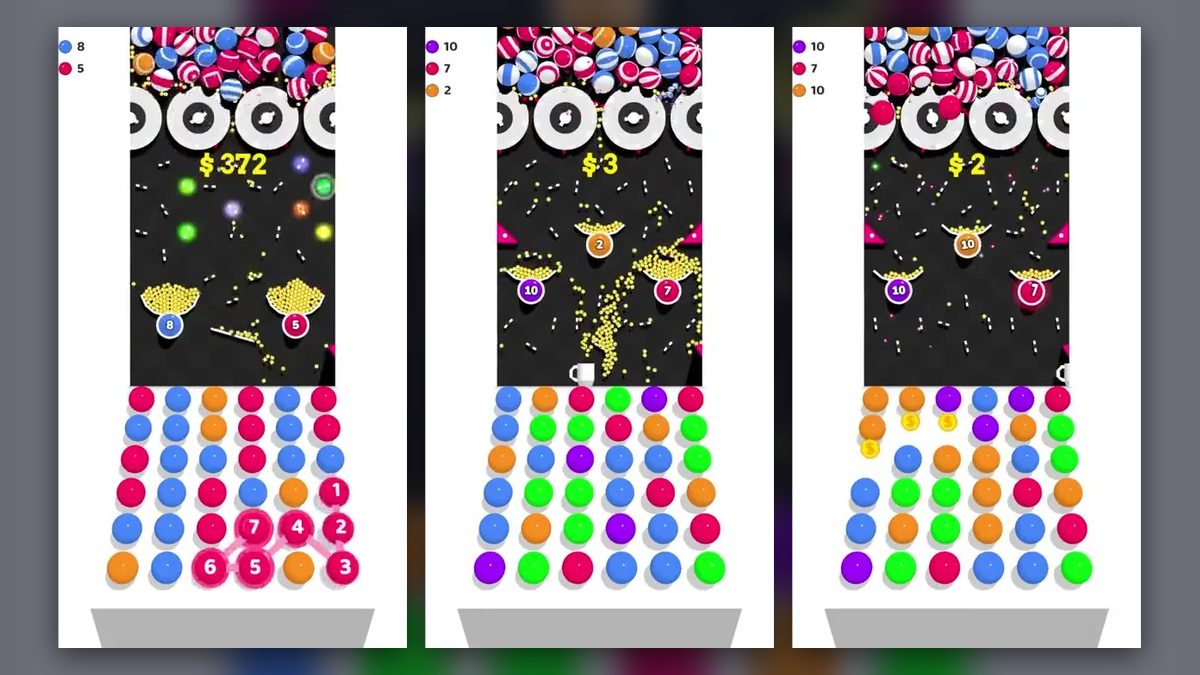
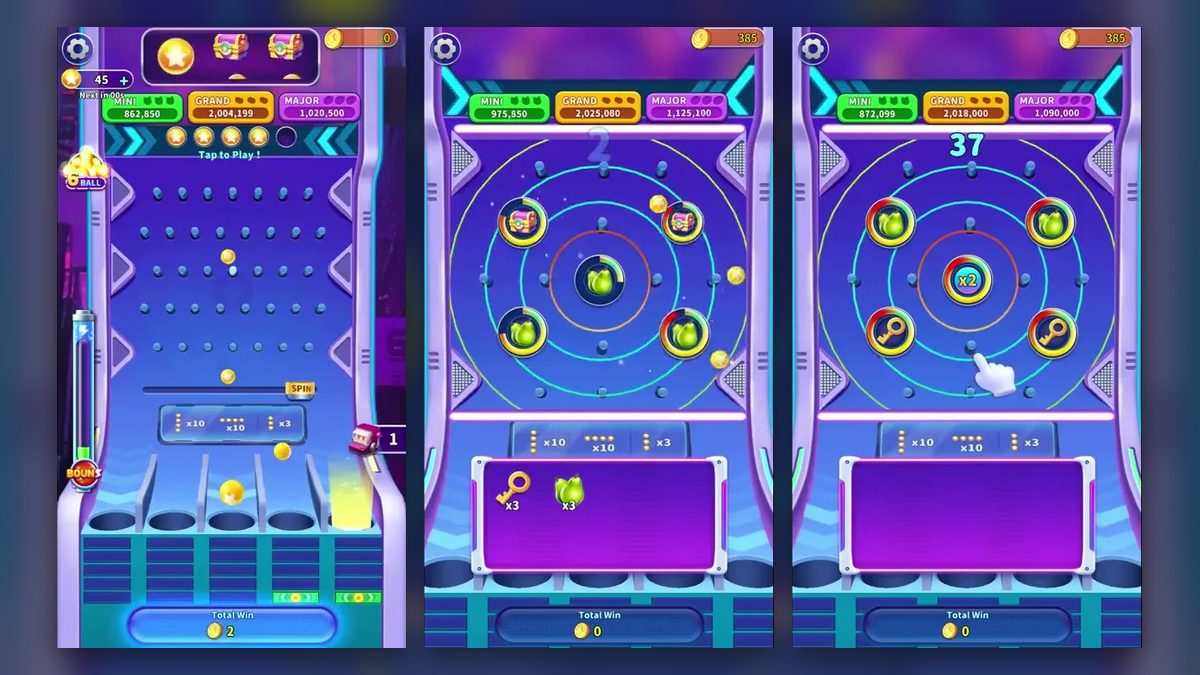
A capsule at the top of each pegboard drops balls in its side’s color. They bounce down staggered rows of orange pegs and settle into one of three slots: a small yellow ‘$’ box, a wide teal ‘R’ strip and a red ‘X2’ box, in mirrored order on the blue side. A number in the board’s top corner usually stays between 1 and 16 and climbs much higher during yellow’s big ball streams, at one point into three digits.
The machine under each board carries a ‘SLOT CASINO’ sign, with the words ‘Life’ and ‘Death’ on either side of a skull, above its three reels. The symbols clear enough to name are a bomb, a cherry, a radiation sign, a cannon, a rifle, a red 7, a skull and a round brown token. Now and then the bulbs around a machine’s edge light up yellow, as they did when the blue reels landed three cherries.
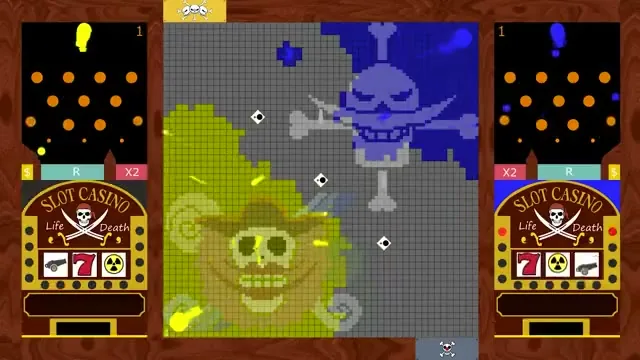
Labels appear in bold block letters in the black panel under the reels. Two are about balls: ‘ADD 1 BALL’, and ‘ADD 3 BALLS!!’ on three cherries. Five name weapons: ‘BUILD CANNON’, ‘PIERCE SHOT’, ‘POISON SHOT’, ‘MACHINE GUN’ on three cannons and ‘NUCLEAR SHOT’ on three radiation signs. Bombs come as ‘ADD 3 BOMBS’ or, on three bombs, ‘ADD 7 BOMBS’, while the round tokens go with ‘HIRE EXPERTS!’ and ‘HIRE AMATEURS’.
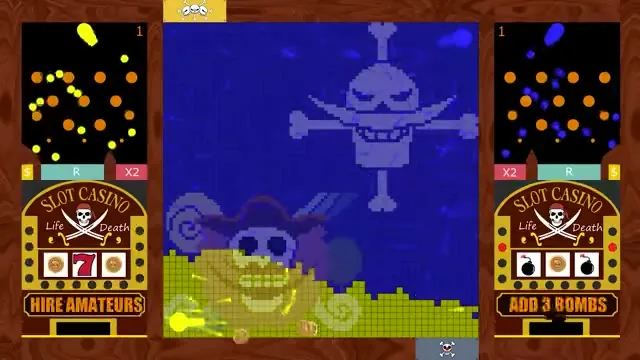
The cannons sit in opposite corners of the grid, yellow at the bottom left and blue at the top right. A barrel points a different way from one moment to the next, and a dark puff shows at the muzzle when it fires. Streaks of each side’s color show inside its own territory, yellow inside the yellow area and blue inside the blue.
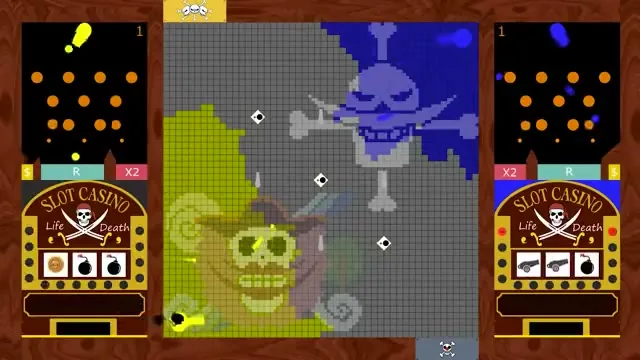
Three white diamond markers sit on a diagonal across the gray middle when the match begins. They stay put while the gray shrinks and vanish one at a time as the colored areas reach them.
Blue’s first ‘BUILD CANNON’ left a mark away from the corners. Shortly after the blue side’s first one, a small blue cross-shaped patch appeared alone in the gray near the top left, then spread into a blue blob. The label came up twice more, once more for blue and once for yellow.
Bombs land as large translucent circles. With three bombs on the yellow reels, ‘ADD 7 BOMBS’ appeared, and soon after, big yellow circles burst over part of the blue area. When the blue reels showed bomb, token, bomb, ‘ADD 3 BOMBS’ was followed by a single large blue circle at the top right of the grid.
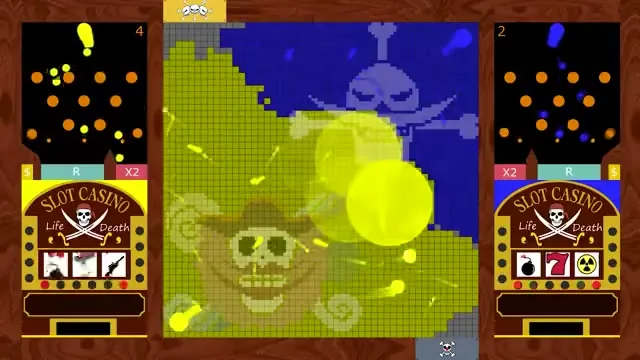
A 7 on both outer yellow reels sets off yellow’s ball streams. It happened four times, and each time a stream of yellow balls poured out of the bottom of the yellow machine toward the grid’s bottom-left corner. The first came on 7, radiation sign, 7: the yellow board’s counter jumped to 24, and within moments yellow had swallowed most of the remaining gray. The fourth came on three 7s, and a bright yellow arc swept out from the yellow cannon, followed by a chain of white balls and big yellow circles.
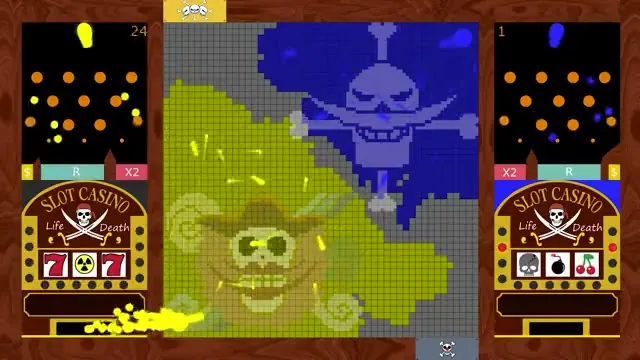
Three radiation signs on the blue reels put up ‘NUCLEAR SHOT’, with a small radiation icon below the panel. A small dark projectile crossed the middle of the grid, and then a huge dark-blue circle covered most of the yellow area.
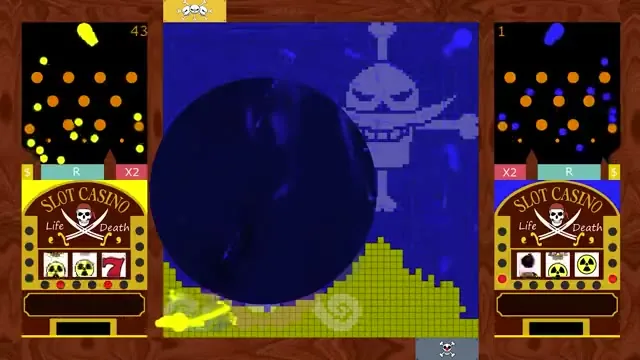
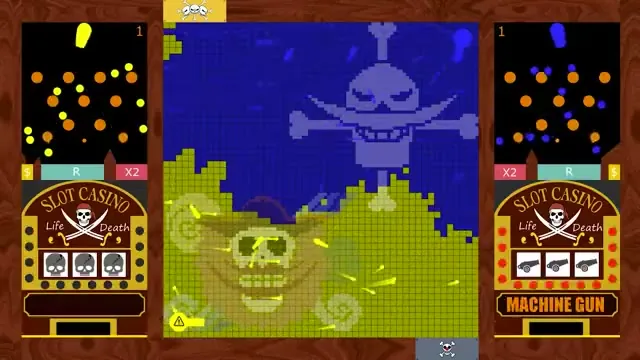
The reels have bad results too, each with its own label. On the blue side, skull, skull, 7 showed ‘PANALTY!’, spelled just that way, and a yellow warning triangle then sat at the blue cannon. Three skulls on the yellow reels gave ‘SHUT DOWN!!!’, followed by a warning triangle by the yellow cannon. When all three reels differ, the panel can also read ‘BAD LUCK!’.
The hiring labels leave their own traces. After blue’s ‘HIRE EXPERTS!’, small skull figures crowded around the yellow tab at the grid’s top-left edge, with large brownish circles nearby; the same figures came back after three tokens on the yellow reels. Yellow’s ‘HIRE AMATEURS’ was followed by small brown round objects at the bottom of the grid, then a gray half-dome in the bottom-right corner next to the light-blue tab, with yellow cells spreading around it.
Green balls with dark stripes turn up on the grid every so often. The first appeared near the yellow cannon early on. A few more showed near the border after yellow’s ‘POISON SHOT’, and many spread across the grid during yellow’s late comeback.
A border that swings between yellow and blue
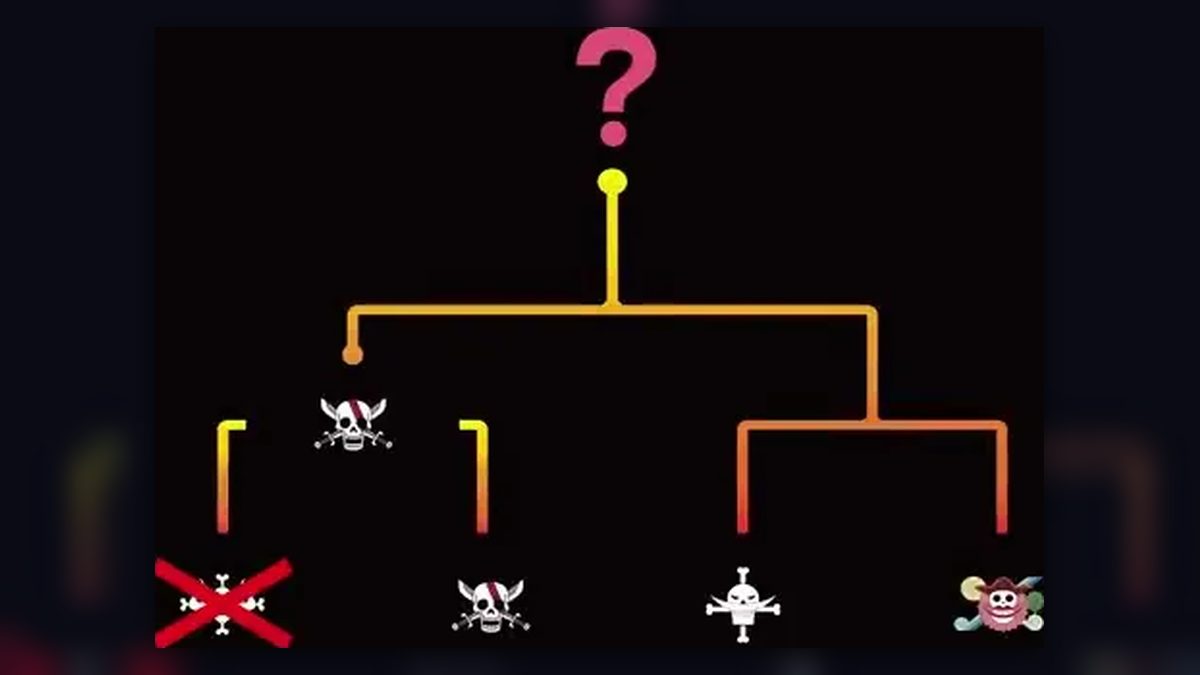
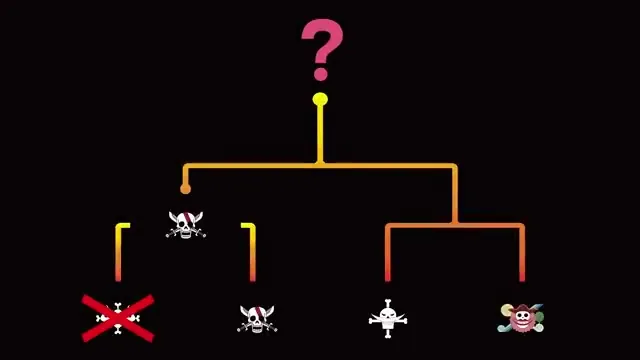
Before the match, a bracket screen lights up on black. Four pirate emblems sit along the bottom, joined by glowing orange and yellow lines. The leftmost is crossed out with a red X and the second appears again one tier up, while a pink question mark waits at the top.
The board opens mostly gray, with a yellow wedge in the bottom-left corner and a blue wedge in the top-right. Two large pixel-art pirate emblems show faintly behind the cells, one in each half, and stay visible through whichever color covers them. A small yellow tab with a skull icon sits at the grid’s top-left edge, a light-blue one at the bottom-right. Over the first stretch both colors spread into the gray, and blue gains its separate outpost.
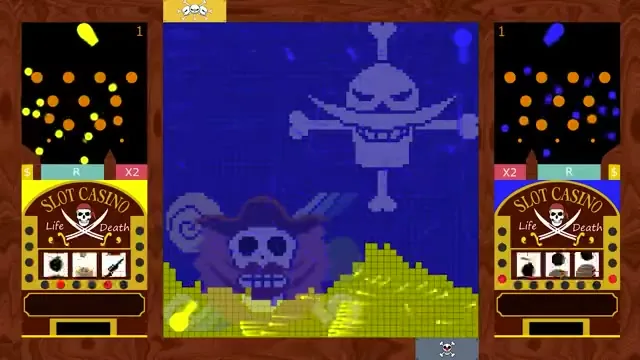
After yellow’s first ball stream, the gray was nearly gone and yellow held most of the grid, with blue pressed into the top-right part. Blue then took back the upper half and pushed the border down. Its ‘NUCLEAR SHOT’ went further: once the blast cleared, yellow was left with a strip along the bottom, and it stayed pinned there until the late comeback.
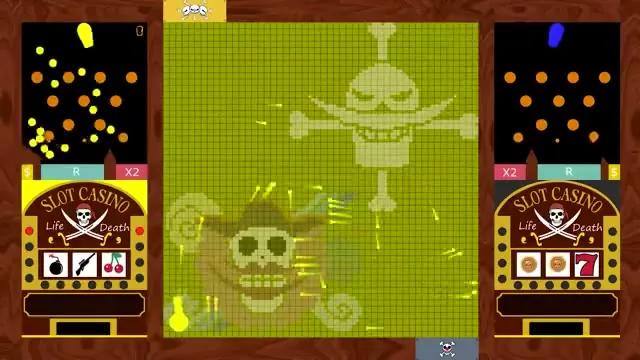
After three 7s on the yellow reels, yellow swept back over most of the grid while blue shrank into the top-right corner. The blue pegboard then lost its counter and its balls. By the close every cell was yellow, and no win text or results screen appeared.
None of the usual extras showed up around the match: no shop, currency, booster, reward or ad offer. The ‘$’ slot and the casino sign are part of the board, and no money or payout appeared anywhere.
Reels that turn a few symbols into firepower
Gamble Battle sets the self-running trigger of an idle bouncing-ball game, balls dropping through pegs with no help, right on top of a slot machine. We see this as the simplest and best-fitting way to mix idle play with chance. The whole screen is a pegboard and a slot machine on each side of one grid, plus a cannon in each corner, with no menus or upgrades in sight. The result is simple, and a lot of fun.
Different slot results set off different effects for the cannons and the grid. Three radiation signs on the blue reels led to the ‘NUCLEAR SHOT’ that knocked yellow down to its last strip. Three bombs on the yellow side rained circles over blue ground, while ‘BUILD CANNON’ planted a blue outpost in the open gray.
The reels draw on a short list of symbols, yet their combinations lead to outcomes as far apart as a lone cross of blue cells and a blast over most of one side. That is the larger point the game makes: an idle game’s random pieces can be few, in kind and in number, and still work very well as a whole when they are combined with care.
The One Piece pirate theme lays a coat of teenage bravado over all of it. A skull with a crescent mustache over crossed bones looms across the top half of the grid, and a bracket of four crew emblems comes before the match.
Unexplained slots and an open-ended bracket
We had no complaints about Gamble Battle. What follows are limits of what the match showed, not faults.
Nothing on screen explains what the three pegboard slots do or what the number in each board’s corner counts. Some labels, ‘PIERCE SHOT’ and ‘MACHINE GUN’ among them, left no effect on the grid that we could pick out.
We saw no results screen once the grid turned fully yellow, and no step for choosing a side before the match. What happens next in the four-emblem bracket is something we can’t speak to.
Watching reels decide a pirate tug-of-war
The match plays out on its own, so the player’s part is reading each label as it appears under the reels and then finding what it did to the border. That might be a blue cross appearing in open gray, or a dark-blue blast flattening one side.
These mechanics sit well with a taste for luck-driven reversals: after one line of three 7s, yellow went from a strip at the bottom of the grid to most of the board, and soon to all of it. Slot reels and a pegboard share each column, so a liking for either finds something to follow, with a pirate crew on each side to pull for.
Verdict
Gamble Battle gets a full fight out of a pegboard over a slot machine on each side and a cannon in each corner. A handful of reel symbols covers everything from a lone outpost to a blast that wipes out most of one color, and the One Piece crews give it swagger. It is good, simple fun, and it makes the case that chance in an idle game needs only a few parts, as long as they fit.