Idle Dice 3D Review: Dice That Roll Themselves for Coins
An Idle Dice 3D review of dice that autoroll every five seconds, earn coins for '+1' upgrades and pay extra on 'Pair' (x2) and 'Triple!' (x7) combos.
Game at a glance
Idle Dice 3D:Incremental Game
7/ 10
Our score
Fans of rolling dice and fans of idle games, rejoice.
In this article6 sections
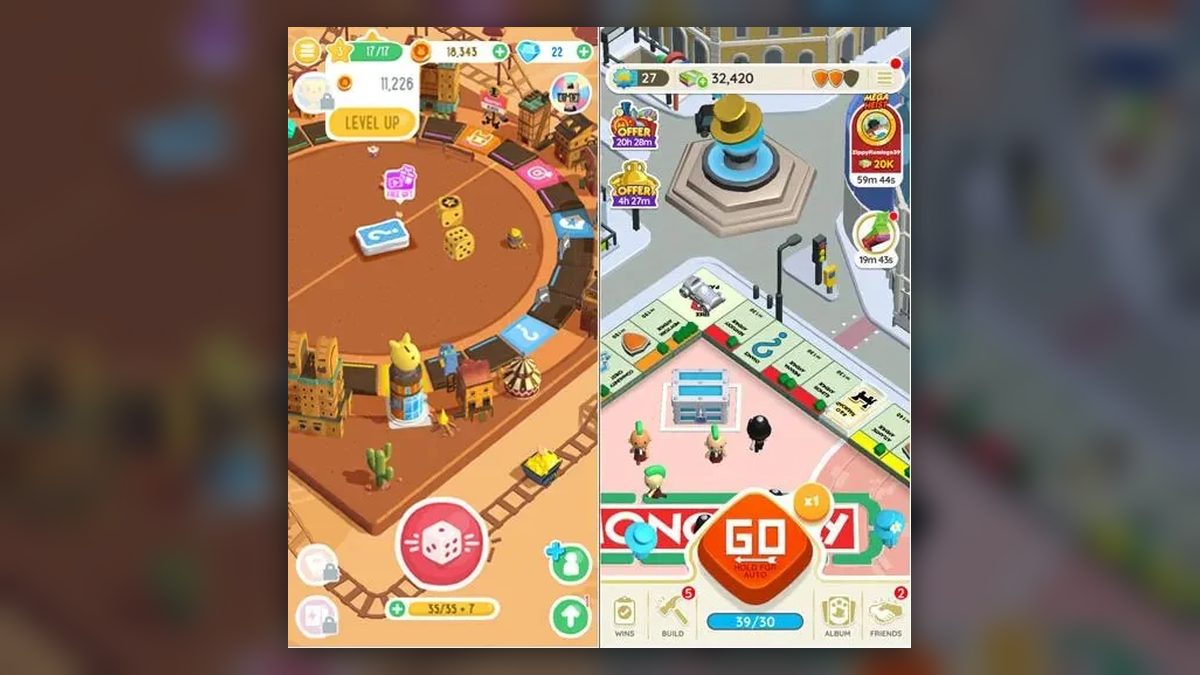
Tap ‘+1’ on a die’s row to level it up, then let the game toss every die across a wooden tray whenever a five-second countdown runs out. That loop sits at the center of Idle Dice 3D, an idle incremental game in which each throw pays coins and the coins buy richer throws. Coin-paying dice throws drive everything here, which puts it alongside other games like monopoly go.
The dice half and the idle half are combined very cleverly, and the achievement goals stacked on top give it strong long-term replay value. In the one session we played, just under three minutes long, a single purple die grew into a tray of three.
Five-second autorolls and ‘+1’ upgrade rows
There is no stage to clear and nothing to lose. Play takes place in one continuous tray with no win or fail screen and no limit on moves or lives, and the targets come from tutorial tips and an achievement list. The only brake on progress is price.
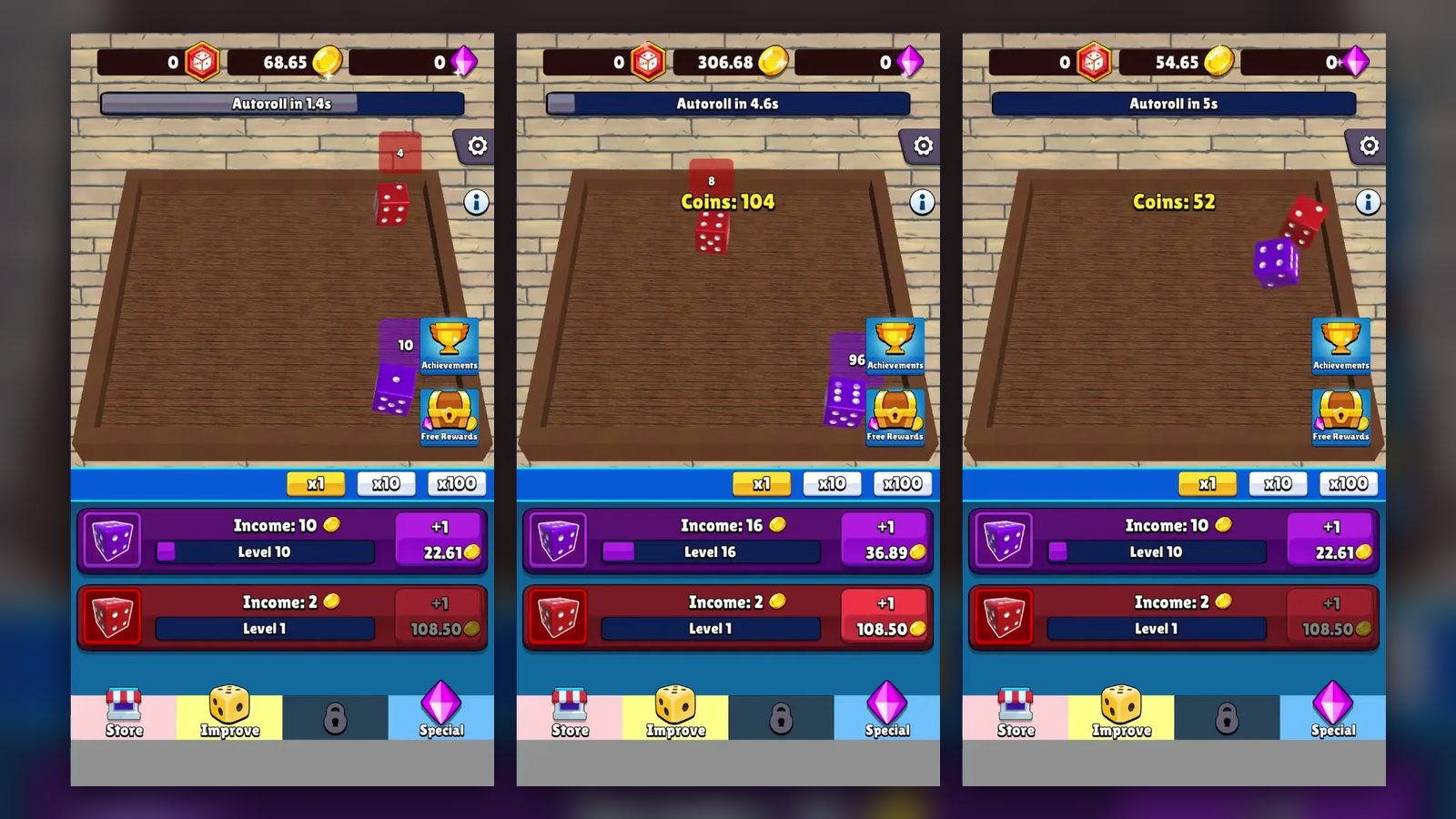
The tray sits against a beige brick wall, and the blue strip beneath it holds the controls behind the Idle Dice 3D gameplay. A die’s level goes up each time its ‘+1’ price button is pressed, and the coin counter drops. Above the list, an ‘x1’ button stays highlighted in yellow next to ‘x10’ and ‘x100’. The opening tip closes with ‘OK’ and reward panels with ‘Collect’; the achievement list has a red X, and a gear button and an ‘i’ button sit at the upper right.
Rolling takes care of itself. A bar under the top counters reads ‘Autoroll in 5s’ and counts down in tenths of a second while a gray fill creeps from left to right. When it runs out, the dice land in new spots and the bar resets to five seconds, so coins keep coming in between purchases.
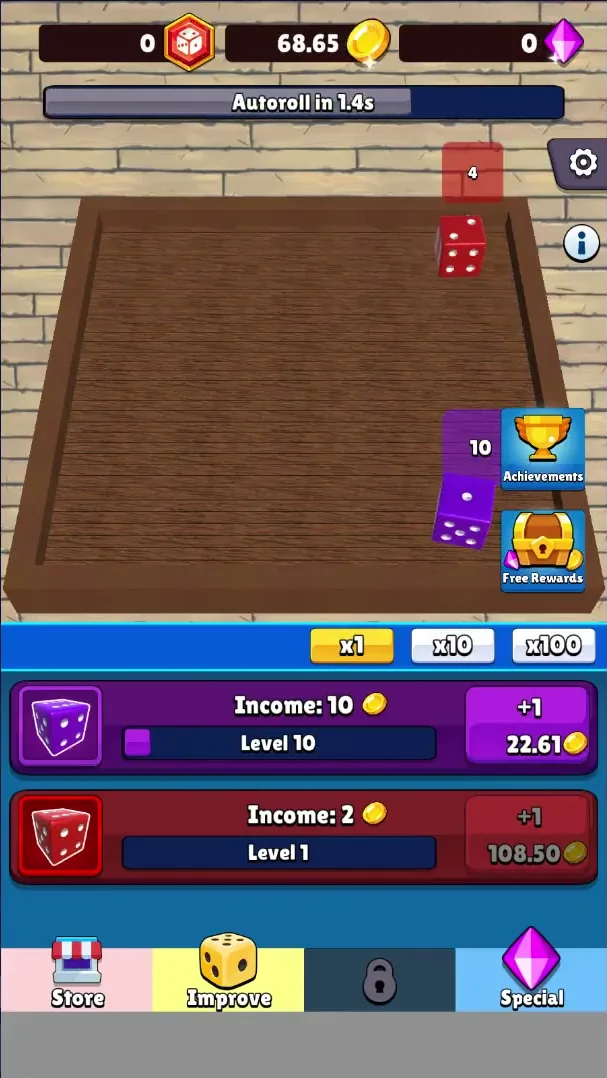
When the dice settle, a tag in each die’s color floats above it with a number, and a yellow total appears at the top of the tray. An early two-dice throw adds up plainly: the purple tag reads 40 and the red one 10, for a line above the tray that says ‘Coins: 50’. That sum drops into the counter at the top, and the countdown starts again.
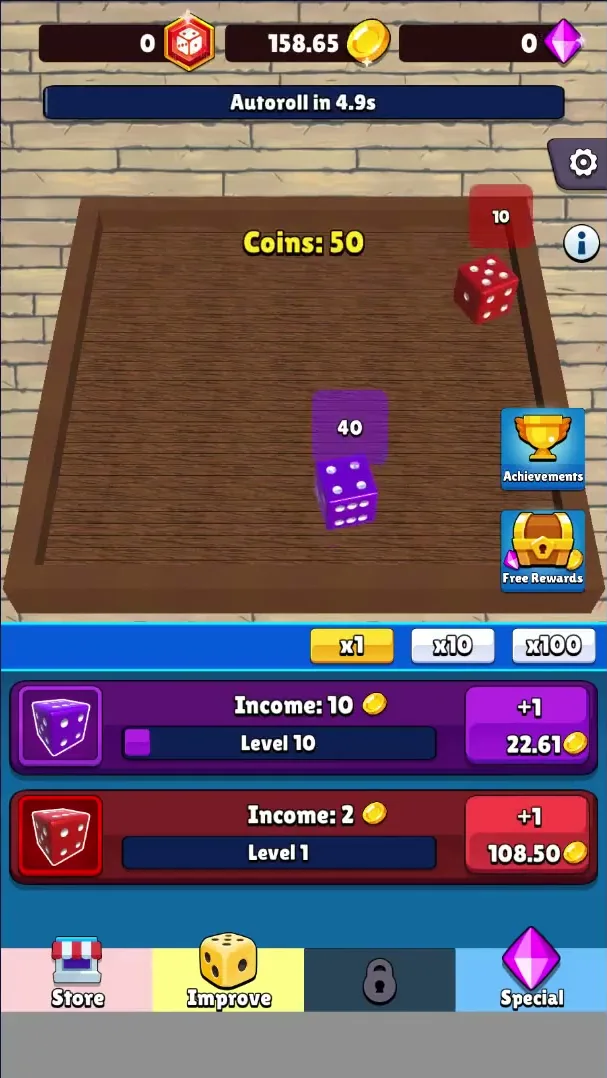
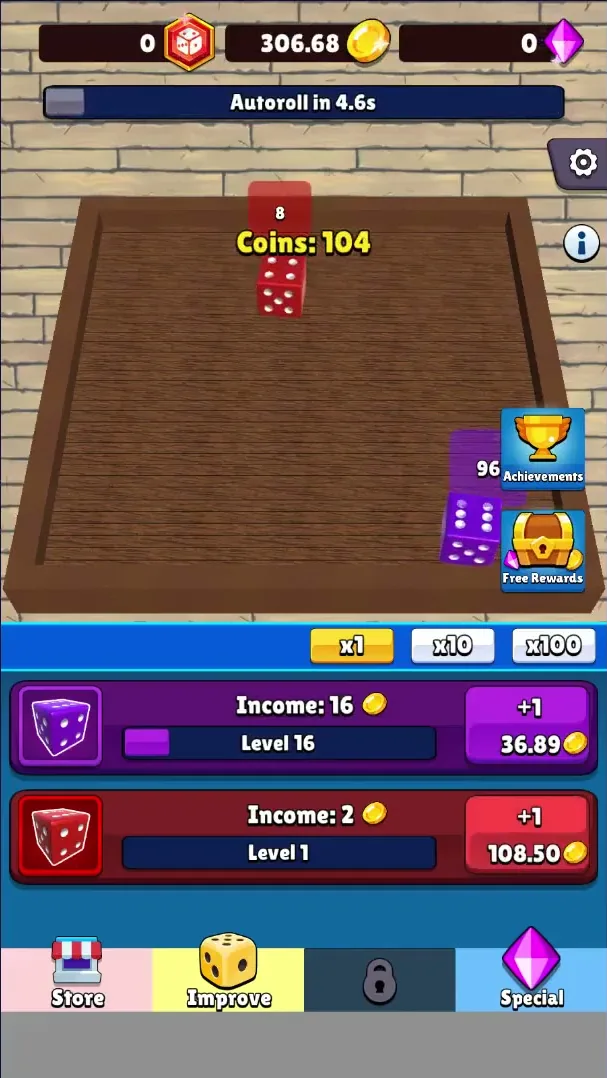
Each die owns a row in its own color. A die icon sits on the left; an ‘Income’ figure above a ‘Level’ bar fills the middle; a ‘+1’ button with a coin price takes the right. Income climbs with level at a different rate for each die: the purple die shows ‘Income: 10’ at Level 10 while the red die shows ‘Income: 20’ at the same level, and the green die starts at ‘Income: 4’ on Level 1. Buttons light up when the coin counter covers the price: with 36.68 coins in hand, the purple die’s 36.89 button stayed dim, as did the red die’s 108.50, and once more coins came in, both were lit.
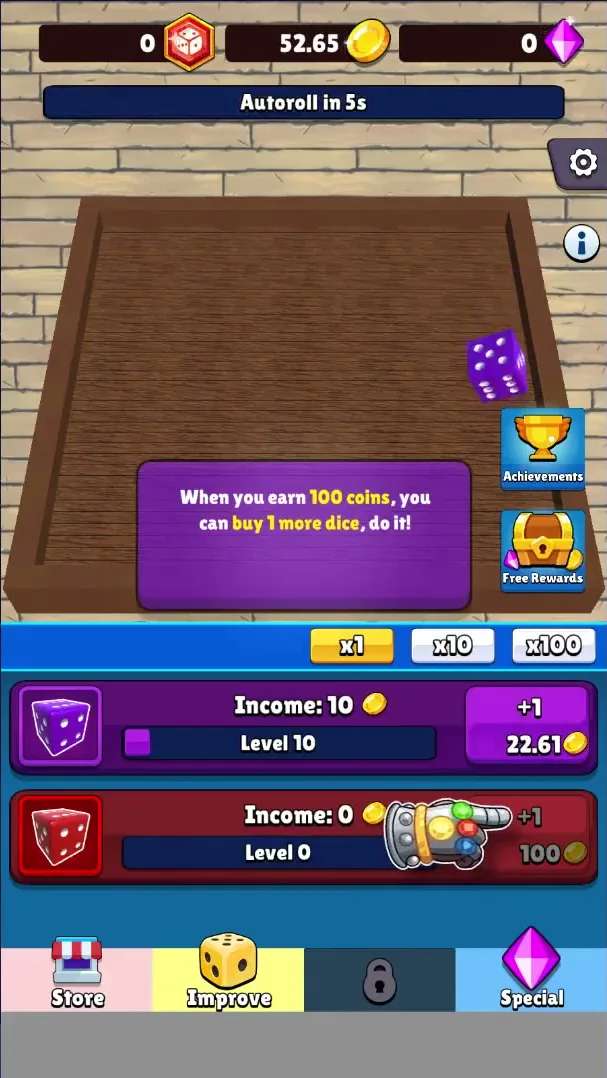
New dice come from the same list. A fresh row appears at ‘Level 0’ and ‘Income: 0’, and its ‘+1’ price is what the die costs; buying it takes the row to Level 1. The red die went for 100 coins, announced by a purple tip, ‘When you earn 100 coins, you can buy 1 more dice, do it!’, with a cartoon metal gauntlet pointing at its button.
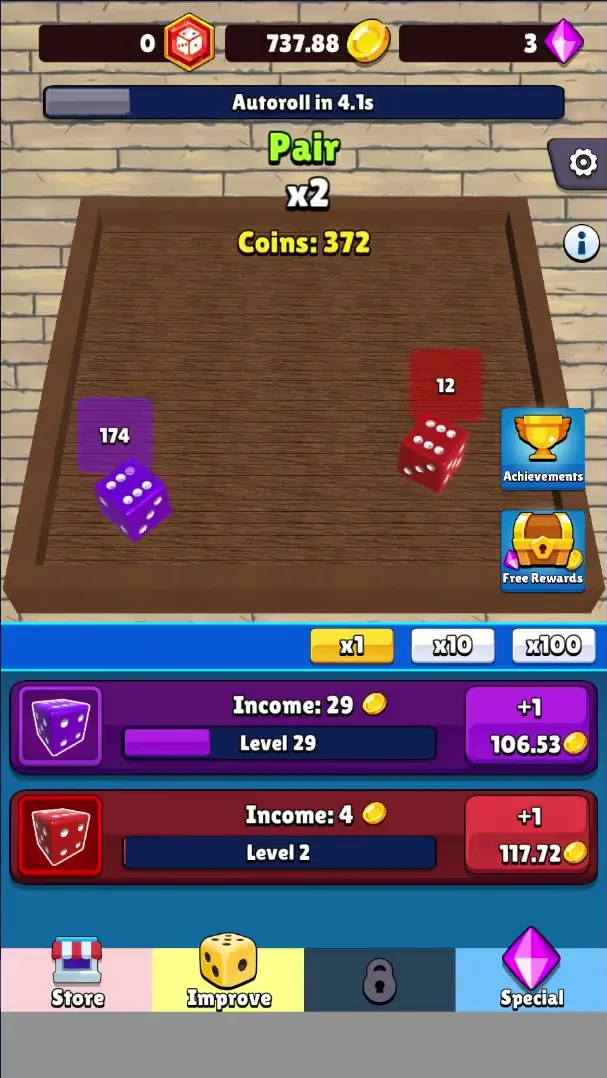
Some throws land a combo. A green ‘Pair’ with a white ‘x2’ beneath it appears over the tray, and the payout grows to match: tags of 174 and 12 came to ‘Coins: 372’, twice their sum.
Once three dice share the tray, a bigger combo turns up. An orange ‘Triple!’ carries a white ‘x7’, and one such throw put ‘Coins: 3.07K’ over the tray, with the red die’s tag at 156 and the green die’s at 24.
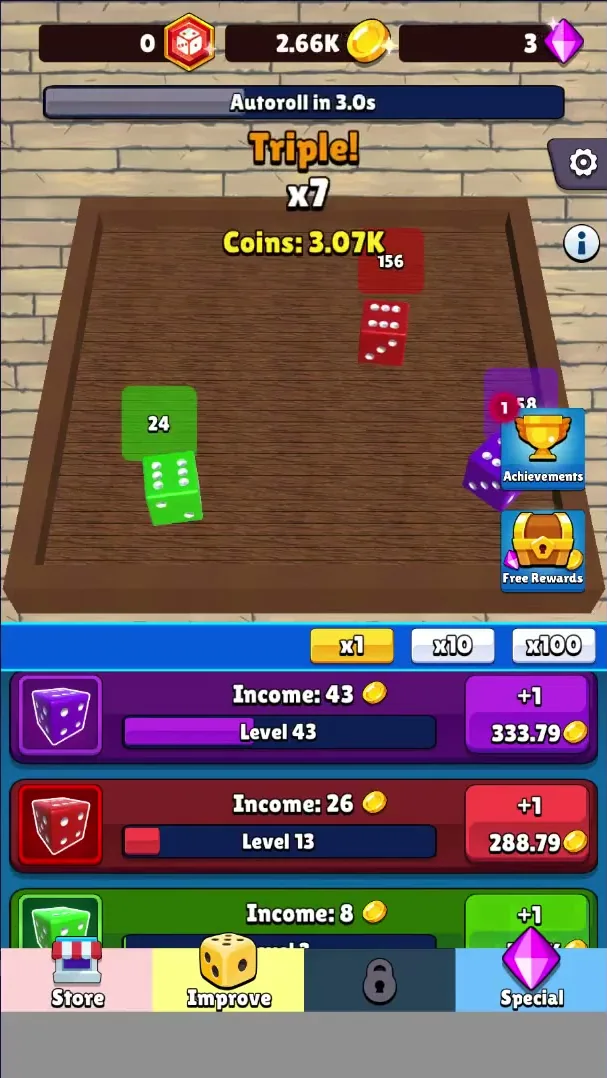
From one purple die to three
The game grows by adding dice rather than stages. It opens with a single purple die rolling alone beside a purple tip panel that reads ‘Keep playing!’ and sets a target: improving the dice to Level 10. The purple row then climbs toward that mark one ‘+1’ at a time.
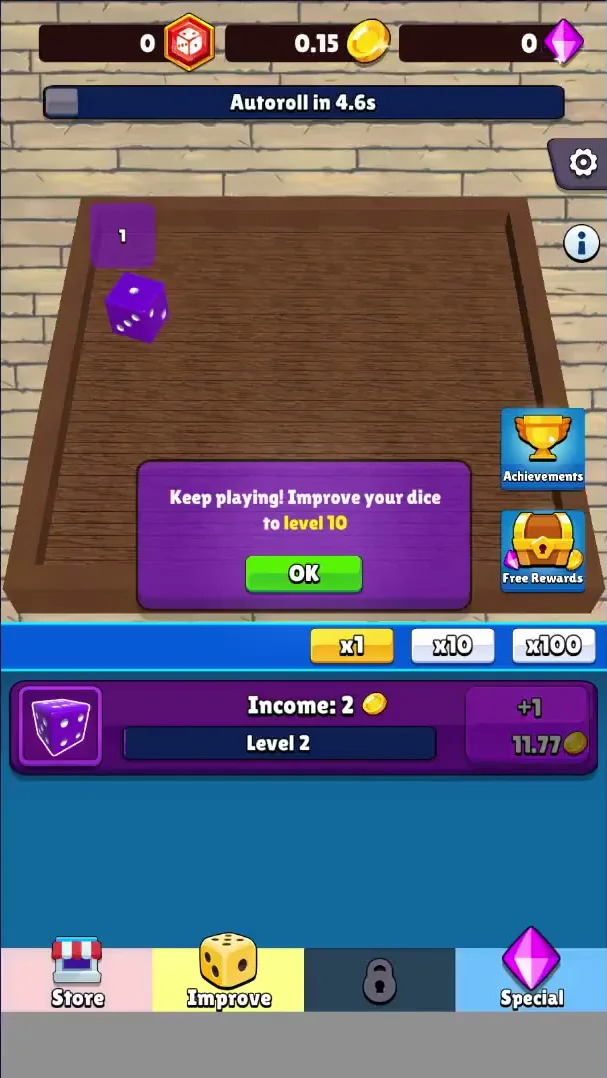
With the purple die at Level 10, the red die’s row shows up, and once it is bought two dice share every throw. The list gains its second row, and the first ‘Pair’ banner follows later on.
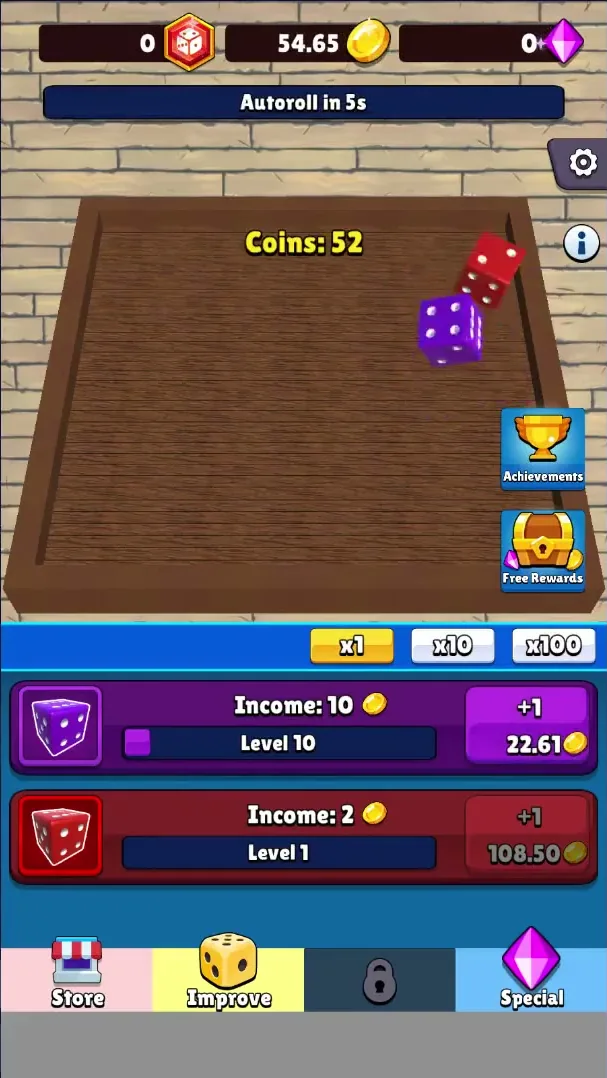
The third die costs ten times as much as the second. The green row appears with a dimmed ‘1.00K’ on its button, and shortly afterward the green die is in the tray at Level 1, so each throw uses three dice and ‘Triple!’ banners start to appear. With three rows, the list no longer fits and scrolls.
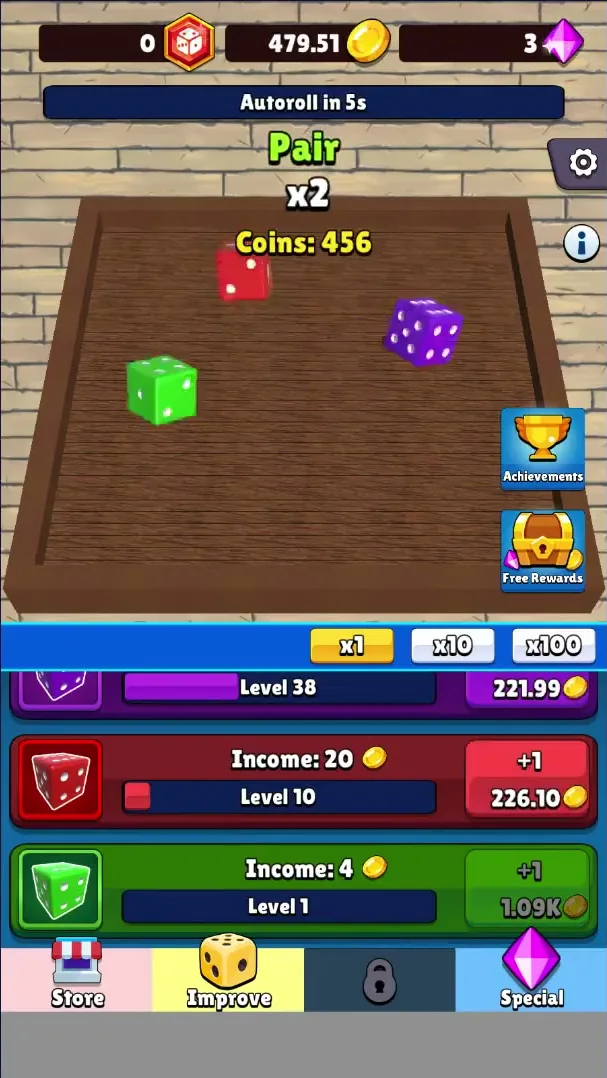
Prices climb with every level. The purple die’s next ‘+1’ cost 11.77 coins at Level 2 and 22.61 at Level 10; by Level 29 it had reached 106.53, and by Level 52, 695.58. Payouts grow alongside, from a single-digit ‘Coins: 3’ on an early solo throw to the 3.07K of that Triple.
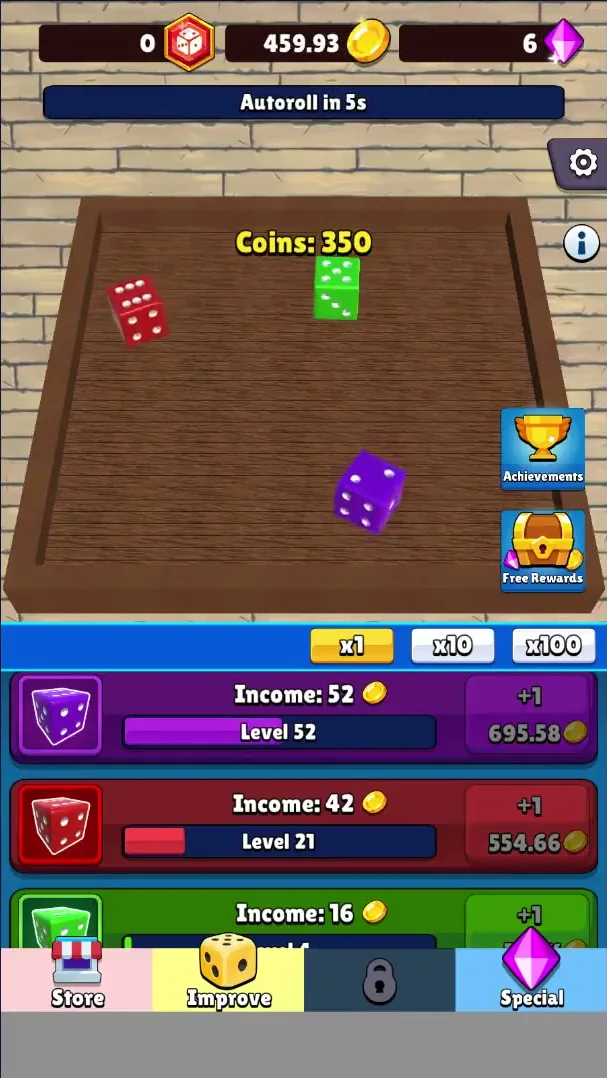
Three counters run along the top of the screen. Coins sit in the middle, shown with decimals and a K suffix for thousands. Gems fill a pink counter on the right and are paid out by achievements, while a third counter on the left, beside a red dice badge, never moved off zero.
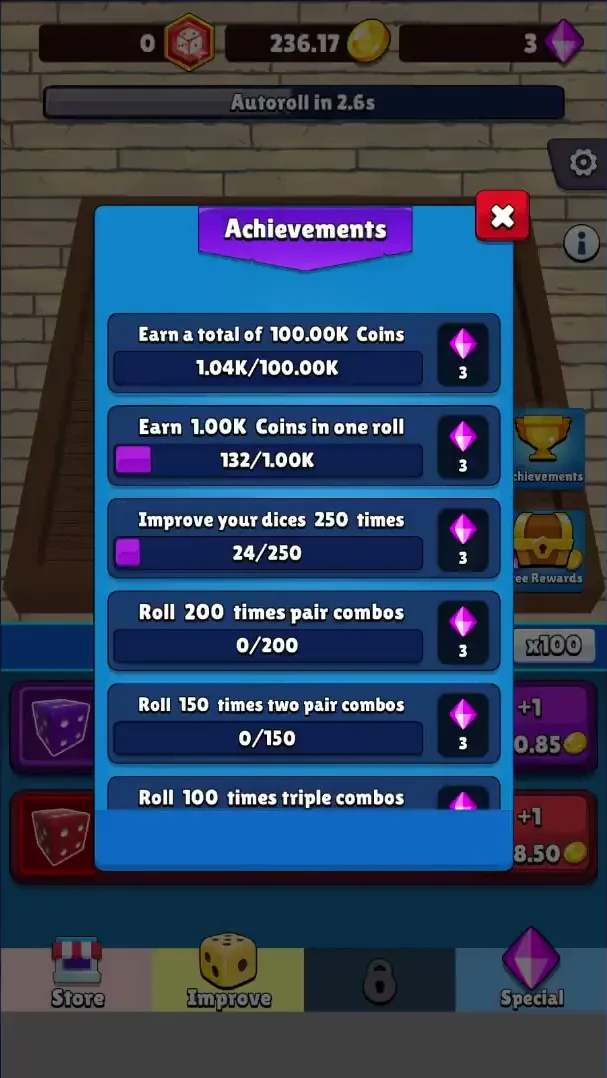
The trophy button labeled ‘Achievements’ opens a list of long goals, each with a progress bar and a 3-gem reward. Two are about coins: 100.00K earned in total and 1.00K from a single roll. One asks for 250 die improvements, and the others on view count combos: 200 pairs, 150 two-pair combos and 100 triples.
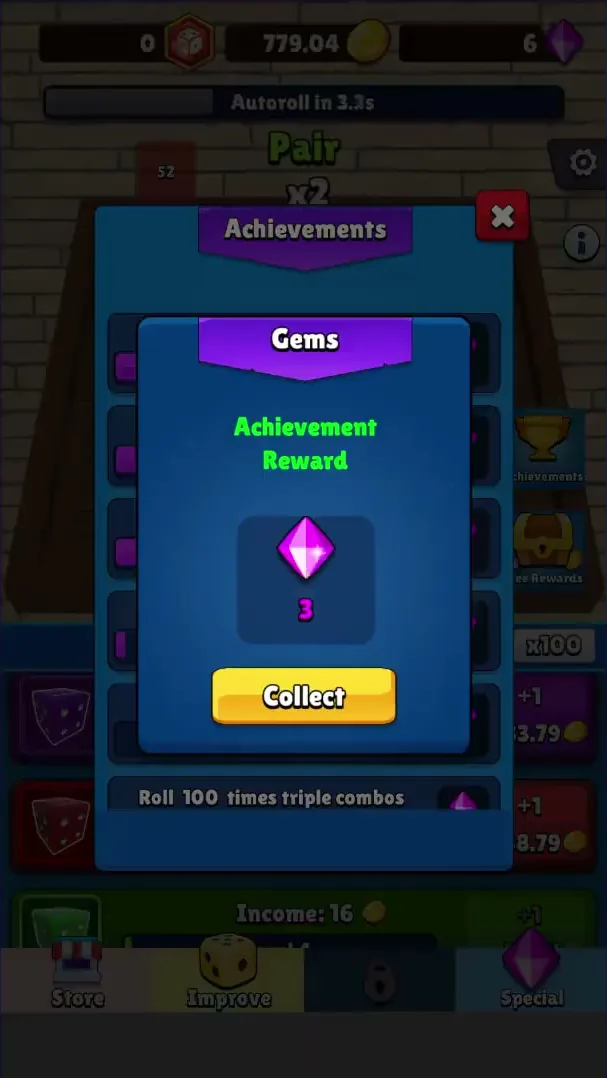
A finished goal puts a red ‘1’ badge on the Achievements button. The reward arrives in a panel titled ‘Gems’ that reads ‘Achievement Reward’ and shows 3 gems above a yellow ‘Collect’ button.
A treasure chest labeled ‘Free Rewards’ sits under the Achievements button. The bottom tab bar holds ‘Store’, ‘Improve’, a dark padlocked tab and ‘Special’, and the upgrade list lives under ‘Improve’. No ads or offers appeared during our session.
Throws that pay for the next upgrade
We liked how neatly the two halves interlock. Each throw tops up the coin counter, and the coins go straight back into ‘+1’ levels that raise each die’s income for later throws. The combos feed the same loop: a ‘Pair’ doubles the coins that pay for those levels, and a ‘Triple!’ carries an ‘x7’. An early two-dice throw paid ‘Coins: 50’; with three dice and a Triple, one throw paid 3.07K.
The achievement list layered on top gives Idle Dice 3D strong long-term replay value. Its targets reach far past the opening: when we opened the list, total earnings stood at 1.04K of the 100.00K goal and upgrades at 24 of 250, with the pair and two-pair counts still at zero.
Store tab and Free Rewards chest left unopened
We have no criticism to report. Several parts of the screen were never opened, though. The ‘Store’ and ‘Special’ tabs stayed closed, as did the padlocked tab between them and the ‘Free Rewards’ chest, so their contents and any prices are unknown.
The ‘x1’ button stayed selected throughout, leaving ‘x10’ and ‘x100’ untried, and neither the gear nor the ‘i’ button was opened. Achievements paid out gems, but no screen showed what they buy.
Picking the next ‘+1’ between autorolls
These mechanics fit a taste for tending a growing number. Between throws, the decision is which lit ‘+1’ to press or whether to hold coins for the next die’s row, while the dice roll on their own each time the five-second timer runs out.
People who love throwing dice and people who love idle games both have reason to be thrilled here. Dice tumble and score over and over while the counters keep climbing between taps. Goal-chasers get a long achievement list to work down.
Verdict
Dice throwing and idle leveling are matched with real skill here, and the goal list laid over them gives the game strong staying power for the long haul. The loop could also carry more than this one game: as the engine that moves a roguelite forward, in a mashup of that progression with the heavy character growth of an RPG, an action RPG or a card game, it could become something fun and new.