Puzzle Park Match Blast Review: Match-3 That Fuels a Park
A Puzzle Park Match Blast review: matching hearts, suns and green pieces fills three meters on a Coin Master-style park screen.
Game at a glance
Puzzle Park Match Blast
7.5/ 10
Our score
Match-3 meets Coin Master, packaged as a theme park you build.
In this article6 sections
Three meters sit under the top bar of the park screen in Puzzle Park Match Blast. Each one is tied to a piece color, and the puzzles push them higher. Those puzzles play like other match 3 games on a portrait phone screen, but they are only half of the design.
The other half comes from Coin Master, the spin-to-build hit, which puts this one among games like coin master. Coins won on the board buy rides for an amusement park, and the host talks up shields and raids on other parks. We played Levels 2 through 4 and the park screens around them. Using matched pieces to charge up the Coin Master-style tools outside the puzzles is a really interesting idea, though the join between the two halves is a bit stiff.
Chasing Target Panels With Limited Moves
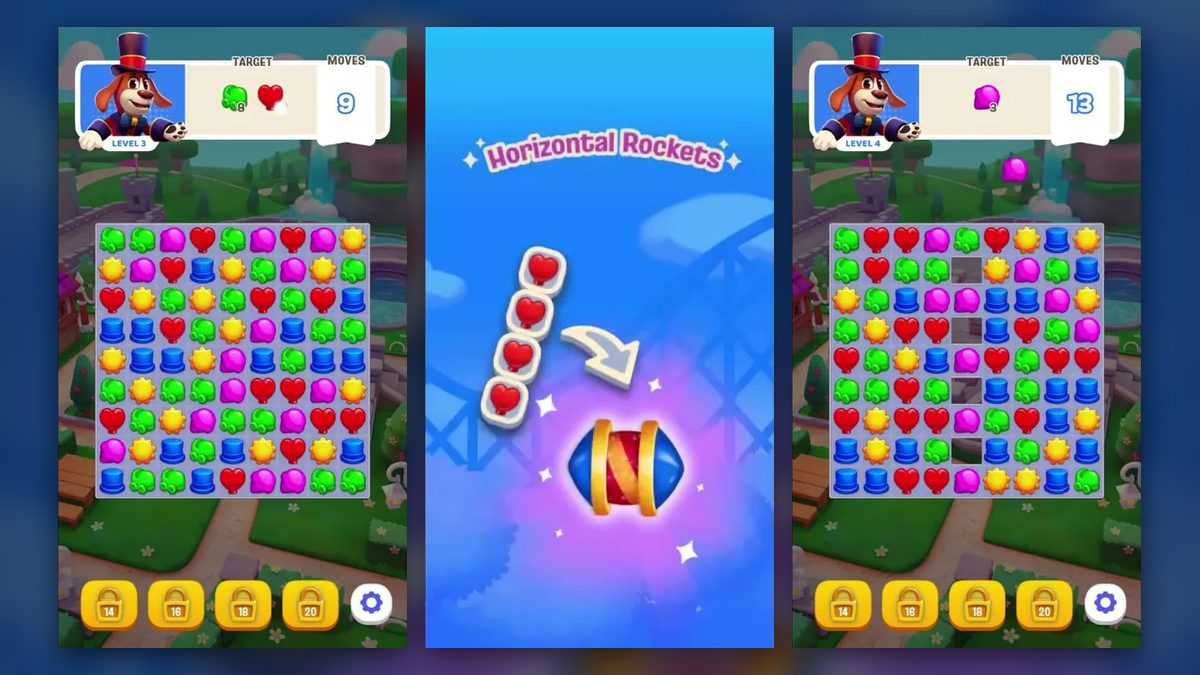
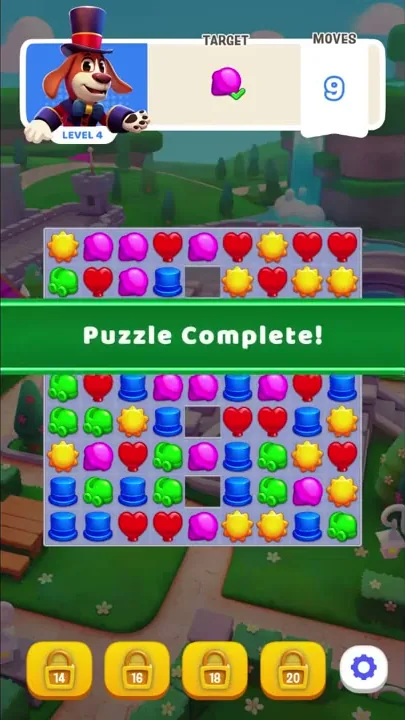
Every level shows a target panel at the top. It has an icon and a count for each piece type to collect, next to a MOVES counter that drops by one per move. The goal is to clear every count under TARGET before the moves run out. A finished target gets a green check mark, and once all of them are checked, a green “Puzzle Complete!” banner crosses the board, as it did at the end of Level 4 with 9 moves to spare.
You play by moving pieces around the grid, and the tutorials show which ones to move. A lesson step dims the board so only the cells to move stay lit, sometimes with a pointing hand over them. In the T-shape lesson, a heart and a sun overlap mid-swap at the top of the lit column. Between levels, large buttons handle everything else: Build opens the park menu, and a green LVL button starts the next level.
Puzzle Park Match Blast gameplay switches between two screens. On the board, lining up three or more matching pieces clears them, and new pieces drop in from above to fill the gap. Each collected piece flies up into the target panel, and larger matches leave special pieces behind. After a level the game goes back to the park, where coins pay for rides and the color meters fill before the next level starts.
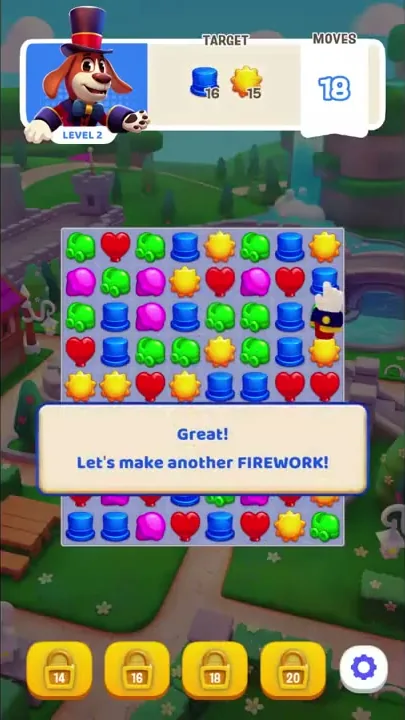
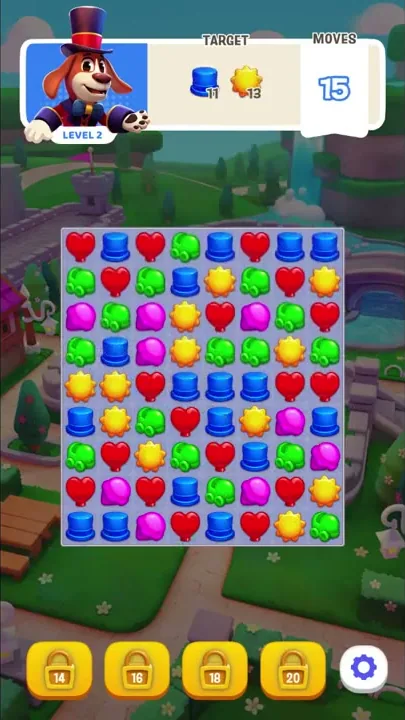
Blue top hats and yellow suns make up the Level 2 panel. While the tutorial is still running, it asks for 16 hats and 15 suns with 18 moves left. Five moves later the hats are down to 8 and the suns to 13, as new pieces tumble into a cleared gap near the top of the board. By 11 moves left the hats are checked off, and five moves after that only 2 suns are still missing.
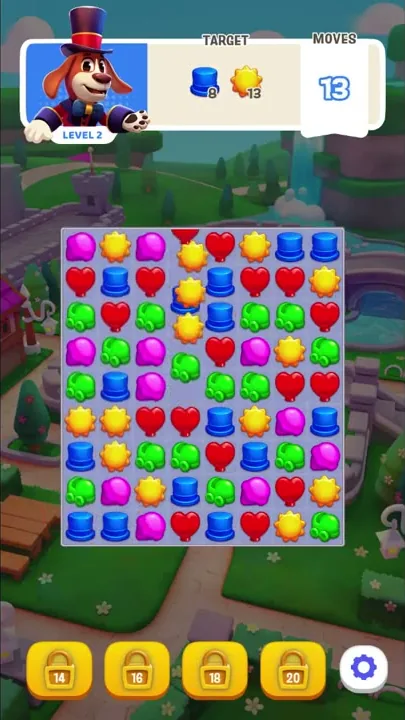
Five basic pieces fill every board. Hearts are red and top hats blue, suns are yellow, and the last two are rounded shapes in green and pink. The grid itself is see-through and floats over the park, which stays in view around it.
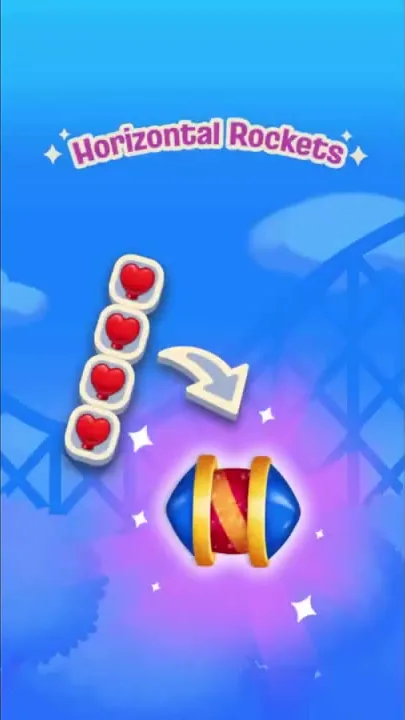
Special pieces are introduced on full-screen cards with a blue roller-coaster backdrop. Each card pairs a match shape with the piece it makes. The Horizontal Rockets card shows four hearts in a line and an arrow pointing to a capsule with blue ends and a striped red-and-gold middle. Rockets like that one sit in the bottom row of a Level 2 board and show up again in Level 3.
The firework is named in a Level 2 lesson. “Great! Let’s make another FIREWORK!” reads the panel across the lower board, while a pointing hand rests on the rightmost column of the board.
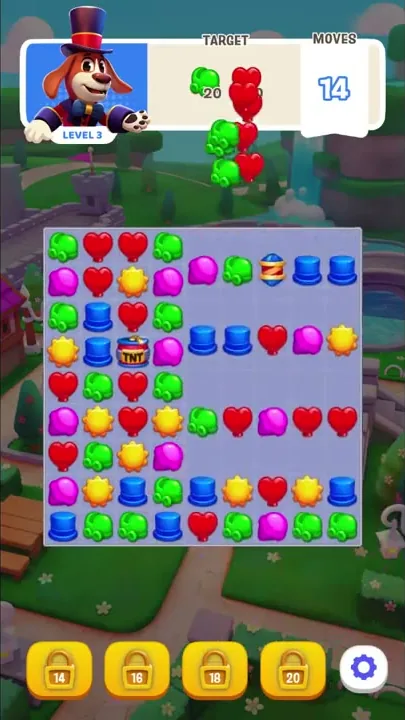
TNT gets a card of its own: five blue top hats in an L shape, with an arrow to a red barrel labeled TNT. In Level 3 the lesson reads “Make a T-Shape match to create a TNT!” and lights up a T of suns. Moments later a TNT barrel and a striped rocket sit on the board. Several rows have gaps, and collected pieces stream up toward the target panel.
The winged bomb belongs to Level 4, where the lesson reads “Nice job! Let’s create another WINGED BOMB now!” The panel spotlights a small cluster of suns and a single blue hat in the top-right area, with the hand resting on the hat.
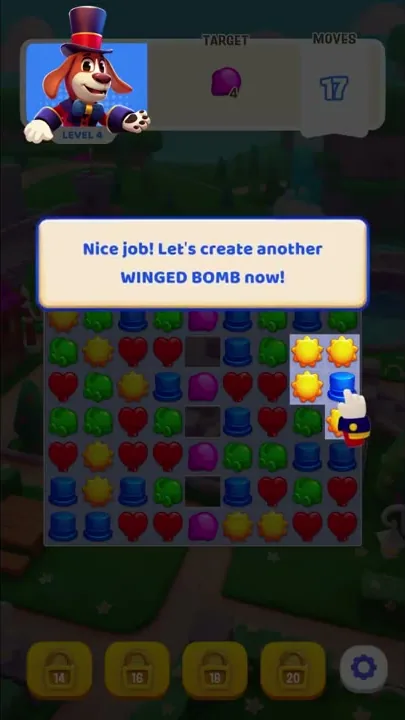
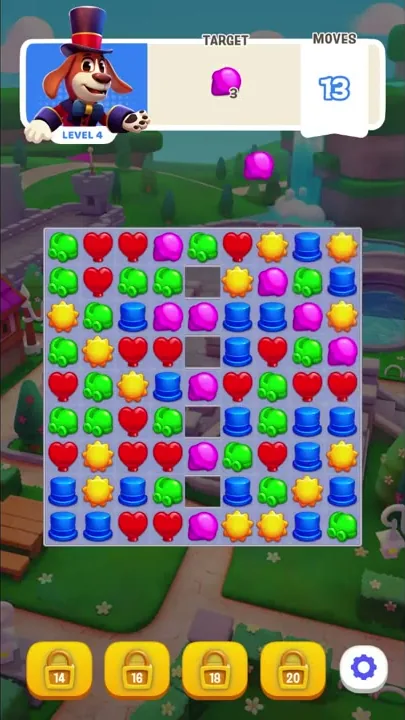
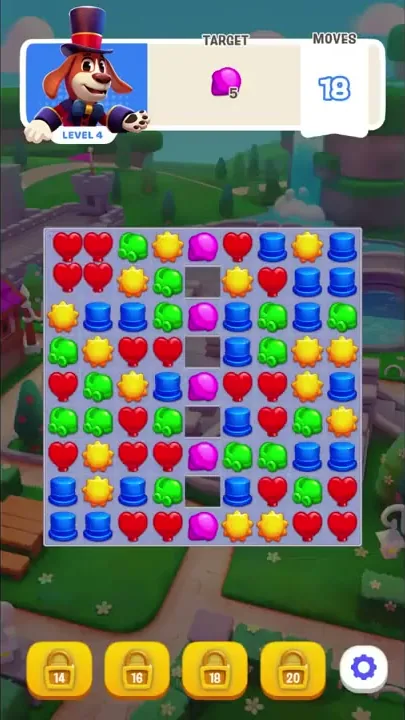
Level 4 also has the first empty cells: four dark squares in the middle column, one in every other row starting from the second. They hold no pieces for the whole level, so that column alternates between pieces and gaps.
Barker is a cartoon dog in a top hat and ringmaster coat. He fills the left end of the level header and gives tips in speech panels on the park screen. Special pieces go off in bright flashes. Behind the board, the park is a rounded cartoon 3D scene seen from above at an angle, with lavender stone walls and bridges over ponds.
From Plain Grids to Empty Cells
The boards change size and shape across these levels. The Level 2 grid is 8 columns by 9 rows with no obstacles, and its panel asks for blue top hats and yellow suns. From Level 3 the grid is a plain 9 by 9, a size it keeps in Level 4, when the empty cells appear.
Special pieces come one lesson at a time. The rocket card appears just before the Level 2 board, and that level’s tutorial covers the firework. A TNT card follows the Level 2 board and leads into the T-shape lesson in Level 3, while the winged bomb waits for Level 4.
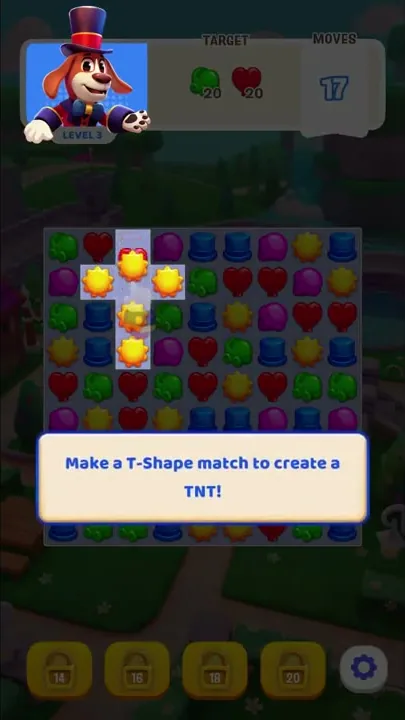
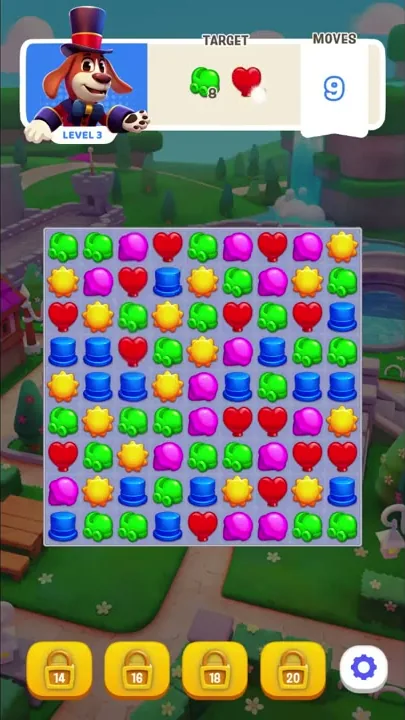
The target list, by contrast, gets shorter. The Level 2 and Level 3 panels each list two piece types, with both Level 3 targets set at 20: green pieces and hearts. Level 4 cuts the list to a single target of 5 pink pieces. At 18 moves, before any pink piece has been collected, every pink piece on the board sits in the middle column, alternating with the empty cells.
A pop-up now comes before Level 4. Under its LEVEL 4 header, a Streak Gift banner reads “Unlock at 35 stars” next to an info button. Below it, “Select Powerups:” sits over three locked slots, then a green play button with “Cost: 1000” and a ticket icon.
Inside every level, a bar under the board holds four yellow padlocked slots marked 14, 16, 18 and 20, next to a gear button. None of them had opened by the end of Level 4.
You win coins on the board and spend them in the park. The Build button, with a red number badge, opens the First Park panel. It has a progress bar out of 15 that ends in a treasure chest, and five rides, each showing a coin price above either a row of three small stars or a NEW! tag. On the first visit the prices ran from 2.1K to 8.9K, with NEW! tags on the last three.
Each purchase spends coins and moves the bar along while a white smoke cloud covers the park. The rides then appear in the park: first a cart under a pink umbrella and a duck perched on a target stand, then a unicorn spring rider. After Level 3 a floating coin marked 10,000 appears over the park.
A star counter in the top-left corner rises in step with the build bar. As it moved from 3 to 4, a STAR COASTER track marked “UPGRADE!” slid in with star markers along it, and a coin icon with a green arrow sat at the 4 mark.
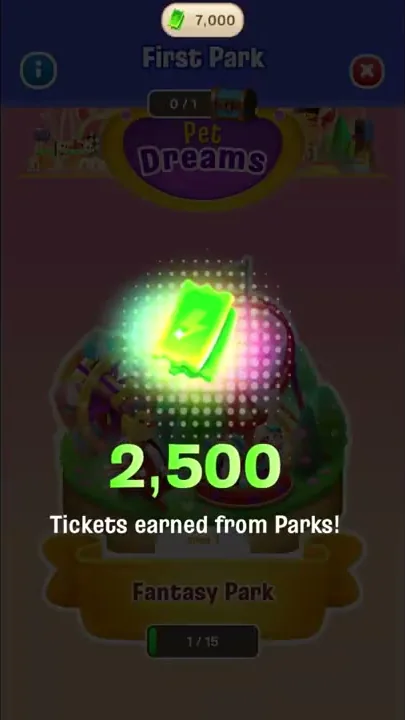
Tickets are the green currency next to the coins, and starting a level costs them, 1000 on the Level 4 pop-up. Back in the park after a level, a floating ticket marked 1,000 appears and the total goes up by the same amount. The purple COLLECT! button gives more: it opens a First Park screen announcing 2,500 “Tickets earned from Parks!” between a Pet Dreams banner and a Fantasy Park plaque. After that the button reads Map, with a ticket icon and a countdown timer under it.
The three meters connect the park back to the board. Each pairs an icon with a piece color: a purple shield over a red heart, a cyan-and-purple gadget shaped like a blaster over a yellow sun, and a green balloon with a blue star over a green piece. A round profile photo with a coin label ends the row.
On the park screen, piece icons with numbers float over the park, and Barker’s tip says that collecting pieces in the puzzles earns coins, shields, shut downs and raids on other parks. The meters start empty and climb as levels are cleared, though no raid or shield came into play.
Colored Pieces That Double as Park Charge
Pieces cleared on the board do double duty. Hearts cleared for the Level 3 target also push up the heart meter on the park screen, and the suns collected in Level 2 raise the sun meter. Each level feeds the park’s tools as well as meeting its own goal, and we found that idea really interesting.
Putting a match-3 core with mass appeal together with an outer system that has already proven itself is, in our view, an original take of its own. The board sticks to familiar match-3 parts such as target panels and rockets. The park borrows Coin Master’s layer of raiding and building: coins turn into rides for First Park, and Barker’s tips point toward shields and raids on other parks. The game blends the two under one amusement-park theme, from the ringmaster dog in the level header to the roller-coaster backdrop behind the special-piece cards.
A Stiff Hinge Between Board and Park
The link between the two halves feels a bit forced.
Swapping Pieces, Then Buying Rides
On the board, the player reads a short target list against the move counter and lines up matches of three or more, making rockets and TNT when the shapes allow. Off the board, the player picks the next ride for First Park while the star counter and build bar rise. That split answers a liking for two kinds of play at once: a board to clear up front, and a park that fills in behind it as the color meters climb.
Verdict
Setting a match-3 board with broad appeal inside the build-and-raid shell of a proven hit makes an original pairing. Routing every level’s pieces into the park’s tools gives it a really interesting twist. Where the two layers meet, the fit is not quite smooth, and the seam shows.