Merge Hearts Review: Fruit Orders Outside, a Garage Inside
From Orchard fruit orders to a garage rebuilt with a DROP! button, this Merge Hearts review covers both of the game's merge grids.
Game at a glance
Merge Hearts
8/ 10
Our score
Very enjoyable double merge that solves long chains; long haul unproven, not fully solved.
In this article6 sections
Merge Hearts is a very enjoyable spin on merge games: a mobile game with two separate merge boards, one outdoors and one indoors. Splitting the merging between them gets around the long merge chains that traditional games of this kind run into in their middle and late stages. The long-term experience is still unproven, though, and to our mind it is not fully solved.
Outdoors, guests order apples and blueberries, which come from tapping an Orchard. Indoors, a DROP! button fills a garage floor with tools and soaps, and merging them rebuilds the room while a short story plays out.
An Orchard outside, a DROP! button indoors
Merge Hearts has no stages to clear one by one. Progress comes from finished guest orders, which raise the star level shown on a badge in the top-left corner, and from finished build tasks in the garage, which fill a progress bar marked with a nut. The rule underneath both is the same: matching items dragged together turn into a bigger one.
Taps work the Orchard, and dragging one item onto its matches merges them. A tap on a guest’s speech bubble hands an order in, and coin stacks on the grid are tapped to collect them. In the garage the DROP! button is pressed for new pieces, and story scenes play in dialogue boxes with a Skip button.
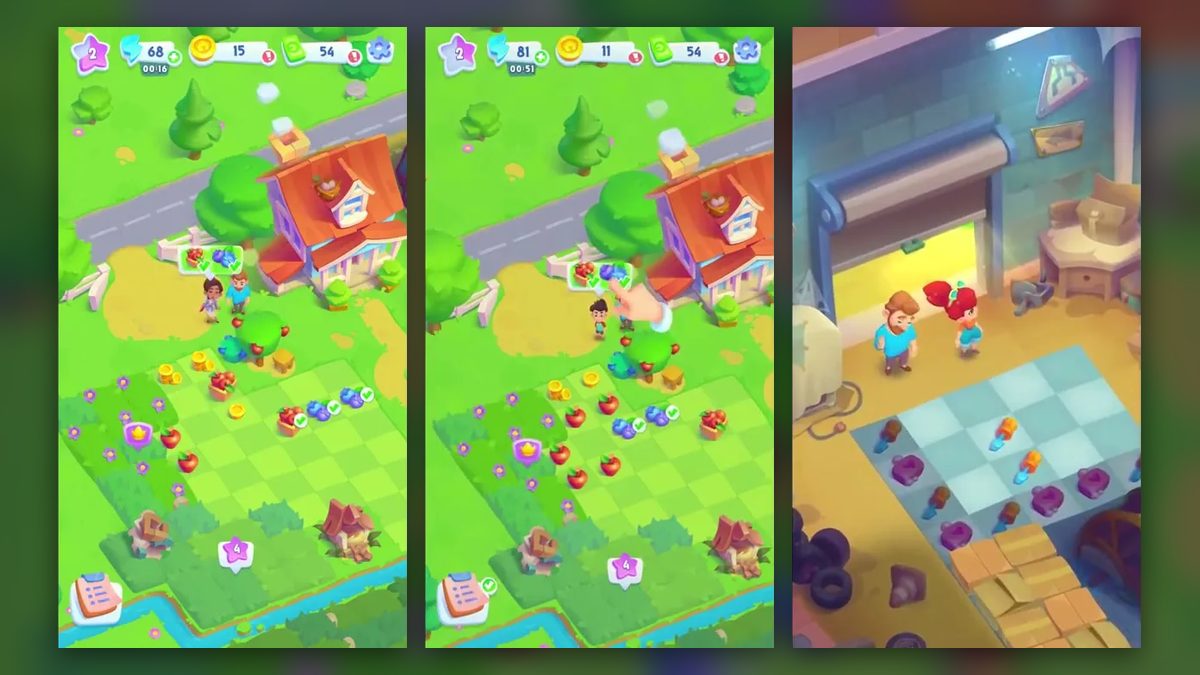
Outdoors, the Merge Hearts gameplay is a loop: tap the Orchard, merge what falls out, and hand the results to guests by the farmhouse, who pay in coins. Indoors, DROP! supplies the pieces, and merged items go into build tasks that put furniture in the garage.
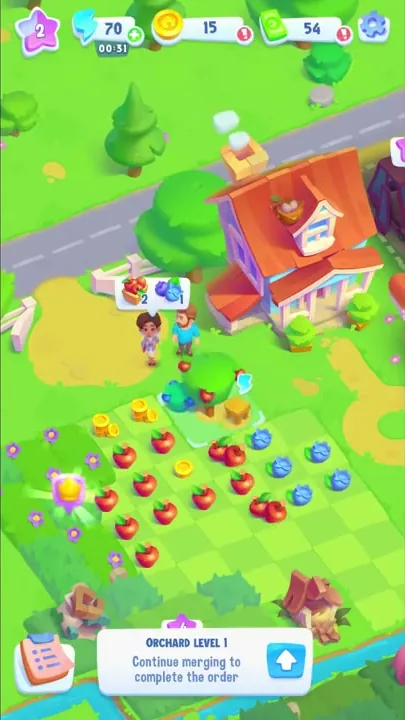
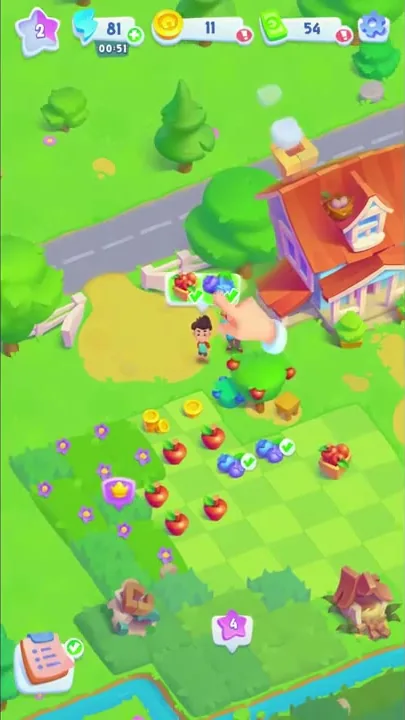
The outdoor board is a light-and-dark green checkered patch of grass below a farmhouse with an orange roof. Flower beds and two broken-down huts line its lower edges, beside a purple star badge marked 4. Everything we played runs from star Level 2, out here among the fruit, to star Level 3 in the garage.
The first guest wants blueberries marked 2, and the energy counter starts at 98. The next order asks for an apple basket and blueberries marked 2, and the one after that for a basket marked 2 and blueberries marked 1. By the time those baskets sit on the grid, the taps on the Orchard have brought energy down to 68.
The Orchard itself is a small apple tree with a blueberry bush and a crate, standing at the top corner of the grass grid. A banner at the bottom of the screen reads “ORCHARD LEVEL 1” above the line “Continue merging to complete the order,” with a blue up-arrow button beside it, and the Orchard stays at that level throughout. Each tap shows a “-1” next to a lightning icon and spills apples and blueberries onto the grid. A tutorial card marks this step with “Collect items from the Orchard” under a green DONE banner.
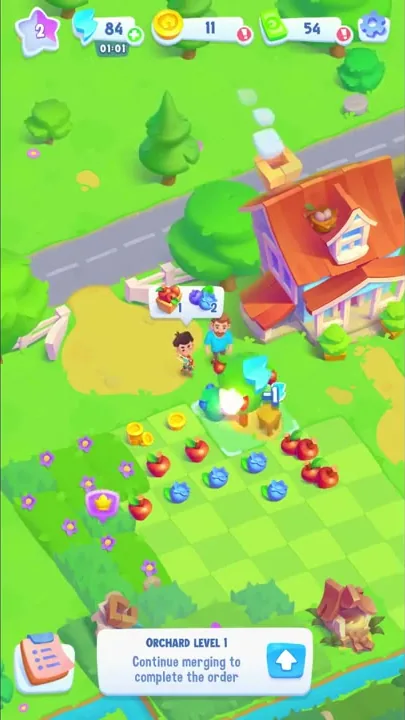
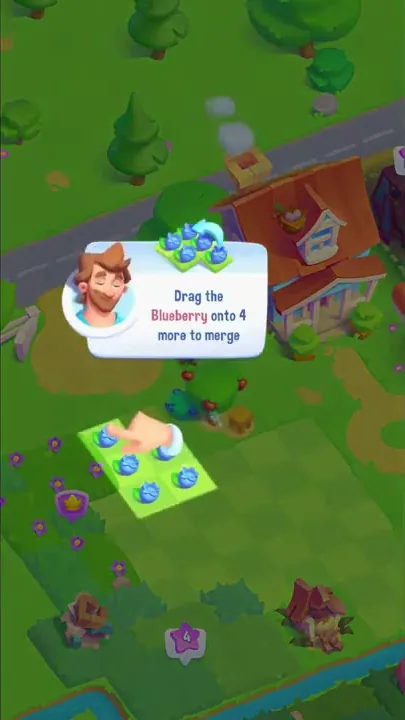
The first merge takes five pieces at once. The tutorial dims the screen and lights up five blueberries, and a pointing cartoon hand demonstrates while the bubble reads “Drag the Blueberry onto 4 more to merge.” A green DONE card afterward confirms “Merge 5 blueberries together,” and larger blueberry bunches then sit beside the Orchard, the form the first guest’s order calls for.
Apples land on the grid as single apples and as pairs, and merging them produces baskets of apples. Guests order those baskets: with a request for a basket marked 2 waiting at the farmhouse, two finished baskets sit on the grass.
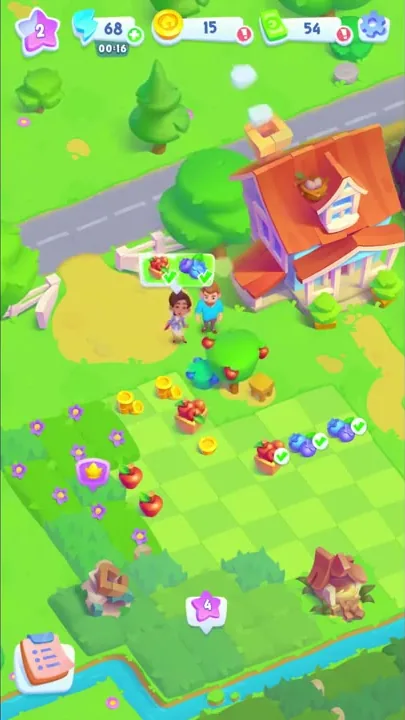
Guests walk up to the farmhouse with a speech bubble that lists the items they want and how many of each. Grid items that match get green check marks, and one tap on the bubble hands them in. Once the guest leaves, gold coin stacks lie on the grid, and a tutorial line spells out the deal: “Guests give coins for completing orders.” Tapping a stack sends a glowing stream of coins up to the counter.
In the garage, a pink DROP! button in the bottom-right corner takes over from the Orchard. Each press puts new tools and soaps on a teal-and-white checkered floor grid, and the counter under the button, next to an orange icon, goes down as they land. It reads 34/90 at the first build task and 28/90 a few builds later.
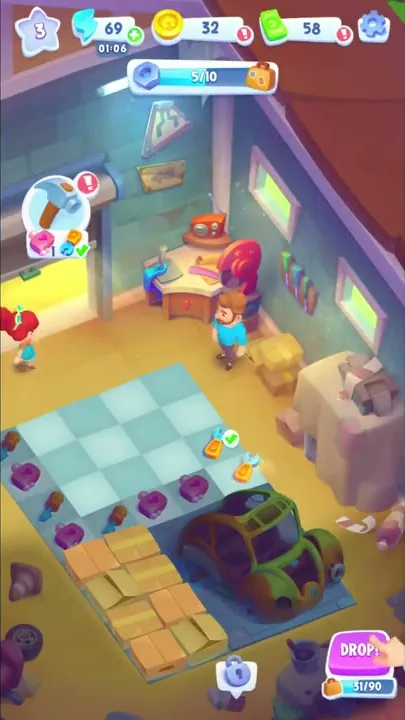
The garage pieces come in two kinds: purple heart-shaped soaps and orange-and-blue tools. When a soap is selected, an info panel headed SOAP appears and explains that merging soaps gives the item one step up. That item is pink, and it is what the build tasks ask for.
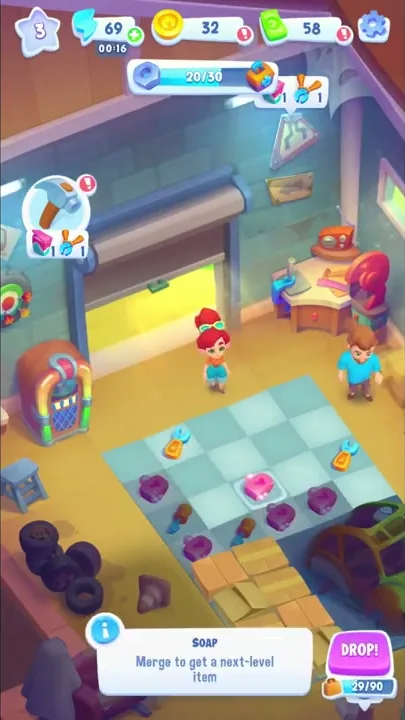
Not all of the floor is free. A stack of cardboard boxes covers the lower part of the grid, and a rusty green car shell sits at one corner of it. Later on the stack is smaller, and more floor tiles are open.
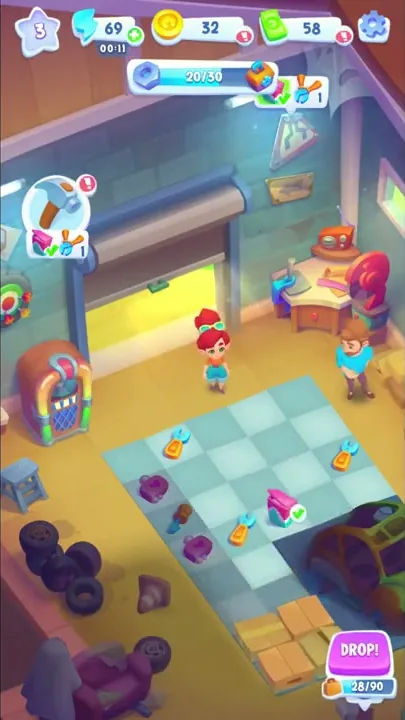
Building runs through task bubbles, led by a hammer bubble on the left side of the screen, and two can be open at the same time. Each lists what a build needs, such as one pink item and one tool. Items that qualify get green checks, and once everything is ready the bubble turns green. The item then floats to the spot where the build goes, with a “-1,” and a new piece of furniture appears there.
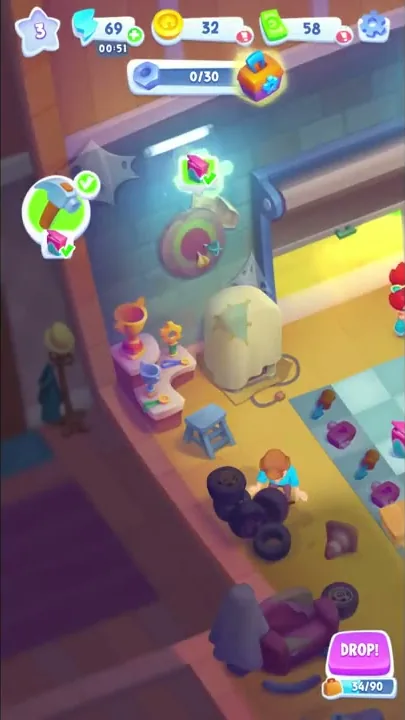
From a star badge to a furnished garage
Progress outdoors is counted in stars. With the guest orders done, the badge goes from 2 to 3 and a “NEW LEVEL” screen opens, with “Here are your rewards” above the reward cards. Three item cards show a red car with luggage on top, a shed with a chicken and a coin on a green tile. Below them, two currency cards hold coins +10 and green banknotes +4, and “Tap to continue” closes the screen.

The level-up is also where the setting changes. The camera pans across the map, where land past dashed borders is drawn darker and overgrown with stumps and rocks, and stops by a red car for a short scene: “Look, Stel! I bet this is my grandpa’s car!” Play then moves inside a cluttered garage with its own merge grid.
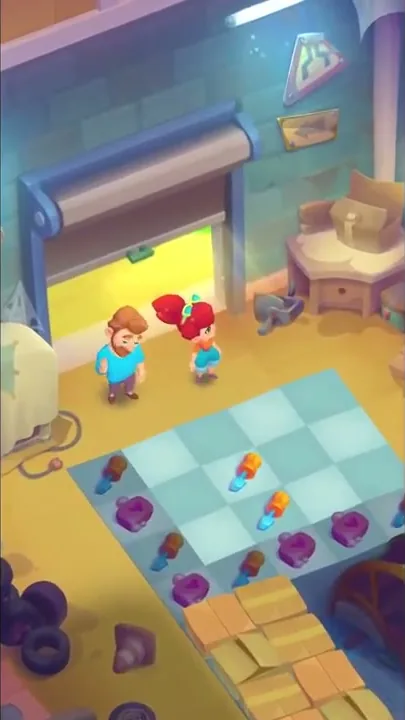
From there, furniture marks the progress. A workbench with a red vise goes in first, and Greg, the bearded man in the blue T-shirt, greets it with “Ta-da! Looks pretty good to me. Way to go, me!” A shelf with a trophy follows, then car posters with a dartboard, then a jukebox, and last a motorcycle mounted on the wall.
Builds also fill the nut progress bar under the currencies, which has a nut icon at its left end and a box icon at its right. A “+5” nut pops up as the trophy shelf appears, and once the bar reaches its first target it restarts at 0/30 with a different box icon. It reads 30/30 when the motorcycle goes up, and right after that, a line of dialogue announces that something interesting has turned up.
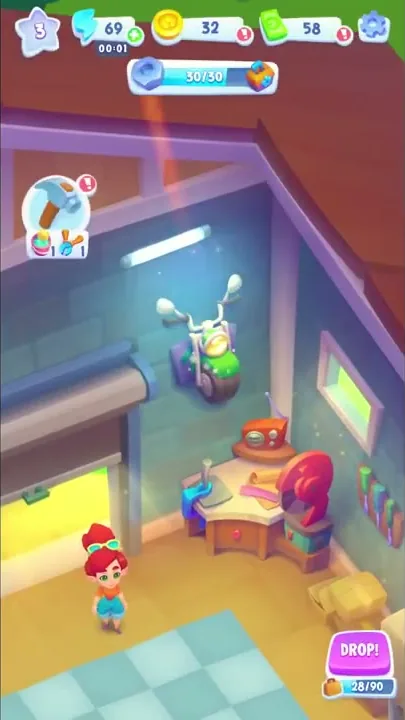
Around the two boards, the screen tracks a few more things. Energy is a lightning-bolt counter at the top with a green “+” and a countdown timer under the number; each Orchard tap costs one point, and the count holds steady indoors. Coins have a gold counter with a red “!” badge and come from guest orders and the level-up screen. Green banknotes, a second currency with the same red badge, show up as a reward card on the level-up screen.
A clipboard button sits in the bottom-left corner outdoors, sometimes with a red “!” and sometimes with a green check. In the garage, a house-shaped button takes that spot, and a tutorial hand points at it. A gear button for settings sits in the top-right corner. No ad, shop screen or paid offer came up.
Two merge boards that split the work
We enjoyed the double-merge design a great deal. Outdoors, merging serves a line of guests and turns fruit into coins. Indoors, merged soaps and tools go into builds that add a workbench, a jukebox and a motorcycle on the wall, and the story moves along as the room fills. The two boards have different pieces and different goals, but the same drag-to-merge action.
Splitting the merging this way also solves a known problem of traditional merge games: merge chains that stretch out in the middle and late stages.
The production values look like the work of a large, established studio. The presentation outdoors is bright, rounded 3D cartoon art seen from a high angle, with a road and a stream running past the farmhouse. The garage is warmly lit, with yellow light coming in under a half-open roller door and old tires stacked on the floor.
Each new piece of furniture gets a camera pan before the view returns to the grid. The two recurring characters are Greg and a red-haired woman with green glasses pushed up on her head, and Greg’s lines appear in dialogue boxes with his portrait.
How long the Orchard and garage hold up
The long haul is the open question: it still has to prove itself, and our sense is that it is not fully solved.
Everything shown here comes from the opening stages. The Orchard never moves past its first level, and the garage has only just filled its second nut bar when the story teases what comes next. How the long-term experience holds up beyond them is something only longer play can show.
Filling orders, then furnishing a garage
Outdoors, the work is reading a guest’s bubble and deciding which fruit to merge, with an eye on the energy that every Orchard tap uses. Indoors, it is pressing DROP! for pieces and merging soaps into the pink item a hammer task names, then watching a jukebox or a motorcycle appear on the wall. The two halves line up with two common tastes in mobile games: filling orders on a merge board, and putting a run-down room back together while a story plays out.
According to industry research, the core players of this game are men aged 20 to 30. That suggests the way a game blends its systems, and not only its premise, can reach a different crowd within the same genre.
Verdict
Two boards sharing one merging action make for a lot of fun, and the split keeps the long chains that weigh on traditional games in this genre at bay. Staying power is the open point: it still has to prove itself over the long run, and we don’t think it is entirely solved. Taken as a whole, the result is a clearly positive one.