Royal Battle Review: Peg Boards That Buy Four Neon Armies
Balls landing in slots priced 2G to 80G buy the soldiers, and this Royal Battle review follows four neon armies in a race to five round wins.
Game at a glance
Royal Battle
6.5/ 10
Our score
Take away the ball drops and it already looks like a small strategy war game.
In this article6 sections
Royal Battle is a trade-off that cuts both ways. Letting falling balls buy its troops waters down the strategy of choosing troops to counter troops and leaves more to chance. In return, the battles themselves look more concrete and give more to watch.
It is a mobile ball bounce game for four neon teams sharing one screen. Balls bounce down each team’s peg board into slots that price its soldiers, the cost comes off that team’s gold, and the new recruits gather in its corner of a square arena. When a countdown runs out, all four armies fight at once. The single match we played ran 16 rounds before one color reached five wins.
Five price slots under every peg board
A round goes to the color whose soldiers are the last ones left in the arena. Each panel counts its wins out of 5, starting from ‘WINS 0/5’, and the match ends as soon as one color reaches 5/5. Losing a round only moves another color’s count up. There are no lives to lose and no fail screen, and the only end screen is the winner’s banner.
No input shows up anywhere in the match. From the opening question, ‘Which color will win?’, to the final banner, the balls fall and the soldiers march and fight while no buttons or touch marks appear. No screen for choosing a color came up either, so we can’t confirm whether a player can back one of the four.
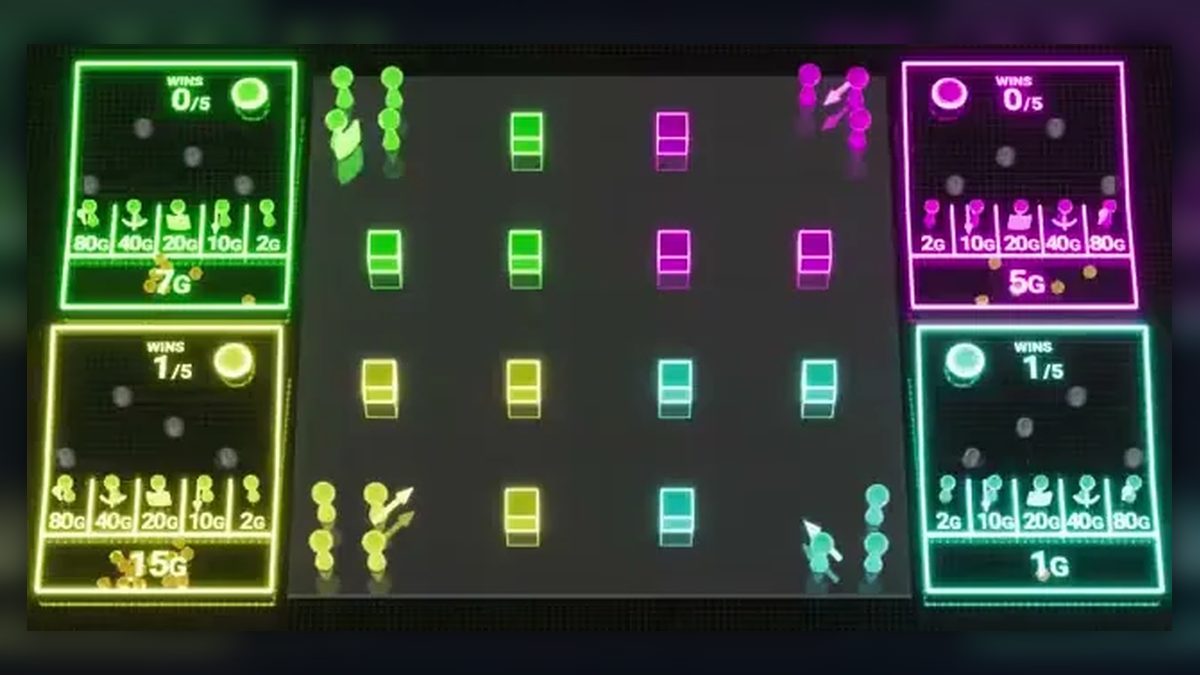
Each color has a neon panel in one corner of the landscape screen, two stacked on either side of a gray square arena: green above yellow on the left, magenta above cyan on the right. A WINS counter sits at the top of the panel and a gold counter at the bottom. Between them, a board of gray pegs runs down into five slots, each with its own soldier icon and price. Green and yellow list 80G, 40G, 20G, 10G and 2G from left to right and magenta and cyan list them in reverse, so the cheapest slot is always on the arena side.
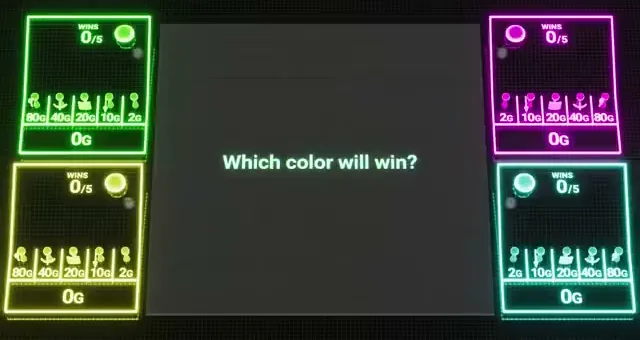
Some balls trail a dark line as they fall. The ball icon at the top of each panel, on the arena side, sometimes shows as a hollow ring instead of a filled one, and nothing on screen says what either detail means.
Every round runs through the same cycle. A ‘Buy Soldiers’ countdown appears in the middle of the arena, and while it runs, balls keep tumbling through all four boards into the slots. Minus pop-ups take gold off a team’s counter as its new soldiers line up in its corner. When the timer reaches 00.00, the soldiers march out and fight, and the color left standing gets one more win before a round banner leads into the next buy phase.
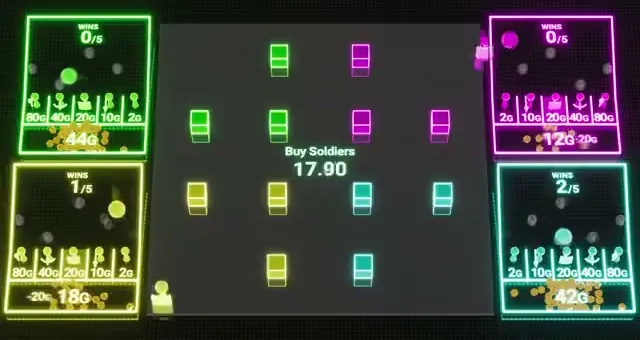
The countdown shows seconds and hundredths. The highest reading we caught was 18.83, and it ticks down to 00.00 while recruits keep appearing in rows in the four corners.
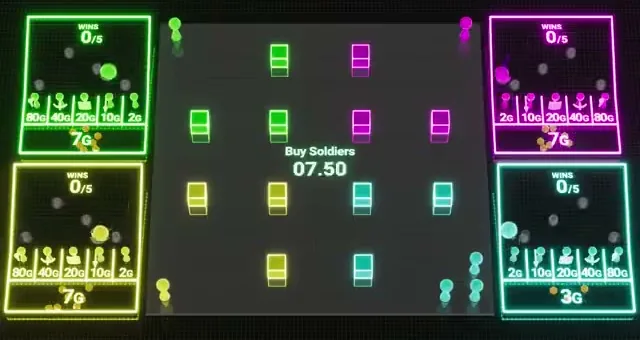
The soldiers are small glowing figures in their team’s color. Some have round heads and others carry white pointed objects, and in the second round magenta also fielded a tall block-shaped figure. During the countdown they wait in their corner. Once it ends, each one walks out with a health bar above it.
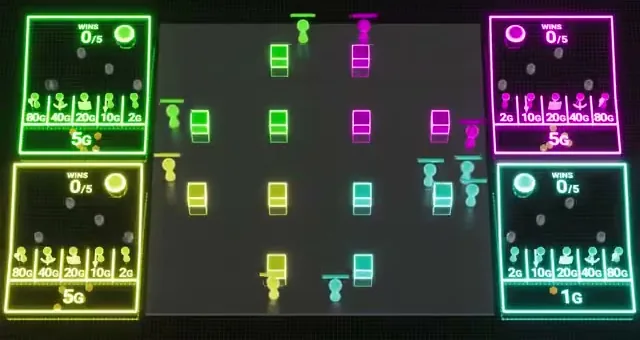
Some soldiers fight at range, sending arrow-shaped projectiles across the field in white or in a team’s color. In the third round a magenta arrow is in flight and a lone cyan soldier fires a white one. White arrows fly again in the crush of Round 14.
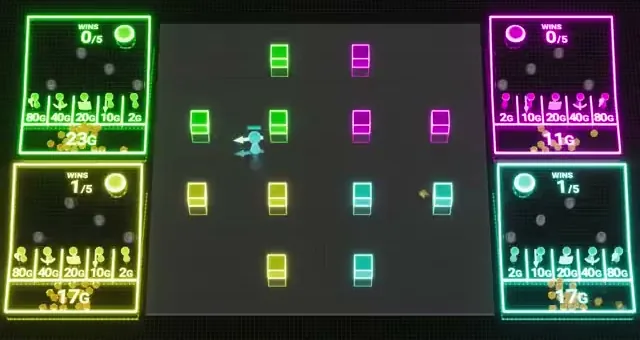
The arena itself never changes. Each color has three glowing, translucent cubes in its own quarter of the arena. They sit in four rows, two cubes in each outer row and four in each middle one, and the soldiers fight around them. The same cubes stay in place from the first banner to the last.
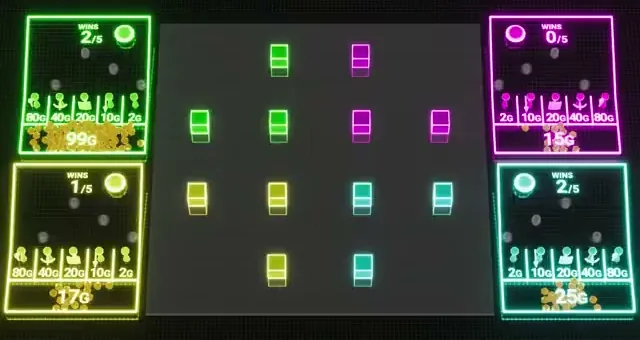
The fighting starts along the edges. Each army leaves its corner along the outer sides of the arena and meets its neighbors: green clashes with magenta across the top and with yellow down the left, while cyan takes on yellow along the bottom and magenta on the right. The survivors then push into the middle.
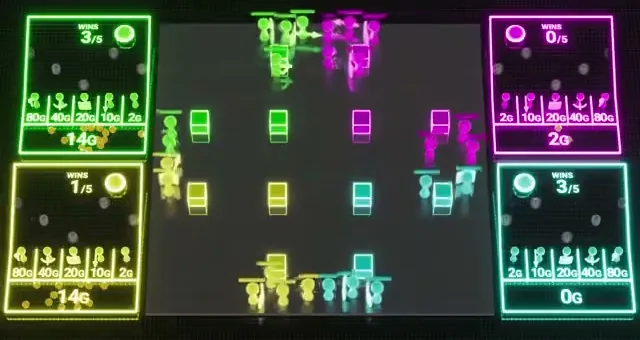
When a round ends, the WINS counter of the color with the last soldiers standing goes up by one. A banner such as ‘Round3’ or ‘Round12’ then appears over the empty arena before the next buy phase.
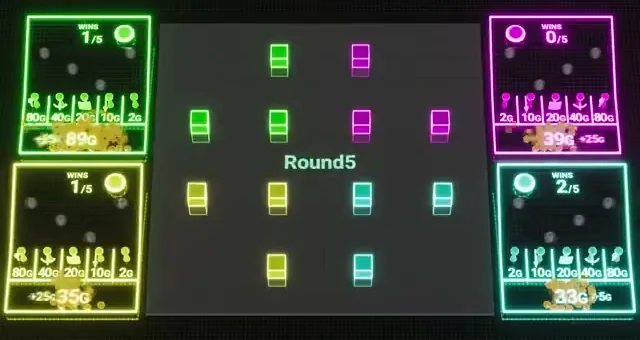
A team low on gold fields a smaller army. In the match’s last buy phase, cyan had just 4G to spend and only a few soldiers in its corner, while yellow’s corner was full. By the time the armies met, cyan’s gold was gone.
The first round opens under a ‘Round1’ banner with no gold on any of the four panels and WINS 0/5 on each. With the countdown at 17.50, a ‘-2G’ pop-up sits beside cyan’s gold, and small groups soon line up in all four corners. After they march out, cyan’s soldiers are the last still fighting, bunched beside a magenta cube, and cyan moves up to 1/5.
Corners that fill as the gold piles up
The arena stays the same from start to finish. What changes is the size of the armies and the gold behind them. Through the first four rounds, each corner holds only a handful of soldiers.
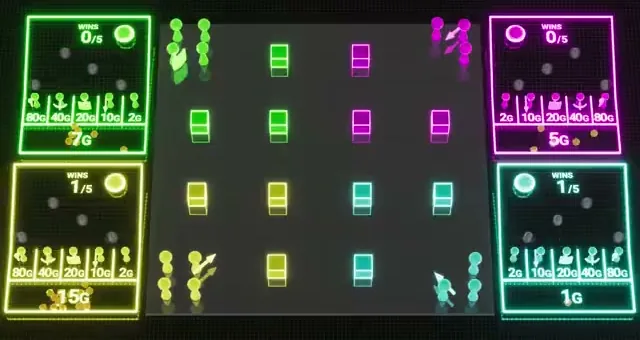
From the fifth round on, the armies grow and the gold totals reach three digits. Green’s gold hits 104G in Round 6, and magenta and yellow later pass 100G too. By the middle of the match, the corners usually fill with rows of soldiers before the fight, and the biggest armies of all meet in Round 14.
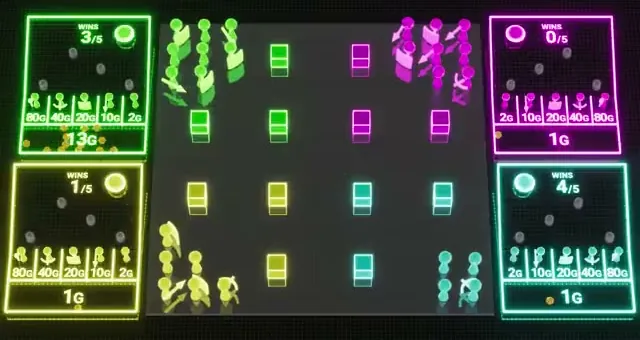
The lead changed hands several times. Cyan and yellow traded the first three wins between them. Green then took three of the next four rounds, and after Round 8 cyan became the first color on 4/5. Magenta waited until Round 9 for its first win and took the following round as well.
Yellow made its run last. After Round 10 it still had a single win, while 140G piled up in its tray. It then won Rounds 11 and 12, lost Round 13 to magenta and took Round 14, which put it on 4/5.
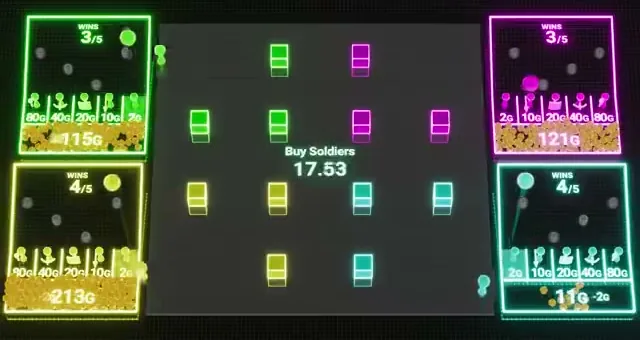
Magenta then took Round 15, which left three colors on 4/5 and green on 3/5. The deciding round came down to yellow and magenta near the center of the arena, and yellow’s fifth win put ‘Yellow Win’ across the middle, where it stayed.
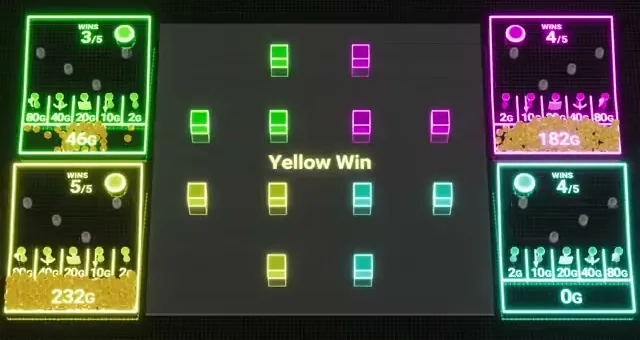
Gold is the only currency on screen, and each team keeps its own. It starts at 0G and shows as 3D coins heaped in the tray at the bottom of the panel, so a rich team’s panel visibly fills up: yellow finished the match on 232G with its tray full. Totals carry over from round to round instead of resetting, and green started Round 5 already holding 89G.
Spending shows as minus pop-ups beside a counter. Cyan’s ‘-2G’ came early in the first buy phase, and a ‘-10G’ left yellow on 0G in the second. Totals can drop quickly too: during the Round 12 buy phase, green’s gold fell from 92G to 12G within moments.
Gold comes in as well. Small ‘+2G’ pop-ups appear beside counters during fights, and bigger ones show up too: ‘+20G’ beside yellow as it closed out Round 11, and ‘+25G’ beside yellow and magenta as Round 5 began. Coins lie scattered across the arena floor mid-fight, and nothing on screen spells out what earns each amount. No shop, upgrade screen, offer or ad appeared at any point during the match, and no menu ever opened.
Battles that look more concrete and more watchable
The battles now look more like real armies fighting, and they are more watchable. When the countdown hits 00.00, soldiers with health bars pour out of all four corners at once. In Round 8 every edge of the arena has its own clash, and in Round 14 white arrows streak over blurred clusters of bodies and health bars.
On a board this small, each round plays out like the battle phase of a strategy war game. Remove the random ball triggers and what is left would already pass for a miniature strategy game. Armies set out from fixed corners and meet along the edges before the survivors fight over the middle among the cubes.
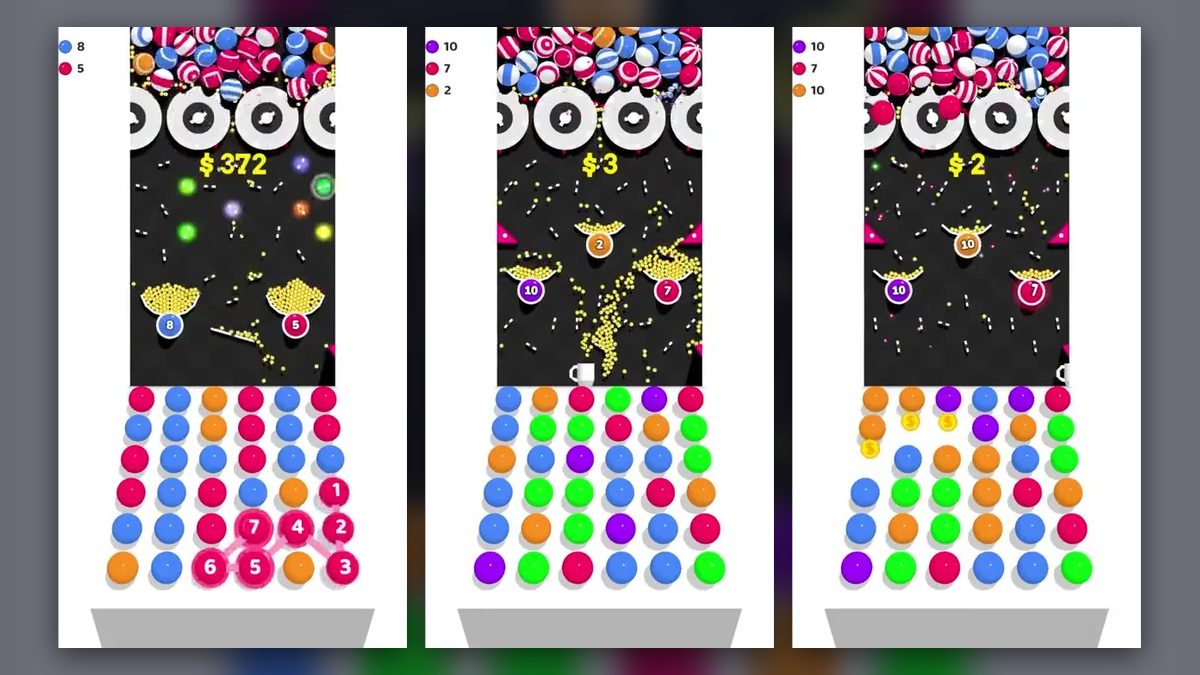
The core idea itself is a mashup of army composition and pinball-style chance. Each panel offers five soldier icons at five prices, and the balls bouncing down its pegs settle into those slots, so every corner’s army is built from wherever the balls land.
The theme, a melee of mixed troops, has room to grow as well. It could move toward bigger packaging, and that opens up more possibilities for pinball-style idle auto-battlers.
Ball drops that thin out troop counters
The same mashup comes at a cost. With balls deciding the purchases, the strategy of matching troops against the ones they counter is diluted, and each buy phase leaves more to chance. Every panel lays out five soldier icons from the 2G slot to the 80G one, yet nothing on screen shows anyone picking a slot: where a ball settles after bouncing off the pegs is what puts a soldier in the corner. Different kinds of troops fighting on one board put Royal Battle in the same company as games like Clash Royale, but here the troops come from where the balls bounce.
Tracking gold heaps and four-way fights
With no input visible from start to finish, the match plays itself out on screen. Balls tumble down four peg boards at once while gold comes and goes on the counters, and when the timer runs out, four armies pour from their corners together. These mechanics suit a taste for watching results take shape rather than steering them, such as spotting which tray is filling with coins and then checking whether that corner’s rows grow to match.
The opening screen asks ‘Which color will win?’ before the first ball drops. Yellow had a single win after 10 rounds and still finished first, and three colors were one win from victory going into the last round.
Verdict
Handing the shopping to falling balls trades away some of the thinking about which troops beat which, and each round leans more on chance as a result. The payoff is on the battlefield, where the fights now read as armies colliding, health bars and arrows included, and give the eye more to take in. Underneath the chance sits what is already a compact strategy war battle, and a brawl of mixed troops has room for bigger packaging. Taken together, that lands Royal Battle just above the middle.