Space war Review: Marble Luck Dressed Up as Fleet PvP
A Space war review of peg boards whose lower slots read INTY, BOMBER, HUNTER and GUNSHIP, set beside a red-versus-blue fight between two motherships.
Game at a glance
Space war
7.5/ 10
Our score
With a strong setting and dressing, this marble drop could put a strategy war game ahead
In this article6 sections
A marble bounces down a field of pegs and drops into one of a row of labeled slots. Anyone who has seen a ball bounce game knows that picture, and Space war keeps it as it is. What changes is the space around it: the peg boards shrink into the top corners of a landscape screen, and the middle goes to a red fleet and a blue fleet fighting in the mold of EVE Online’s player-versus-player battles.
Underneath, the drop works the way it always has. The fleet war wrapped around it is what gives the idea somewhere to go.
Marble boards beside a mothership duel
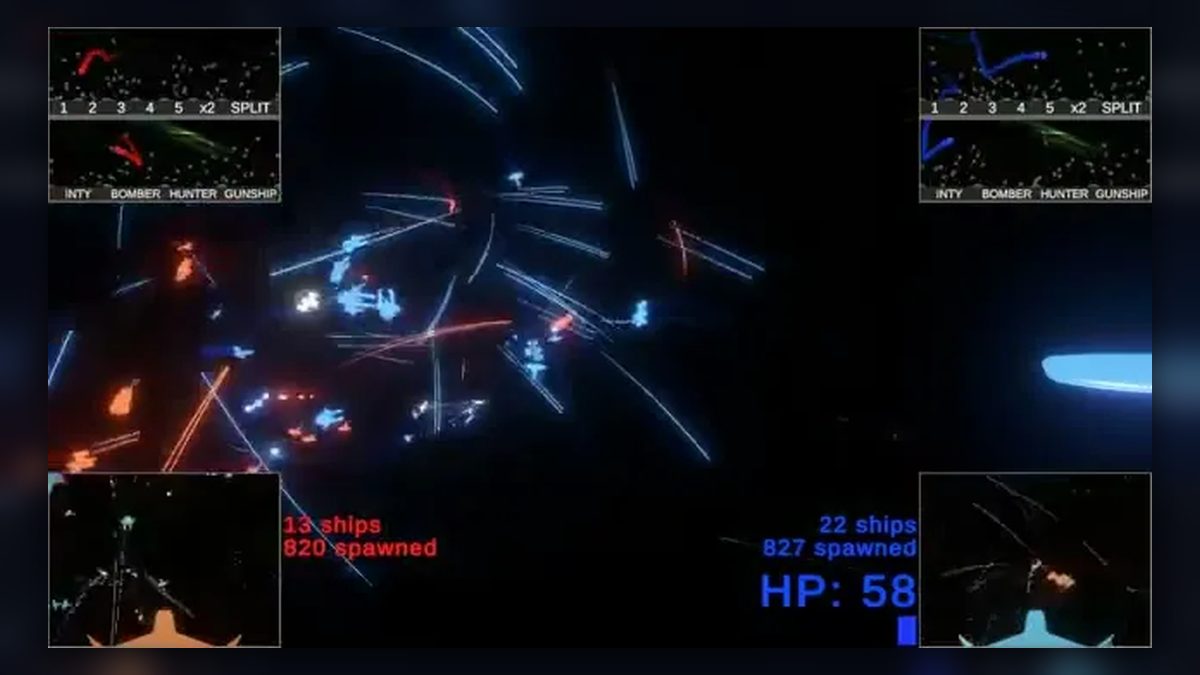
The opening banner sets the goal: “DESTROY THE ENEMY MOTHERSHIP”. A red-orange mothership hangs at the left edge and a blue one at the right, two long glowing hulls with empty black space between them, and each starts at HP: 1000 with a bar underneath that shrinks as the number drops. Two bases with units crossing the middle to attack each other will be familiar from games like clash royale, though here each side has a single big target.
Above each HP readout the HUD keeps two running counts: the ships that side has on the field and the ships it has spawned so far. Both sides open the match with “1 ships” and “0 spawned”. Nothing on screen counts down or limits moves.
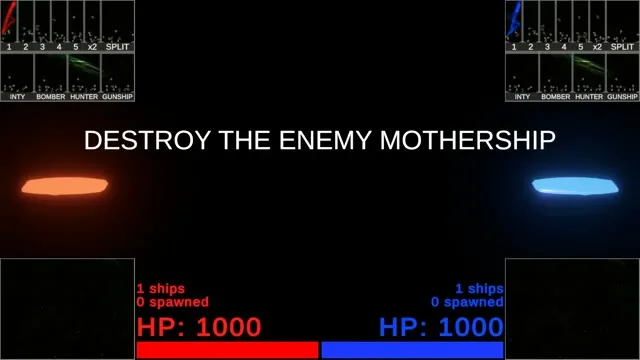
No button, menu or touch prompt shows anywhere in the match we played. Marbles keep falling and fleets keep fighting from the opening banner onward with no visible input.
Each top corner holds that side’s marble board, built in two parts. The upper peg field ends in slots marked 1 to 5, then “x2” and “SPLIT”; the lower one ends in slots marked “INTY”, “BOMBER”, “HUNTER” and “GUNSHIP”. A marble’s path shows as a trail in its side’s color, red on the left board and blue on the right. A green glowing bar lies across the HUNTER column of both lower boards, and the small white dots scattered over the boards start out sparse and grow much denser as the match goes on.
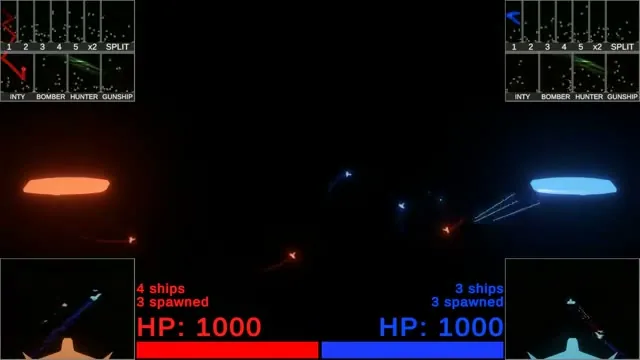
While trails run down a side’s boards, that side’s spawned count keeps rising. New ships in its color appear near its mothership, head into the middle, fight the other fleet and fire on the enemy mothership, whose HP goes down.
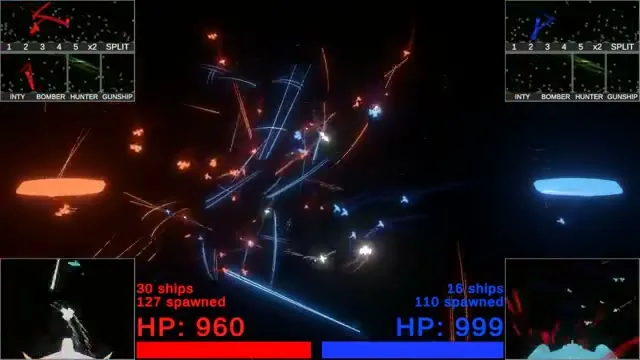
A board can carry several trails at once. Early in the match red trails cross on the red upper board, and much later both red boards are crowded with them. Across that busy stretch red’s spawned count climbs from 540 to 620, while blue’s moves from 575 to 591.
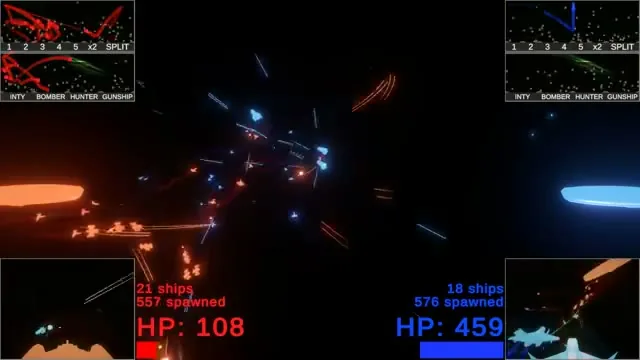
Every ship glows in its side’s color, orange-red on the left and blue or cyan on the right, and comes in one of several shapes and sizes. Small arrow-shaped craft fly alongside larger, blocky ones, usually in loose groups across the middle.
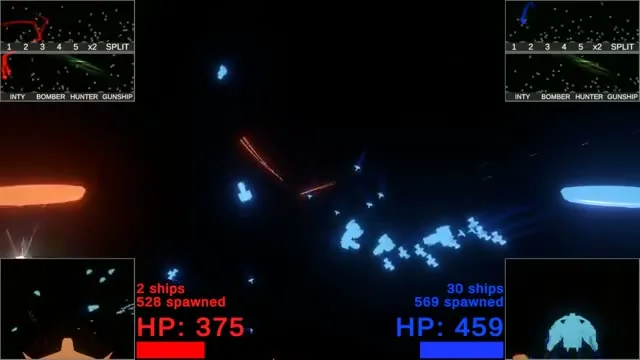
Fire shows as long, thin streaks of light in each side’s color, crossing the battlefield as the fleets fight. Large glowing orbs turn up as well: one white near the bottom center and one orange beside the blue mothership, and later a bigger orange one in the same spot.
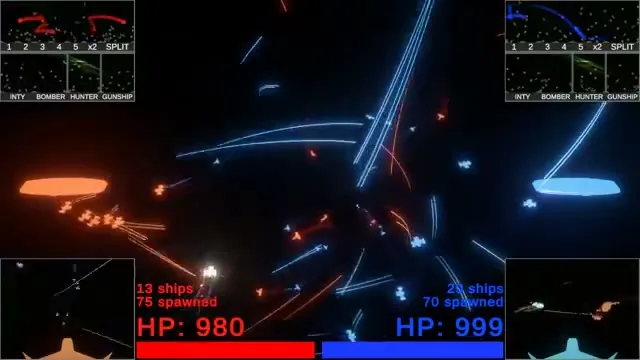
The two bottom corners each show a view from behind one ship of that side, an orange ship on the left and a cyan one on the right. Both panels are dark under the opening banner, while neither side has spawned anything; blue’s lights up first, once its count reads “1 spawned”, with red’s still black. The ship being followed changes over the course of the match, from a small craft early to larger ones later.
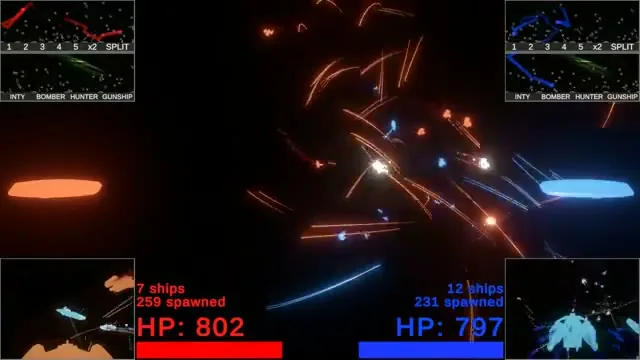
All of it sits on a plain black background, lit in neon. The framing shifts during the match: at some moments both motherships are fully in view, at others the view moves in and cuts them off at the screen edges. At the busiest points the center fills with dozens of small ships and crossing streaks.
From full hulls to one mothership left
Neither mothership loses any HP at first. Both ship counters start at 1, and just before the first damage lands red has 10 ships out to blue’s 22, with 51 spawned on each side.
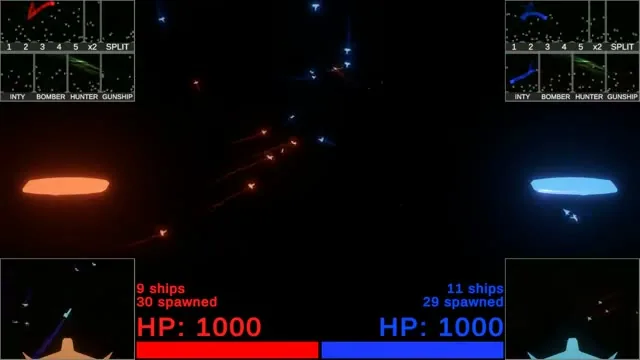
Once damage starts, red’s mothership loses HP faster: 830 against blue’s 917. The lead then swings back and forth until both motherships are tied at 687, and after that red slips again, down to 411 against blue’s 653.
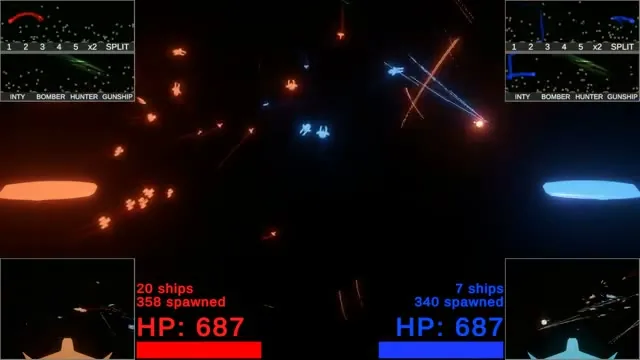
Later, red’s mothership drops from 375 to 310 to 113 in quick succession while blue’s holds at 459. At 310 the red hull is covered in white flashes as blue streaks converge on it.
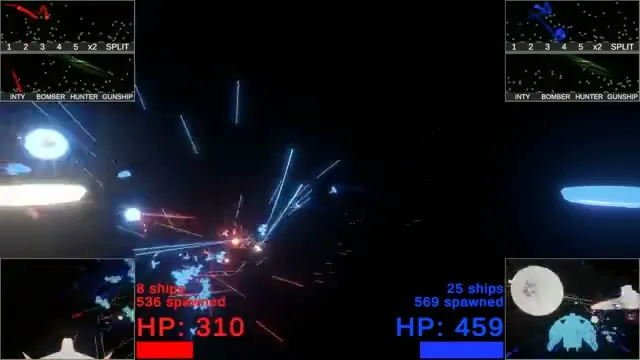
Red’s fleet then swells. Within half a minute its ships on the field go from 21 to 41, then 56 and 58, while blue’s number stays between 6 and 18. Blue’s mothership falls from 459 to 425, and a few seconds later to 275, with red’s own hull sitting at 90.
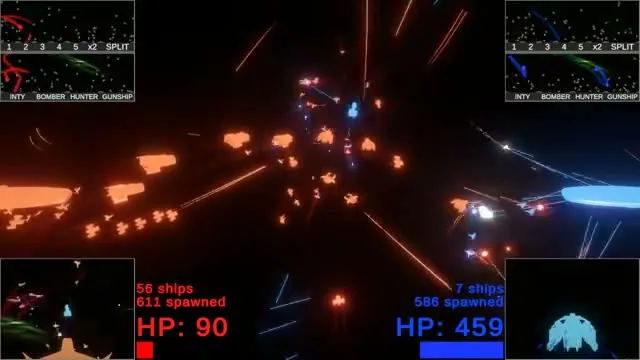
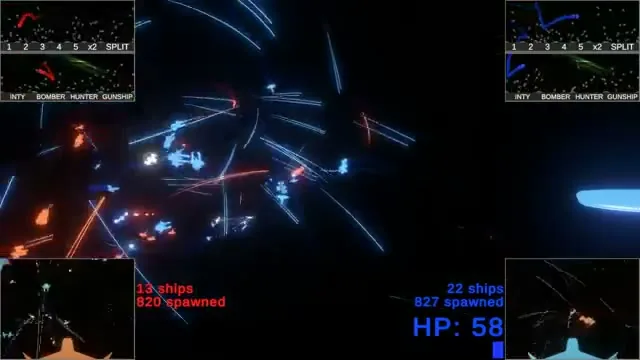
Toward the end both motherships run low, red from 89 down to 18 and blue from 210 down to 58. Then the red mothership vanishes from the left edge, and its HP readout goes with it. Red’s spawned count freezes at 820 while blue’s keeps climbing to 844, and red’s ships on the field thin out from 13 to 1.
No upgrade or army-management screen appears around the match at any point. Everything described above happens on the one battle screen.
Random marbles dressed up as a fleet war
Space war pairs the randomness of a marble drop with its space-war setting, and the two are fused tightly. The lower slots of every board are named for ship classes (“INTY”, “BOMBER”, “HUNTER”, “GUNSHIP”), the boards sit in the corners of the battle itself, and each side’s spawned count climbs while its trails run.
Its core is gradually drifting toward strategy war games. With a strong setting and enough dressing, we think a core like this could grow into the surprise ingredient that lets a strategy war game overtake its rivals.
The drop underneath is unchanged, ordinary peg fields with labeled slots. Wrapped in neon fleets trading fire between two glowing motherships, though, it already looks like a format with a lot of room for dressing and imagination, the kind that could carry army management or character-upgrade systems on top.
What the slots and controls leave open
We have no complaints to raise about Space war. The points below are things a match leaves open, not faults.
The board labels go unexplained. Nothing on screen says what “1” to “5”, “x2” or “SPLIT” do, whether a marble passes from the upper board into the lower one, or how a landing turns into a ship. “INTY” is never spelled out, no ship shape is tied to a class name, and the green bar over the HUNTER column has no label either.
Input is the other open point. No control of any kind shows on screen, so a player’s part in the match is not visible from the battle alone. No results screen appears either; after the red mothership disappears, the fight goes on for the rest of what we saw, with red down to one ship.
Peg-board chance and fleet battles on one screen
The appeal sits with people who like watching chance play out on a peg board, marble by marble. A match here means keeping an eye on four small boards at once while the ship counts at the bottom rise and fall.
Fans of big fleet fights of the EVE kind get the other half: two neon armadas trading streaks of fire across a black field, and an HP race between the motherships in which both run low. Fleet sizes swing widely along the way, from a handful of ships to dozens and back.
Verdict
Space war rests on one tight pairing of marble-drop chance with a war between fleets. The drop itself is the familiar one, yet the war built around it already hints at army-management and upgrade systems that could sit on top, and, given a strong setting and dressing, at a shortcut by which a strategy war game might overtake its rivals. The result is a good idea with plenty of road ahead of it.