Sanctuaries Review: Trap-Lined Corridors and a Pyramid Town
Arrow Volleys on the walls, an Impaler in the floor and the hero Xipil: a Sanctuaries review of a comic-style trap defense game with a town hub.
Game at a glance
Sanctuaries: Temple Defenders
8.5/ 10
Our score
A well-finished trap defense game, and we really like how its home town looks.
In this article6 sections
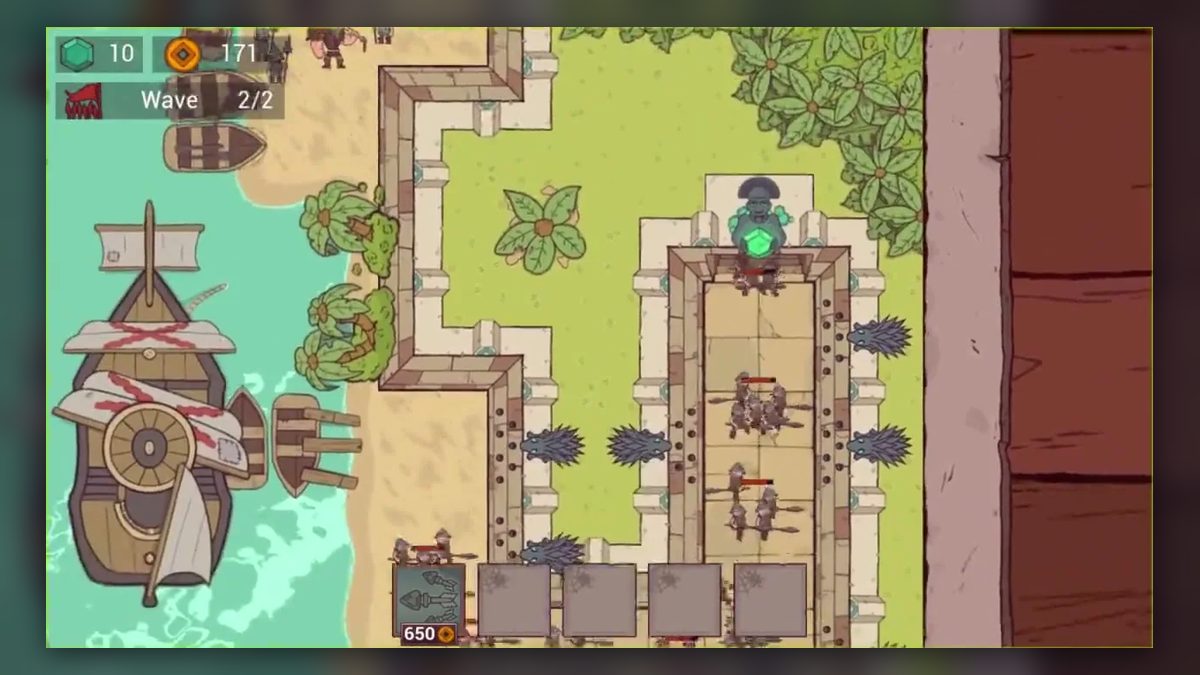
Build traps into the walls and floor of a stone corridor, then watch helmeted soldiers pour off a ship on the beach and march toward a statue holding a green gem. Sanctuaries, listed in full as Sanctuaries: Temple Defenders, is a comic-style, trap-based entry among tower defense mobile games. Between battles it moves to an illustrated refuge town where traps and heroes are unlocked, and both have upgrade menus there.
In the two battles we played, an unnamed opener and Tutorial part 2, the trap bar grows from one card to two and the hero Xipil joins the fight. We really like the hand-drawn visual style, the home town most of all, and the game as a whole is finished to a high standard.
Spiked Walls Between a Beach and a Gem
A battle runs from sea to statue. Spear-carrying soldiers in metal helmets climb out of a ship and its rowboats on the beach, then follow a walled stone corridor that bends around a grassy block up to the statue with the green gem. The player spends coins on traps from the bar at the bottom of the screen and builds them along that corridor. Between battles the game cuts to a town hub, where the Workshop handles traps and the Training Ground handles heroes, and the second battle opens with a screen for picking a hero and up to five traps.
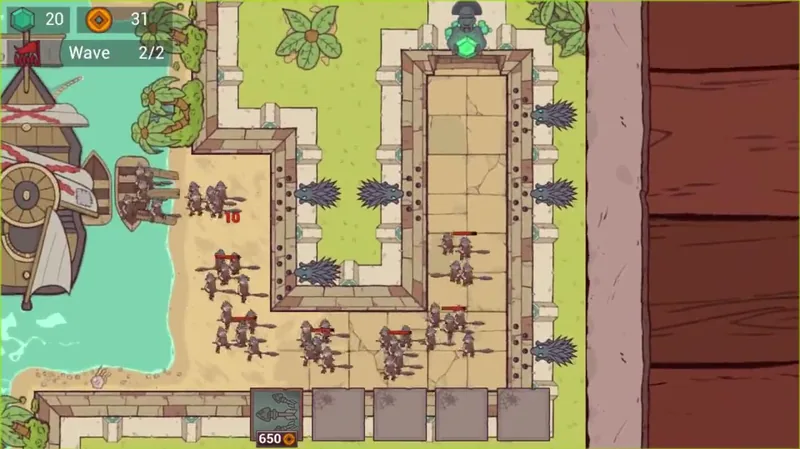
The corridor ends at the statue with the glowing green gem. Both battles come with 20 gems, tracked by a green counter at the top left, and the results screen of the first one reports “Remaining gems” out of that same 20.
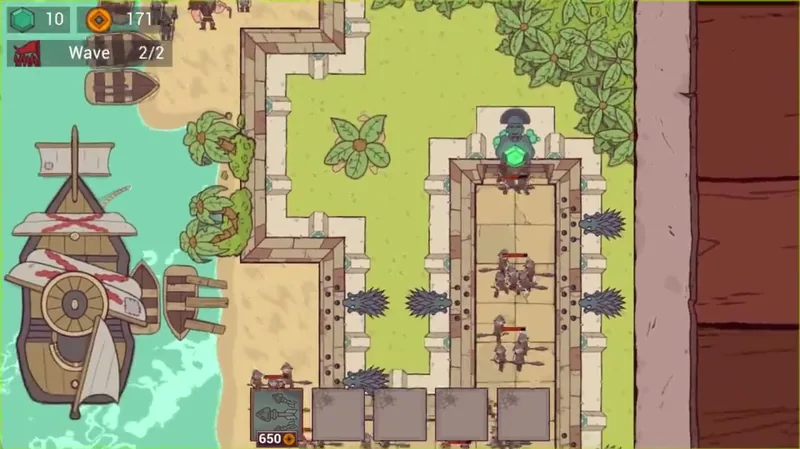
Enemies come in waves, tracked by a counter under the gems: Wave 1/2 and then Wave 2/2 in the first battle, Wave 1/3 in Tutorial part 2. Before a wave, an “Incoming wave” panel shows a soldier portrait with a number, 105 ahead of Wave 2/2 and 10 in Tutorial part 2. While the 105 panel is up, a round badge with crossed weapons and the number 16 sits at the corridor entrance. The soldiers talk in small speech bubbles over their heads, and small red numbers such as 10, some under a coin icon, pop up along the path during the fighting.
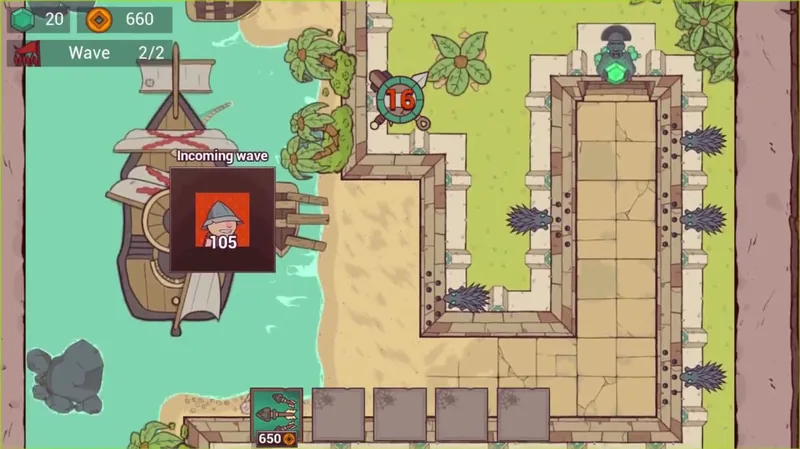
Arrow Volley is the wall trap. Its card reads “Send several arrows in a straight line” and costs 650 coins. Once built, it becomes a dark, spiky device on a corridor wall, and a line of small arrows can be seen crossing the corridor from one of them. In the Workshop it is unlocked from the start, while the cards around it carry padlocks.
Building takes two choices. Selecting a card opens a banner reading “Choose an available slot to build this trap”. The free build spots along the walls turn into green squares with crossed-tool icons, and the selected card shows a red X. Choosing a spot builds the trap and takes its price off the coin counter: an Arrow Volley in Tutorial part 2 takes it from 2,432 to 1,782. The bar has five slots, with the empty ones covered in cobwebs. In Tutorial part 2 a circular-arrows button sits to its left, and a “1x” button and a menu button sit at the top right.
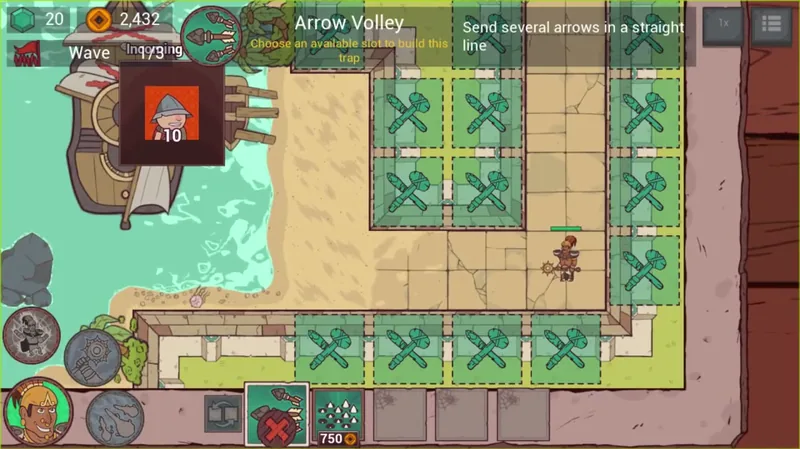
The Impaler goes in the floor. Its card promises “Rows of spikes piercing through enemies” for 750 coins. Once built, it sits in the stone path as a dark square grate with spikes at its corners. It is unlocked in the Workshop for 50 of the gear-shaped currency, and in Tutorial part 2 it goes down right after the Arrow Volley, a few steps from the hero.
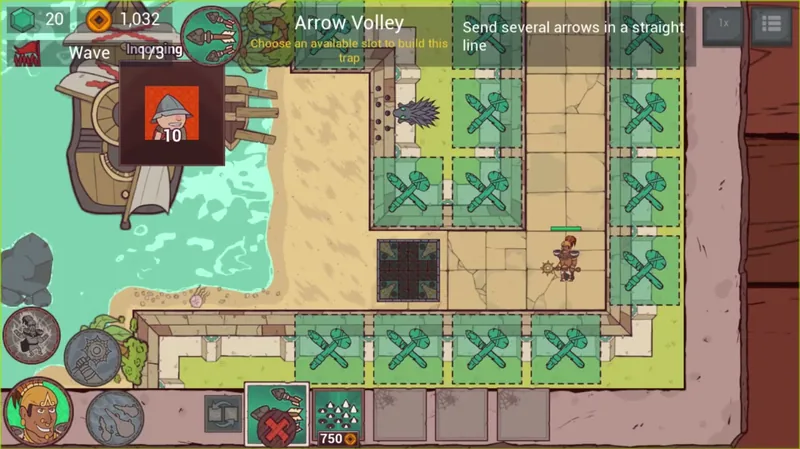
A hero joins the traps on the field. In Tutorial part 2, Xipil, the Flame Bearer, stands in the corridor holding a sun-topped staff, with a green health bar over his head. His portrait and three round ability buttons fill the bottom-left corner. Their icons match the three abilities listed for him in the Training Ground, the first of them Fire bolts.
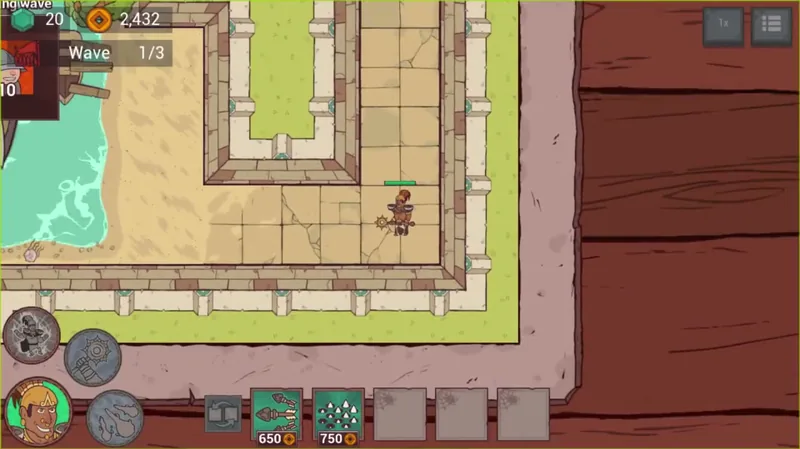
Coins are the battle currency. The orange counter at the top left pays for traps at the price printed on each card, and it climbs again while the fighting goes on.
During Wave 1/2 of the first battle, Arrow Volleys already line the corridor walls, and the bar holds a single 650-coin card beside four cobwebbed slots. One more Arrow Volley goes up on an inner wall as Wave 2/2 begins, and then crowds of soldiers spill across the beach and into the corridor. While they pack the stretch in front of the statue, the gems fall from 20 to 17 and then to 10, and the battle ends in Defeat.
From One Trap Card to a Five-Slot Loadout
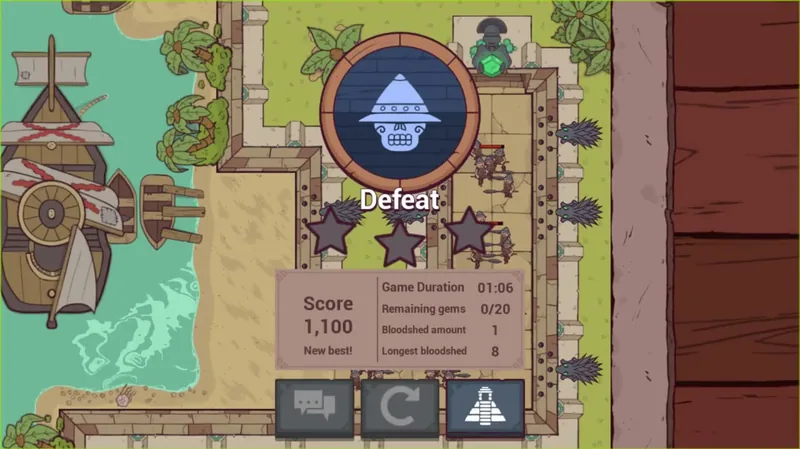
Both battles take place on one map, with the ship and rowboats on the left and the walled corridor climbing to the gem statue, so the change comes in the kit. The opening fight puts a single trap type in one of the five slots and leaves the other four under cobwebs. It runs two waves before ending in Defeat. Its emblem, a skull in a metal helmet, hangs over three unfilled stars, and the results panel lists a score of 1,100 marked “New best!”, a Game Duration of 01:06, Remaining gems 0/20, Bloodshed amount 1 and Longest bloodshed 8. Three icon buttons sit under the panel, among them a circular arrow and a pyramid.
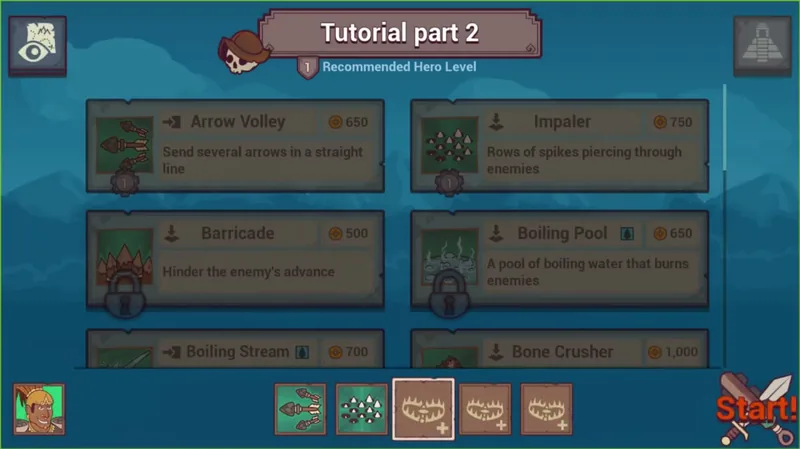
A pre-battle screen comes before Tutorial part 2. Under the battle’s name and a hero-level badge marked 1, it first lays out four hero cards with three ability icons each: Xipil, Flame Bearer; Atl, Ruler of Currents; Eztli, Keeper of the Dead; and Xochitl, Sower of Life. Only Xipil’s card is not dimmed.
Once he is picked, a trap list with prices follows. Arrow Volley (650) and Impaler (750) are open, while Barricade (500, “Hinder the enemy’s advance”) and Boiling Pool (650, “A pool of boiling water that burns enemies”) carry padlocks. Boiling Stream (700) and Bone Crusher (1,000) sit lower down. Arrow Volley and Impaler go into the first two of the five loadout slots, and a crossed-swords “Start!” button begins the fight, while an eye-and-map button at the top left opens a preview of the battlefield.
On the field, Xipil now stands in the corridor beside a trap bar with two cards. This time the fight is set for three waves instead of two, shown as Wave 1/3.
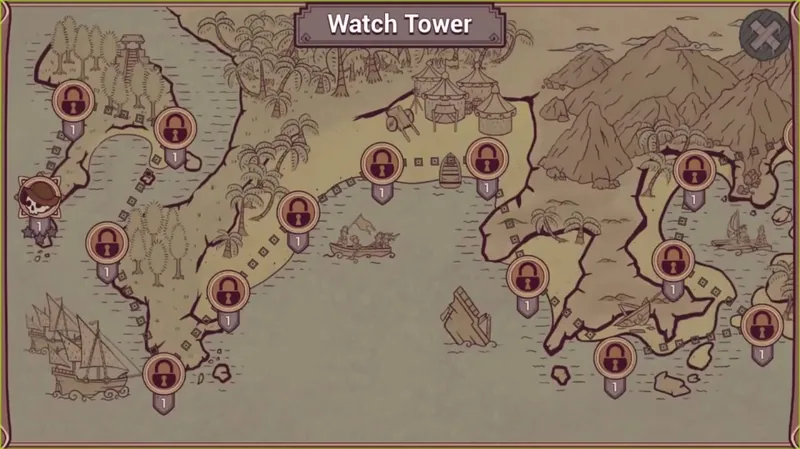
Between the two battles comes the Watch Tower, a hand-drawn map of islands joined by dotted paths. At the far left, a node with a skull in a brimmed hat carries a “1” badge and stars, and the rest show a padlock above their own “1” badge.
The town hub holds the long-term layer around the levels. It is an illustrated town gathered around a large stepped pyramid, with houses and striped market awnings among the palms, and villagers walk through it past a banner with the Defeat skull on a platform in the middle. Currency counters line the top edge. Building icons run along the bottom: a map, a hammer, a feathered mask, a hand holding a dagger, a campfire, a bowl and a pot. A red “!” marks the next stop, moving from the hammer to the mask and then to the map, and four more icons sit at the top right.
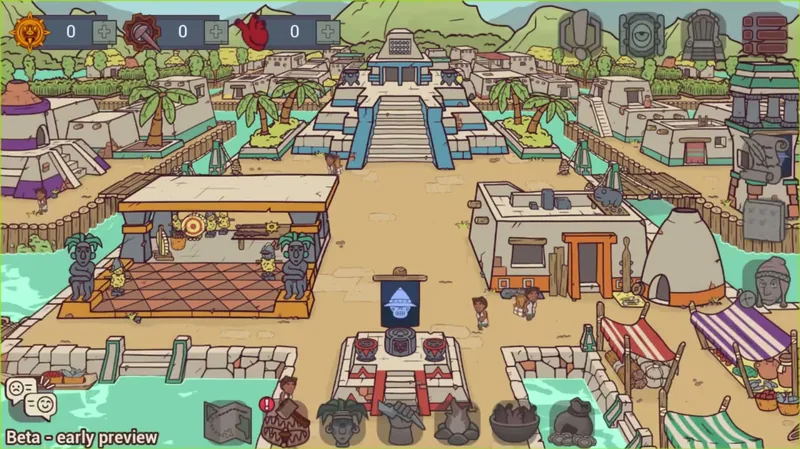
Those three counters appear across the top of the town and its menus, each with a “+” button. A sun medallion leads the row, followed by a gear with a hammer and a red heart. The gears are spare parts, which the guide hands over so the Impaler can be unlocked, and the hearts pay for heroes. A fourth counter, a green orb, sits above the hero abilities and pays for ability upgrades.
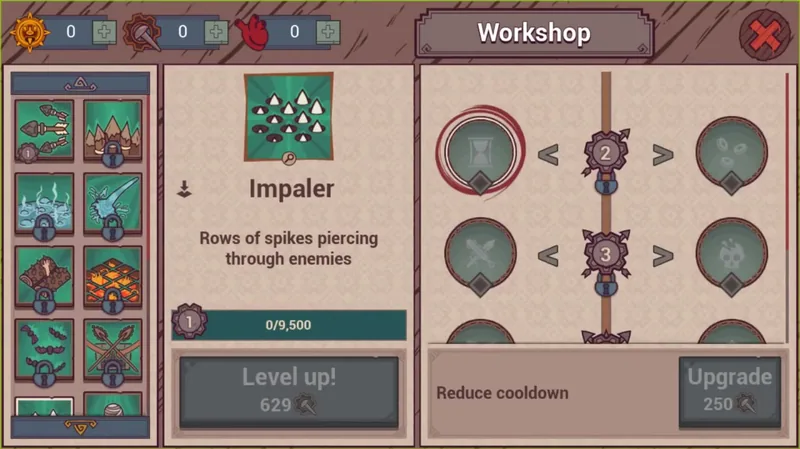
The Workshop is where traps grow. A scrolling two-column grid of trap cards, nearly all padlocked, fills the left side, and the selected trap shows its name and description above a level badge and a progress bar. Once the Impaler is unlocked, it gets a grayed “Level up!” button priced at 629 gear and an upgrade tree on the right. There, numbered gear badges each sit between two round options with arrows pointing either way, and the highlighted option reads “Reduce cooldown”, next to an “Upgrade” button marked 250.
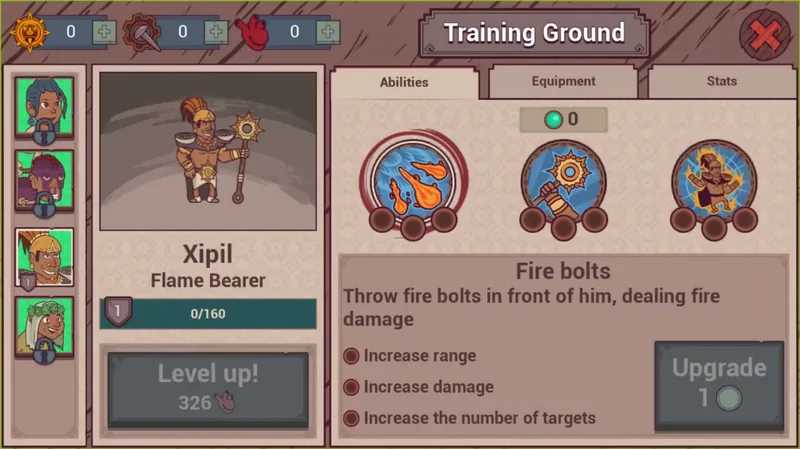
The Training Ground does the same for heroes. Four hero portraits run down the left side, and Xipil, the Flame Bearer, unlocks for 50 hearts while a green-and-gold chest graphic appears over the screen; after that, the other three portraits still carry padlocks. His Abilities tab lists three abilities with three small pips under each. The first, Fire bolts, reads “Throw fire bolts in front of him, dealing fire damage” and offers “Increase range”, “Increase damage” and “Increase the number of targets”, with an “Upgrade” button marked 1 green orb. A grayed “Level up!” button asks for 326 hearts, and Equipment and Stats tabs sit beside Abilities.
Thick Outlines and a Pyramid Town
We like the visual style of this trap defense a lot. The battles are drawn from above in thick dark outlines and flat colors: a turquoise sea washes up on the beach where the wrecked-looking ship lies, and pale stone walls cut through green grass and palm trees. The whole battlefield looks like a board lying on wooden planks, and the menus are drawn in the same hand, with parchment panels and painted hero portraits.
The art of the home town is a favorite in its own right. Shown at a raised three-quarter angle, its flat-roofed houses and stone statues gather around the stepped pyramid. Striped market awnings crowd one corner, and villagers walk between the buildings.
Taken as a whole, Sanctuaries is a highly finished tower defense game and a fine one. That finish carries from the corridor battles through the Watch Tower map and the loadout screen to the Workshop and Training Ground menus.
Inside a battle there is a range of things to deploy, built into the terrain or standing on it. Arrow Volleys bolt onto the corridor walls and the Impaler sinks into the floor, while Xipil takes his place in the corridor with his ability buttons ready. The trap list before Tutorial part 2 already names more, from Barricade and Boiling Pool down to Bone Crusher.
Outside the battles sits a refuge town, and its buildings are where traps and heroes are leveled up and given skill builds. The Workshop’s upgrade tree asks for a choice between two options at each tier, such as Reduce cooldown for the Impaler. In the Training Ground, Xipil’s Fire bolts lists upgrades for range, damage and the number of targets.
The main story is funny. Soldiers plead “Not me, pick him!” on their way down the corridor, and a speech bubble at the gem statue reads “It’s a trap!” as the battle is lost. A purple-haired guide with changing faces and gestures chats from the corner in battles and menus alike.
Padlocked Heroes and Untried Abilities
We have no criticism of Sanctuaries to report, so what follows are limits rather than faults. The first battle closes on Defeat, and the session ends with Tutorial part 2 still on Wave 1/3, so how a battle is won and what fills the three stars remain open questions.
The Impaler shows up only as a built grate and Xipil’s abilities only as buttons and menu entries. The other three heroes appear only as dimmed or padlocked cards. The town’s buildings act as menus here, and building up the town itself lies beyond what was seen, along with its other icons and the Equipment and Stats tabs. The town screen also carries a “Beta - early preview” label in its bottom-left corner.
Corridor Placement and Two-Option Upgrade Trees
These wave defense mechanics suit a taste for deciding where defenses go and for tuning a build between fights. In battle the player picks a spot for each trap, a wall for the Arrow Volley or the corridor floor for the Impaler, and pays for it from a coin counter that climbs as the fighting goes on. Before a fight the job is choosing one hero and filling up to five trap slots. After it, the job moves to the Workshop’s two-way upgrade choices and the upgrade options on Xipil’s abilities. A story told through jokey speech bubbles and a talkative guide runs through both the battles and the menus.
Verdict
Sanctuaries is a well-made wave defense game with a high level of finish, from its corridor fights to the upgrade menus of its refuge town. We are fond of its hand-drawn look, and fonder still of the pyramid town. It also belongs to a growing group of games that take a proven way of playing and set themselves apart with a distinctive visual style.