Chicken Defender Review: A Defense Map Rolled Into a Tower
This Chicken Defender review looks at a defense game where 180-coin cannons in a square tower's walls fire on creatures climbing toward a caged chicken.
Game at a glance
Chicken Defender:Tower Fight
7.5/ 10
Our score
A familiar formula, rebuilt from an unusual point of view.
In this article6 sections
Pick a cannon card, fit it into a socket on the wall of a square tower, and let it fire on the small round creatures crawling up toward a caged chicken on the roof. Chicken Defender belongs to the center-base branch of tower defense mobile games, except that the creatures’ routes and the turret sockets run up the walls of a 3D tower instead of across flat ground.
The draw is that 3D view of a familiar layout, while the art and the systems around the waves could use more polish. The game rang a faint bell, as if we had come across it a few years back, but it is judged here as a newcomer.
Cannons and Blocks on a Square Tower
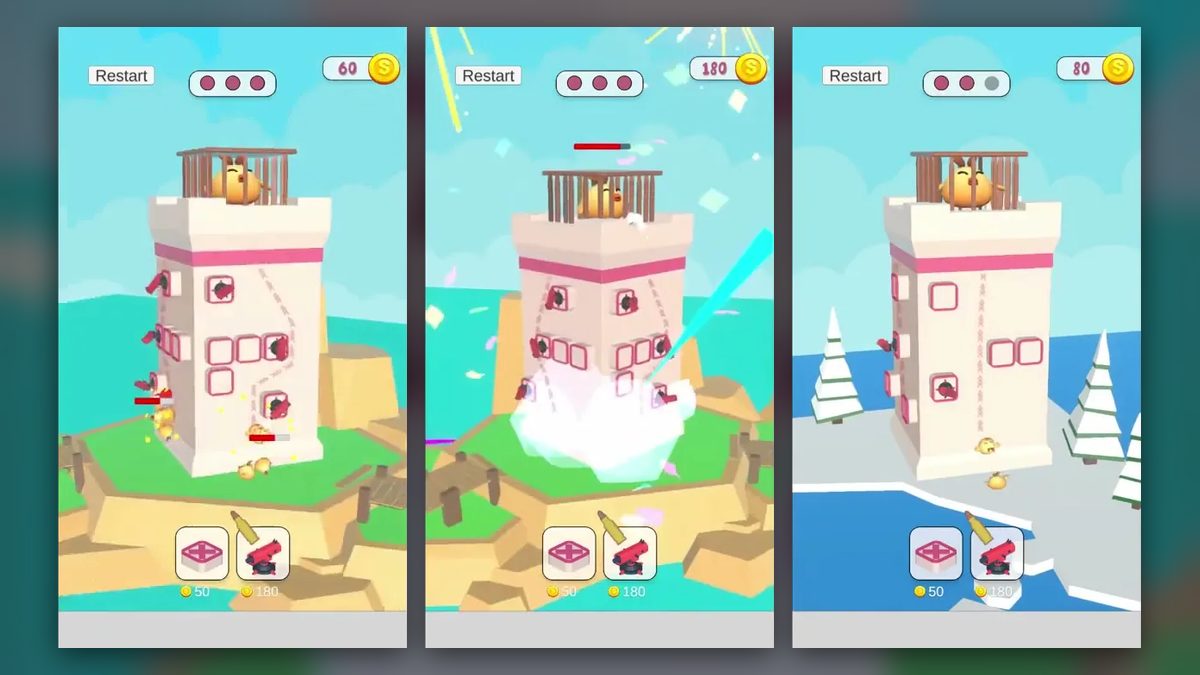
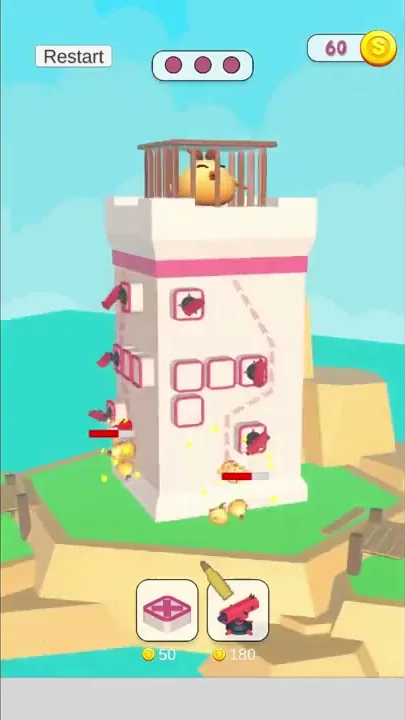
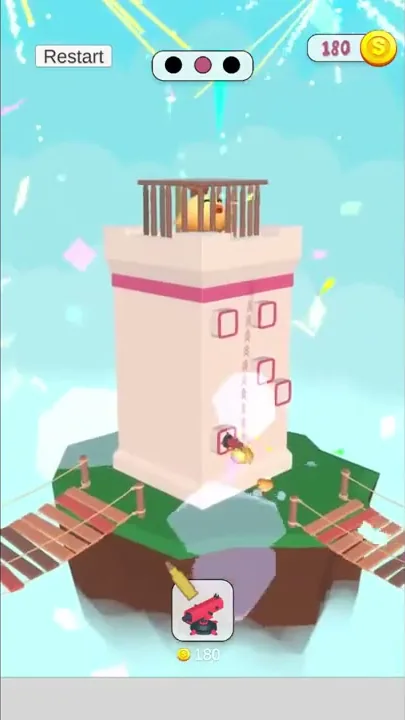
We played the closing moments of a stage on a floating island, then two stages after it, a snowfield and a sandy island, each from setup to its third wave. On the roof sits the thing being defended: a round orange chicken in a wooden cage. The creatures climb toward it, and the cannons on the walls are there to keep them off.
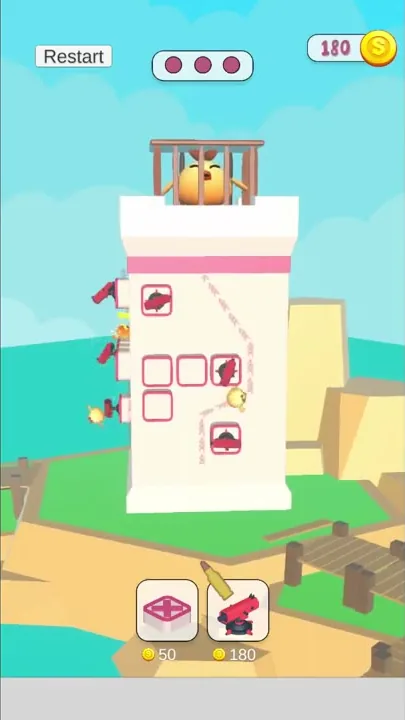
Building and defending overlap. Coins buy cards from the tray at the bottom of the screen, and those cards turn into cannons and blocks on the walls. Once a wave is running, the cannons fire on the climbers, and more of them can still go up mid-wave.
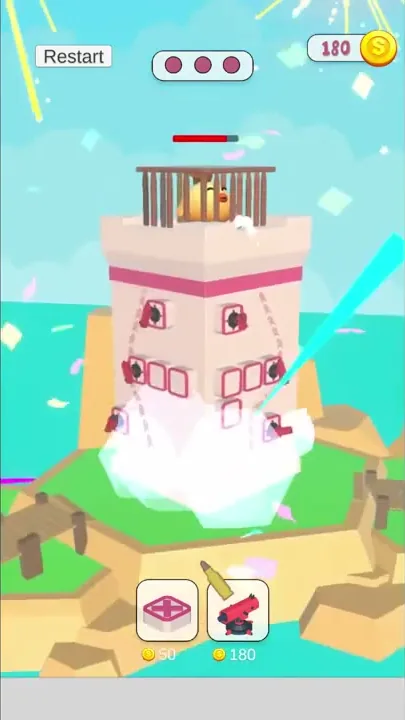
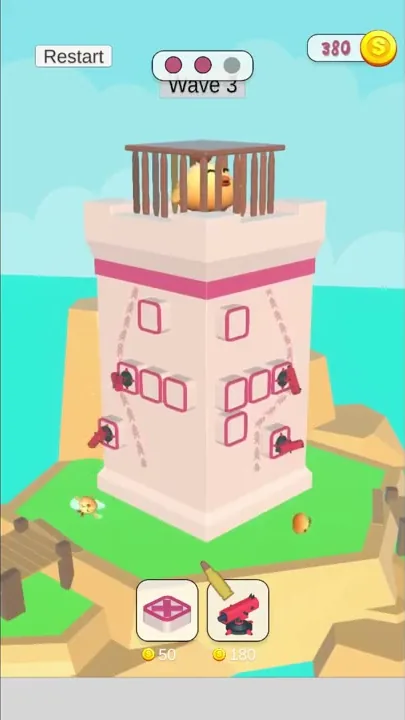
The stages seen run in three waves. Three dots at the top of the screen turn from gray to pink one at a time, and a “Wave” label beneath them counts from 1 to 3. On the sandy island, once all three dots are pink, confetti and light streaks sweep over the tower and a red bar shows above the cage, then the next loading screen appears.
Building starts with a card. Picking one lifts it above its neighbor, and the spots where it can go light up green on the tower. For the cannon those spots are the free sockets, and a large glowing cyan ring also appears on the wall. The camera usually looks down at a corner of the tower so two walls are in view, the view turns around the tower to show its other sides, and a plain white Restart button sits in the top-left corner.
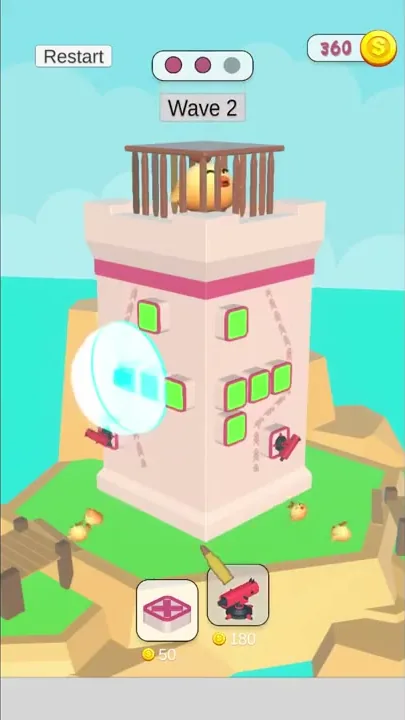
The sockets are pink-edged squares that stick out from the walls, alone, in pairs or in rows of three. A cannon costs 180 coins: a red barrel on a dark mount that sits in a socket, pointing away from the wall.
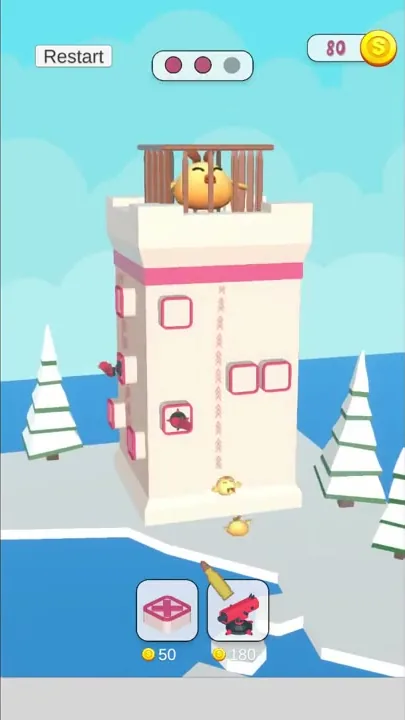
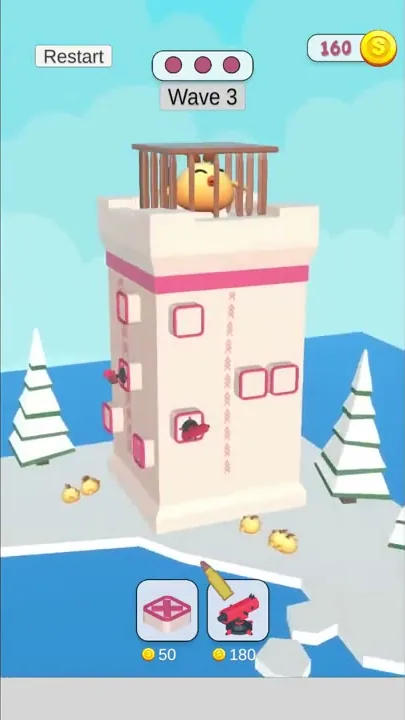
The second card is a pink-edged block for 50 coins. While it is raised, a dense grid of green squares covers both visible walls, with one square picked out in cyan, so it has far more possible spots than the cannon. Once placed, it shows a pink X face, like the one set low on the left wall of the snowfield tower. The waves seen don’t show what it does to the climbers.
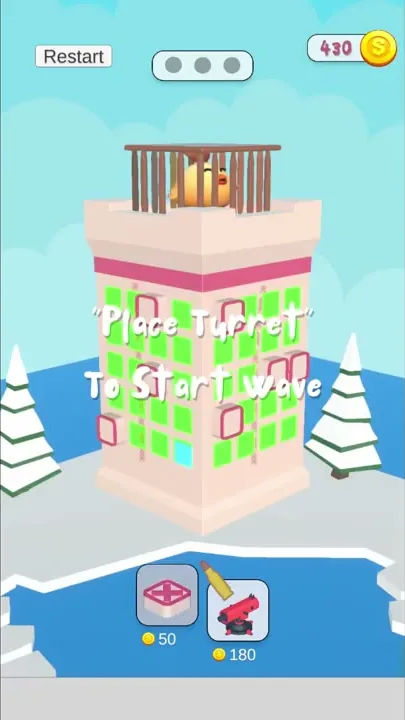
The attackers are small round creatures, yellow to orange, that gather on the ground around the base and crawl up the walls. Red bars float over some of them, and orange bursts flash on them next to the cannons.
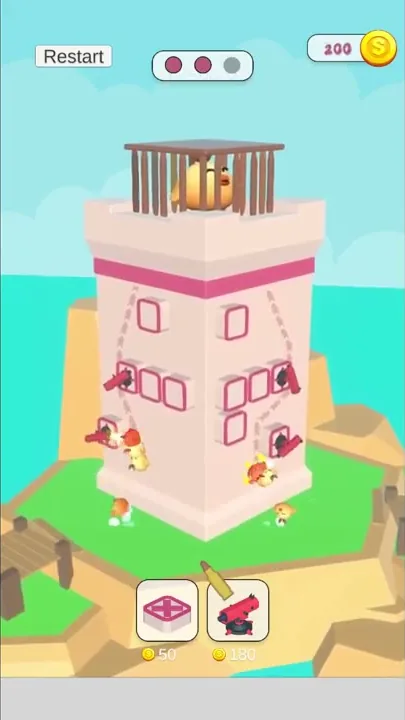
Lines of pink chevrons point up the walls, and the climbers are seen on these trails. On the snowfield tower they run straight up; on the sandy island they curve as they rise.
Two cards, a block at 50 coins and a cannon at 180, wait in the tray as the snowfield stage opens under the prompt “Place Turret” To Start Wave. The block goes in low on the left wall and a cannon into a right-wall socket while the dots are still gray. By the time the first dot turns pink, a second cannon sits on the left wall, and the coin counter in the top-right corner climbs as the waves run.
From a Floating Island to Rows of Sockets
Inside a stage, cannons keep going up as the waves pass. Two sit low on the sandy-island walls when the Wave 1 label appears, four are in place shortly after, and by the third wave the wall facing the camera holds three while three more jut from the left wall. The cannon card comes up again during the snowfield’s Wave 3, with creatures gathered on the snow around the base.
The tray grows as well. In the floating-island stage, the earliest one seen, it holds only the cannon card. That tower stands on a grassy island floating above the clouds, with rope-and-plank bridges leading off to both sides, and a single straight trail runs up its front wall past a few sockets.
From the snowfield on, the 50-coin block sits beside the cannon. Both of the later stages open on the same prompt, with all three dots gray and a small numbered pill beneath them.
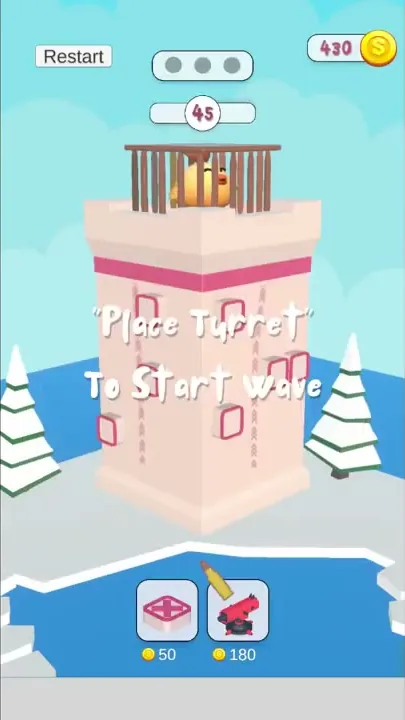
The walls change along with the scenery. Snow-covered pines flank the snowfield tower, with icy blue water in front, and its sockets mostly sit alone, apart from one pair on the right wall. The sandy island has a green lawn and wooden piers in a turquoise sea, and there a row of three sockets crosses the middle of each visible wall, with one socket above the row and one or two below it.
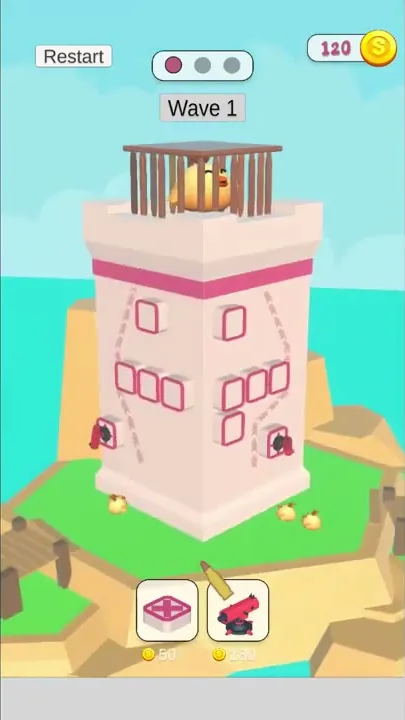
Coins are the economy on display. The counter in the top-right corner drops when a card is bought and rises while the waves run, and each card shows its coin price beneath it. Between stages comes a flat 2D loading screen: three cartoon chicks on a cloudy sky above the word “LOADiNG…”.
A Flat Map Rolled Up Into Walls
Center-style tower defense seen in 3D is the highlight. Picture the flat ground of a central hold-the-line defense map rolled up into a tower: the paths become chevron trails and the build spots become sockets, while the creatures climb from the ground around the base toward the chicken on the roof.
To the eye, that makes it very much an original take. With the camera above a corner, two walls and their cannons are in view together, so the sandy island’s third wave shows cannons on both walls firing on climbers at once.
Pastel Low-Poly Art and a Sparse HUD
The visuals and the systems around the play could both be a bit more refined. The art is simple low-poly 3D in soft pastels: a cream tower with a pink band, topped by a round chicken in a wooden cage.
The systems seen around the play are sparse. The Restart button, the wave dots and the coin counter sit along the top of the screen, the price-tagged cards sit along the bottom, and the flat loading screen separates one stage from the next.
Choosing Walls and Sockets for Each Cannon
The choices seen are about placement: which socket on which wall takes the next cannon, whether a block goes down first, and when to add another cannon as the counter rises mid-wave. The mechanics line up with a taste for central defense, where the enemies converge on one point, here turned upright and watched from above a corner while the view swings around the tower.
Verdict
Chicken Defender takes a familiar kind of defense game and rebuilds it around an unusual viewpoint, wrapping the whole fight around one tower. It comes out as a good game, and its visuals and the systems around the waves are where we’d still like to see more care.