Stickman Car Survival Review: 12 Cars, One Survivor
A Stickman Car Survival review of a hands-off physics race in which presses, spikes and piston columns whittle 12 HP-labeled cars down to one.
Game at a glance
Stickman Car Survival
4/ 10
Our score
Next stop: another dimension.
In this article6 sections
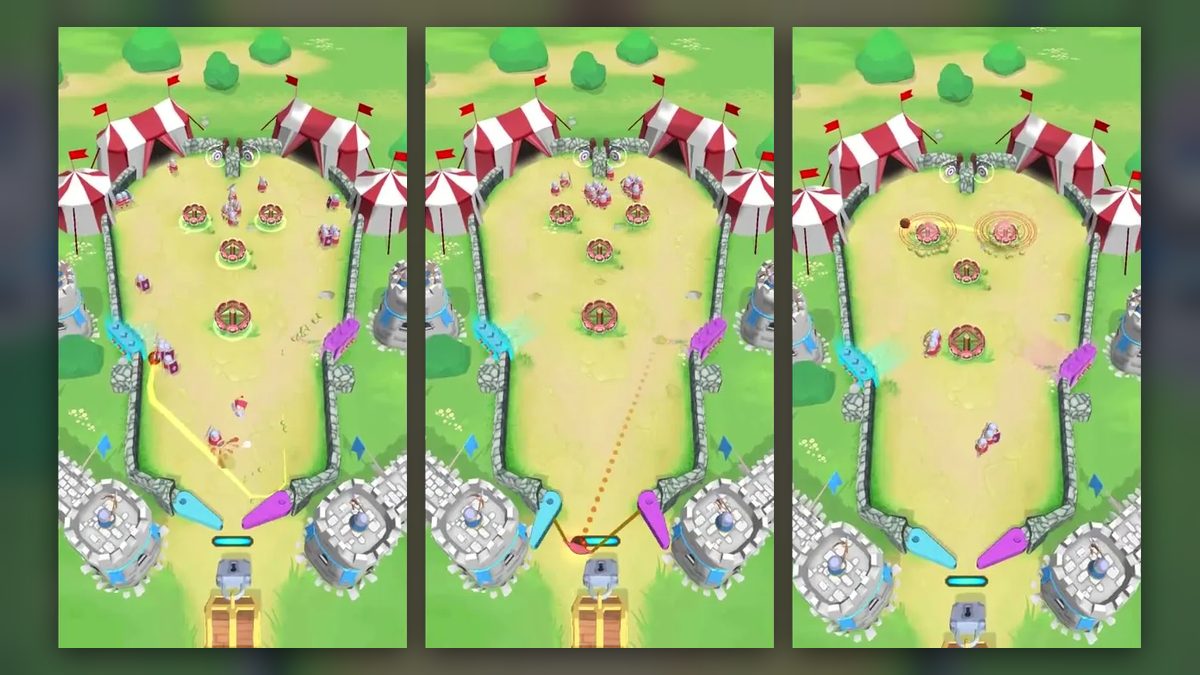
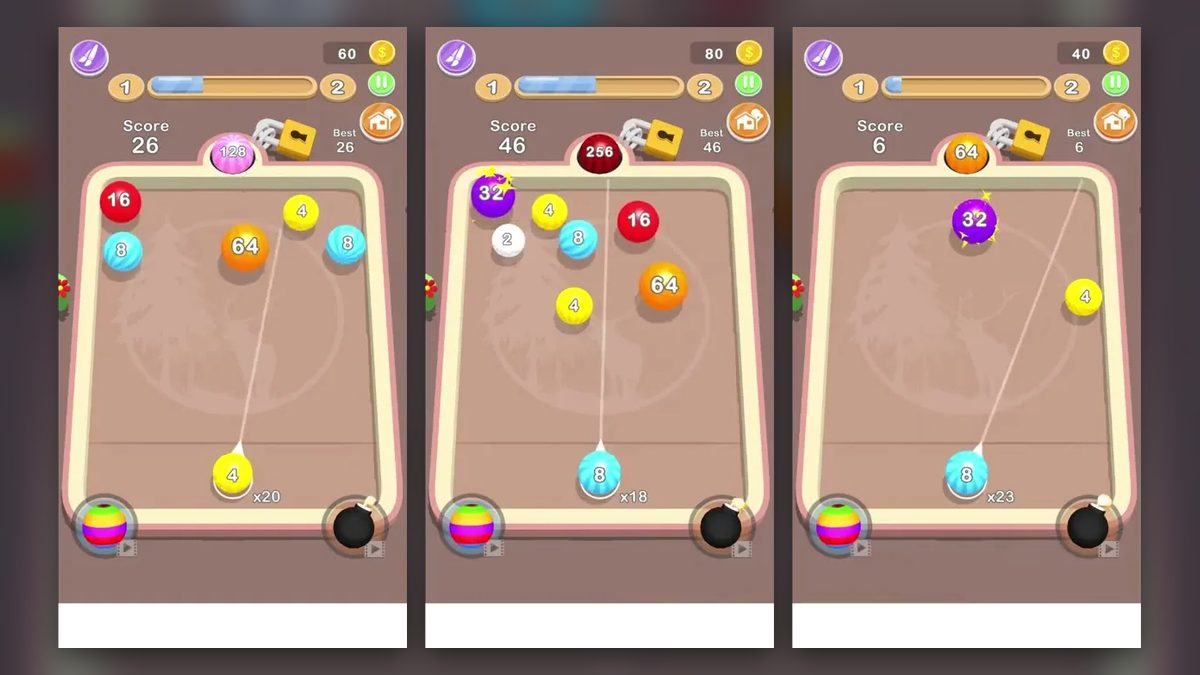
Bouncing-ball physics games usually star the ball itself: a marble or a handful of small balls. Stickman Car Survival works like a ball bounce game, with the same physics-driven setup, but its subject is racing. The balls give way to 12 cars, each with its own HP label, and the course turns into a gauntlet of crushers, spikes and pistons that leaves one car standing.
Underneath sits a purely physics-driven idle auto-battler, the kind of game in which the contestants settle things among themselves. In the one race we played, the pack crashed its way through the course for about seven and a half minutes until a teal car reached the checkered finish line alone. Tying the physics to the racing subject is the distinctive part. Beyond it there is nothing else to play with, and our overall take is a low one.
Twelve cars and a column of HP labels
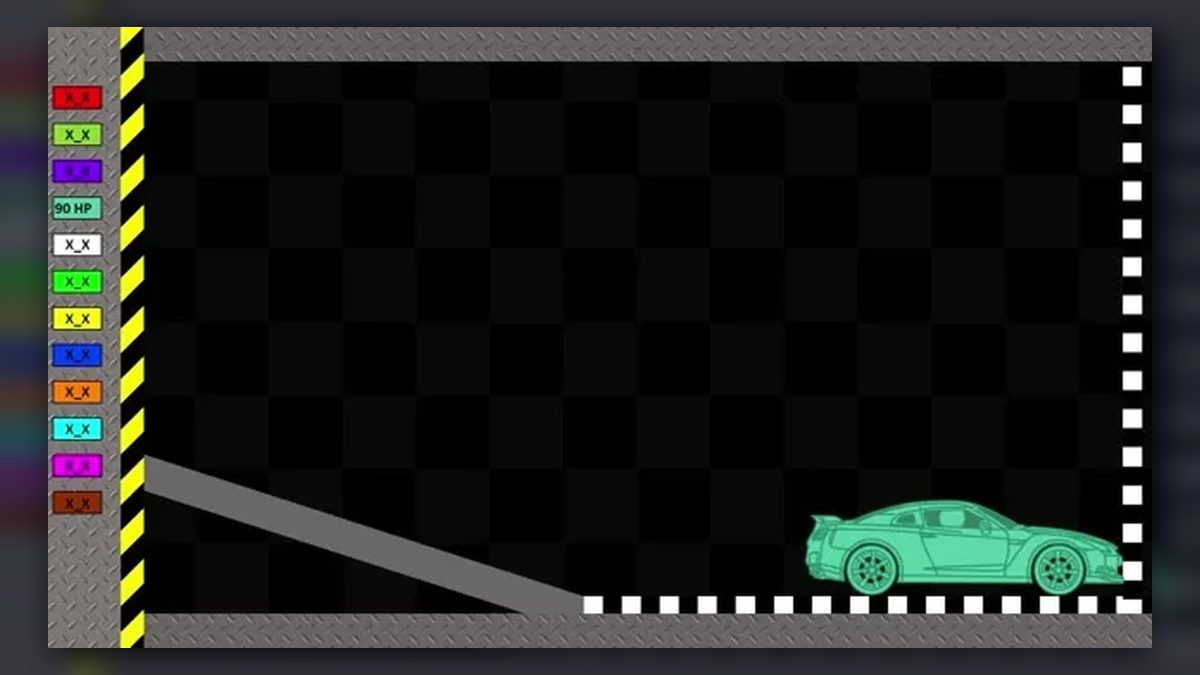
The race opens in a narrow pen between two gray walls, set on a dark checkerboard background inside a diamond-plate metal border. Large text across the screen asks “Who will win?”, the only goal the game prints. Down the left edge, beside a yellow-and-black hazard stripe, runs a column of 12 colored labels, one per car, each reading “100 HP”. From top to bottom they go red, lime green, purple, teal, white, green, yellow, blue, orange, cyan, magenta and brown, and the matching cars stack up inside the pen.
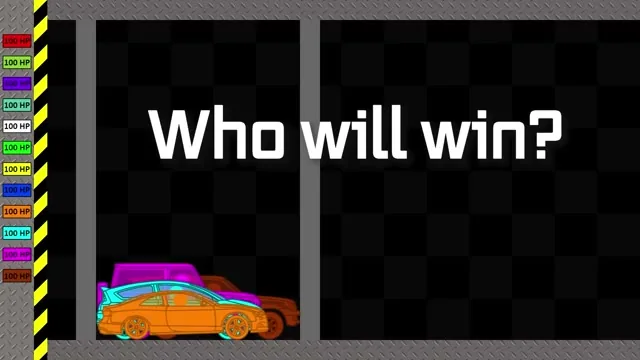
Each car is a different model drawn as a tinted, see-through outline, so cars that overlap show through one another. The magenta and brown cars are boxy SUVs, and the yellow one is a muscle car. A wrecked car comes apart into separate pieces, loose wheels included, and the wreckage stays behind as the pack moves on.
No controls appear at any point, and there are no buttons or menus on screen. Apart from the HP column and the opening “Who will win?”, nothing is drawn over the course: no score, no timer, no touch markers. Once the walls of the pen disappear, the cars roll right on their own and the view scrolls with them, so a car that falls behind ends up at the left edge of the picture. In the fastest moments the cars blur as they move.
The HP column is the whole scoreboard. A label’s number drops as its car takes hits, changes to “X_X” when the car is out of the race, and stays that way to the end. The game keeps no other count, so the race comes down to the one label still showing a number once every other label reads “X_X”.
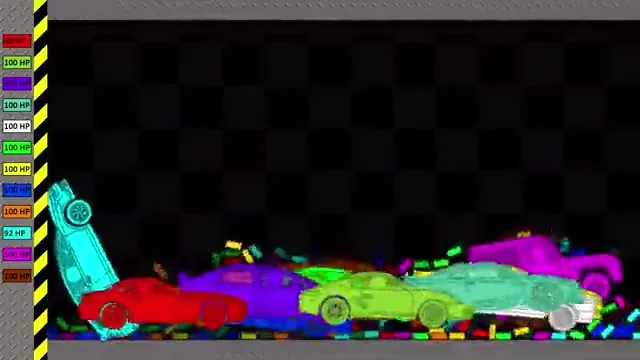
Over the first bumps and slopes, all 12 labels hold at “100 HP”. The first pile-up comes on the flat beyond them. Cars push into one another and stack up while colored fragments fly off the heap, and the cyan car ends up tipped on end against the left wall, its label down to “92 HP”. Contact, a pile-up, lost HP, then the next obstacle: that cycle is the whole Stickman Car Survival gameplay loop.
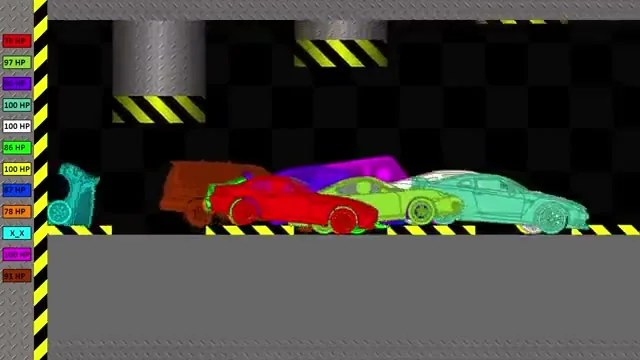
A staircase of gray pillars comes next, each bar taller than the last, and the pack climbs it to a raised block. Beyond it, two presses hang over a hazard-striped ledge, and this is where the cyan label becomes the first to read “X_X”, the car’s broken parts lying at the left edge. The brown label follows soon after, which leaves 10 cars.
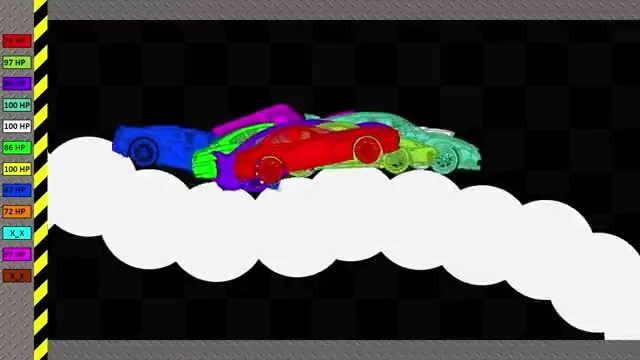
White half-dome bumps sit on the floor in two sizes. Small, evenly spaced ones come right after the start, and the cars roll over them. Larger ones turn up after the diamond bridge, where the cars tip as they cross.
Gray slopes shape much of the rest. Early on the pack climbs a hill and drops through a dip; later, ramps lead up onto raised ledges, and steep downhill runs leave cars flipped on end against one another. At one point a ramp splits the field, with some cars riding the upper ramp while the rest carry on along the floor below.
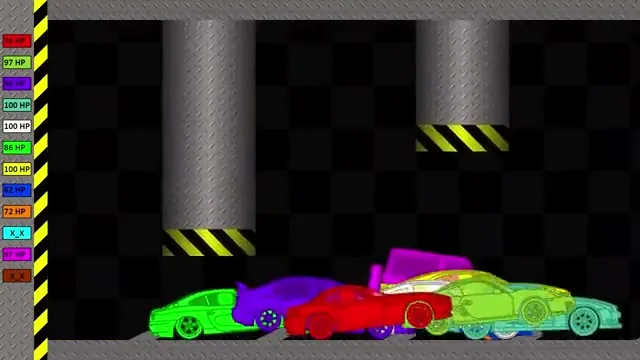
Hydraulic presses return again and again. Each one is a gray metal column with a yellow-and-black striped end, most of them hanging from the ceiling over the track, and paired presses hang at different heights. In the final set, the press above the cars hangs lower from one moment to the next. Beside another, the green car lies in pieces with its label at “X_X”.
A ramp drops the pack into a ball pit, a heap of small multicolored balls lying across the track. The cars drive straight into it, and a few balls are still caught among them on the far side.
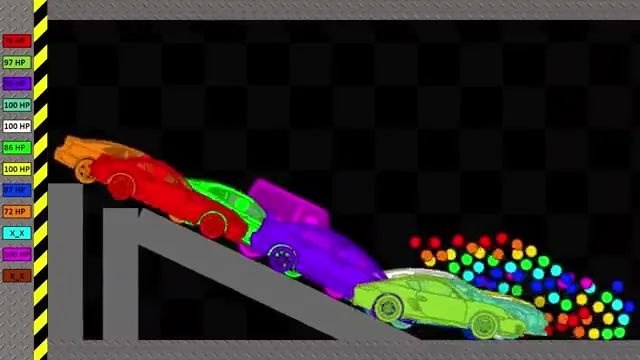
Further on, a hazard-striped ramp climbs to the cloud platform, a white floor shaped like a cloud. The cars ride along its bumpy top and are back on the gray floor beyond it soon after.
A raised gray ledge looks firm when the pack reaches it. Then the sections under the cars turn faint and see-through, and before long the whole pack is down on the floor below.
On the piston floor, the track itself is a row of wide metal pistons with hazard-striped tops. The tops rise with the cars sitting on them, lifting the whole pack higher up the screen.
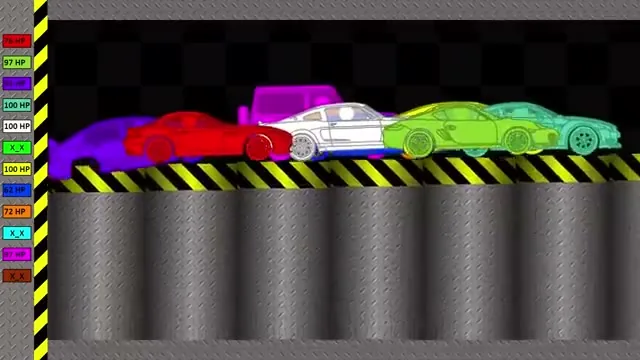
The diamond bridge turns the track into a dotted line of small gray squares and diamonds for the cars to ride along, with presses coming at it from the ceiling and from the floor. Three cars go out here almost together. The red, orange and magenta labels all switch to “X_X” within moments of one another, and a red splash covers the top of the HP column.
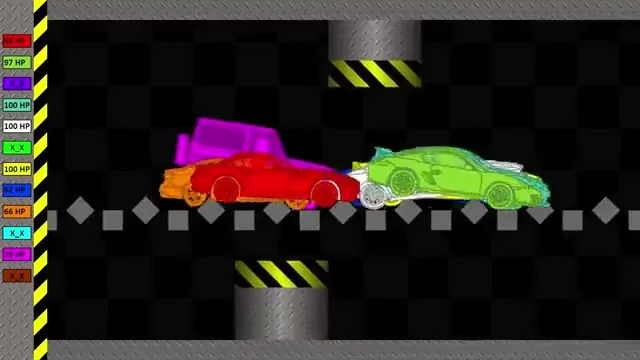
Four presses hang side by side in a stepped row, each lower than the one to its right, with the lime car underneath. Moments later the columns reach the floor, and the lime car lies in pieces beneath them with a loose wheel, its label reading “X_X”.
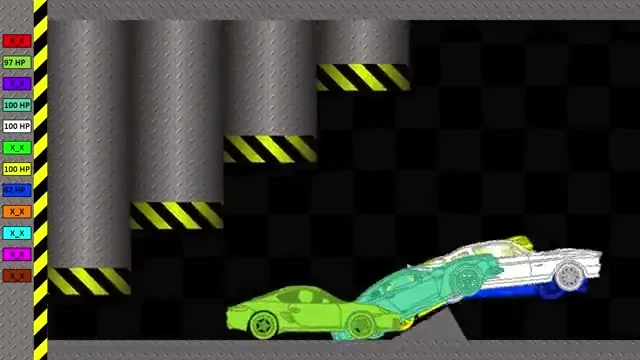
Spikes come in two sizes. Small gray spikes stand in rows on a hazard-striped floor, while a separate floor of large spikes carries the cars across on its tips.
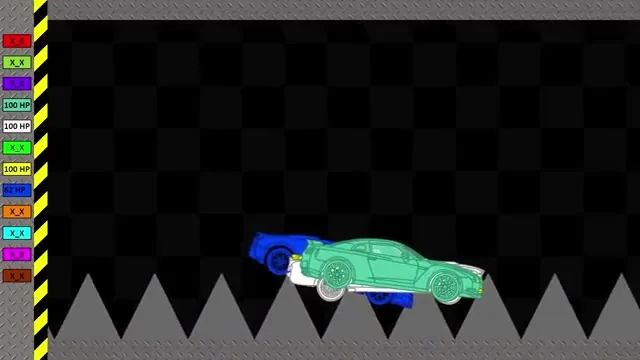
After another ramp, the track becomes a row of metal columns with striped tops at uneven heights, and the heights shift from one moment to the next. A curved line of red balls shows at the upper right as the cars climb toward it, with small white squares on the ceiling. Red balls then roll among the cars, and the blue car ends up flipped on its side.
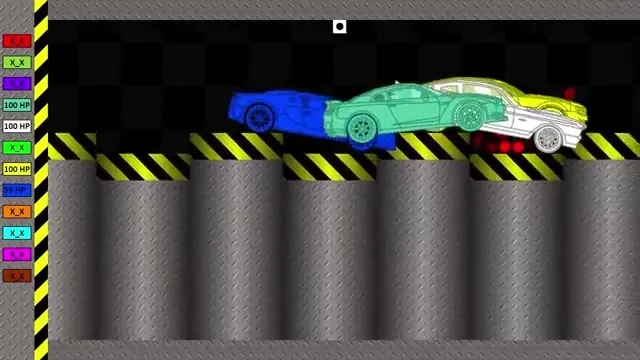
Near the end, the track breaks into gray beams tilted at opposite angles, with gaps between them. The remaining cars drive across them on the way to the last set of presses.
From a crowded pen to one survivor
The course changes character as the race goes on. The opening minute is open floor, and the first two cars are gone soon after it. A long run of varied terrain follows, from the ball pit to the fading ledge, without a single car going out.
Then the hazards bunch up, with paired presses and the piston floor leading straight into the diamond bridge. In about a minute the field halves, from 10 cars to five. Green and purple go out first, then the three on the bridge.
Four are left after the lime car goes out under the stepped presses: teal, white, yellow and blue. No car goes out on the spike floors, the uneven columns or the angled beams, although the blue label keeps falling. During the final set of presses, white reads “94 HP” and blue “10 HP”; moments later both labels read “X_X”, and a crumpled white wreck lies at the left edge.
That leaves teal and yellow. The yellow label still reads “100 HP” moments before it switches to “X_X”, and the teal car rolls on alone to a white-and-black checkered line that runs along the floor and up the right wall. Its label reads “90 HP” and the other 11 read “X_X”. No winner banner or results screen follows, and the picture simply holds.
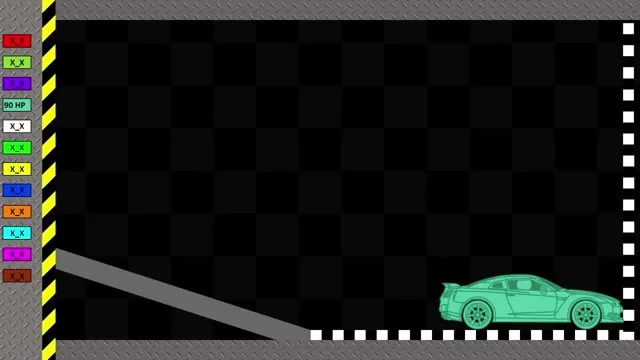
Outside the race there was nothing else to see: no title screen or menu, and no shop, currencies, boosters, rewards or ad offers at any point. Whether the full app has any of them is more than a single race can tell us.
A racing subject built into the physics
What we liked is how closely the physics is tied to the racing subject. The things being knocked around are cars rather than marbles or small balls, and the damage they take is car damage. On the steep slopes they flip on end against one another, and under the presses they come apart: the green car lies in pieces beside one, and the lime car ends up in parts beneath the stepped row with a loose wheel beside it.
Nothing else to play with beyond the race
Beyond that pairing, there is no other distinctive part and nothing else to do. From the moment the pen opens until teal reaches the checkered line, the screen holds only the course and the HP column; no upgrade, shop or input of any kind appears. The course has many hazard types, from the fading ledge to the diamond bridge, but nothing on screen asks the player to respond to any of them.
The race simply begins once the pen has filled. No step for picking, backing or customizing a car appeared before it, and we can’t say whether the game has one.
Following one color down the HP column
The player’s part is to watch. The race reads through the HP column, where each label counts down and turns to “X_X” as its car drops out, while the course scrolls by on its own and the cars sort out the order among themselves.
These mechanics suit a taste for physics runs that settle themselves: watching a pile-up come apart, seeing which cars stay upright down a steep slope, waiting to learn which of the 12 makes it to the checkered line. A taste for steering or building finds nothing to work with in the race itself.
Verdict
The one thing this game has in its favor is a racing subject that the physics is built around, so its crashes are car crashes rather than bouncing balls. Past that there is no other feature to speak of and nothing else to play with, and the overall rating sits low.