Trench War Review: Marbles That Pick the Soldiers
Trench War review: bouncing marbles pick the troops while tanks, biplanes and airships fight across a 3D trench map toward the enemy base.
Game at a glance
Trench War
8/ 10
Our score
Marble-picked armies whose battles come very close to a military strategy game's feel.
In this article6 sections
Keep an eye on the blue and yellow marbles bouncing down black panels at the top of the screen: they pick the soldiers for the two armies fighting underneath. That makes Trench War a mashup of a mobile ball bounce game and a 1v1 battle with a military theme: a blue base faces a yellow base across a 3D field cut with trenches, and the first side to reach the other’s base wins.
In the one battle we played, the fight ran about 24 minutes from the TRENCHWAR title screen to a BLUE VICTORY banner. It starts with crowds of balls, and by the end heavy tanks and airships are fighting beside them. Its three bands give the screen the feel of a sandbox strategy map, and the middle of the screen already puts on a carefully crafted show.
Marbles on top, trenches below
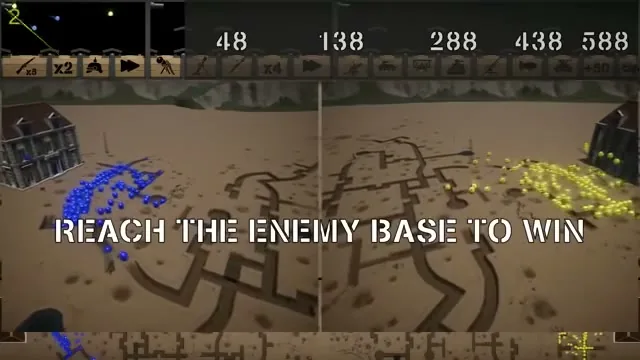
Before the fighting starts, a caption in bold white capitals across a split view of both bases reads “REACH THE ENEMY BASE TO WIN,” and then the view widens to one shot of the whole field. Each base is a multi-story building, the blue one at the left end of the map and the yellow one at the right. That line is the only goal the game spells out. The game shows no move limit or match timer. No lives counter or fail screen appears either, and the battle runs until one army breaks through.
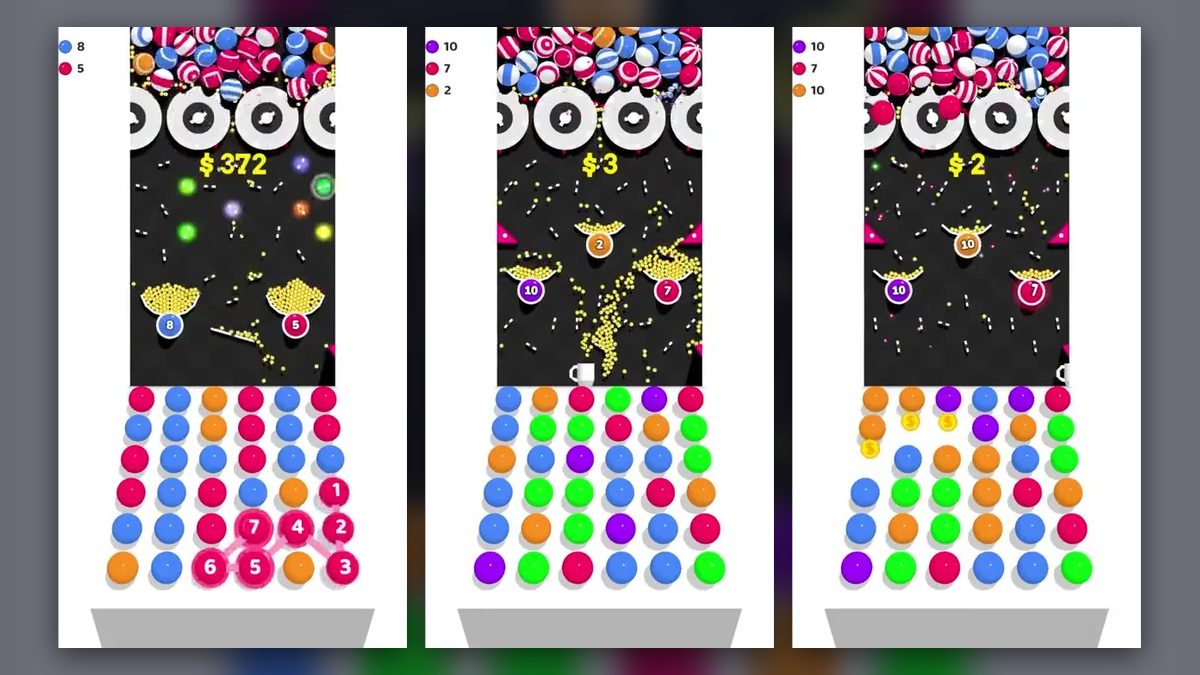
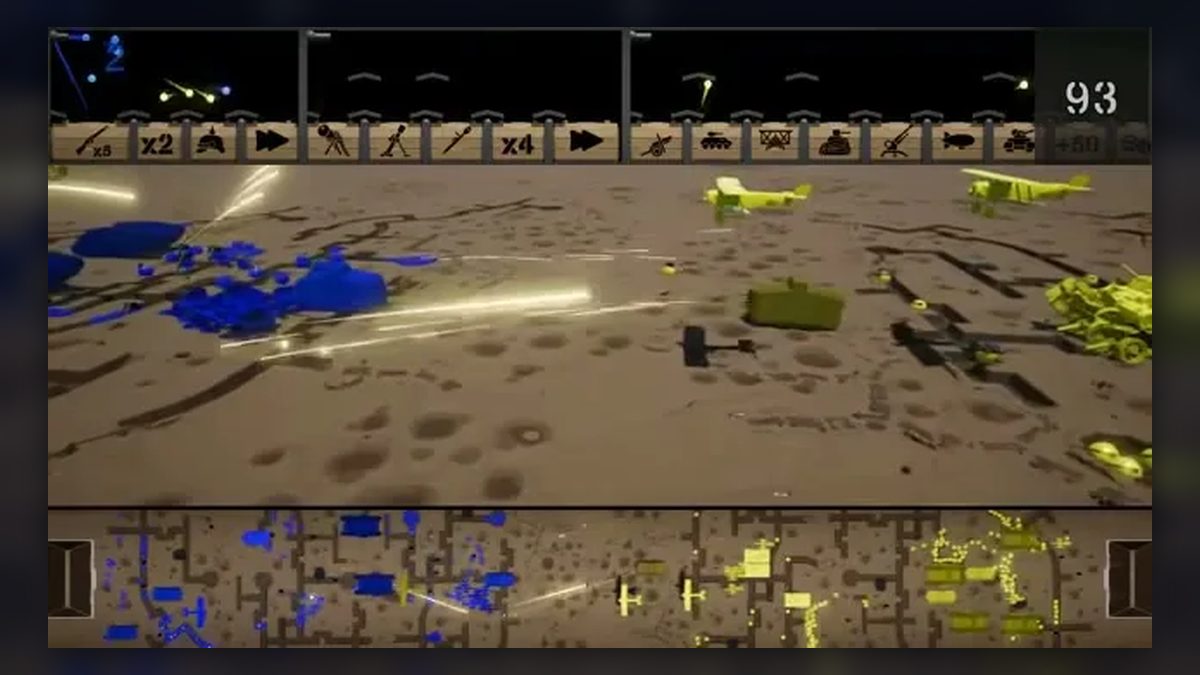
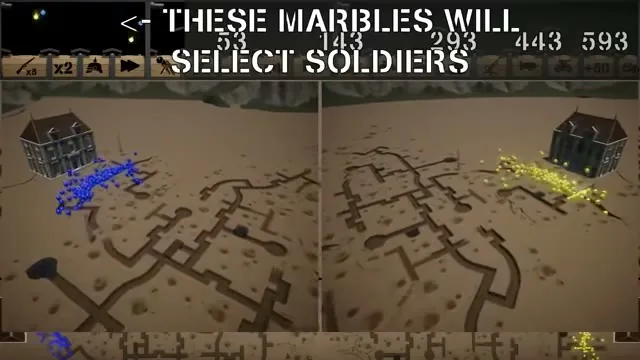
The marbles live in black panels along the top edge. Small blue and yellow marbles bounce around inside them and drop toward a row of icon slots below, and at the start an arrow-tipped caption points at the first panel: “<- THESE MARBLES WILL SELECT SOLDIERS.” There are three panels in all, though only the first and a narrow piece of the second are open as the battle begins.
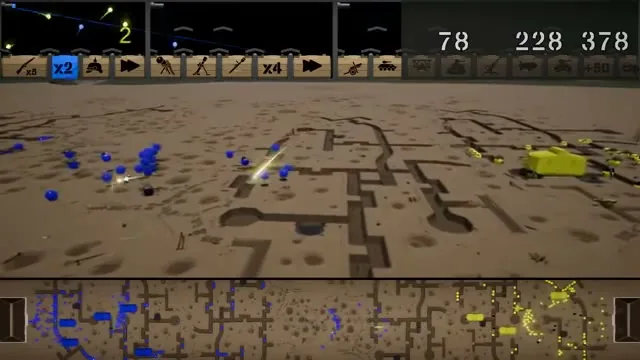
Under the panels runs the slot row. Its icons show rifles, a helmet, mortars, artillery, tanks and a rocket, mixed in with fast-forward arrows, the labels “x2” and “x4” and, near the right end, “+50”. A slot that gets hit flashes blue or yellow for a moment. The “x2” slot lights up blue in the opening minutes and the helmet turns yellow after the 10-minute mark, while “x4” flashes in both colors late in the battle.
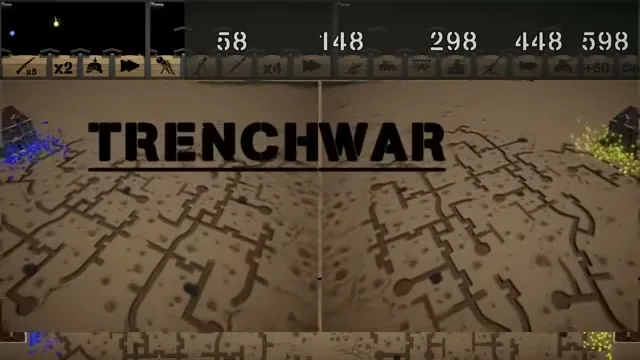
The battle opens with most of that row grayed out under five countdown numbers, which read 58, 148, 298, 448 and 598 on the title screen. They drop by 5 every 5 seconds, and each time one reaches zero, another part of the marble panels opens. The first runs out at about the one-minute mark and the last at the 10-minute mark. From then on the countdowns are gone and the whole row is lit, “+50” included.
Colored digits also pop up among the marbles, in blue or yellow. Small ones such as 2 and 16 appear throughout the fight, and larger ones such as 101 and 141 show up near the end.
Controls never appear on screen. From the title screen to the victory banner, no taps or touch markers show up, no button is pressed and no menu opens. The marbles bounce and the armies move and shoot by themselves, so the session plays like an idle auto-battle that the player watches.
Trench War gameplay runs on two tracks at once. Up top, marbles of both colors keep falling and lighting slots. Down on the field, the two armies work their way through the trench maze toward each other and trade fire on their own. Every so often a countdown runs out and the panels widen, all within one continuous battle.
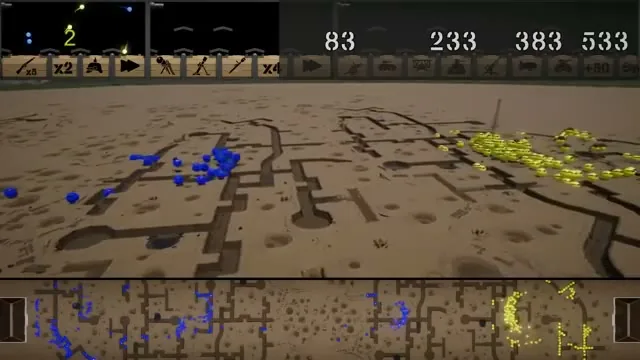
Each army’s foot troops are plain blue or yellow balls. They pour out of the bases and roll across the trenches in loose crowds, and by the late stages they pile up by the hundreds.
Units fire on their own. The shots show up as bright white-yellow tracer streaks across the field, and large flashes burst where they land.
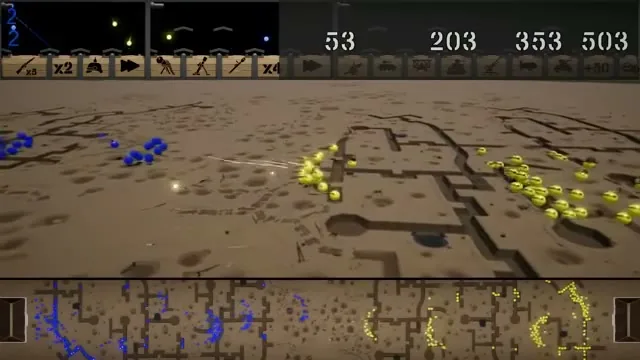
The ground is a wide sandy map with a rocky wall along the far edge. Both halves are carved into a maze of sunken trenches, and the open stretch between them is pitted with craters. Units cross the trench lines as they push forward.
All of this is stacked in three bands. The marble panels and slot row sit on top, and the middle band holds the 3D battle, where a low camera follows the front line. Along the bottom, a strip shows the whole trench map from above with a gray bar at each end, and as the front shifts it fills with blue blocks from the left and yellow blocks from the right.
From ball crowds to tanks and airships
The panels open up in five steps, one per countdown. At about the one-minute mark a NEW MARBLES ADDED banner appears over the field and the second panel widens, with the slots under it, “x4” among them, no longer gray. Around two and a half minutes in, a third panel opens above an artillery icon and a tank icon. That panel widens at five minutes under the same banner and again at about seven and a half, and one more banner at 10 minutes clears the last countdown and lights the full row.
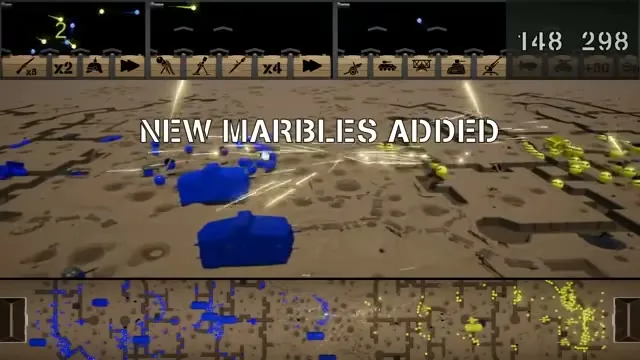
The armies change along with the panels. Not long after the third panel opens, a boxy yellow vehicle is out on the field, and soon a group of blue vehicles is trading fire with two yellow ones in the middle of the map.
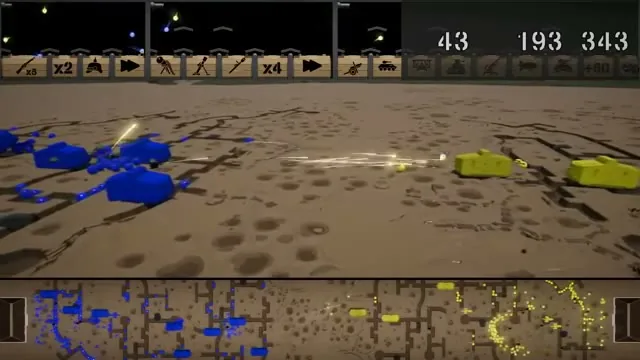
From then on, some vehicles are drawn all white for a moment. Others turn dark navy or black in the thick of the fighting.
Aircraft come next. Around the time the third panel widens again, at about seven and a half minutes, small blue and yellow biplanes start flying low over the battlefield.
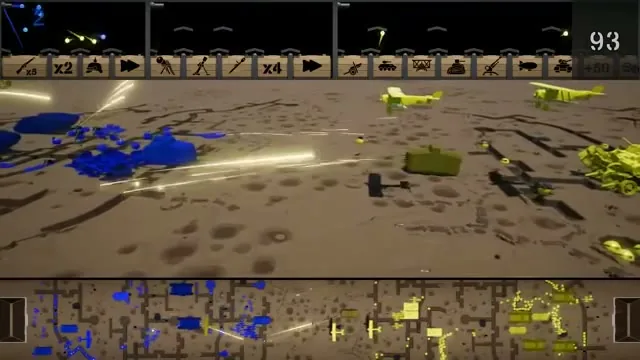
The 10-minute unlock is followed by the heaviest machines. Large tanks with long-barreled turrets lead both armies from then on, and by the end several of them fill the front line. Like the other units, they come in flat blue or yellow.
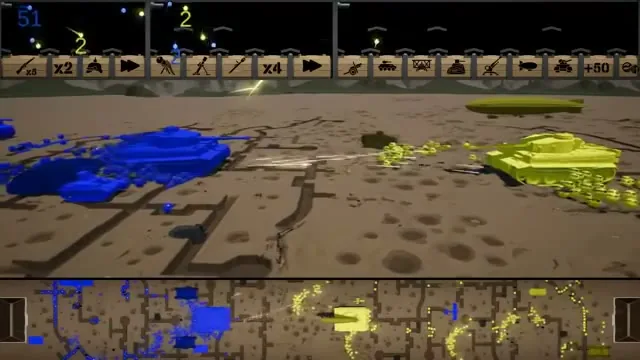
Airships arrive around the same time: long cigar-shaped blimps in blue and yellow that float above the tanks. Deep into the battle a blue one and a yellow one hang in the air at once.
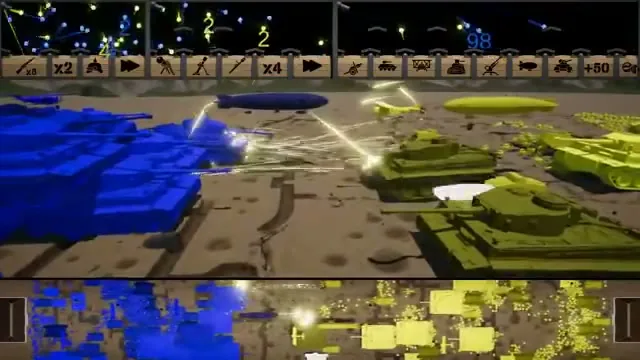
After that, the change is one of scale. Between about 13 and 23 minutes both armies keep swelling until the battle view and the map strip are packed with tanks, balls, planes and airships, and the front line sways back and forth across the middle of the map. Tracer streaks and bright flashes fill the middle band, and the strip at the bottom turns into a patchwork of blue and yellow.
The finish comes when the blue army pushes up to the yellow base building. A BLUE VICTORY banner in outlined blue letters spreads across the map strip, and moments later blue forces are swarming the building.
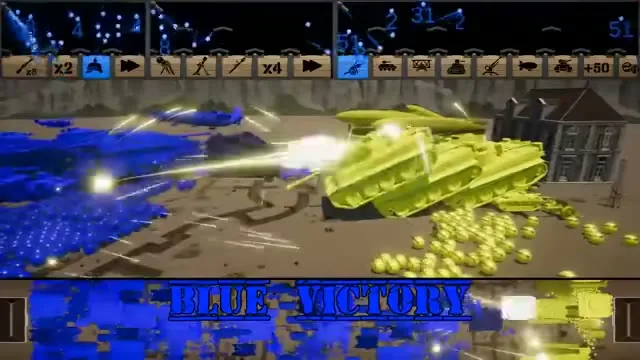
Nothing outside the fight shows up. No home screen or shop appears between the TRENCHWAR title and the victory banner, and neither does any currency or booster. No reward panel or lives counter shows up in that stretch, and there is no ad. The “x2”, “x4” and “+50” labels belong to the slot row inside the battle, not to any store.
Three screen bands and a sandbox map
The three-band layout gives the war a sandbox strategy feel. The top band is the random part, where bouncing marbles do the picking, and the middle band is given over to the look and animation of the 3D battle. The bottom strip works like a sandbox map seen from above, showing the whole front at once, so late in the match, when it has become a patchwork of blue and yellow, it reads as an overview of the same fight the middle band shows up close.
The fighting comes very close to the look of military strategy games such as Top War and Warpath. In the late stages, heavy tanks and ball infantry meet along one front line while biplanes and airships fly overhead. We can picture games like those taking up this marble format to reach a different kind of strategy.
The battle show is already carefully made. Tracer streaks cross the craters and flashes burst where shots land, while hundreds of units crowd the screen at once and planes pass above them.
The 3D terrain is another highlight. The armies fight over sandy ground with sunken trench mazes on both halves and craters in between, and every advance toward the other base runs across those trench lines.
The marbles also carry the two advantages of this marble-driven idle format. Everything in the panels tumbles and bounces under real-feeling physics, and the format has a strong knack for killing time.
Slot effects and controls left unshown
We have no criticism to make of Trench War. What follows are things the battle left open, not faults.
Because no input appears at any point, the battle does not reveal whether a player picks a side, places units or simply watches the marbles decide. Nothing on screen marks either army as the player’s own.
The slot icons go unexplained in the same way. The “x2” and “x4” slots and the helmet slot light up again and again through the battle, but the screen never connects a lit slot to a unit arriving on the field.
Only one map and one battle appear, framed by the title screen and the victory banner. Anything beyond that single match stays out of view.
Watching marble-picked armies grind forward
Trench War lines up with a taste for bouncing-ball idle games, where the play is watching marbles fall and seeing what they set in motion. Here the result is a war that keeps growing, from crowds of balls to armored vehicles and tanks with aircraft overhead.
The other taste it matches is following big army clashes: tracking the overhead strip as blue and yellow blocks push back and forth, catching a slot as it flashes, spotting the first biplane over the trenches. The session asks for attention rather than input, and no way to steer units by hand appears in it.
Verdict
Trench War takes the small idea of marbles falling through a board and hangs an entire war on it. Its three-way screen offers a strategist’s view of the front, and the fighting in the middle is staged with real care over sunken terrain the armies have to cross. We were happy to see a game core that modest grow into something this full. As mid-match strategy, new packaging forms and battle tactics get folded into mashups like this one, the format should keep finding more possibilities.