Tile Defense Review: Castle Defense Laid Tile by Tile
This Tile Defense review covers a castle defense built from road, farm and Archer Tower tiles, played from a four-card hand against goblin waves.
Game at a glance
Tile Defense - Puzzle Tower
9/ 10
Our score
This mode could let strategy games overtake; a bit of a pity it's pure tower defense.
In this article6 sections
Five tiles go down before each goblin wave in stage 3 of Tile Defense, and a badge at the top of the board counts them off from 5 to 1. The game belongs with the tower defense mobile games, but its defenses are tiles you lay yourself. A castle starts alone on a floating grass island, and the land around it grows one tile at a time, from roads and farms to forests and Archer Towers, until goblins pour out of a portal.
Behind the matches sits a deck of cards that gain levels, and the subject is castle defense. We played two Land 1 matches: the closing seconds of a one-wave match and all of stage 3, which runs two waves. It is the most imaginative strategy tower defense with card upgrades we have come across in half a year, though it is a bit of a pity that it stays a pure tower defense.
A four-card hand and a five-tile countdown
Both matches carry a goal bar under the HUD, with a star icon and a counter, and both ended on a VICTORY screen once that counter was full. The one-wave match asked to “Defeat 6 Goblins in one game.”; stage 3 asked to “Defeat Wave of Monsters no. 2.” and its counter moved up one step per beaten wave. A WAVE counter beside the silver total shows how many waves a match holds. Silver is the only limit on screen, and neither match showed a health bar for the castle or a timer.
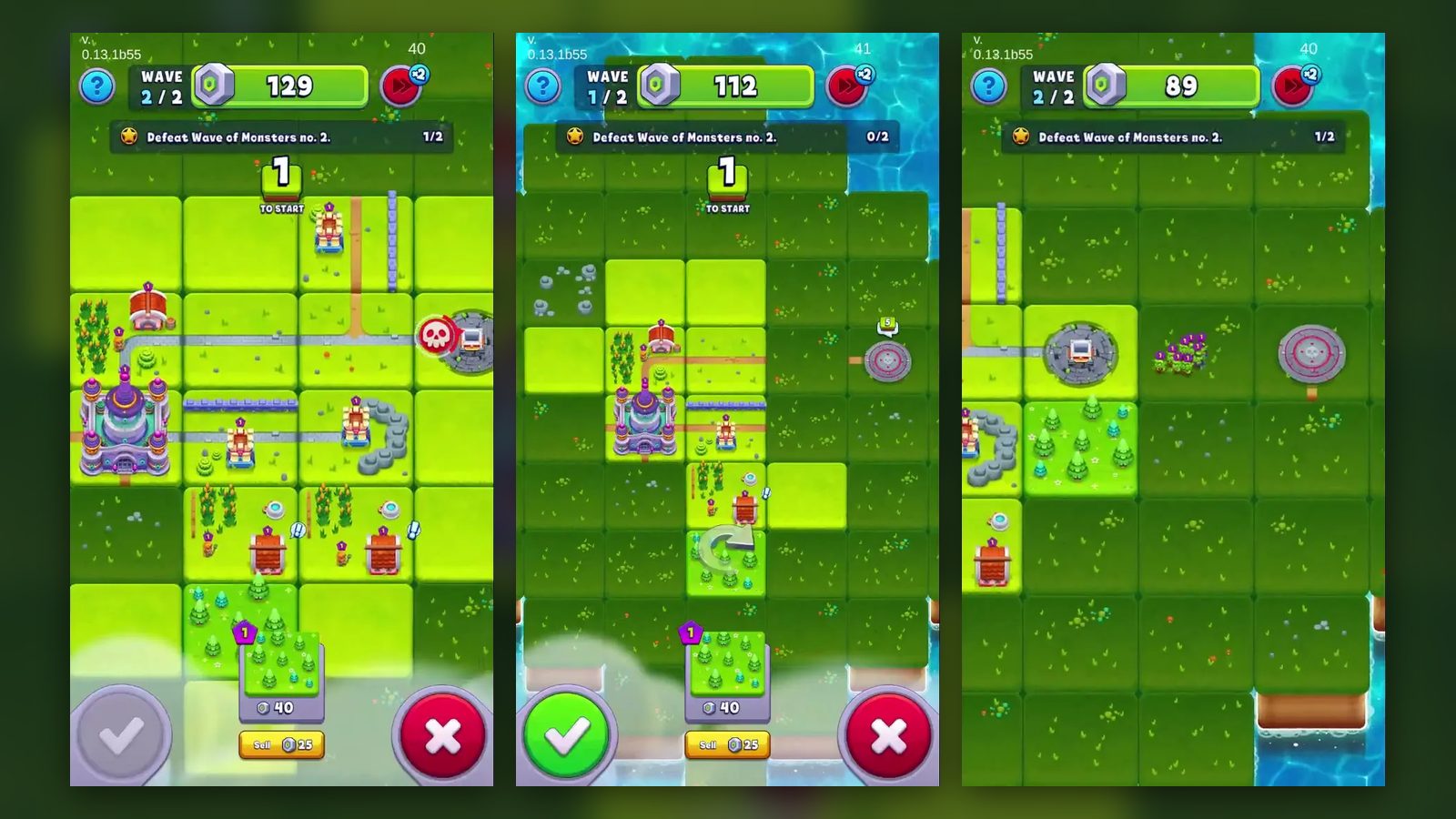
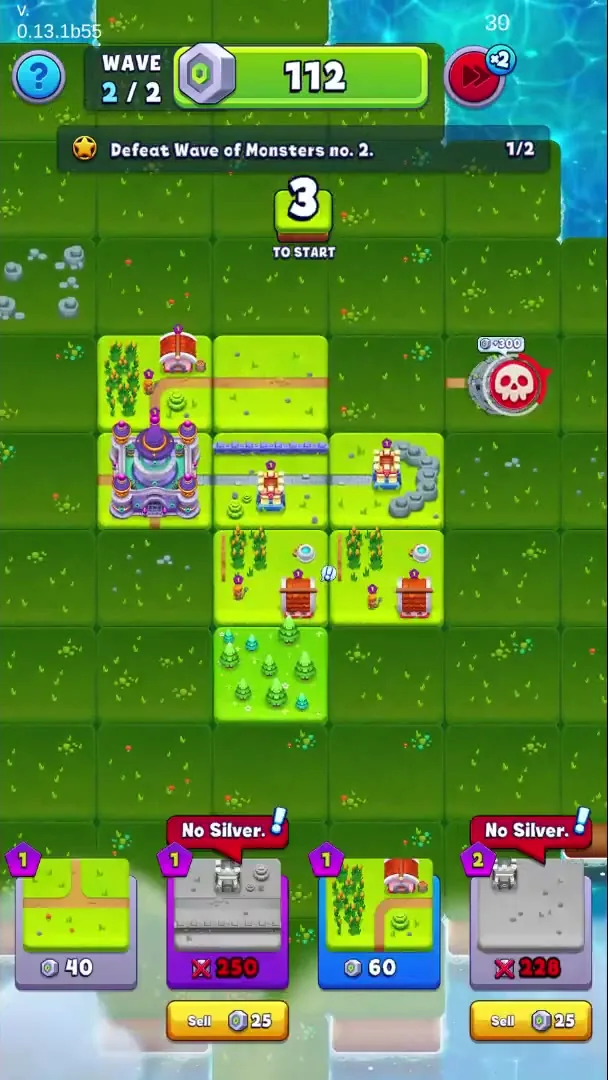
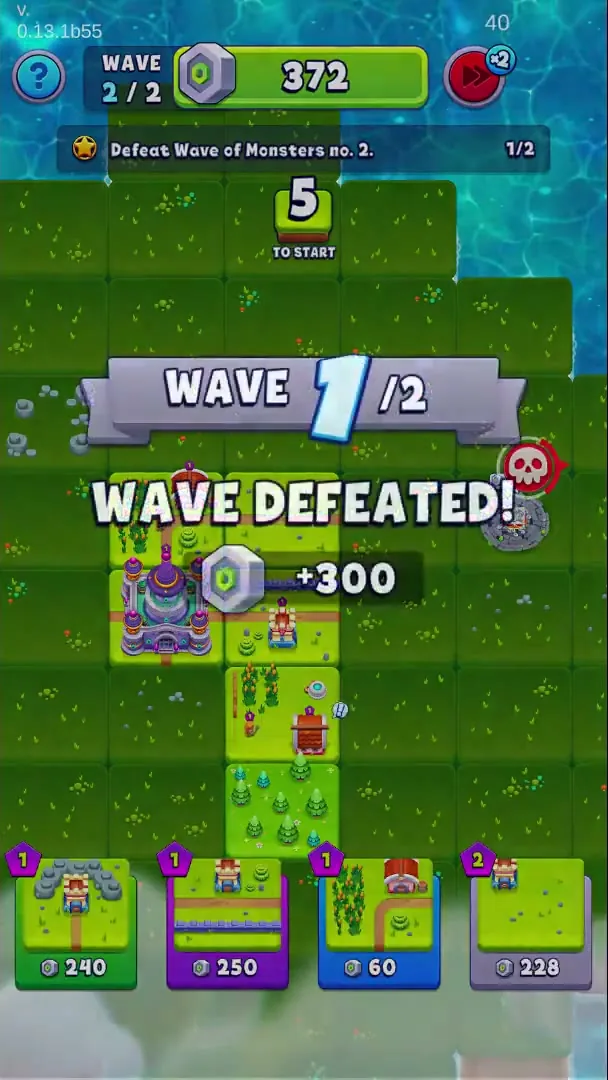
Each match alternates between building and defending. In a build phase you spend silver to put tiles from a hand of four cards onto open cells next to the castle or next to earlier tiles. The “TO START” badge drops by one with each tile, from 5 down to 1, and the next tile sets off the wave: goblins come out of a portal, and the hand disappears while they are on the board. Beating the wave flashes “WAVE DEFEATED!” and pays +300 silver; the badge then resets to 5 and building resumes until the last wave gives way to the VICTORY screen.
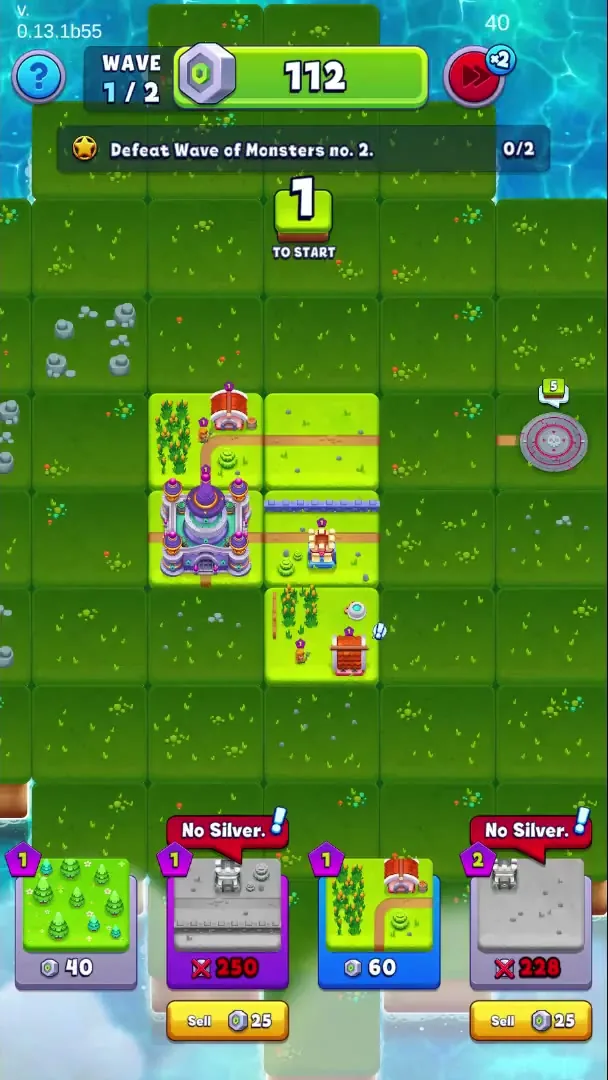
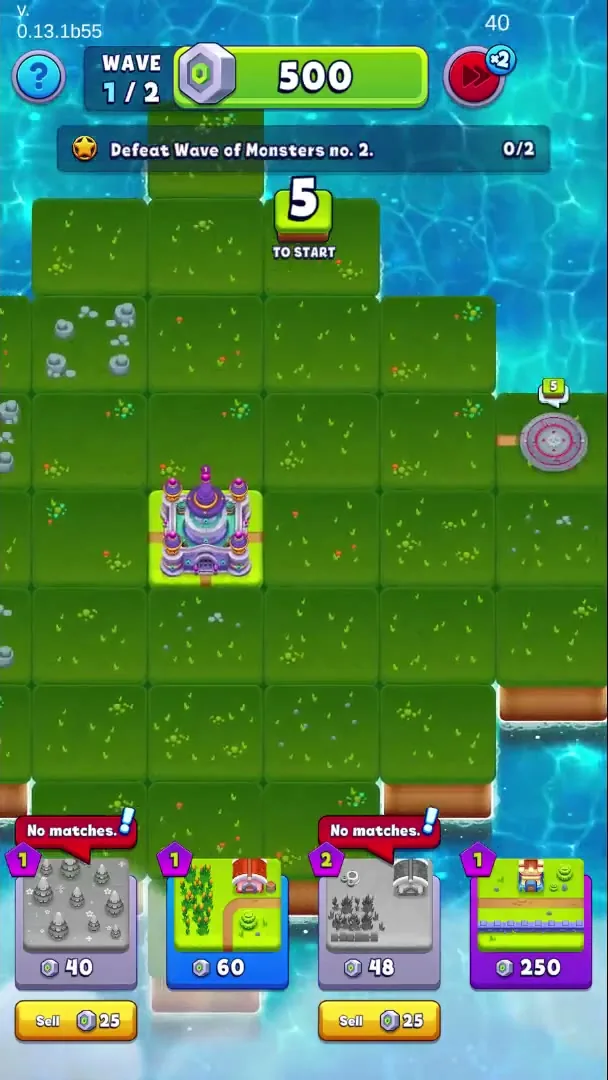
The hand is a row of four cards under the board. Each card carries a purple level badge and a silver price under a picture of its tile, in a frame that may be gray, blue, green or purple. Play a card and the row refills to four with one that was not there before; a 30-silver Road turned up that way early in stage 3. Some cards sit grayed out under a “No matches.” tag, while a card you cannot afford wears a red “No Silver.” tag over a crossed-out red price.
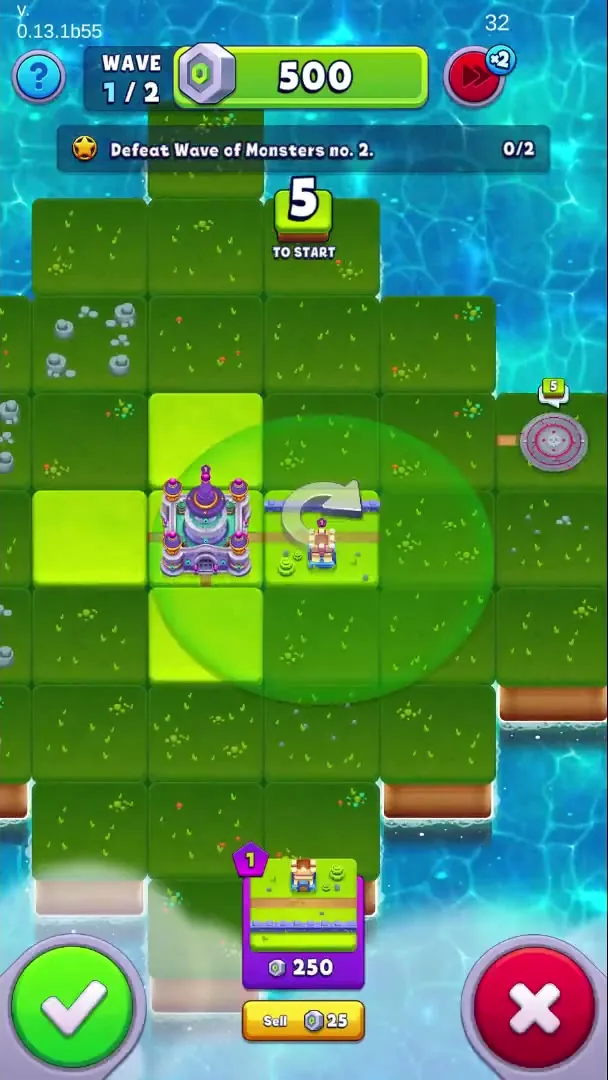
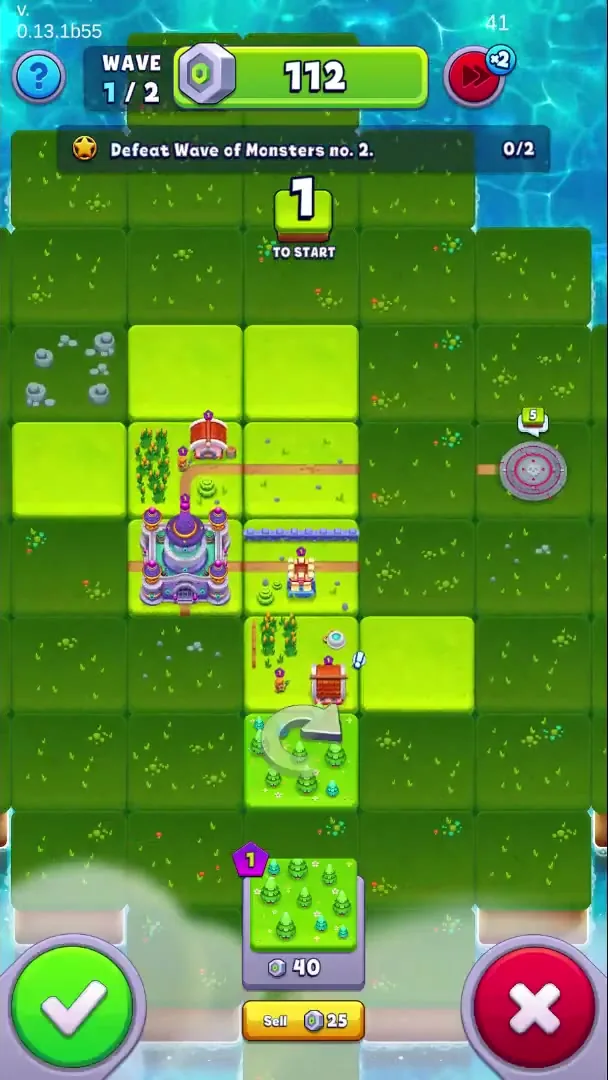
Picking a card hides the rest of the hand and sets it between a green check button and a red X, above a gold “Sell” button priced at 25 silver. The same button sits under grayed or unaffordable cards, though selling a card is never shown. The tile appears as a preview on a board cell with a curved arrow drawn over it, while some of the open cells next to the placed tiles glow lime green. The check turns gray whenever no preview is on the board, and an Archer Tower card also casts a large translucent green circle around its preview.
Chunky cartoon tiles form a floating grass island in turquoise water, and every built tile is a brighter lime green than the darker grass around it. The HUD keeps a “?” button in its upper-left corner and, across from it, a red fast-forward button with an “x2” badge. A small “v. 0.13.1b55” label and a two-digit number that keeps changing take up the very top corners of the screen. The camera pulls back for a wide view of the build, then moves in close or pans right toward a new portal.
Archer Towers come in three versions. One stands on plain meadow in a gray frame, with a 2 on its badge and a 228-silver price; one sits inside a ring of stones in a green frame for 240; and one stands behind a low wall beside a road in a purple frame for 250. The stone-ring tower’s card text reads: “The Archer Tower fires at Monsters within its range, dealing physical damage. Especially effective against weaker Monsters.” Placed towers carry a small purple “1” badge, and by the second build phase of stage 3 three of them stood on the board.
Two different cards share the Farmhouse name. The blue-framed one is a red barn with crops and a curved road for 60 silver; the gray-framed one is a brick house with crop rows and a fence, priced at 48 with a 2 on its level badge. Small farmer figures stand in the placed farm tiles, and the brick-house tiles also carry a small round silver-colored icon and a blue “!” bubble.
The Forest is a gray-framed, 40-silver block of pine trees with no road on it. It opened stage 3 grayed out under “No matches.”, yet one went in below a farm tile later in the first build phase. A second went down beside the ruined portal before wave 2.
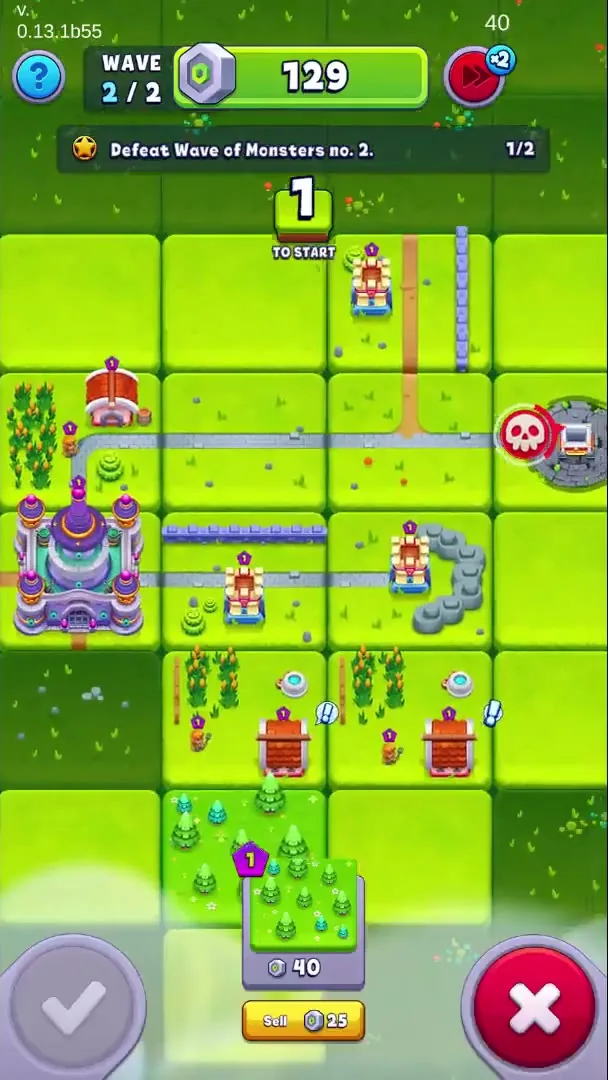
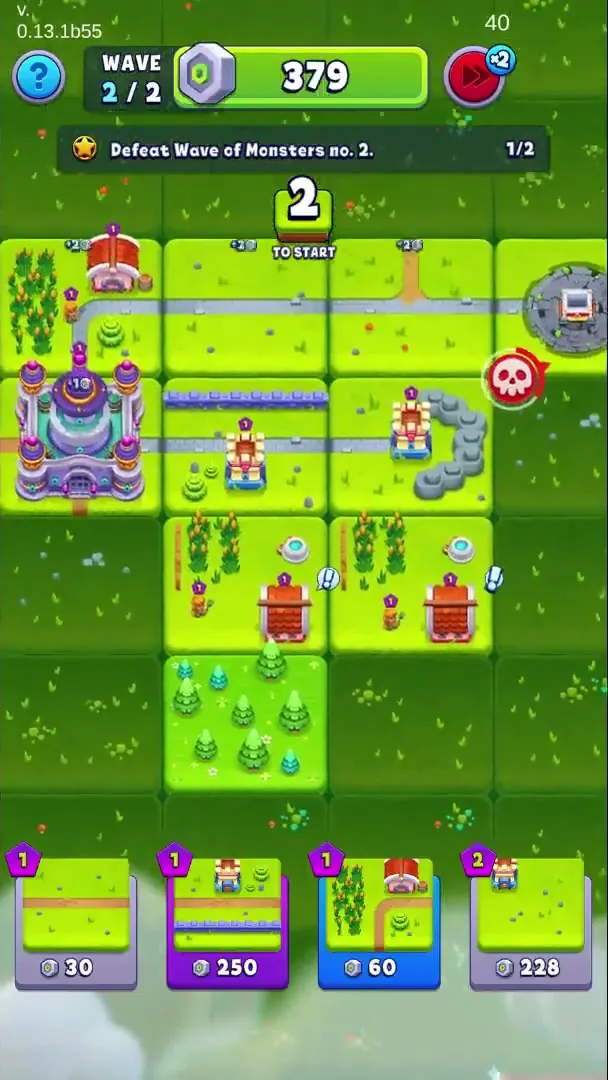
Roads are where the pipe-puzzle side of the design shows. Tiles carry dirt road pieces on some of their edges; the 30-silver Road card is a straight piece and the 40-silver Crossroads is a T-junction. Where tiles link up with the castle the dirt becomes a gray paved road, and the Big Crossroads card spells out the rule: “Crossroads consists of roads. Completed roads are paved and allow you to connect various objects with the Castle.” Midway through the second build phase of stage 3, a paved road ran along the top row to the ruined portal.
Goblins come from a round gray portal pad with a pink ring, set on the grass away from the castle. In the first match it stood near the board’s top-left corner; in stage 3 it was on the right edge, with a small “5” tag above it before wave 1. When a wave starts, goblins in purple helmets file out and move onto the built tiles. Wave 2 came from a fresh portal further right, and its goblins walked past the ruin onto the paved road.
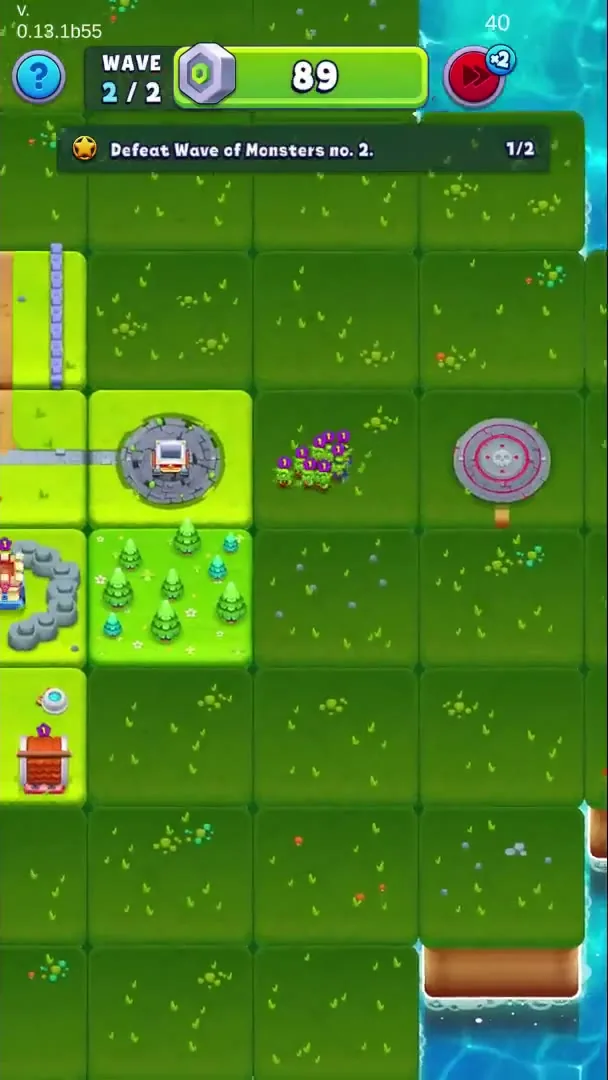
A beaten portal stays on the board. After wave 1 a red skull marker appeared beside it, and the pad turned into a gray stone ruin with a small white-and-red box in the middle and a “+300” tag with a silver icon above it. The skull stayed through the next build phase. Silver read 112 before the Crossroads tile carried the paved road up to the ruin and 379 right after, and the tag was gone by the time wave 2 began.
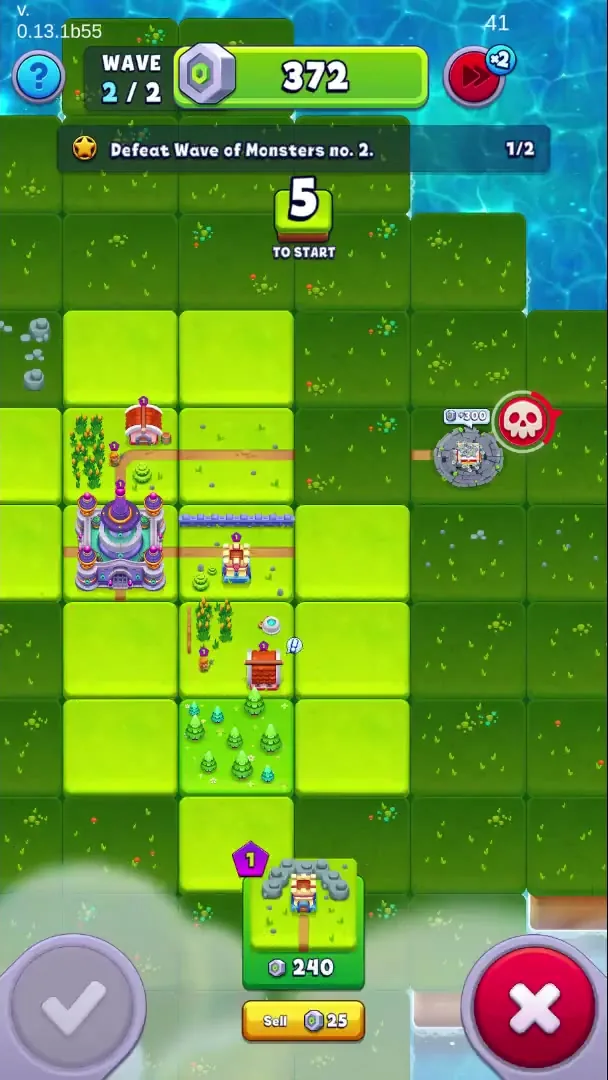
Bare grass surrounds the castle when stage 3 begins, with one rocky cell up and to its left, more rocks along the left edge and the portal on the right. The 500 starting silver dropped to 250 the moment a walled Archer Tower went in beside the castle. A barn Farmhouse above the castle and a Road next to it came next, then a brick Farmhouse below the tower and a Forest below that, and wave 1 followed. The second five were a stone-ring tower, another brick Farmhouse, the Crossroads, a second walled tower and another Forest, before wave 2 closed the match.
Land 1 slots and the deck behind them
The two matches differ in length and goal: the first held a single wave and counted goblins, while the second, under the slot marked 3 on the Land 1 card, ran two waves and counted waves beaten. Inside stage 3, the break between waves changes the board as well. A gray “WAVE 1/2” ribbon appears with “WAVE DEFEATED!” and +300 silver, the HUD moves to wave 2 of 2, and the “TO START” badge resets to 5. The first portal remains as a ruin, and right after the “WAVE 2/2” ribbon, a new portal stands further right with goblins coming out of it.
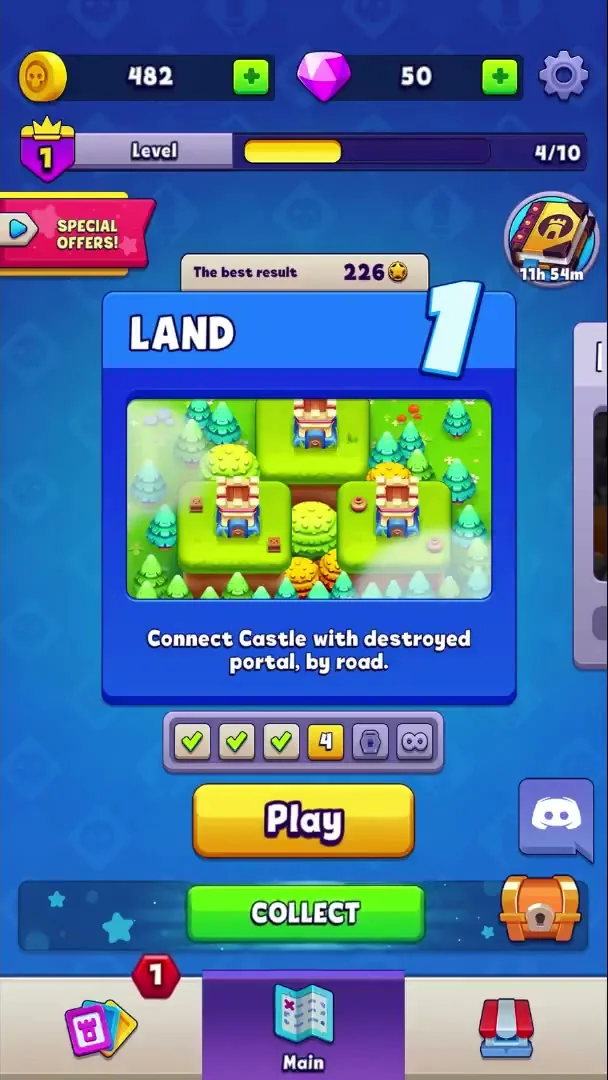
Between matches, the Land 1 card on the home screen tracks its stages in a row of six slots. Cleared slots carry a check mark and the current one its number, and the row ends in padlocks and an infinity symbol. After the stage 3 win the card showed three check marks and slot 4, with a new goal: “Connect Castle with destroyed portal, by road.” A second land card, its title starting with “L”, peeks in from the right edge.
Each win ends on a VICTORY screen that repeats the goal with a check mark, then lists DAMAGE DEALT, DEFEATED WAVES and a RESULT score with a star icon, tagged “THE BEST RESULT!” both times. The one-wave match came to 1120 damage and a RESULT of 114; stage 3 came to 2160 and 226. Under “You receive” sit coins and five copies of one card: coins x1 and five Farmhouse cards the first time, coins x3 and five stone-ring Archer Tower cards the second. The screen’s two buttons read “OK” and “CONNECTING”.
Five daily quests run alongside the matches. Two count goblins (“Defeat 20 Goblin(s) in one game.” and “Defeat 100 Goblin(s).”) and one counts waves (“Defeat 10 Waves of Monsters.”); the others are “Earn 250” and one about chests from destroyed Monster Portals. Progress shows on the VICTORY screen and in a “DAILY QUESTS” window with a “New quests in:” countdown, where finished quests fill a bar marked with a book icon. The bar leads to three chests, the first marked “OPEN!” and the next two needing 3 and 5 books, and the home screen carries a quest-book button with a timer.
Chests open on a blue backdrop. One revealed “Big Crossroads” x10 above a “Tap to continue.” prompt, and a second closed chest glowed there later. Under the home screen’s “Play” button runs a bar of stars with a green “COLLECT” button and a padlocked chest at the end.
The Deck tab is where Tile Defense takes after games like Clash Royale, with Clash Royale-style card progression built on copies and levels. Its “CURRENT CARDS” section is a grid of eight in two rows of four: the three Archer Tower versions and both Farmhouses, plus Crossroads, Forest and Road. “YOUR COLLECTION” and “LOCKED CARDS” follow, and Big Crossroads first sat among the locked cards next to a Road and a Shrine. Each card shows its level and a copy counter such as 1/5 or 2/25; a full counter turns green with an up arrow, as Big Crossroads’ did once it reached the collection.
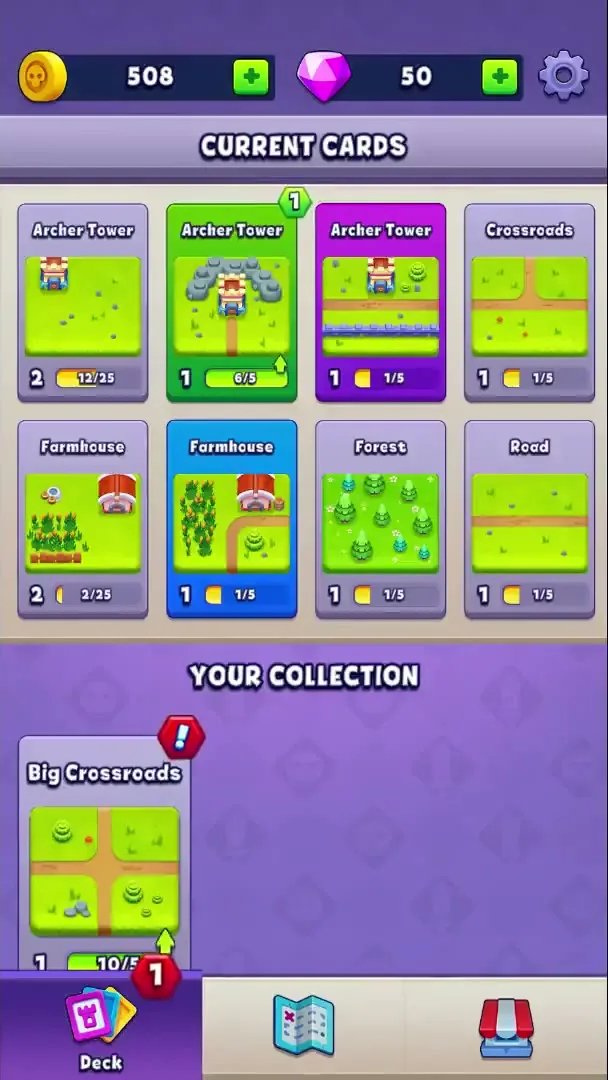
A “CARD INFO” window names the card’s rarity (“COMMON” on the stone-ring Archer Tower, “BASIC” on Big Crossroads) beside a terrain tile labeled “MEADOW”. Below come the “PLAY COST” in silver (240 and 50), a description and an “UPGRADE” button, and the Archer Tower’s window also lists a “MAX BUILDING LEVEL” of 1 plus two rows of three padlocked perk icons, each tagged with its own level label. Card levels carry into matches. Before stage 3 the brick Farmhouse carried a 1 on its deck badge beside a full, green counter; in the stage 3 hand it carried a 2, and back in the deck it kept that 2, with a counter that now runs to 25.
Gold coins and pink gems, each with a green “+” button, head the home and deck screens beside a settings gear. Below them on the home screen, a crowned player-level badge stands next to a “Level” bar that moved forward after the stage 3 win, with a pink “SPECIAL OFFERS!” button at the left and a Discord button at the right. Menus come in blue or purple with thick rounded lettering, and the bottom bar holds the Deck and Main tabs beside a shop icon with a red awning. No ad appeared in the play or the menus we saw.
Towers and roads laid around a castle
Every building is a tile set down on open grass, from walled Archer Towers to barns and roads. The cards behind those tiles gain levels between matches, the way the brick Farmhouse entered stage 3 with a 2 on its badge.
The tower-defense format itself looks appealing at a glance. Castle defense is the foundation, and it opens the design up at once. A castle sits at the center of every board with goblins pouring from a portal toward the land around it, and a beaten portal becomes a ruin that the next stage on the Land 1 card asks you to reach by road. There is strong room here to grow into a strategy game, and we count it a sure prospect.
We can’t say whether Tile Defense is the first game that pairs pipe-puzzle road laying with collectible, upgradeable cards on a castle-defense base. If another game got there first, we’d be glad to be pointed to it and go pay respects to the original. Either way, the three parts are combined with real polish.
Kept to stage-by-stage tower defense
For all that room, Tile Defense stays a pure tower defense, which is a bit of a pity. The mode could give a strategy game a way to pull past its rivals by changing lanes. Here, though, everything happens in single matches picked from the Land 1 card, with the deck in between, and no map or territory layer appears above them.
Road builders and castle keepers
During a match Tile Defense is a placement puzzle on a budget. Each build phase sets a hand of four cards against a silver total that one 250-silver tower can cut in half, and roads turn to pavement once they are completed. A taste for laying routes piece by piece, the way pipe puzzles do, matches that build phase, and its countdown is measured in tiles placed rather than seconds.
Between matches the activity turns to collecting. Card copies arrive from wins and chests while their counters fill and turn green, and the daily quests feed a book bar that ends in chests. A liking for growing a card collection over many matches fits that side of the game.
Verdict
Laying out a castle’s defenses tile by tile, with a card collection that levels up behind them, makes Tile Defense the most imaginative strategy tower defense with card upgrades we have seen in six months, and its parts mesh with real maturity. It looks like a sure bet to grow. One small regret remains: an idea with this much strategy-game potential was kept a pure tower defense.