Wonder Journey Review: Match-3 With a Boy and His Grandpa
Wooden crates, toy planes and star drums fill the boards before grass arrives: a Wonder Journey review of a match-3 starring a boy and his grandpa.
Game at a glance
Wonder Journey: Match 3 Puzzle
7/ 10
Our score
Today's match-3 games with extras already set a very high bar for craft.
In this article6 sections
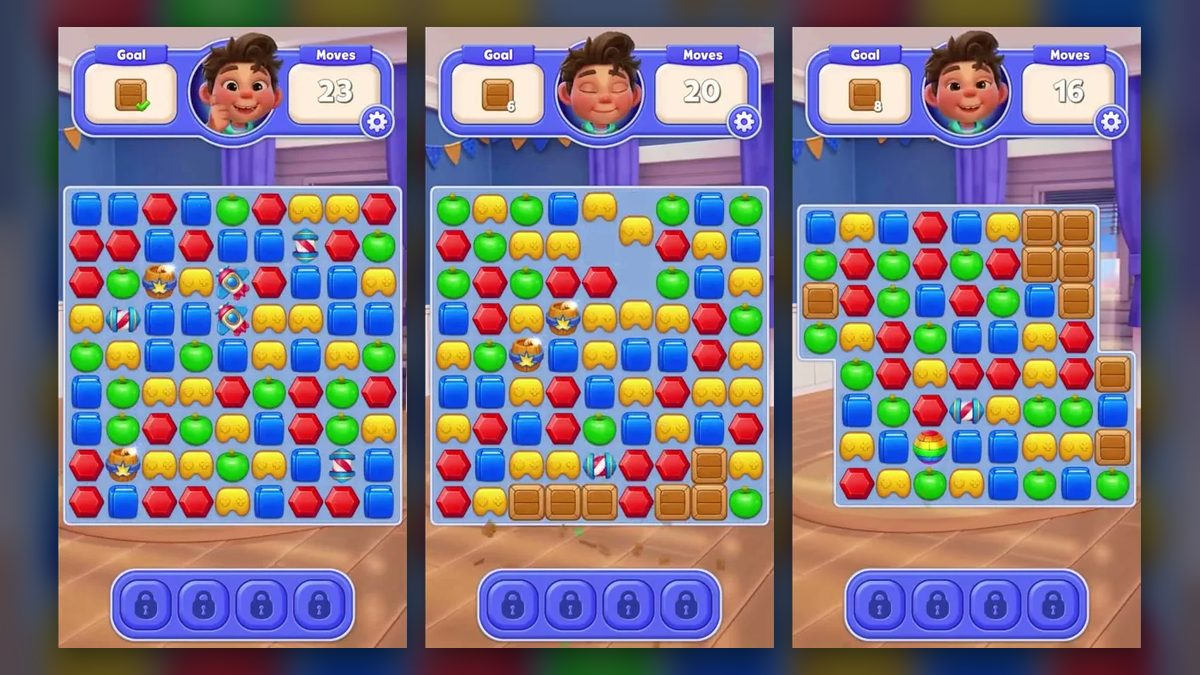
Early in the first of the four levels we played, Wonder Journey’s Goal card asked for 52 wooden crates. Matches knocked that down to 27 and then 12, and the card flipped to a green check with 23 moves still unused.
Wonder Journey belongs among the match 3 games that build extras around the matching, dressed as a kids’ adventure starring a boy and his grandpa. Its artwork and craft are pitched younger and more game-like than the usual match-3, and the game as a whole feels young, happy and innocent.
Breaking crates against the Moves counter
Each level sets one target on the Goal card in the upper-left corner, showing the piece to clear and how many remain. Meanwhile the Moves counter on the other side of the boy’s portrait drops as play goes on. When the target count runs out, the card shows a green check and the level ends, and the three boards finished here all had moves to spare. The four boards run from the one before Level 3 to the one after Level 4, with crates as the target on the first three and grass on the last.
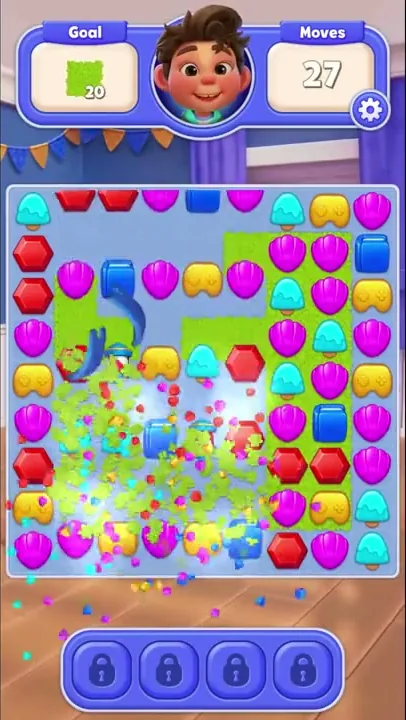
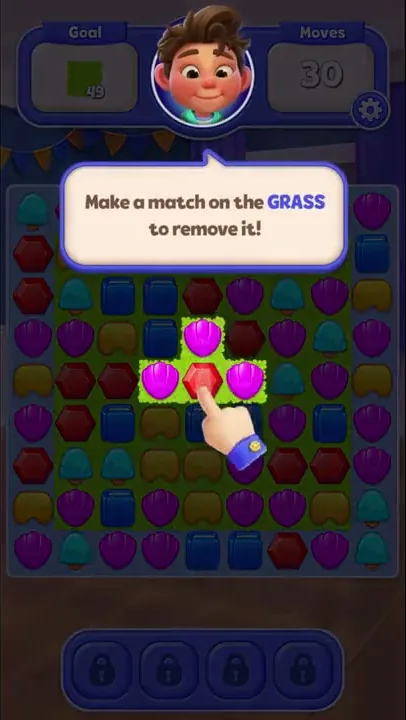
The game is played in portrait, and the player works by touching pieces on the board. On the grass board, a tutorial hand points at a red hexagon inside a highlighted T of four cells, with magenta shells on both sides of it and one more above. Moving that hexagon would line up three shells in a row.
Matching same-colored pieces clears them, and crates beside the cleared group split into wood chips. New pieces drop into the gaps while the Goal card counts down what remains, and special pieces form on the board along the way. Once the goal is met, the game returns to the home screen, where a green button naming the next level starts the next board.
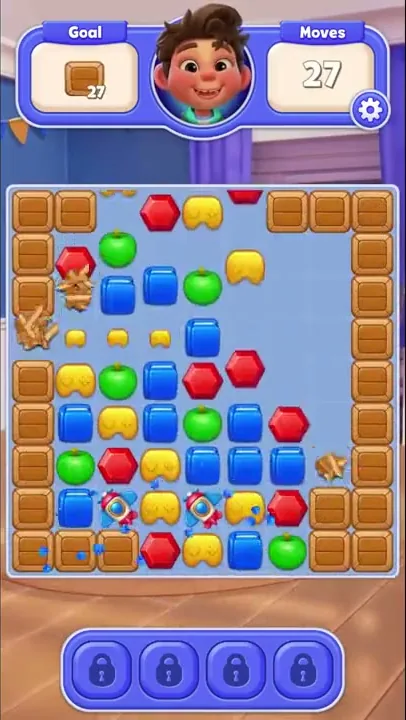
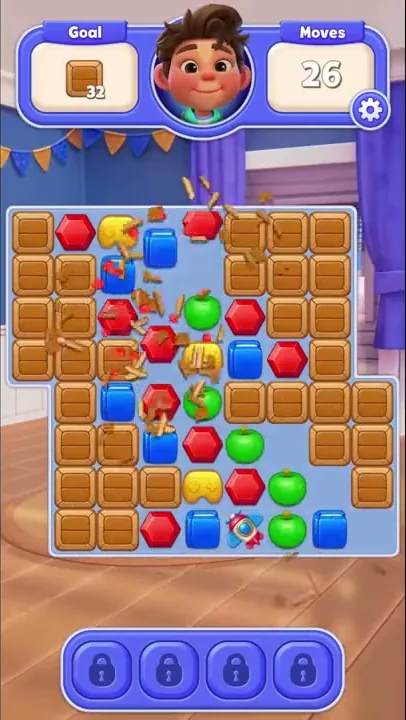
Wooden crates take up whole cells, so no piece sits inside one. They split into wood chips when pieces next to them are cleared or when a beam passes through, and the Goal card’s count drops as they go.
Grass is the other target: bright green turf lying under the pieces, removed by making a match on top of it. It bursts into green bits as it goes. On the grass board the count fell from 49 to 1, with the last tile hiding under a blue cube near the top left.
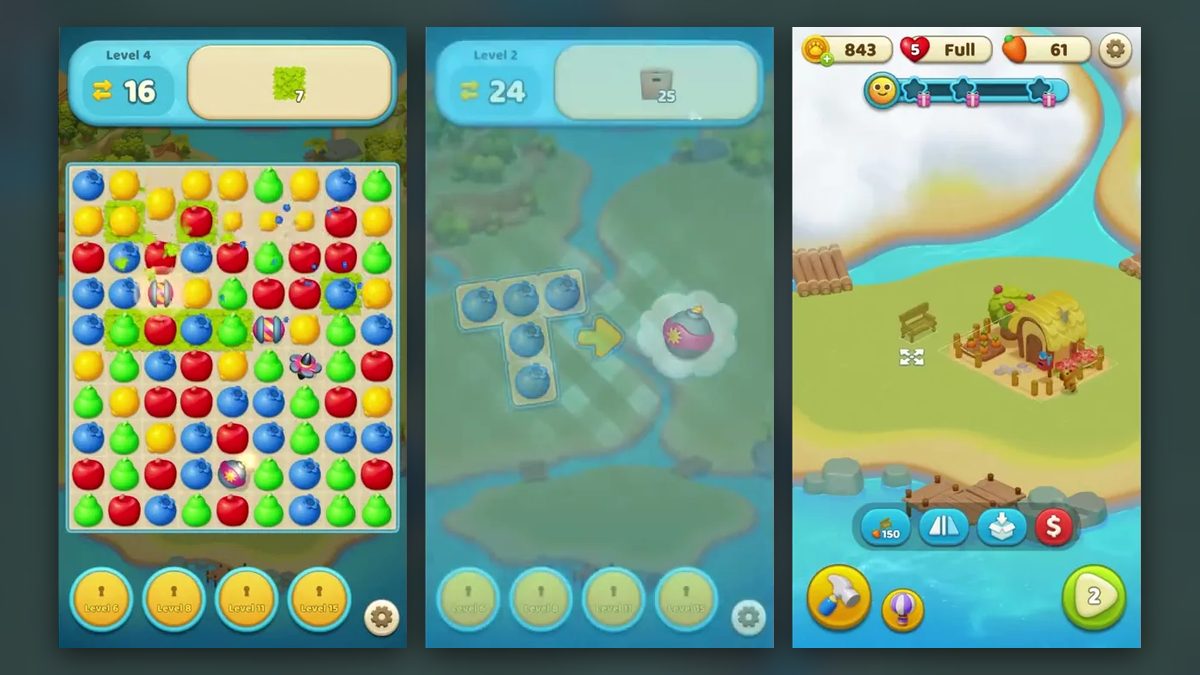
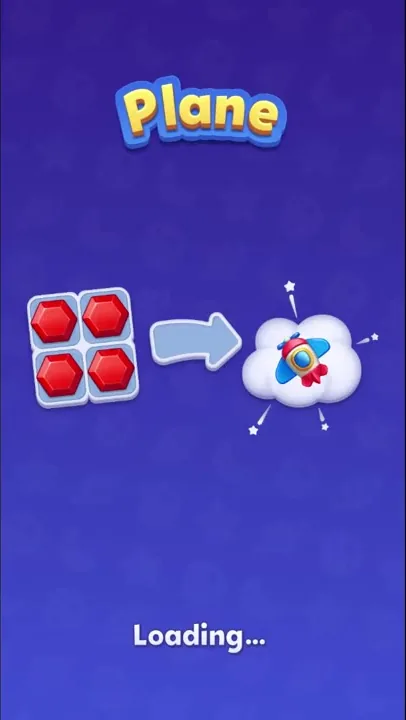
Planes are blue-and-red toys that fill one cell each, and a pair of them was already on the board early in the first level. A loading screen titled “Plane” pictures four red hexagons in a 2x2 square, with an arrow pointing to a plane on a small cloud.
Striped cylinders are red and white with blue end caps, again one cell each. They turn up both standing upright and lying on their side. By the time the first board’s goal was met, three of them stood among the pieces alongside two planes and two star drums.
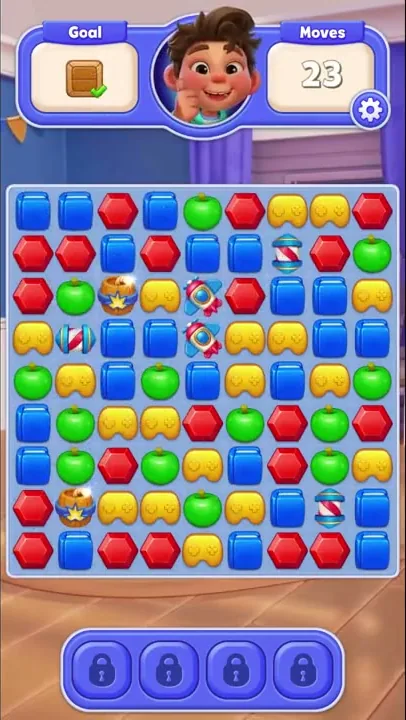
The star drum is a brown drum with a blue band and a gold star on the front, also a single cell in size. Drums appeared as early as the first board, and in Level 4 two of them sat diagonally next to each other.
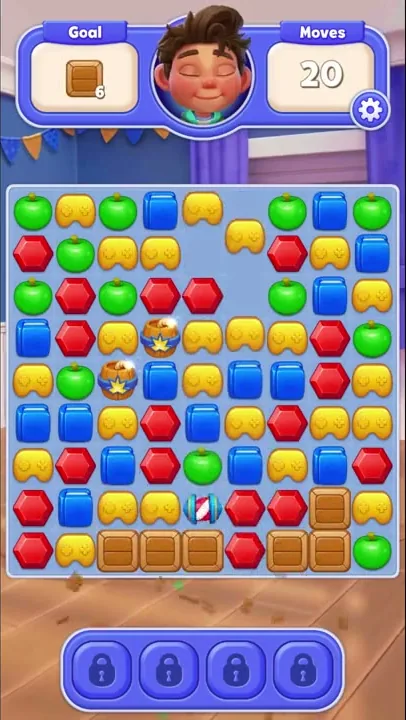
The rainbow ball is striped in rainbow colors and takes up one cell. The first one appeared in Level 3, and at one point in that level the screen dimmed while the ball glowed brighter than the pieces around it.
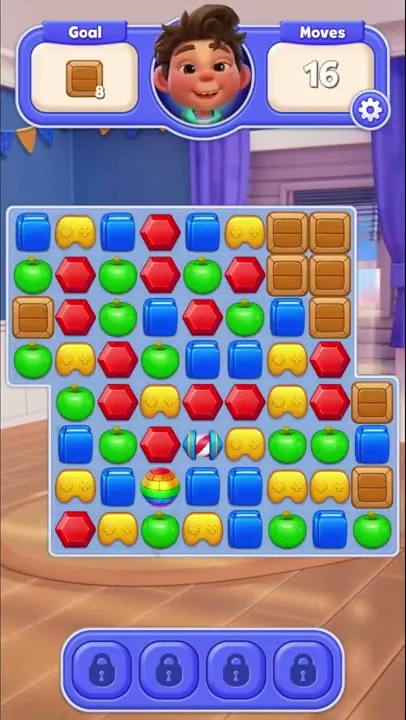
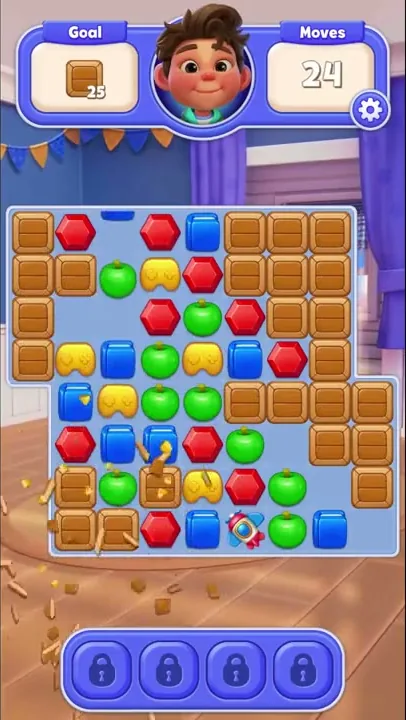
Bright beams sweep a whole row or a whole column and leave the cells in their path empty. One cut across the fourth row in Level 3, splitting the crates it passed through. Later beams ran down columns in Level 4 and on the grass board.
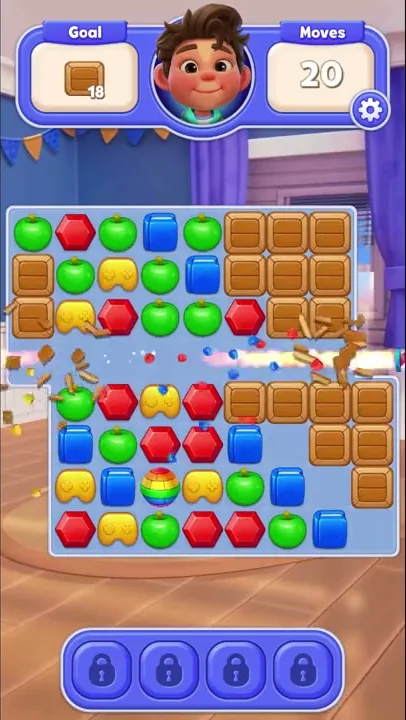
Crates filled the left side and the corners on the right of a staggered board, with a diagonal band of pieces between them. That was Level 3 early on, with 32 crates on the Goal card and 26 moves still to use. The rainbow ball turned up with 19 crates left, and the row beam followed at 18. The count worked down to 5, then the card flipped to its check with 12 moves unused.
From staggered crates to a grass patch
The first three boards drew on four colors of pieces: red hexagon gems and yellow two-lobed pieces alongside green apples and blue cubes. Special pieces arrived early. Planes were on the opening board along with cylinders and drums, while the rainbow ball and the first beam came in Level 3.
Board shapes shift from level to level. The opening board was a full 9x9 square, while the next was an 8x8 grid in two halves, with the top four rows set one column to the left of the bottom four. Crates stayed the goal through that change.
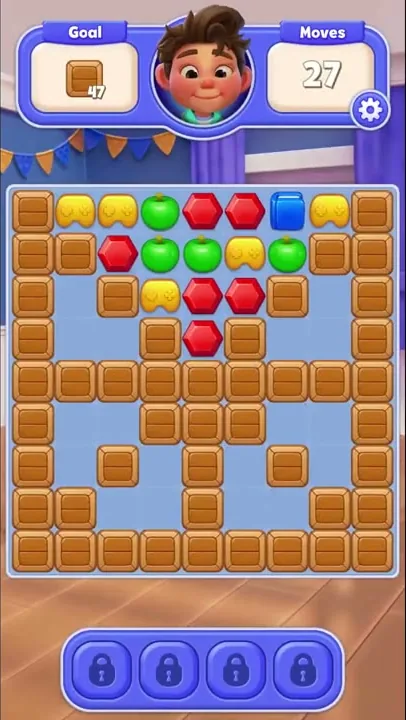
A 9x9 square came back in Level 4, much of it given over to crates in a mirror-image pattern. Crates lined both sides and the bottom edge, and a solid row of them ran across the fifth row with more standing above and below it. Early in that level the Goal card asked for 47 crates, and pieces filled only a wedge in the top rows while the other open cells stood empty.
The target itself changed after Level 4. A loading screen titled “Plane” came first, and on the next board the Goal card switched from crates to grass. A hint bubble read “Make a match on the GRASS to remove it!” while a hand pointed at a highlighted move. The piece set grew to five colors there, as magenta shells and cyan domes joined three of the earlier colors.
Between levels the game returns to a child’s bedroom. The boy waves from the window of a red cardboard rocket while his white-haired, bearded grandpa leans on it, and a large green button below names the next level. A coin counter with a green plus badge occupies the upper-left corner, and a lives heart marked “Full” holds the opposite one. Below the heart, a round collection icon shows a picture card with a cloud, and its count out of 10 went up by one after each finished level.
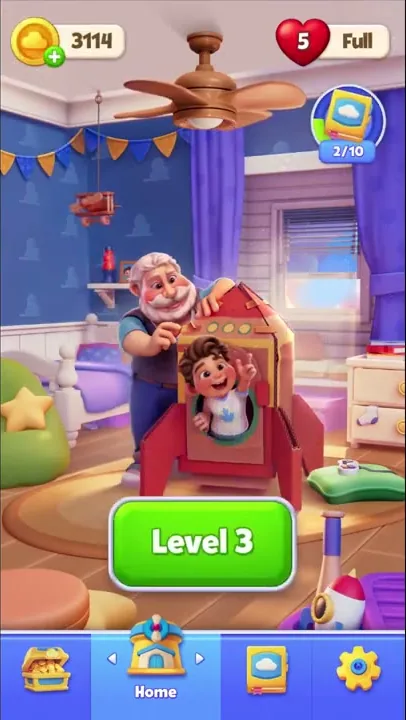
A bar along the bottom of the home screen holds four buttons: a treasure chest, a house labeled “Home” with small arrows on both sides, a book with a cloud on its cover, and a gear. A second gear is tucked into the corner of the Moves card during levels. Beneath the board is a row of four booster slots, each showing a padlock.
Finishing a level turns the Goal card into a Reward card with a coin and the number 5. Beams then fly from the Moves counter onto the board while the counter keeps dropping, and “Tap to skip” shows beneath the board. Back on the home screen after Level 4, coins flew up to the coin counter from a “+39” label.
Toy-shaped pieces and a boy’s bedroom
The artwork and craft lean younger and more game-like than in the usual match-3, and that shows in the characters. The boy and his grandpa are rendered 3D cartoon figures, and the loading screens put them in costume: the grandpa in a green jet-pack suit with goggles, the boy in a red cape holding a magic hat and wand, and the grandpa again clutching a beach ball beside broken shell pieces.
The pieces and obstacles follow the same childlike line. Next to apples and chunky cubes, the special pieces look like toy planes and drums with gold stars, while the obstacles are wooden crates and patches of grass.
That young, happy mood carries into the small touches. The boy’s portrait between the Goal and Moves cards changes expression as play goes on, raising a finger when a goal is met, and the bedroom with its bunting stays in view behind the boards.
The dressing and overall style carry a bit of Toy Blast about them, with a boy in the lead where Toy Blast has a girl.
Various mini-game modes are mixed in with the matching as well. The four boards described here were all standard goal-and-moves levels, though, so we can’t say how those modes play.
Padlocked boosters and a heart left full
Wonder Journey drew no criticism from us. The points below are limits of the boards covered here, not faults.
The four booster slots beneath the boards showed padlocks, so we can’t say which boosters they hold or when they open. What the treasure chest and the cloud-covered book on the home bar lead to, and what the collection meter gives at 10, also fall outside these boards.
Each finished level ended with moves left over, and the lives heart showed “Full” on each return to the home screen. Running out of moves and losing a life are not part of what these four boards cover.
Clearing crates and grass in a child’s bedroom
The Wonder Journey gameplay on these boards comes down to one task: spot groups of same-colored pieces and spend a limited stock of moves bringing a single count of crates or grass down to zero. Toy planes and star drums form on the board along the way, and beams wipe whole rows or columns.
As a match-3, it shares a genre with games like royal match, with its own dressing around the boards: toy-shaped pieces, a child’s bedroom, and a boy and his grandpa waiting between levels. That mix fits a taste for chasing one target count at a time inside a young, kid-centered look.
Verdict
Wonder Journey lands as a good match-3 with a young, happy face. Its childlike artwork and toy-shaped pieces point the same innocent way as the boy-and-grandpa adventure wrapped around them. It is also a reminder of how high the craft of match-3 games with extras already runs these days.