Tile Match 2048: A Mashup That Feels Great to Play
This tile match 2048 game sends numbered blocks into a tray where two 2s merge into a 4 instead of clearing in threes.
In this article3 sections
This tile match 2048 game belongs to a series on mobile games that combine familiar ideas in new ways. Nothing in the series is sponsored, so the focus stays on how the game plays, and the game itself goes unnamed.
Following our approach to game innovation, this series regularly picks out some of the better examples of fresh ideas on the market, so the approach is easier to understand in practice.
This time, the combination is Tile Match + 2048
How it plays
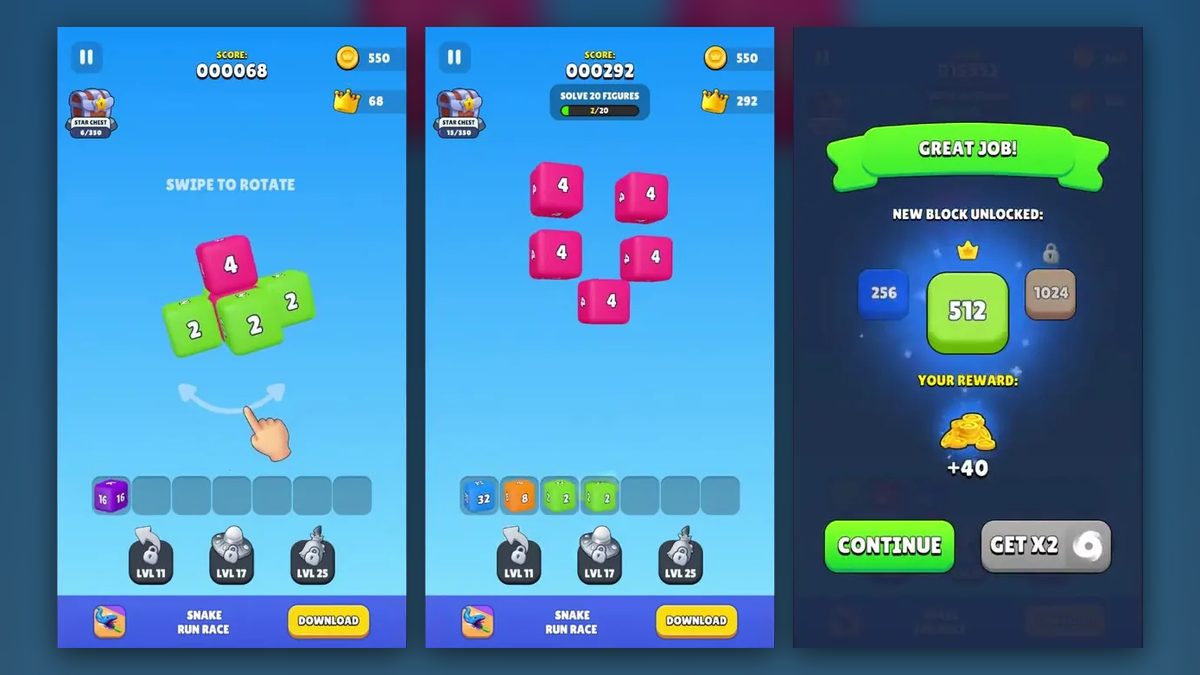
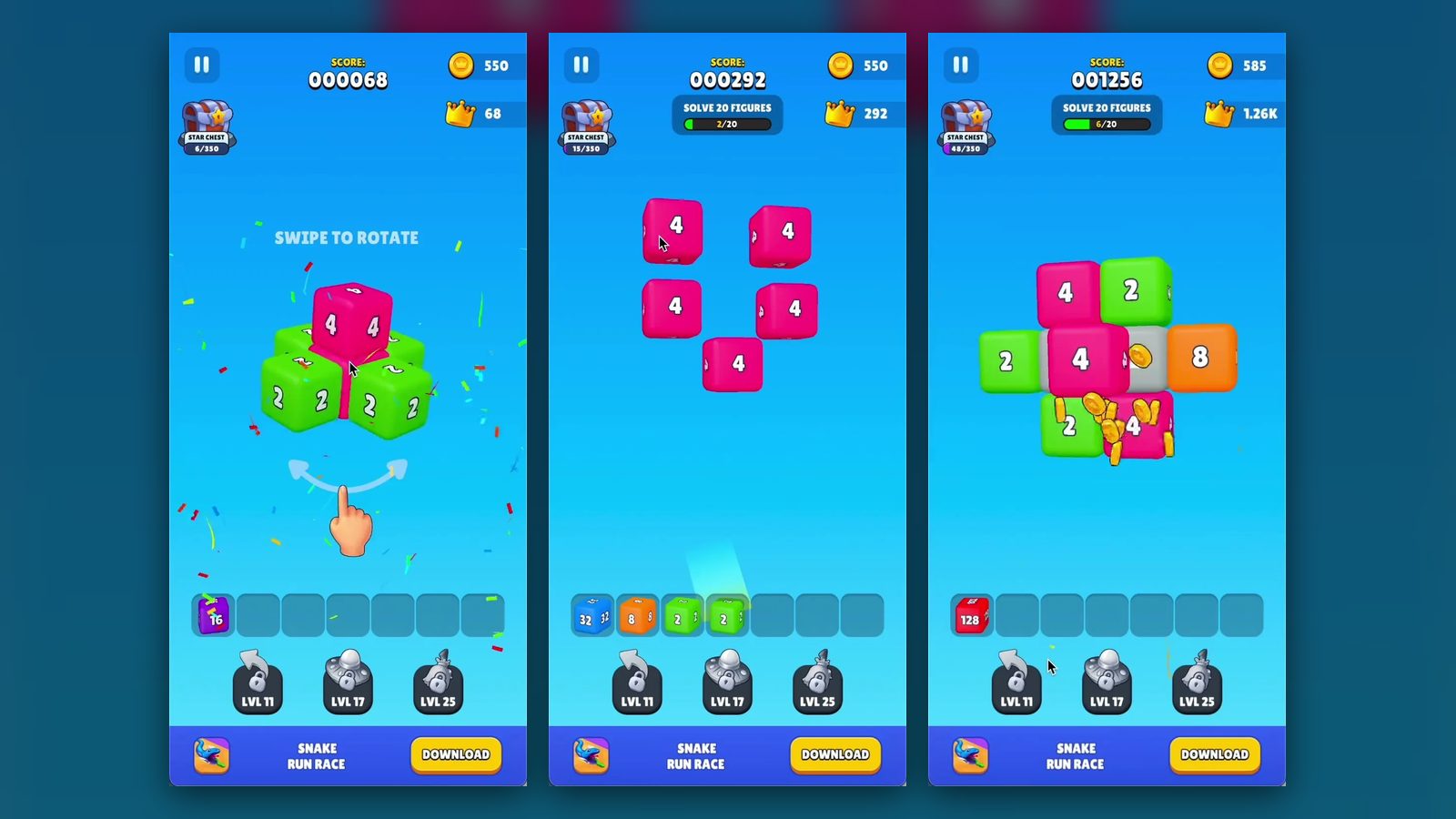
Here is what the game looks like:
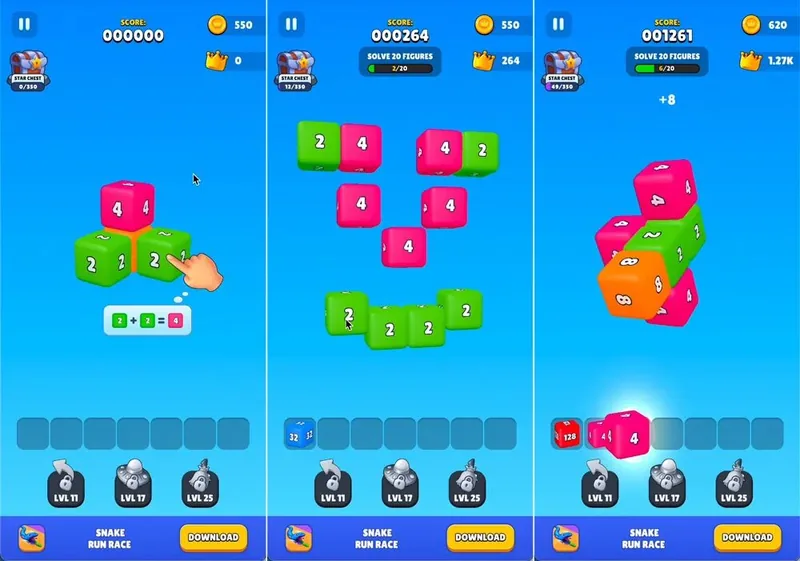
The rules work like this:
- The layout is the same as in traditional tile match games, where you tap tiles into a small tray and three identical tiles clear: the middle of the screen is a holding area, and the bottom is the clearing area.
- The play is where 2048 comes in. Once a block goes from the holding area into the clearing area, it doesn’t clear by matching three. Numbers add up and merge the way they do in 2048: two 2s automatically become a 4, two 4s become an 8, and so on.
- As the screenshot shows, the holding area is a stack of cube blocks. As the levels go on, the game wedges key numbers in the middle of several blocks where the player can’t tap them, which is how it builds difficulty.
- Because of how 2048 works, the clearing area at the bottom never fully empties; the best you can do is keep it small. In the second screen, the 32 in the clearing area carries into the next level and stays there as play goes on. By the third screen, three blocks have been sitting in the clearing area the whole time.
- When the clearing area runs out of space, the player can continue with coins or by watching an ad. Continuing automatically moves three blocks from the clearing area back to the holding area, and the game goes on. Giving up ends the run; a new game starts with an empty clearing area, but the score starts again from zero.
Put simply, play is a steady loop of tapping blocks off the stack and letting matching numbers merge below.
Turning Figures and a Seven-Slot Merge Tray
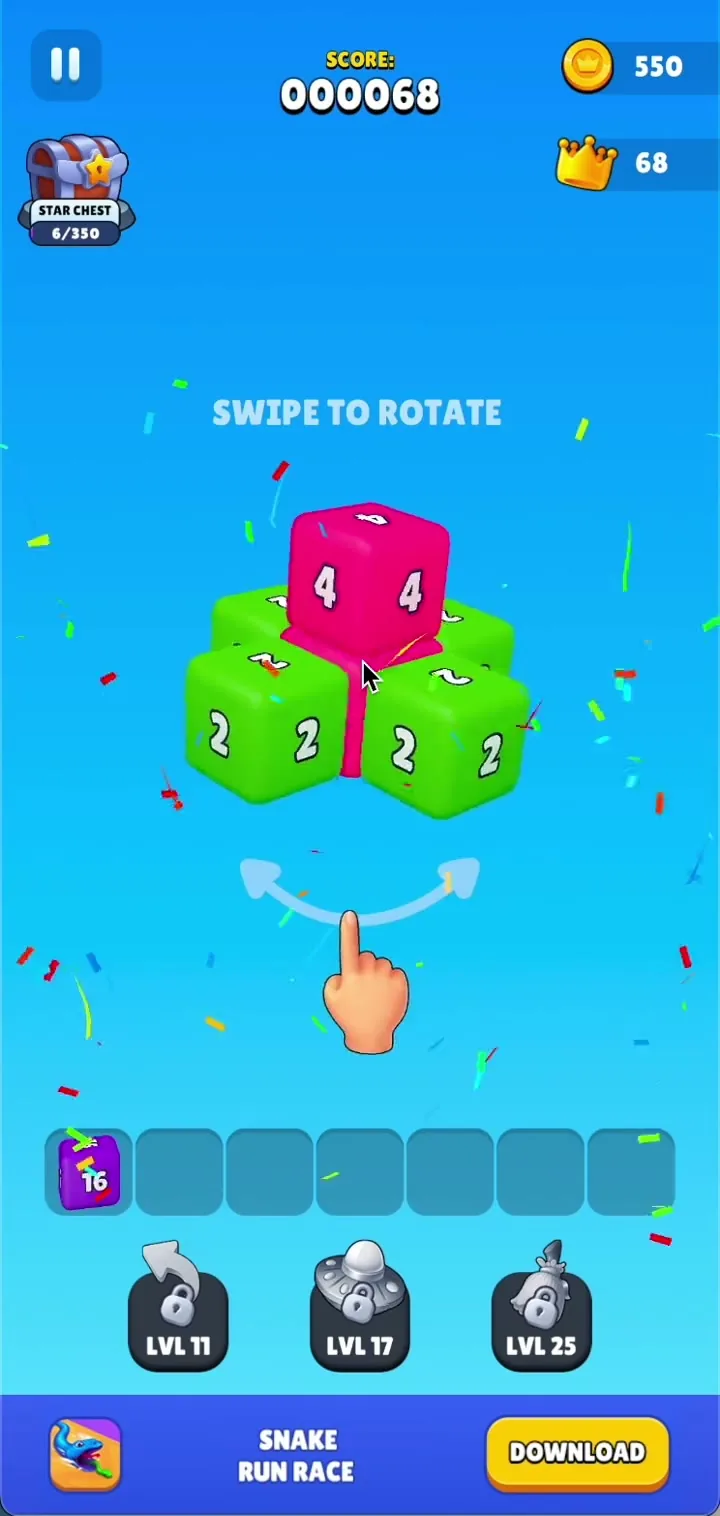
Play is split into figures, which are shapes built from numbered cubes in the middle of the screen. Tapping a cube sends it down into a row of seven slots under the figure, and a trail of light runs from the figure to the tray as the cube flies. Swiping turns the figure and shows it from a new angle, and a pause button sits at the top left.
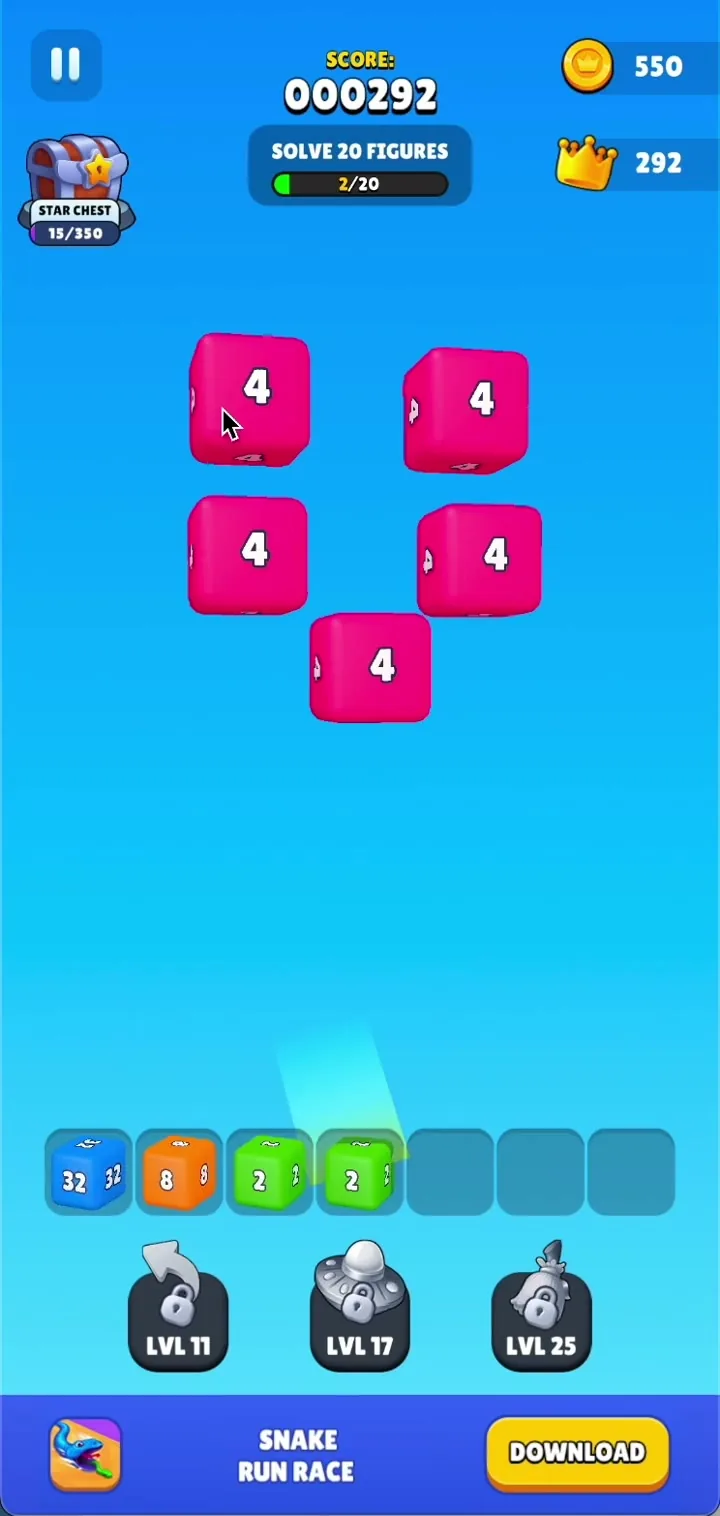
In the first figure, a hand points at a pink 4 resting on an orange 8, and a hint above the tray spells out 4 + 4 = 8. The second figure has pink 4s in the center with green 2s around them, and it adds a “Swipe to Rotate” hint with a curved double arrow and a hand. A “Try It Yourself!” line follows, with the figure turned to a new angle.
Early in the third figure, the cubes lie flat and face the player. Two pairs of a green 2 and a pink 4 sit at the top, three pink 4s form a V below them, and a curved row of four green 2s runs along the bottom. Later in that figure, a green 2 drops into the tray beside another 2, an 8 and a 32, with five pink 4s still in the figure. A few seconds later the screen reads “Figure 3 Solved!” with an x4 combo label, and the tray holds a single 64.
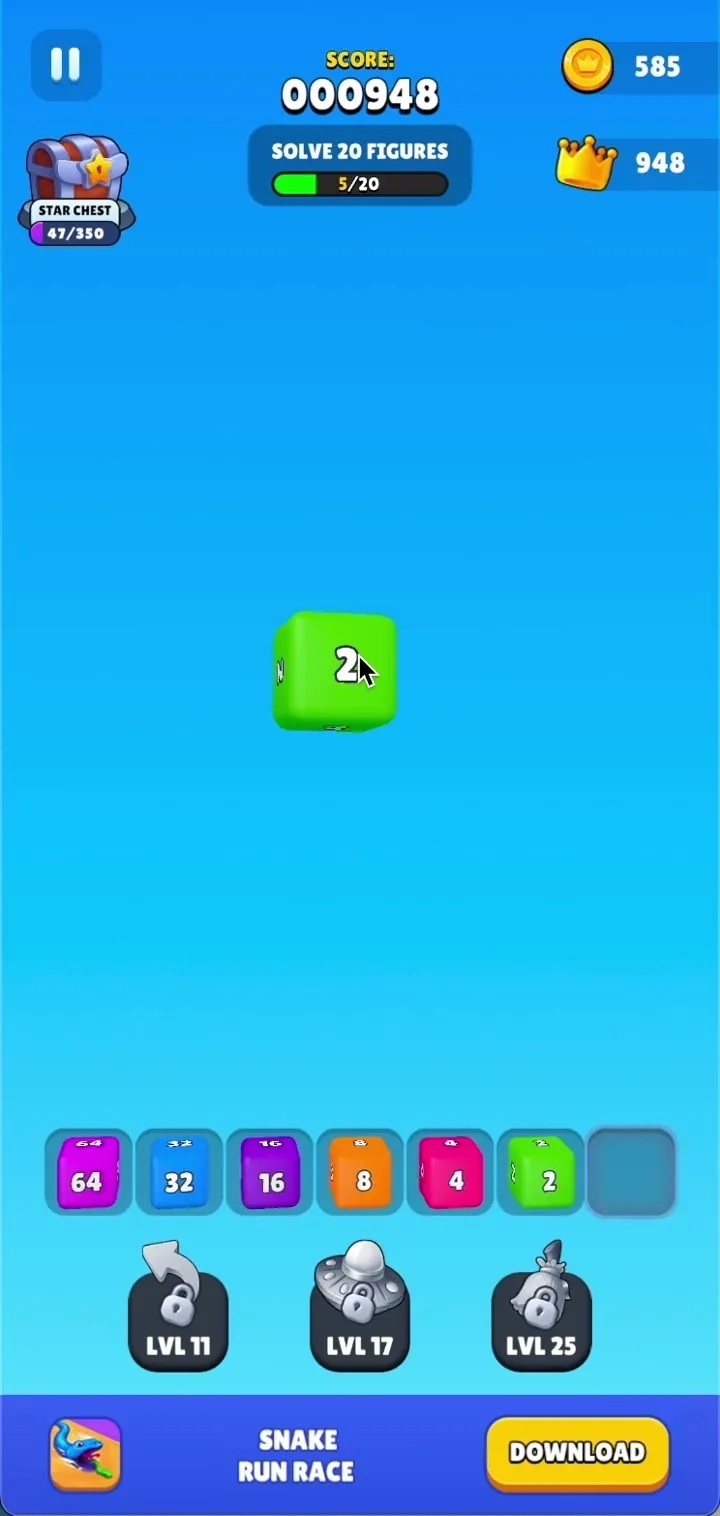
Each value has its own color, and the number is printed on every face of the cube: green for 2, pink for 4, orange for 8, purple for 16, blue for 32, magenta for 64, red for 128 and dark blue for 256. One cube can set off a run of merges through the whole tray. In the sixth figure, which first appears as a plus of green 2s, the tray at one point holds 64, 32, 16, 8, 4 and 2, with one slot free and one green 2 left in the figure. When the next figure appears, that whole row has become a single red 128.
Cubes left in the tray stay put when a new figure appears. The 64 from the third figure is still there in the fourth, which has three pink 4s in a row over two green 2s stacked under the middle one. The 128 stays in the tray through the seventh, eighth and ninth figures.
Solving a figure sets off a burst of confetti and a large “Figure Solved!” line with the figure’s number. A combo label also appears above the tray: a green x3 combo for the second figure and an orange x4 for the third and the eighth. Score popups such as +96 and +80 float up after merges, and the six-digit score at the top center climbs from 000000 in the first figure to 004520 by the eleventh. Under the coin total at the top right, a crown icon shows a number that follows the score, reaching 4.52K by then.
From the third figure on, a “Solve 20 Figures” bar under the score counts solved figures. It reads 2/20 early in the third figure, 5/20 in the sixth and 10/20 by the eleventh.
Across the eleven figures, flat layouts such as the third and fourth sit alongside solid 3D stacks such as the fifth and the eleventh. The fifth figure is a cube-shaped block, mostly pink 4s with an orange 8 at the top left corner and a green 2 at the lower right, and some of its cubes sit behind or inside others. The eleventh is a packed stack of orange 8s and pink 4s, with a green 2 showing underneath and the edge of a purple cube at the back left.
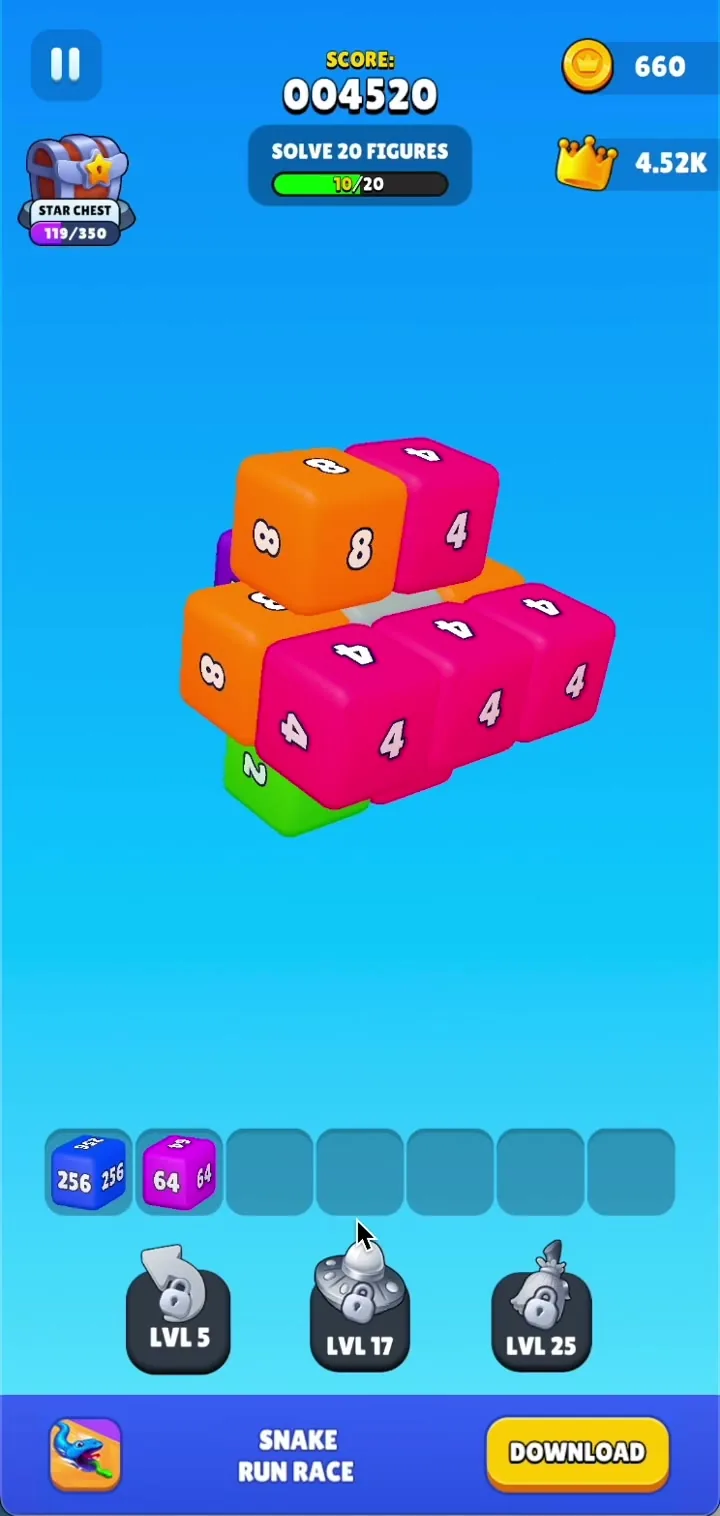
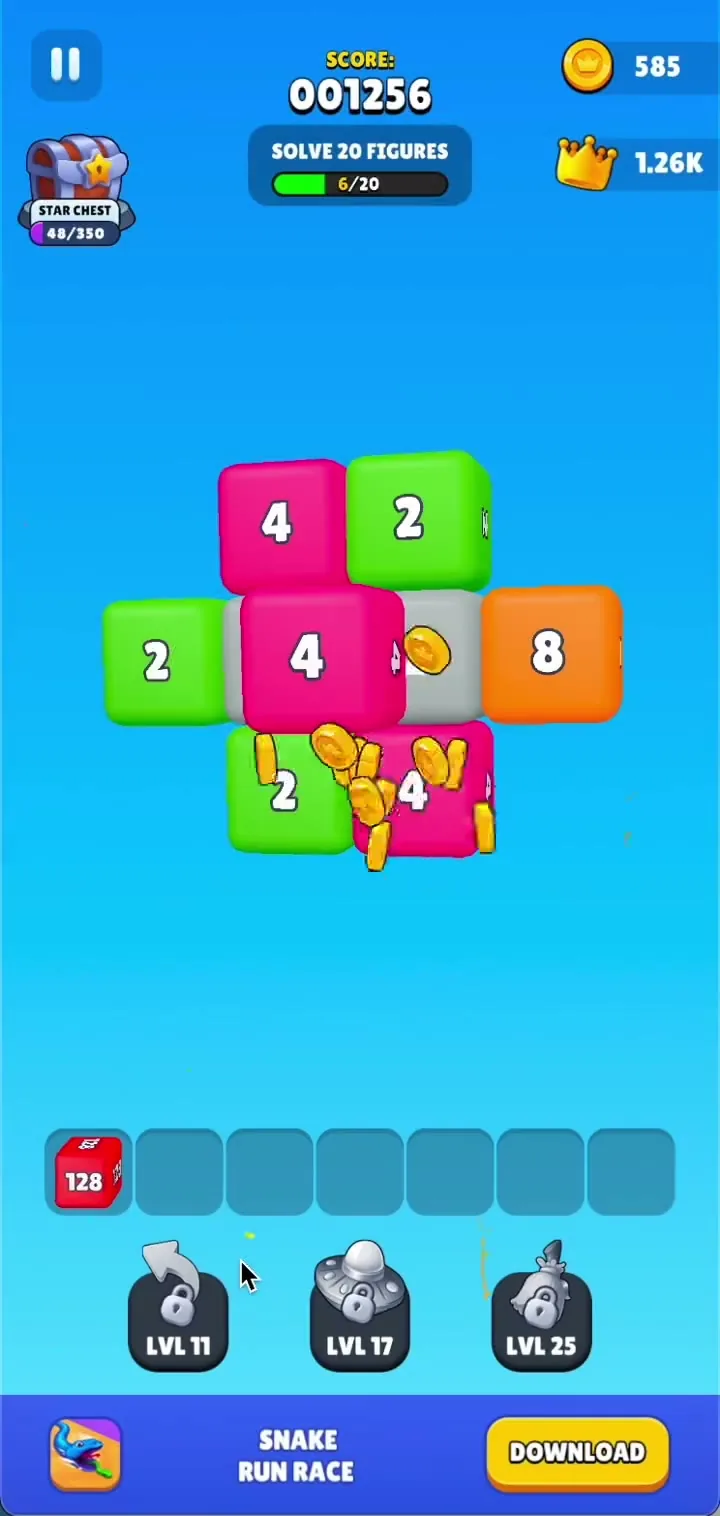
Gray cubes sit inside some figures. Gray shows behind the center of the plus shape, a gray cube sits at the back of a ring of pink 4s in the eighth figure, and gray shows in the center of the eleventh stack. In the seventh figure, one gray cube carries a gold coin, and gold coins spill out over the cubes around it. The coin total at the top right reads 585 at that moment and 620 a few seconds later.
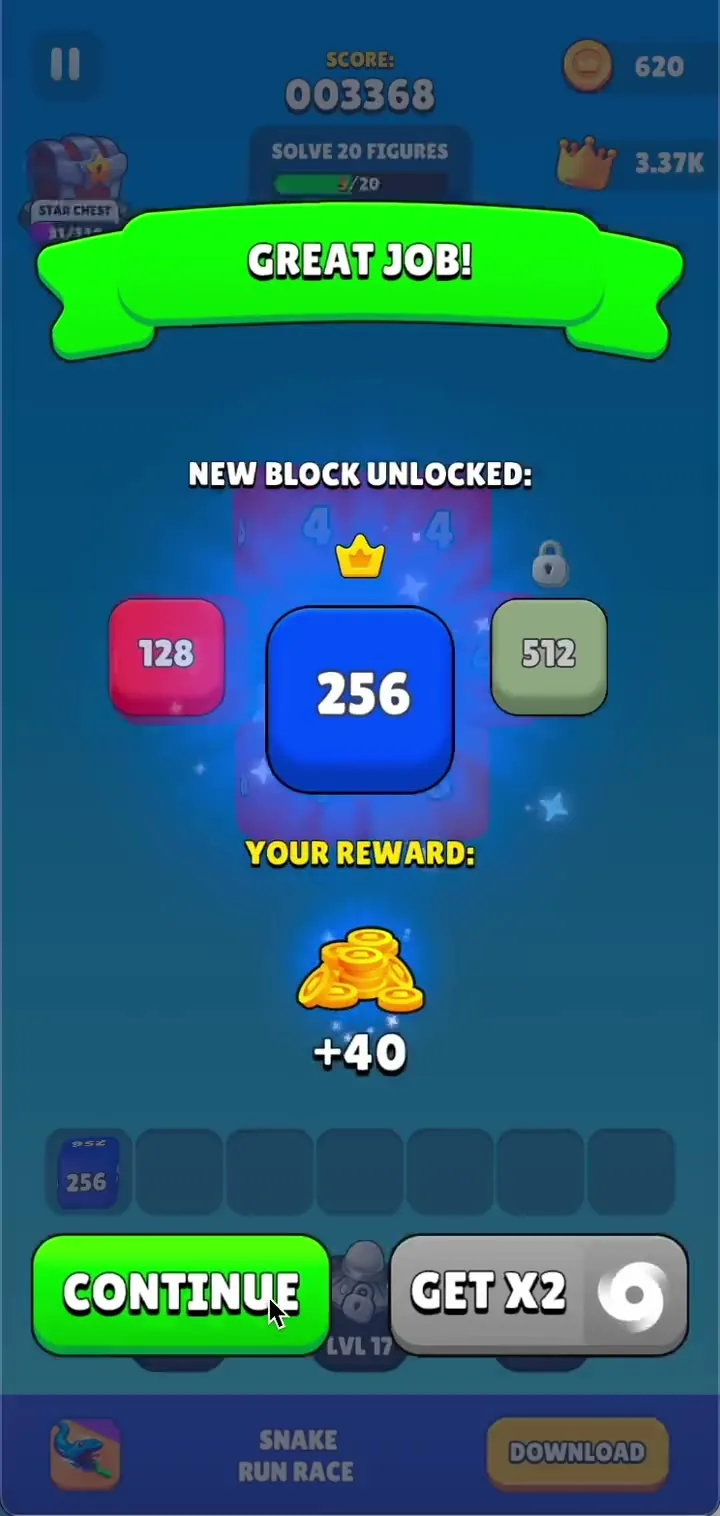
In the ninth figure, a 16 drops in beside 128, 64 and 32 as a +80 popup floats up, and moments later the tray holds a single 256. Making the 256 brings up a “Great Job!” panel that reads “New Block Unlocked,” with the 128 on the left, the new 256 in the center under a crown and a gray-green 512 with a padlock on the right. Under “Your Reward” are a coin pile and +40, along with a green Continue button and a gray Get X2 button. The coin total reads 660 once the tenth figure is in play, and the 256 stays in the tray through the tenth and eleventh figures.
A Star Chest icon at the top left has a counter out of 350 that goes from 0/350 in the first figure to 119/350 by the eleventh, and gold stars fly around the screen after merges. Under the tray sit three dark booster slots with padlocks: a curved arrow marked LVL 11, a flying saucer marked LVL 17 and a gray icon marked LVL 25. By the eleventh figure, the first slot reads LVL 5. A banner ad for another game, with a yellow Download button, runs across the bottom of the screen.
How it rates
The scores, category by category:
| Category | Score | Comments |
|---|---|---|
| Core fun | 9 | Very fun with great handling; clears and chain clears feel great |
| Originality | 9 | A very fresh idea, and very nicely done |
| Art | 9 | Interface and animations both above the market average |
| Overall | 9 | A fresh combination, highly recommended |
The 2048 rules leave the game with two drawbacks for now:
- It can’t be built around levels. A level-based design needs the clearing area to start empty at the beginning of every level, and the 2048 mechanic can’t do that.
- It may not hold players for long, which limits how far the game can go. Without levels, its only pull is chasing a high score and the highest number. Over time, that may cut into how many players keep coming back, which caps the game as a whole.
Even with these problems, this is already a very good new idea, and it leaves room for someone to build on it and find a better answer.
The previous entry in this series: Someone Actually Merged Tile Match With Zuma