2048 Cube 3d Review: Spin the Figure, Merge in the Tray
A 2048 Cube 3d review: numbered cubes leave a turning 3D figure for a seven-slot tray, where equal pairs merge and double, reaching 512 during play.
Game at a glance
2048 Cube 3d:Match Puzzle!
9/ 10
Our score
An ingenious three-way puzzle blend that plays a dimension above other 2048 cube games.
In this article6 sections
Swipe to spin a floating figure of numbered cubes; its cubes leave it one at a time for a row of seven slots below, where any two with the same number fuse into one cube worth double. That loop drives 2048 Cube 3d, a mobile puzzle that belongs with merge games and also borrows the slot row of a triple-tile matching puzzle.
The way it combines a 3D figure and a slot tray with 2048’s doubling is ingenious, and it leaves the rest of the 2048 cube field far behind. After the tutorial, the one goal we played, “SOLVE 20 FIGURES”, shows no level number, so the screen never says whether it counts among the first levels. That goal was about two-thirds done when play ended.
From floating figure to seven-slot tray
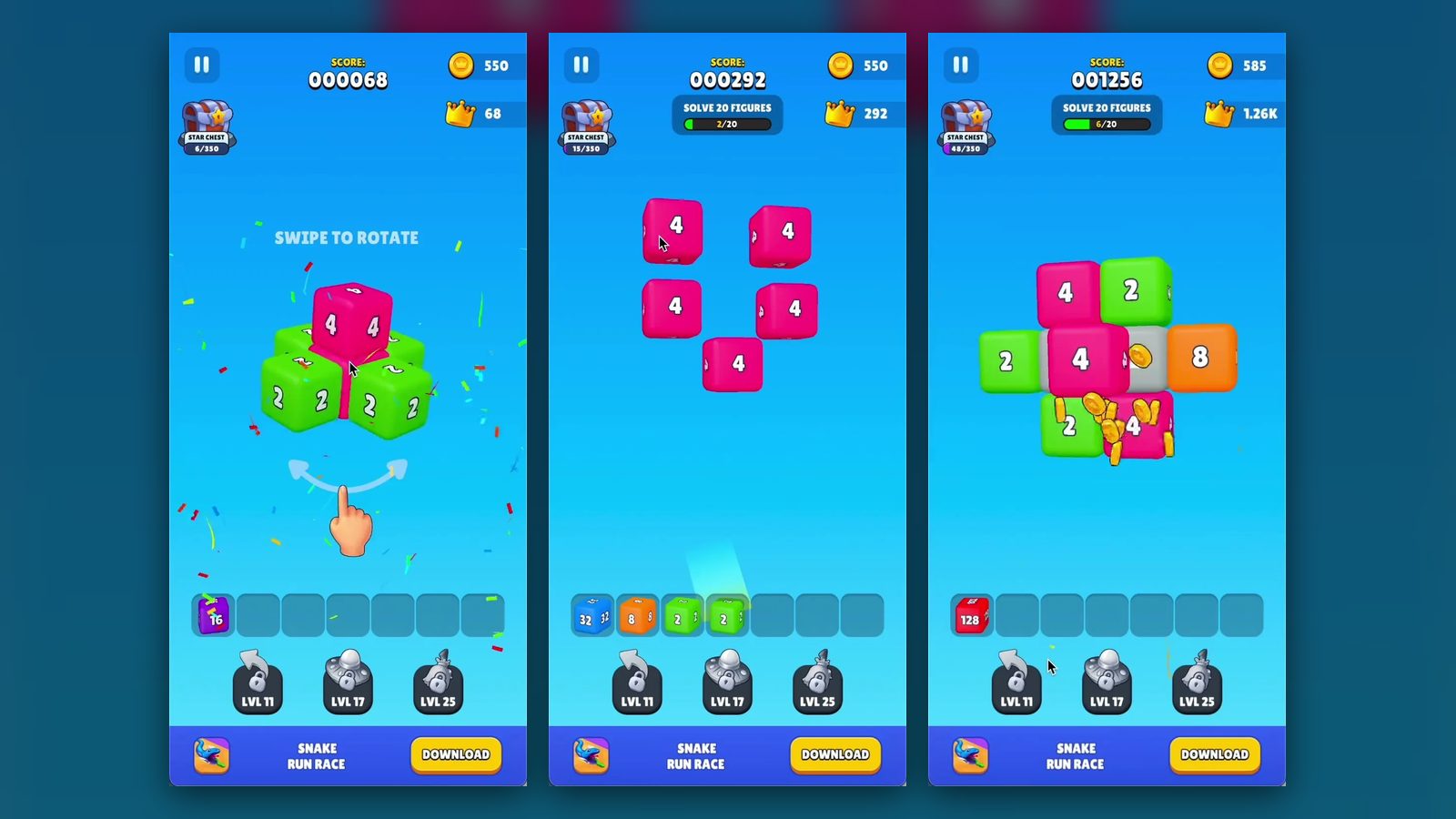
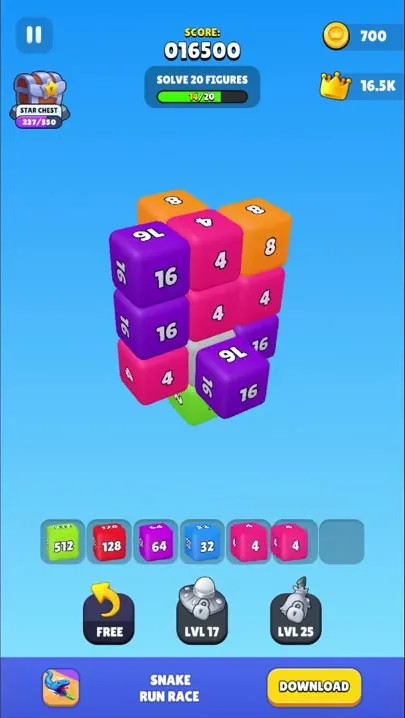
The 2048 Cube 3d gameplay centers on the figure, a 3D cluster of glossy, rounded cubes hanging over a plain sky-blue background, with white numbers printed on several faces of each cube. Cubes leave the figure one by one and fly down into the tray. When two with the same number meet there, they merge into a single cube of double the value, and a white score pop-up such as “+16” or “+48” appears under the goal panel.
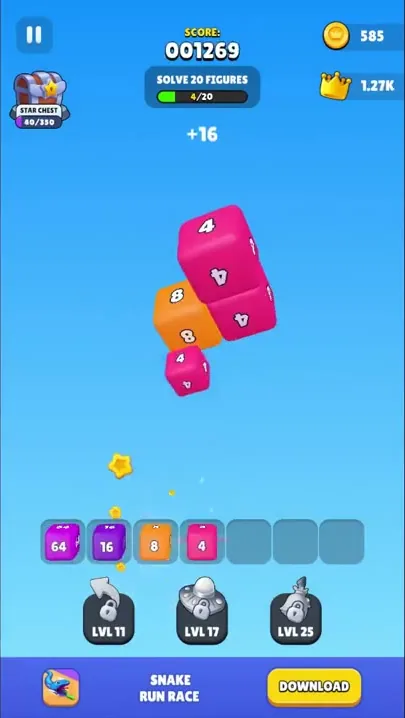
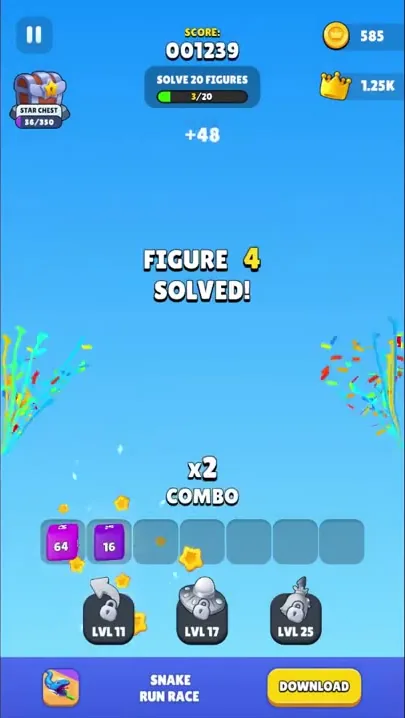
A figure is solved once its last cube is gone. A banner such as “FIGURE 4 SOLVED!” then fills the empty play area while streamers shoot in from both sides, and a fresh figure forms. Whatever sits in the tray carries over: one new figure starts with a 128 already waiting in the first slot. Each solved figure counts toward the goal shown under the score, “SOLVE 20 FIGURES”, and moves its progress bar along.
Swiping turns the figure in 3D, as the “SWIPE TO ROTATE” hint explains, so the same cluster can be seen from different sides. A pause button sits at the top left.
Each value wears its own color. The figures use green for 2, pink for 4 and orange for 8, with purple 16s and light blue 32s among the bigger ones. Cubes made in the tray carry the scale on, from a magenta 64 and a red 128 to a dark blue 256 and a lime green 512.
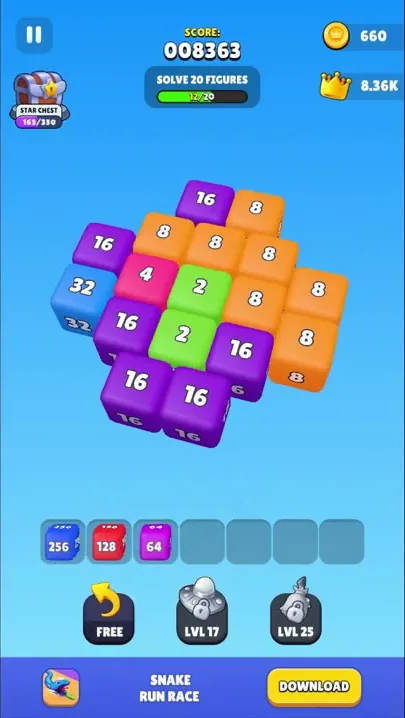
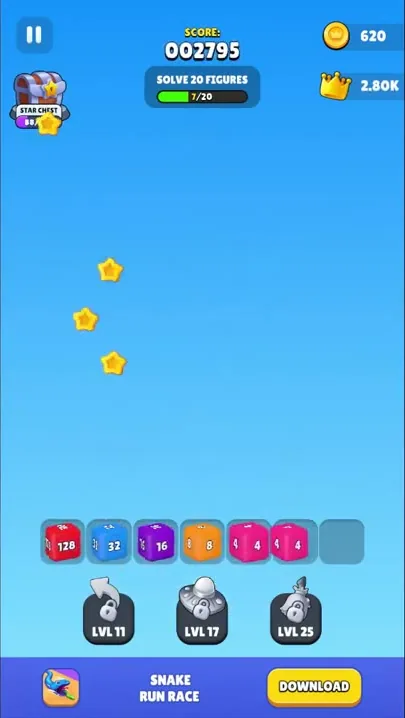
The tray is a row of seven evenly spaced slots and the only limit on screen, since no timer or move counter ever appears. Whenever it is visible, its cubes run from the highest value on the left to the lowest on the right.
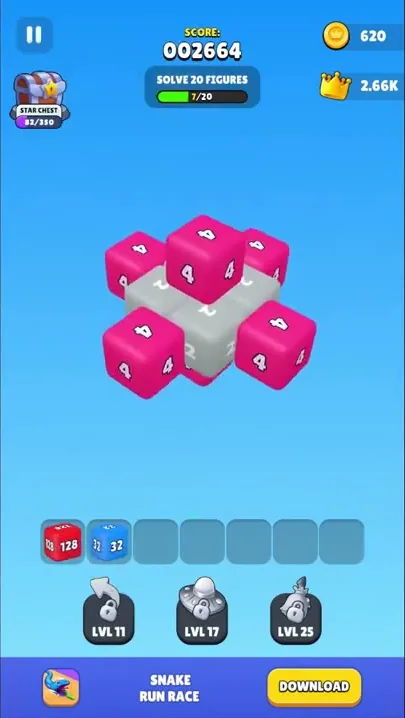
Merges can set off a chain. Partway through the goal, a tray holding only a 128 and a 32 fills to six of its seven slots, stepping down from the 128 to a pair of 4s on the right. Moments later it is down to three cubes, with a 64 now beside the 128 and a lone 2 after them: the 4s merged into an 8, and the doubling ran up the row from there.
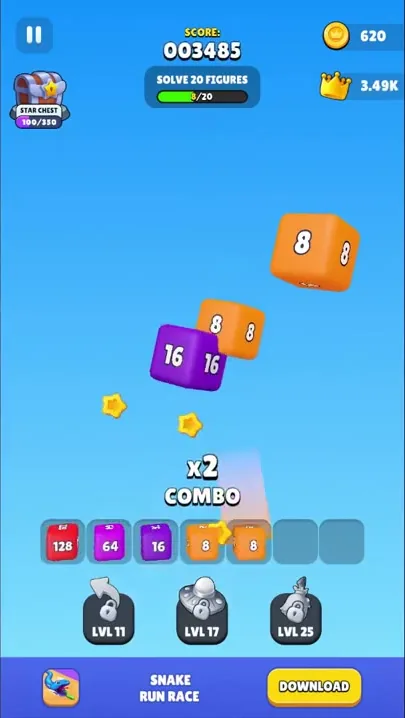
When merges go off, an “x2 COMBO” label can pop up just above the tray. It shows, for instance, while two orange 8s sit side by side at the end of the row with more cubes still in the air. We only ever saw it read x2.
Some figures arrive with gray cubes in them, their numbers only faintly marked. One has a gray core with pink 4s around it. A large figure shows a gray center when it first appears, and shortly afterward a pink 4 and two green 2s sit there in full color.
Bigger figures and a climb toward 1024
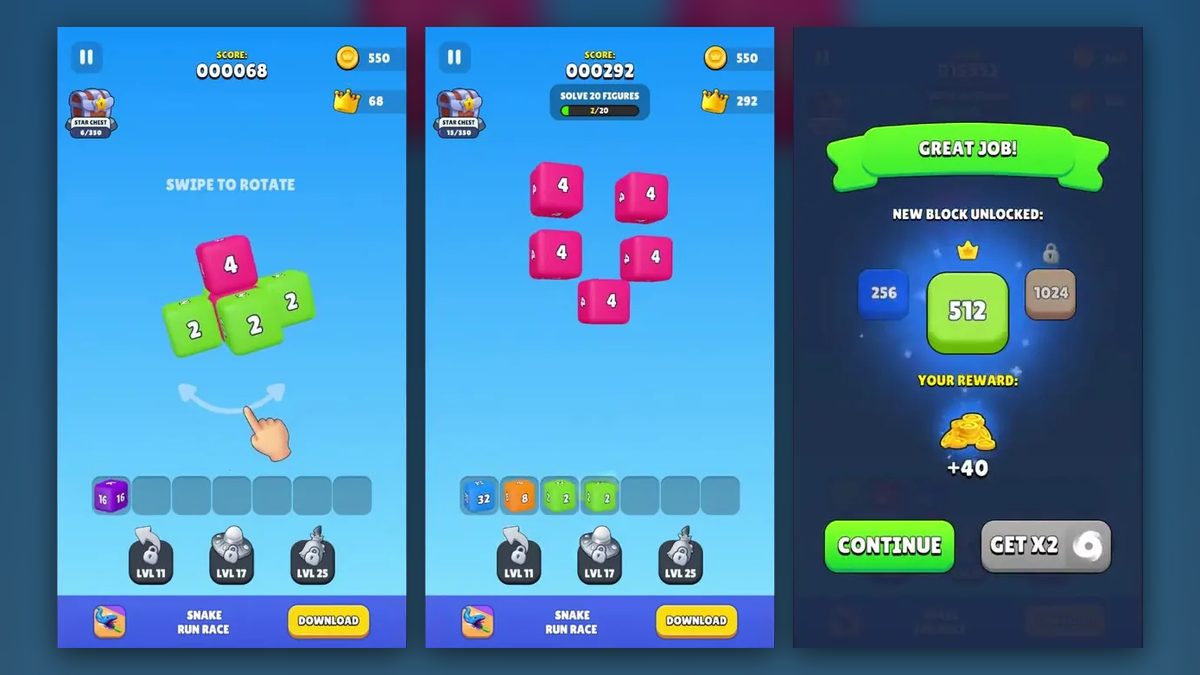
The game opens with a short tutorial. A hand under a curved, two-headed arrow demonstrates the swipe, and then “TRY IT YOURSELF!” appears over a small figure of two 4s and a 2. No goal panel shows yet, and all three booster slots under the tray carry padlocks.
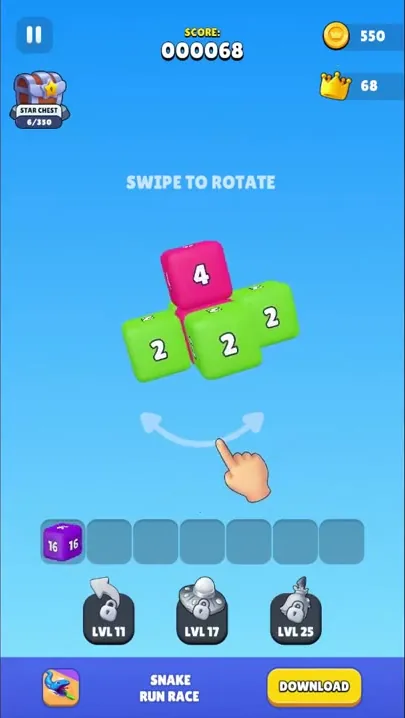
The goal panel turns up once the tutorial is over, first across the figure and then in its regular place under the six-digit score at the top center. From then on it tracks every solved figure.
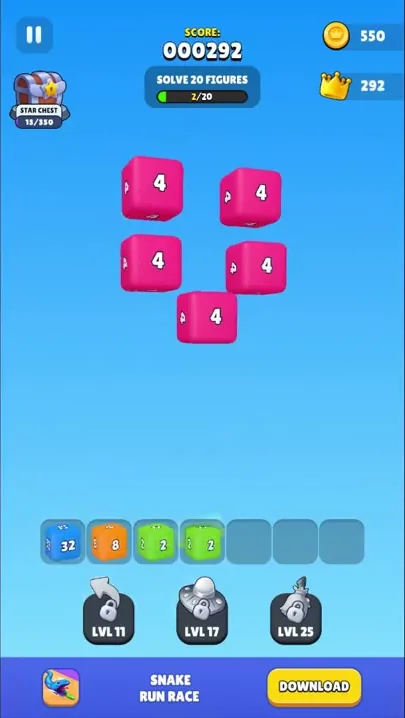
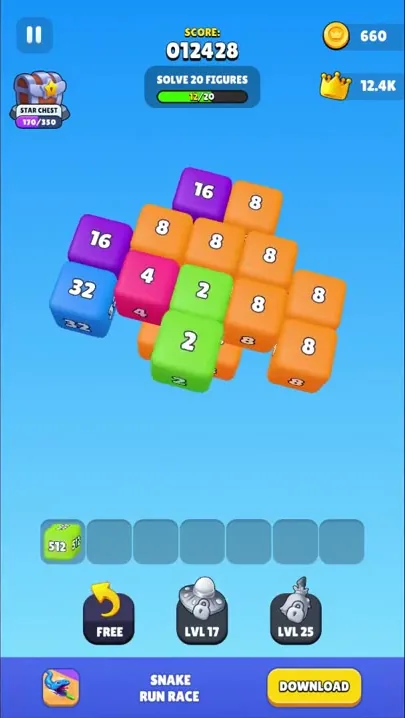
Figures grow as the goal goes on. Early ones are small, like five pink 4s or a cross of green 2s, while later ones become wide slabs and tall blocks. The values inside them climb as well: the first figures hold only 2s and 4s, then an 8 turns up, followed by 16s and eventually a 32.
The highest cube in the tray rises alongside, doubling from a 16 during the tutorial to a lime green 512 well into the goal. At one point that 512 sits alone in the first slot with the rest of the tray empty.
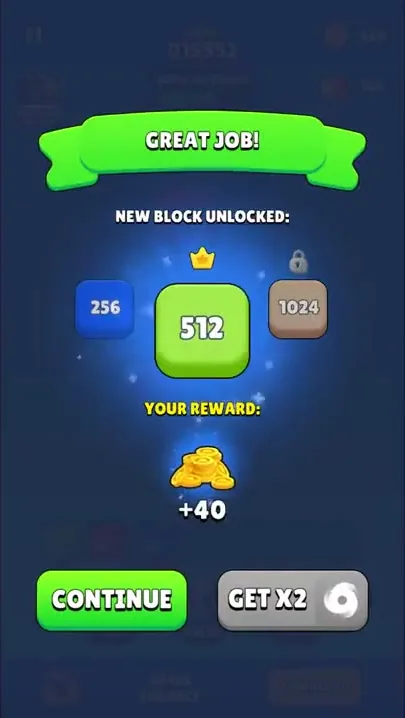
Reaching the 64, and later the 512, opens a “NEW BLOCK UNLOCKED” pop-up over the dimmed game. A green “GREAT JOB!” ribbon heads it, and the new block glows under a small crown while the next one waits dimmed behind a padlock: a 128 after the 64, a 1024 after the 512, with the 256 also shown on the left the second time. Under “YOUR REWARD:” sits a pile of coins, +35 the first time and +40 the second, above a green “CONTINUE” button and a gray “GET X2” button with a round icon.
Coins collect in a counter at the top right. The reward panels feed it, and coins reach it during play as well: a stack floats up to the counter as one new figure forms, and later a burst of coins scatters over a figure. Nothing was bought with coins during play.
Three booster slots sit under the tray, all padlocked and all with silver icons at first: the first a curved arrow over “LVL 11”, the other two over “LVL 17” and “LVL 25”. Partway into the goal the first label changes to “LVL 5”, and soon after, that slot shows a yellow curved arrow marked “FREE”, which it keeps to the end. The other two stay locked, and no booster is used.
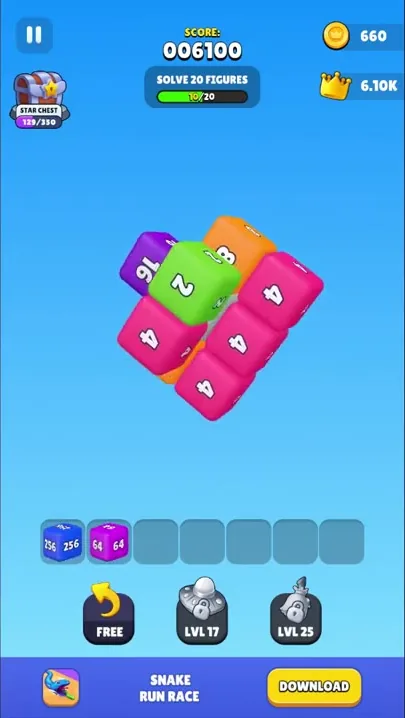
Under the pause button, a “STAR CHEST” icon counts toward 350. Merges throw off small yellow stars that fly up to it, and its counter climbs steadily, though the chest never opens. A crown icon below the coin counter carries a number that keeps pace with the score, shortened with a K once it runs into the thousands.
A banner along the bottom of every gameplay screen advertises another game, “SNAKE RUN RACE”, with its icon and a yellow “DOWNLOAD” button. It stays in place, dimmed, under the reward panel, and no other ad showed up during play.
A turning figure feeding a doubling tray
2048 Cube 3d combines three ideas, and the fusion is clever while still making sense. The spinning figure is the 3D cube puzzle in the mix. The slot row comes from triple-tile matching, except that a pair is enough to merge here where those games wait for three, and the doubling is pure 2048.
The mix wowed us from the first look, and the way its three parts react to one another looks promising. In one stretch late in the goal, with a tall block of 16s and 4s still overhead, the tray reaches six full slots; soon after, merges have cut it down to a 512 and a 256.
Set against other 2048 cube games, it plays in a league above them. Here the doubling is one layer of three, sharing the screen with the turning figure and the seven-slot tray.
The loop also looks ready to serve as the core of a deeper, midcore game with more systems wrapped around it. For now, the layers around it are the coin counter and the Star Chest, plus booster slots and block rewards.
The seventh slot and the unopened chest
We have no criticism to make of 2048 Cube 3d. Several of its parts simply never came into play. We never saw the tray hold more than six cubes, and no fail screen or warning appeared.
The “FREE” booster was never used, and the two locked ones never opened. The Star Chest stayed shut as well, and the “GET X2” button on the reward panel was never pressed. The goal itself ended unfinished.
Turning shapes and chasing bigger numbers
The play is spatial and numerical at once: you spin a cluster of cubes to see it from every side while the tray below keeps doubling pairs. The 2048 climb toward a new highest number is here as well, and reaching one can trigger its own “NEW BLOCK UNLOCKED” pop-up.
Fans of triple-tile matching puzzles will recognize the short row of slots under the puzzle. The figures, which grow from a handful of cubes into tall blocks, give anyone who likes turning objects over in 3D something to work through.
Verdict
Rotation, a row of slots and 2048’s number chase share a single loop, and the join is smart without ever looking forced. Within its niche, it sits a class above the rest. Its core could be lifted straight into a deeper, midcore game, with more systems built around it.