Austin's Odyssey Review: Clear Sand, Then Lift the Fog
An Austin's Odyssey review: clear tan sand from match-3 boards, then spend blue energy drops cutting brush on a fog-covered island.
Game at a glance
Austin's Odyssey
8.5/ 10
Our score
Looks like a match-3 giant quietly pairing its boards with island exploration.
In this article6 sections
Match gems and goblets until the tan sand under them is gone, then head back out to a fog-covered island and spend blue energy drops hacking through brush. That back-and-forth is Austin’s Odyssey, a mashup of portrait match 3 games and Klondike-style exploration, the kind where energy goes into uncovering a fogged map. The setting is a tropical island, and the hero is Austin, an explorer in a wide-brimmed hat.
We played Levels 1 and 2, along with the island clearing around them. The levels and art style feel very seasoned and mature, as does the animation. Along with the hero’s name and the developer listing, they lead us to suspect that a major match-3 studio is quietly behind the game. The overall mark is high.
Sand on the board, brush on the island
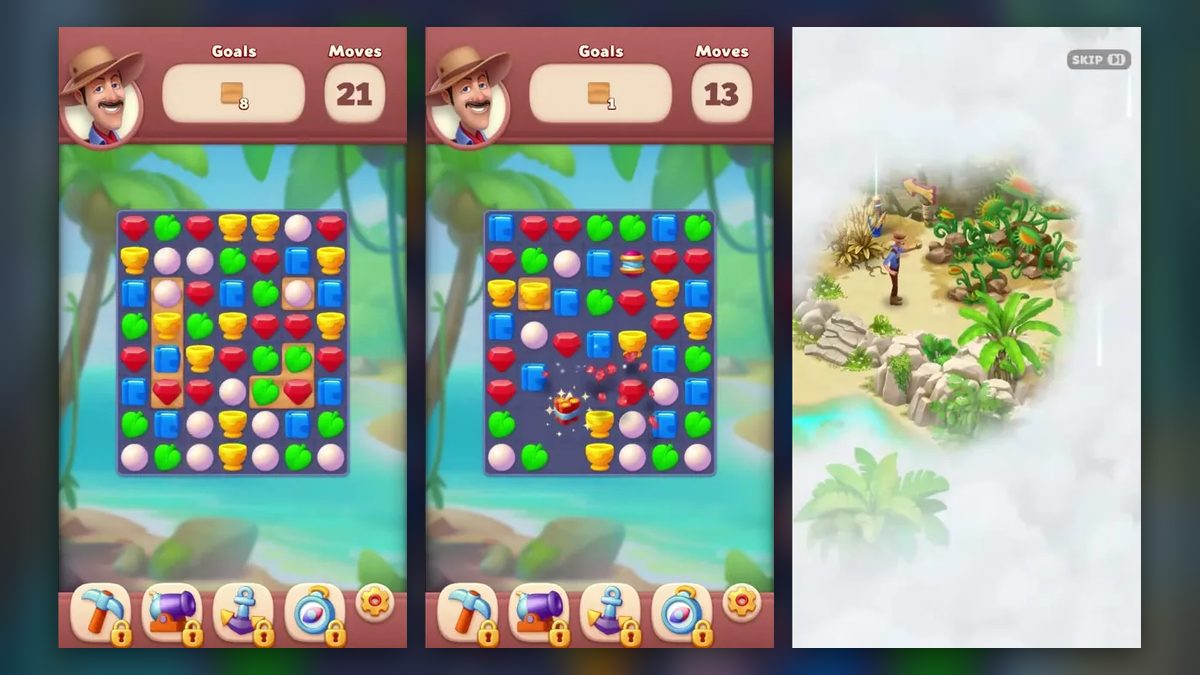
Both levels share one goal: clear the sand. Level 1 introduces it with a tutorial that dims the grid except for a tan block in the middle, while Austin’s portrait appears at the top with the line “Clear the SAND to win the level!” After that, a Goals card at the top of the screen shows a sand icon with the number of tiles left, and a Moves card beside it shows how many moves remain.
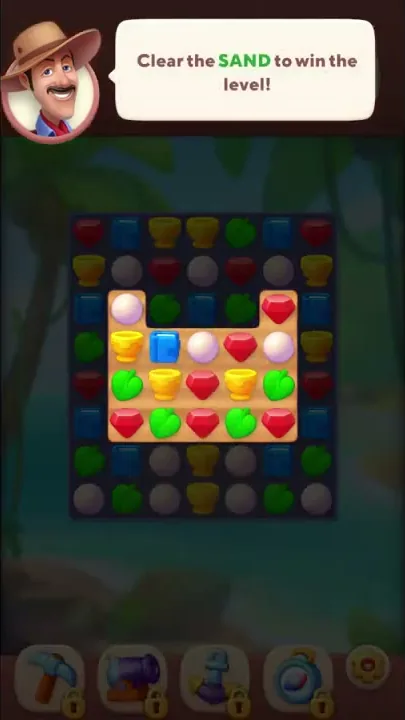
Sand is a layer of tan tiles under the pieces. Matches made on those tiles turn them back to the board’s normal dark color, and the Goals counter drops. When Level 1’s tutorial closed, 8 sand tiles were left: four stacked in the second column from the left and the rest on the right side. With 21 moves on the card, the count fell to 3 with 18 moves left, then to 1 with 15 left, before the last tile went and the Goals card gave way to a reward.
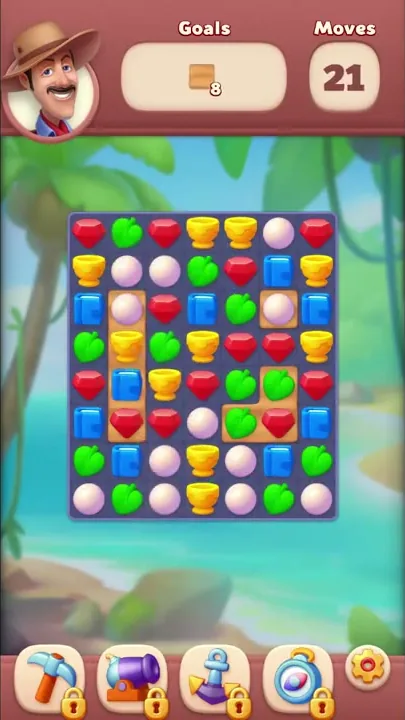
Pieces come in five types: red gems, green leaves, yellow goblets, blue cubes and white pearls. As matches are made, pieces change places across the grid and the tan patches shrink. Both levels were started from the island with a big green Level button at the bottom left; before Level 1 it led through a blurred painting of a beach to the grid. Story scenes come with a SKIP button at the top right, and a treasure-map scene waits on “Tap to continue.”
The two screens take turns: on the island, overgrown spots carry bubbles with a blue-drop energy cost, and Austin clears them to uncover more land, along with coins and story scenes. Clearing drains the energy counter at the top of the island screen; before Level 1 it ran down to 0, and the next stop was the Level button. After both boards, blue drop icons streamed across the island and the counter was higher again. From there the clearing resumes, and that alternation is what Austin’s Odyssey gameplay comes down to.
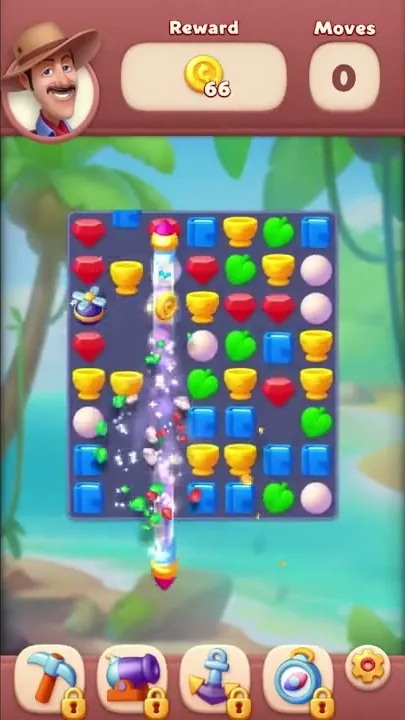
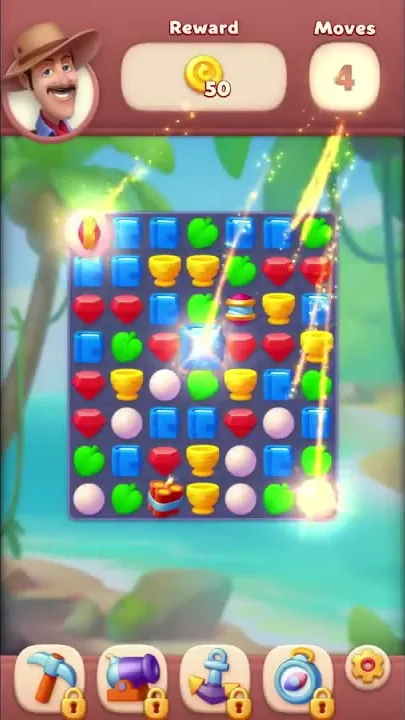
Special pieces also turn up on the board. Multicolored, striped rocket-like pieces appeared in both levels, one with horizontal stripes in Level 1 and one with vertical stripes in Level 2. Each level also showed a beam of light running the full length of one column, with a rocket-shaped piece flying out below the board and the pieces in that column breaking up.
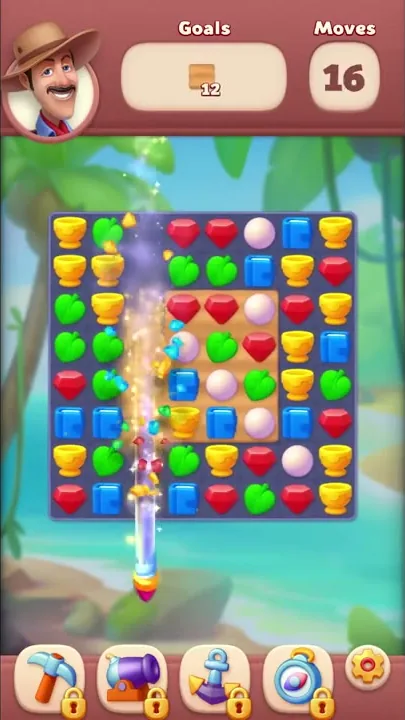
Another special piece looks like a bundle of dynamite: red, with a yellow band. It appeared among sparkles in the lower middle of the Level 1 board and later sat in the bottom row as the level wrapped up.
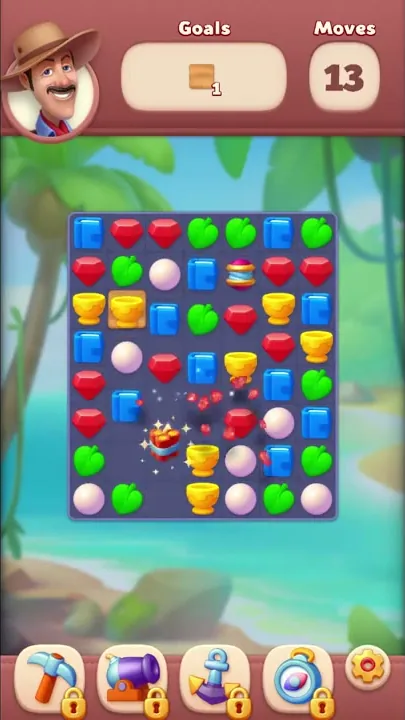
A third looks like a small propeller, a purple dome with light-blue blades. It sat in the left column during Level 1’s closing reward sequence while a rocket fired down another column.
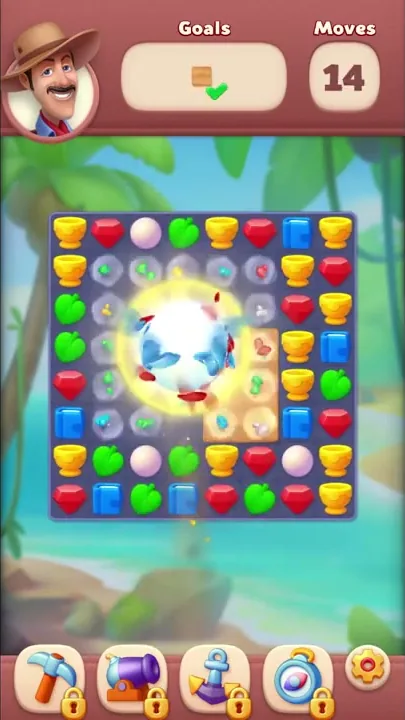
As Level 2’s sand goal took its green check mark, a large white-and-blue burst filled the middle of the board. The cells around it emptied and turned gray.
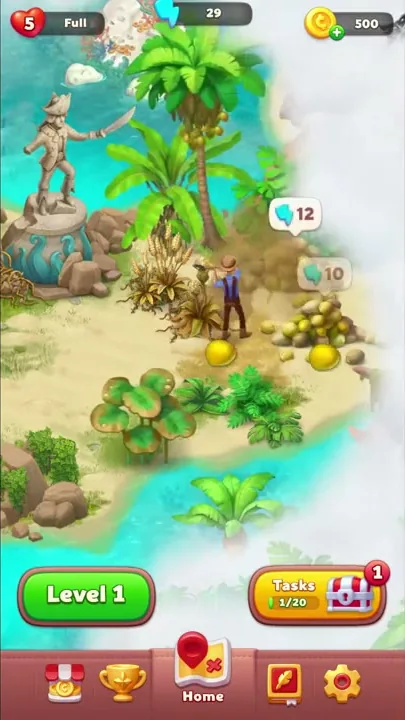
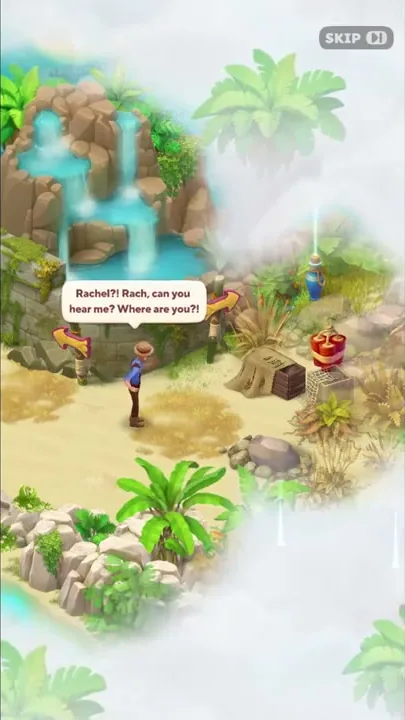
Out on the island, the obstacles range from dry bushes to snapping carnivorous plants, and they carry white bubbles showing a blue drop and an energy cost. Austin works at them with a tool, and brown dust clouds rise as they are cleared. Gold coins land on the sand, and one coin burst showed +20. Some cost numbers are dark gray and others red.
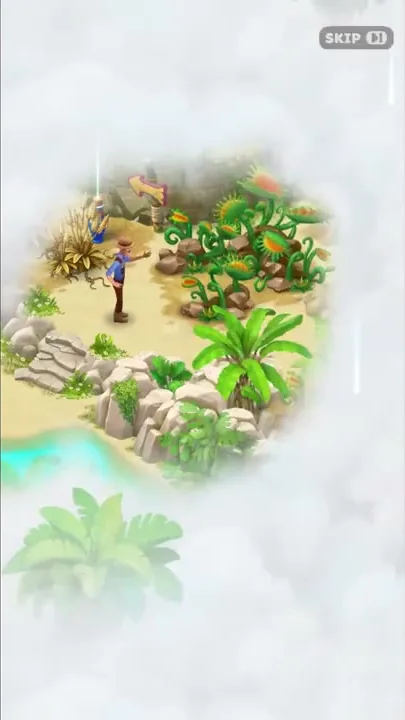
Thick white clouds cover most of the island, leaving only the ground around cleared spots in view. Story scenes open the fog in a ring around newly revealed ground, such as a patch of jungle where large carnivorous plants grow beside the path.
Small piles of gold sit near the edge of the explored ground, each marked by a vertical beam of light. One showed up near the bottom of the screen once the island button read Level 3, below Austin and some crates.
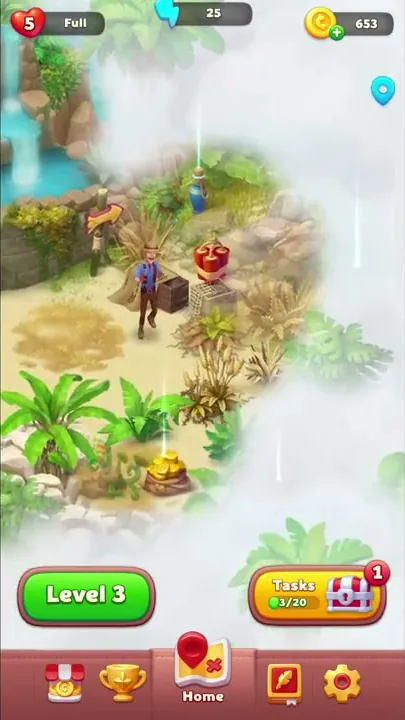
A wider board and a story behind the fog
The board changed shape between the two levels, while the pieces stayed the same five types. Level 1 used a grid seven columns wide and eight rows tall, and the sand left after its tutorial was a column of four plus a few tiles on the right. The second board is eight by eight and opens with one solid 5-by-5 square of sand, from the second to the sixth column and the third to the seventh row: 25 tiles to clear with 22 moves on the card. That goal took its check mark with 14 moves still left.
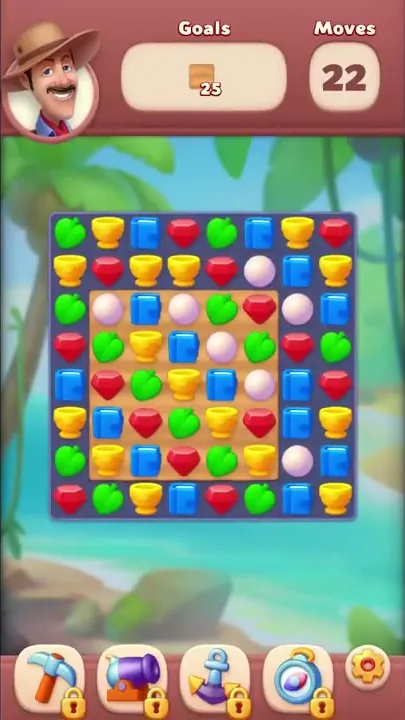
The island tells a story as it opens up. Before the first board, cutscenes pan past a stone pirate statue raising a sword and a white boat run aground beside the beach, and a drawn hand traces a red route across a parchment treasure map. Austin’s portrait then appears with a line about someone named Rachel: “I hope there are no pirates around… But knowing Rachel, she’s probably taken care of them already. Poor pirates.”
The island button moved from Level 1 to Level 2 to Level 3 as the boards were won, and the ground cleared in between led into new scenes. After the first board, Austin comes upon a bed of carnivorous plants and says, “Great! Of all the things I brought, no plant repellent!” He follows it with a note to self about bringing the “How to Survive Botanical Beasts” manual next time.
A pan across a pirate camp with a black flag and barrels near a waterfall comes next. After the second board, a bubble shouts “AUSTIN!” and Austin answers from beside a waterfall: “Rachel?! Rach, can you hear me? Where are you?!”
Once Level 1’s sand was gone, a short reward sequence ran on the board. The Goals card turned into a Reward card with a coin icon and a climbing number. The leftover moves counted down to 0 as golden light streaks flew from the Moves box onto the grid and special pieces went off.
Three readouts run along the top of the island screen. At the left, a red heart shows 5 next to the word “Full.” The energy counter with its blue drop sits in the middle, and at the right is a gold coin counter with a green plus button. Coins drop from cleared obstacles, and the end-of-level reward is counted in coins too.
A yellow Tasks button at the bottom right carries a red-and-white chest and a progress count out of 20, sometimes with a red 1 badge. Task cards pop up above it, “Explore the island” early on and “Follow the voice” after the second board, and the count climbed from 0/20 to 3/20 by the time the button beside it read Level 3.
Under both boards sit four booster slots, each with a padlock. They show a pickaxe and hammer, a purple cannon, an anchor and a blue compass-like device, with a gear button at the end of the row. Back on the island, a bar of five icons runs along the bottom: a stall with a coin, a gold trophy, a map with a red pin labeled Home, a red book with a quill, and a gear.
Rocket trails and a painted pirate island
The levels, the art style and the animation all come across as very practiced and mature. The island is drawn from an angled overhead view in a detailed, painted 3D style, with cutscenes panning across it.
On the boards, a rocket drags a trail of light down a column, and a white-and-blue burst filled the middle as Level 2’s goal was checked off. Once Level 1 was won, golden streaks poured from the Moves box onto the grid.
That maturity, along with a hero named Austin and a developer listing that looks like a front for another company, is why we suspect Austin’s Odyssey is a new Playrix game released quietly, ahead of any announcement.
If that suspicion is right, Playrix is quietly exploring how matching and clearing can be combined with other kinds of play, and may even be hunting for a new core loop in another game at the same time, one built on merge-to-upgrade with two or three matching items. Here the mashup is plain to see: the Level button sits on the island map, the same screen where Austin spends energy on brush.
A match-3 heavyweight moving this way says two things. The rise of Klondike-style games in the market cannot be reversed, and the giant itself has a restless ambition to reach beyond match-3.
Locked boosters and icons left unopened
We had no criticism of Austin’s Odyssey. A few parts of it stayed out of view, though: we can’t say what the red dynamite piece or the purple propeller does, or what the four locked boosters are for. The bottom-bar screens and the Tasks chest also stayed closed, leaving open whether the coin stall is a shop, what the tasks pay out and whether a lost level costs a heart.
Matching sand, then spending energy on brush
On the board side, Austin’s Odyssey sits with games like Royal Match as portrait match-3 built around a move limit, and the work is getting matches onto the tan sand while the Moves counter ticks down beside the goal. That fits a taste for chasing a single target tracked by one number.
The island half asks for a different habit: spending energy on the next cost bubble and watching the fog pull back to reveal more ground and the next story scene. Between clearings, Austin talks to himself about pirates and plant repellent, and the task list points him toward the voice calling his name. That side fits a taste for uncovering a map piece by piece with a story attached.
Verdict
The editors rate Austin’s Odyssey highly, for craft that reads like the work of a studio long practiced at match-3 and for a mashup that hints at where the genre’s giants want to go. It also leaves an open question: can a match-3 giant carry its complete, mature way of making games over to other kinds of play? Whether it can stands for two things at once: the established casual companies’ ambition to expand, and an opportunity for the studios taking their games to markets abroad.