Da Vinci Legends Match-3 Game Review: Leonardo's Florence
A Da Vinci Legends Match-3 Game review: marble busts hide under gold-framed tiles, and Leonardo hands out quests on a painted map of Florence.
Game at a glance
Da Vinci Legends Match-3 Game
8/ 10
Our score
A niche setting, carried all the way through, can make the whole game feel excellent.
In this article6 sections
Da Vinci Legends Match-3 Game is built on the rules of match 3 games on mobile: groups of matching pieces clear off a shaped board while a moves counter runs down, all of it dressed in Leonardo’s world. Leonardo da Vinci talks with Lisa del Giocondo and Cecilia Gallerani between levels, which are reached from a painted map of 16th-century Florence. Every goal lies buried under framed tiles: a chest at first, marble busts after that.
We played three levels, joining the first one partway through. The Leonardo dressing and the art style of its characters match the systems built around the boards, and we liked the result a lot.
Framed tiles with busts buried underneath
Each level names its target in a paper scroll at the top left of the screen: a single chest on the first board, then a count of busts. A banner at the top center counts the remaining moves down, and no timer appears anywhere. When the target is met, the number in the scroll gives way to a green tick.
The board never draws a finger or an arrow to show how a match is made. The prompts that do appear ask for taps: “Tap to skip” during the end-of-level bonus, and “Tap a tile to remove the pieces around it.” when a booster slot lights up. A pointing hand on the map marks the Villa and later its “Visit” button, and dialogue scenes have a fast-forward button as well as a close button.
Da Vinci Legends Match-3 Game gameplay follows one loop. Matches clear pieces, and a match made on a framed tile strips its border away; whatever lies under the framed tiles rises off the board once uncovered and counts toward the scroll. A finished goal leads to a results panel that pays out rewards, then back to the map, where another visit to the Villa opens the next level.
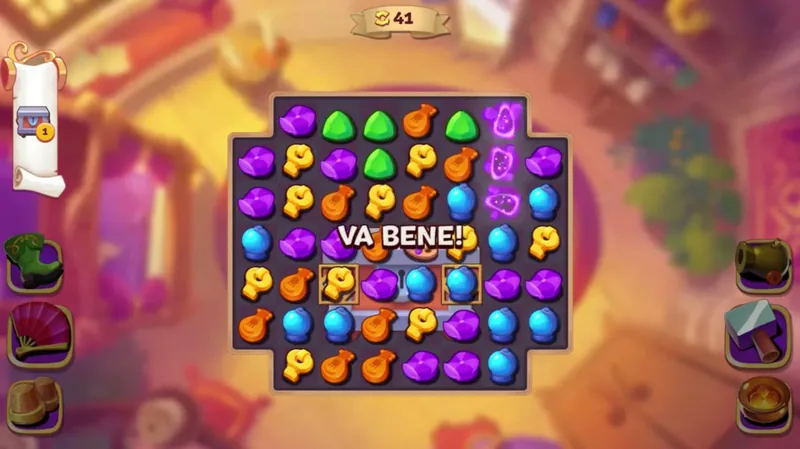
Framed tiles appear on every board. Partway through the first, a block of wooden-framed cells two rows deep and four columns wide sits just below the middle. Matches chip it down to the two framed cells at its lower corners while a silver-and-red chest shows through the gap, and the chest then lifts off the board.
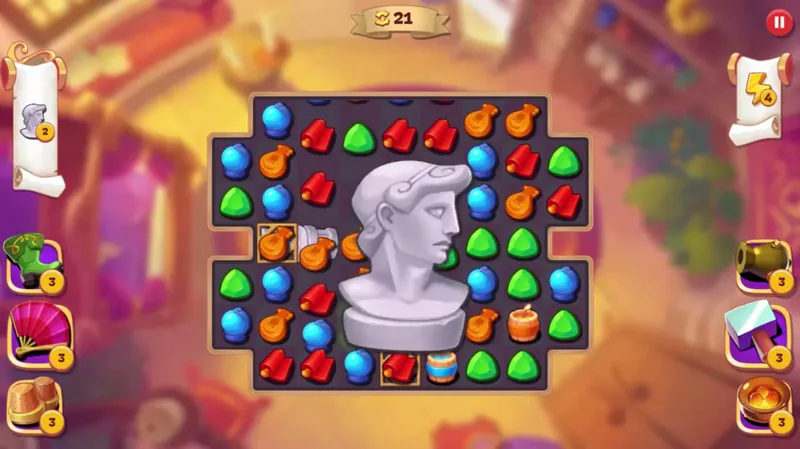
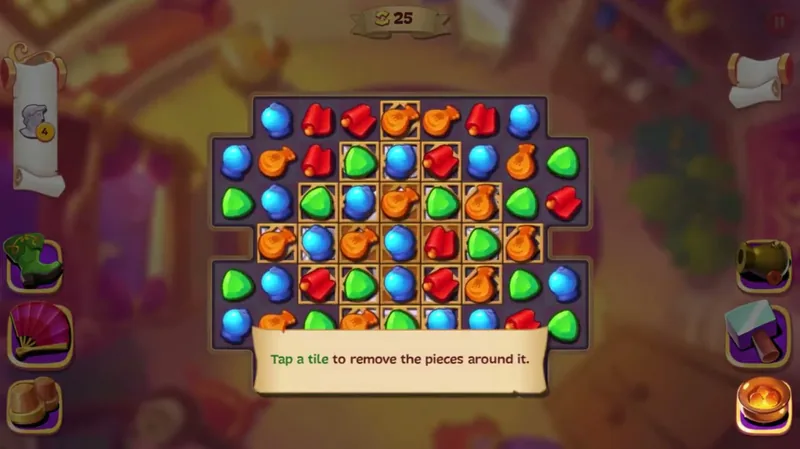
Marble busts take over as the goal from the second board on. Gray-white stone shapes show through some cells once their borders are gone, and white busts rise out of the board and fly off as the count in the scroll falls. On the third board a large gray bust shape is visible beneath the pieces in the center, and the bust that finally rises there is several cells wide.
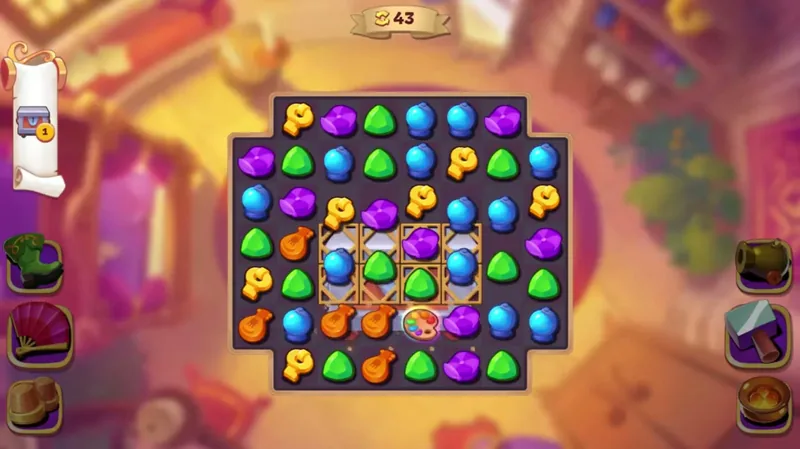
A painter’s palette dotted with color sits in the lower rows of the first board as a special piece. Moments later, green streaks burst from a single point out to green pieces all over the board as “BENISSIMO!” flashes across them.
Capsule pieces have a colored band around the middle and lie either across the board or upright. A horizontal one fires a beam with cone-shaped ends along its entire row.
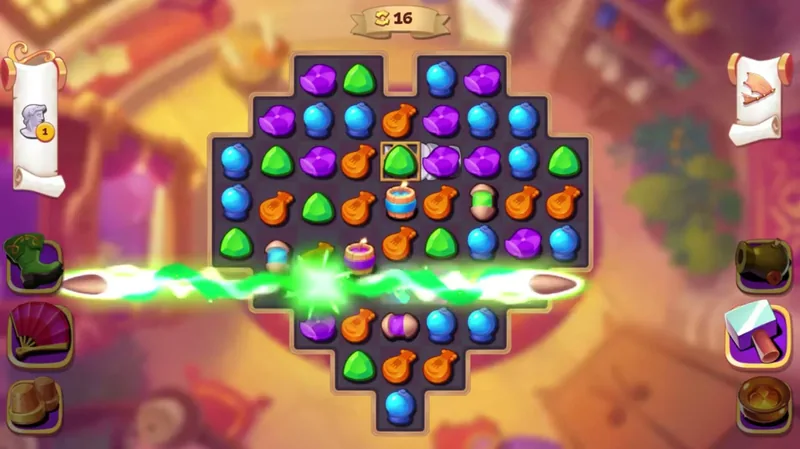
Small wooden barrels with lit fuses, some with a blue or purple band, also turn up among the regular pieces. No barrel is ever seen going off, so what one does is unknown.
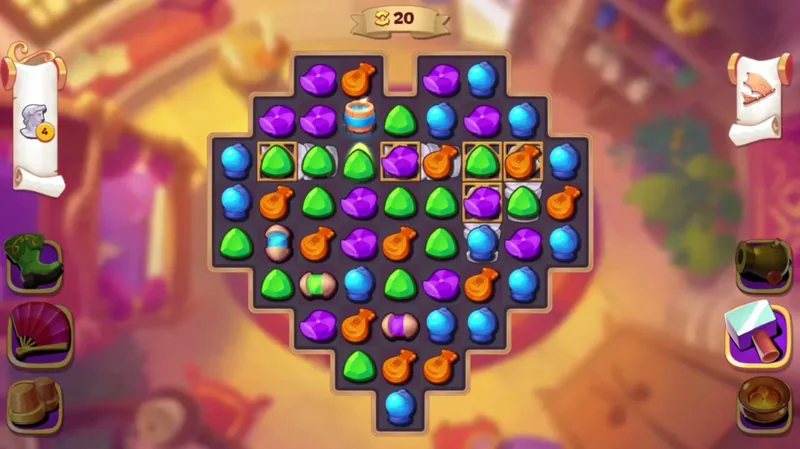
Other effects cross the board too. Yellow lightning bolts and a pink beam shaped like a cross both show up on the third board, while Italian words such as “VA BENE!” flash up after matches.
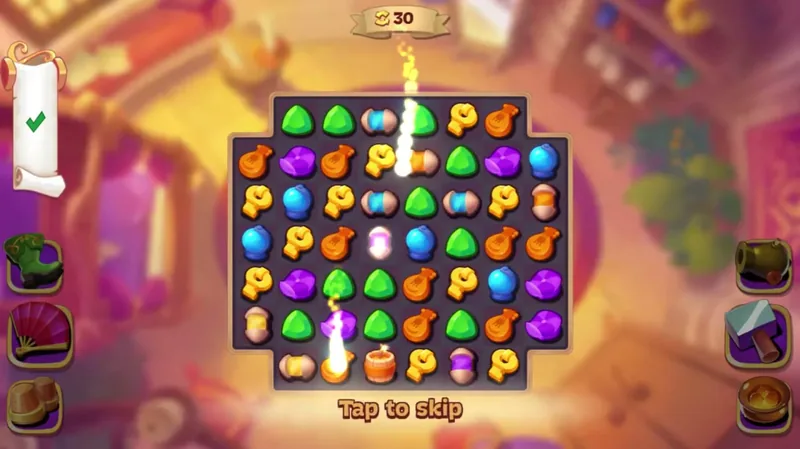
Unused moves are spent for the player. Once the scroll shows its tick, white trails run from the moves counter to pieces on the board and turn them into capsules, with “Tap to skip” waiting below. The counter drains quickly: on the first board it dropped from 39 to 30 within seconds.
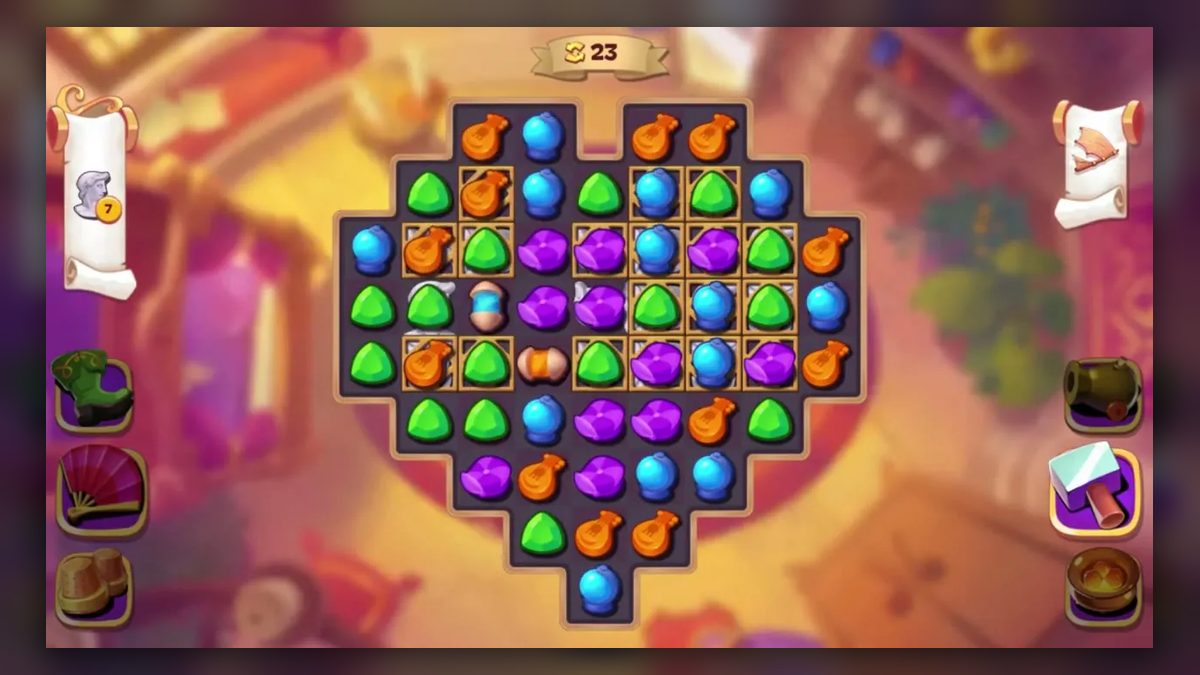
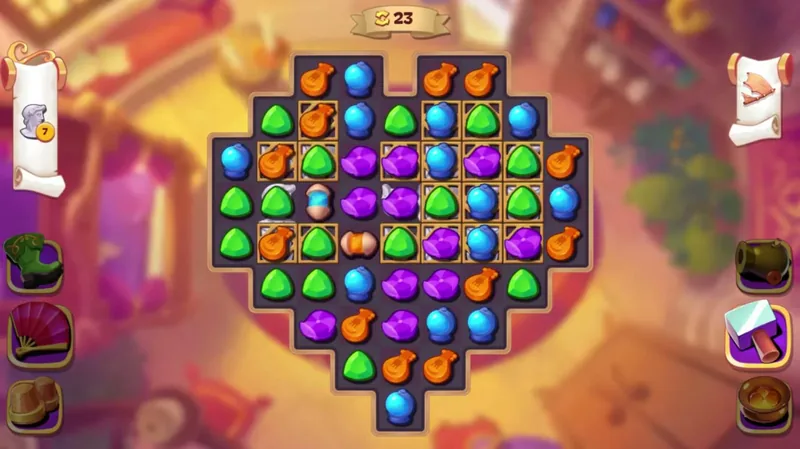
Busts, 9 of them in 25 moves, make up the brief on the heart-shaped second board, where gold-framed tiles cover most of rows two to five. The scroll’s count fell from 9 to 1 as busts surfaced, and an ornithopter wing appeared in the right-hand scroll along the way. The tick arrived with 15 moves still on the banner, and the bonus spent every one of them. The results panel then paid 10 stars and 12 coins, with the wing beside them.
From one chest to a ranked-up Villa
The piece set changes from one board to the next. Five kinds share the first board: purple caps, green gems, blue glass bulbs and orange pouches, plus yellow pieces shaped like hooks. The heart-shaped board drops the yellow ones and keeps the other four, and the third swaps in red folded cloths while losing the purple caps too.
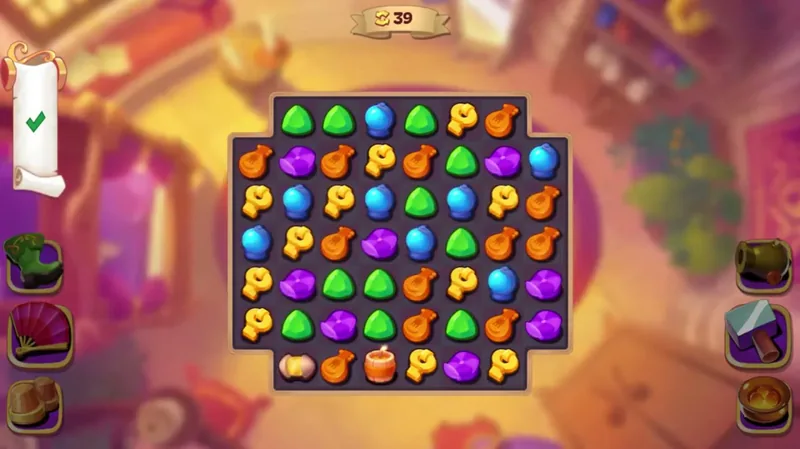
Board shapes change with them. The first is almost rectangular: the rows at its top and bottom are a little narrower than the five between them. Next comes the heart-shaped board, and after it a board with cut corners plus a notch at each end of its middle row. The framed area changes too: a small wooden block on the first board, a wide gold block on the heart, then a diamond of gold-framed tiles in the center of the third.
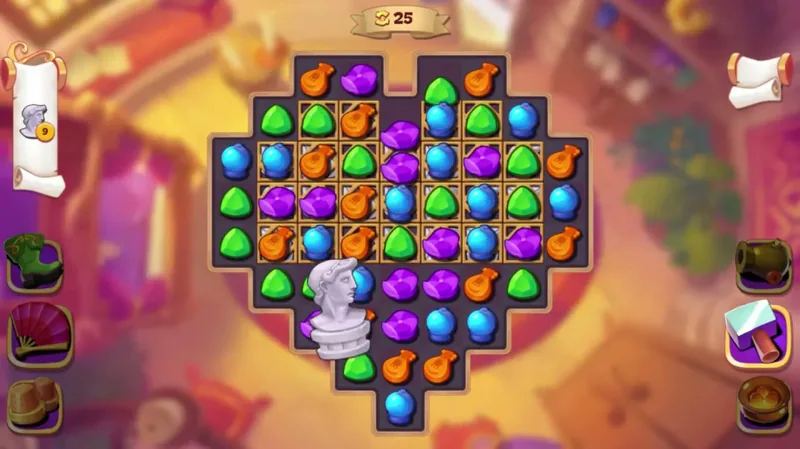
The goals move from a single chest to 9 busts and then to 4; both bust boards start with 25 moves. Before the third board begins, Lisa del Giocondo stands beside a wide banner that reads “Find busts: 4”.
The first tip, the tap prompt quoted earlier, turns up on the third board while the lower-right booster slot, a bowl of glowing coins, lights up. A moment later the booster slots gain counts, and the red pause button at the top right comes out from under the dimmed overlay.
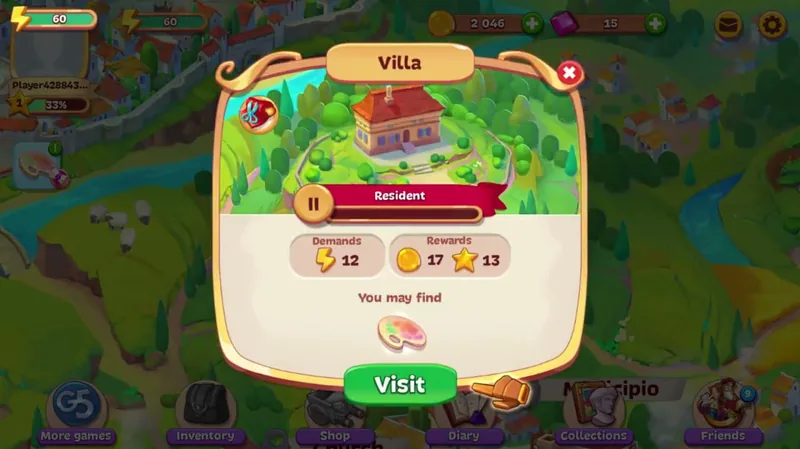
The Villa itself moved up a rank before the third board. Before each visit its panel shows the location’s rank on a bar, then “Demands”, “Rewards” and “You may find” above a “Visit” button. At the first rank, “Guest”, the visit asked for 11 energy and promised 12 coins and 10 stars. At the second, “Resident”, that had become 12 energy for 17 coins and 13 stars, with a palette under “You may find”.
The chest board and the heart-shaped board each ended on a “Villa” panel with the rank bar filling above the rewards and a “Continue” button at the bottom, the first under a “Congratulations!” heading. Both panels showed the Villa at “Guest”, its first rank.
Between levels the game sits on a painted map headed “Florence and Vincetto” and “16th century”. Da Vinci’s Workshop and Piazza della Signoria are marked inside the walled town, and the Villa stands in green countryside beside it. Below the Villa lie the Municipio and the Church; the Contado and the Spanish Garden sit off to the right. Several of these labels carry a padlock with a number, the Municipio’s showing 4.
Six round buttons run along the bottom of the map. “More games” carries a G5 logo, and the rest are labeled Inventory, Shop, Diary, Collections and Friends, the last with a notification badge. Mail and settings icons sit at the top right.
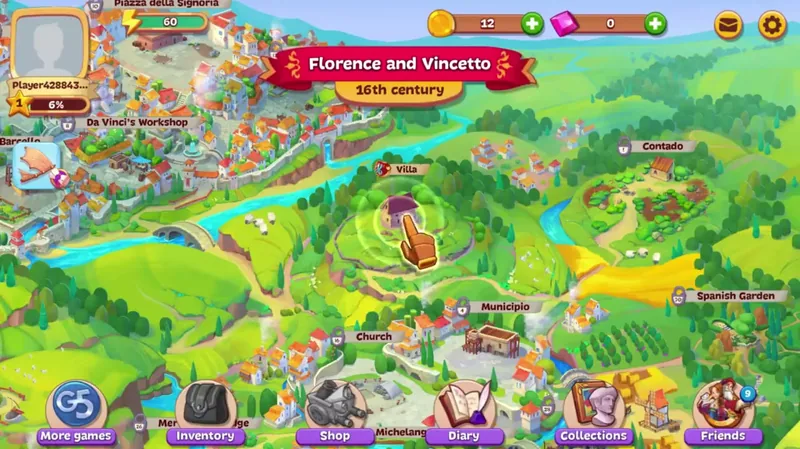
Energy appears as a lightning-bolt meter at the top left of the map, and every Villa visit lists its demand in the same bolts under “Demands”. Coins and pink gems have their own counters at the top, each with a green plus button. Coins arrived as rewards, 12 for each of the first two boards and 22 for the quest. Stars come with every results panel and with the quest, and the player’s profile at the top left shows a star badge beside a percentage bar that climbed as the levels went by, with its biggest jump after the quest reward.
Leonardo hands out the quests. On the map he asks for help sorting through a chest in case his work lies at the bottom, and the quest panel “In the Inventor’s Chest” shows a row of six step markers with the first one ticked. Its task, “Find the Ornithopter Wing.”, carries a tick after the heart-shaped board, and the “Complete” button pays 30 stars and 22 coins. Quest icons sit on the left edge of the map: first the wing, then a palette with a “!” badge.
Items picked up during a level collect in a second scroll at the top right of the board. Besides the wing on the heart-shaped board, it showed a lightning icon marked 4 on the third board, followed by a palette.
Six booster slots flank the board, three to a side. A green boot sits above a red fan on the left, with thimbles below; on the right, a cannon sits over a hammer, with a bowl of glowing coins at the bottom. The first two boards show no counts on them, though the hammer slot wears a glowing border throughout the heart-shaped board, and on the third board each slot shows 3.
“SPECIAL OFFER” and “Check out your reward!” appear on the map after the quest, over a green-and-gold chest set with a pink gem. Shortly afterward, four items sit around the Villa: a pie, potion bottles, a plate of tomato and mozzarella, and a barrel topped with a crystal.
Short story scenes run between the boards. The first puts Lisa del Giocondo and Leonardo da Vinci in front of a villa, with a woman carrying a white animal on her shoulder beside Lisa. Cecilia Gallerani later speaks up on the map to tell Leonardo that everything he needs for his work is at the bank, and Lisa del Giocondo introduces the third board’s goal and reappears when it is cleared. No ad played at any point, including the gaps between levels.
Renaissance dressing from map to board
A Leonardo da Vinci setting is not a mass-market pick, yet it is an interesting angle to start from; the tone is carried all the way through and stays in step with the dressing, so the whole game comes across as excellent. The dressing reaches the board itself, which floats over a blurred, top-down view of a room with a bed and shelves of scrolls, and that room comes into focus as the board fades out. Matches earn Italian praise, and the quest has Leonardo puzzling over why an ornithopter wing he never finished has turned up.
The dressing’s artistic feel and the characters’ art style go together very well with both the systems wrapped around the levels and the clear-the-board puzzling, and the result is strongly artistic. Story scenes set cartoon characters with name plates in front of a Tuscan villa among cypress trees. The map is a painted bird’s-eye view of a walled town with a stone bridge over its river and sheep in the fields. Even the pieces are drawn as objects like caps and pouches.
That art tone felt to us as comfortable to look at as Royal Match, Dream Games’ match-3 blockbuster, did on first sight, which puts the game’s look in the company of other games like royal match. The comparison is about the visuals alone, from the painted map to the room behind the board.
Long-term play and untried boosters
There is no criticism to report. How the game plays over the long run is a question we are leaving aside for now.
A few things also stayed out of view. No booster was clearly put to use, and the screens behind the map buttons stayed closed; their contents and any prices are unknown. The goals were met with 39, 15 and 21 moves to spare, and no out-of-moves screen appeared. Energy refills did not come up either.
Digging up busts between Florence quests
The play here centers on uncovering things. Matches clear framed tiles until a chest or a bust surfaces and lifts away, with a moves counter as the board’s only limit, which suits a taste for watching a hidden shape come into view a few cells at a time.
Away from the board, the player ranks up the Villa and follows short scenes with Leonardo da Vinci and Lisa del Giocondo, ticking off quest steps such as finding the ornithopter wing. That rhythm fits a taste for short story scenes on a map between puzzles and for Renaissance figures drawn in a Western cartoon style.
Verdict
A Renaissance inventor is a niche figure to build a puzzle game around, yet every layer here commits to that choice, from the cartoon cast to the systems wrapped around the boards, and the result is excellent. The art is easy on the eye, and we came away liking it a great deal. Its staying power over the long run is the one question left open.