Fix Phone Puzzle Review: Klotski at a Phone Repair Shop
Two empty cells, a crowd of yellow screw blocks and one red lightning block to slide home: a Fix Phone Puzzle review of Klotski at a repair counter.
Game at a glance
Fix Phone Puzzle
5/ 10
Our score
Klotski as phone repair: a textbook blend of a traditional puzzle and a creative setting.
In this article6 sections
Fix Phone Puzzle is a textbook example of a traditional puzzle blended with a creative setting, and taken as a whole it is a middle-of-the-road game. This mobile game is built on Klotski, the classic sliding-block puzzle in which one large block has to be worked past a crowd of smaller ones. Like the jigsaw puzzle games, it is about getting a piece into exactly the right spot.
Here the board sits inside a customer’s phone, and each solved grid counts as one repair. We played Levels 2 through 5 and left Level 5 unsolved.
Two empty cells and a red lightning block
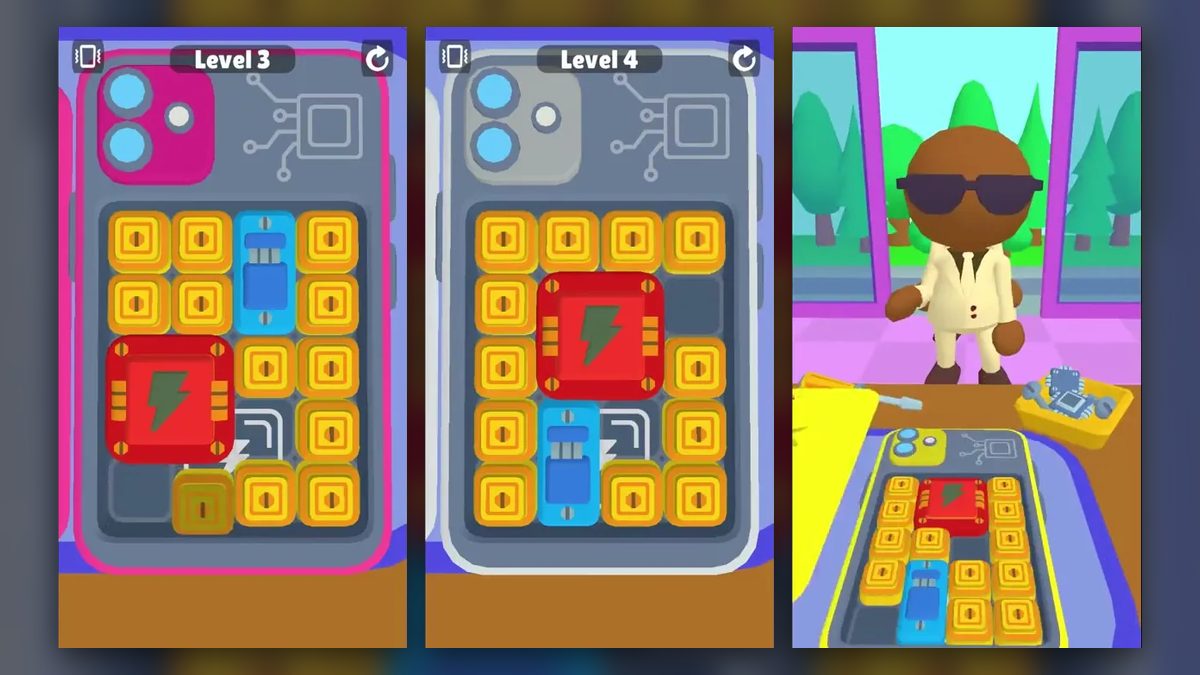
Each puzzle is a grid four columns wide and five rows tall, set into the back of the phone below its camera module. Every cell is taken except two. The goal is to bring the red 2×2 block onto a 2×2 outline at the bottom middle of the grid.
Pieces move one at a time into the empty cells, vertically or sideways, and a moving piece is drawn faded and darker as it passes between cells. The Fix Phone Puzzle gameplay follows from that: shift yellow blocks and the blue piece into the gaps to open a path, then move the red block along it.
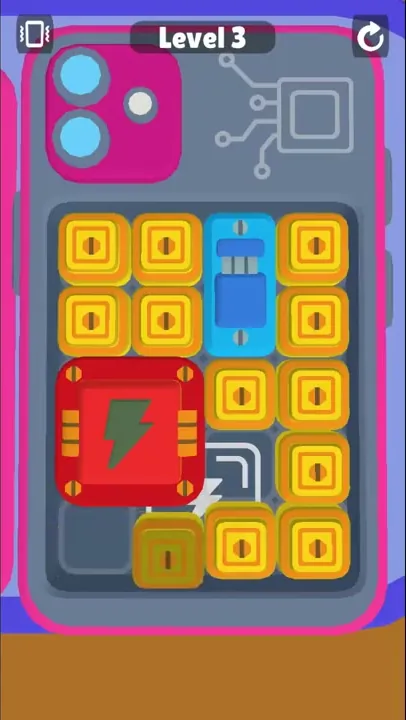
Yellow screw blocks fill most of the grid. Each is a square yellow-orange block that takes up one cell, with a single slotted screw head in its center, and moving them is how the larger pieces get room.
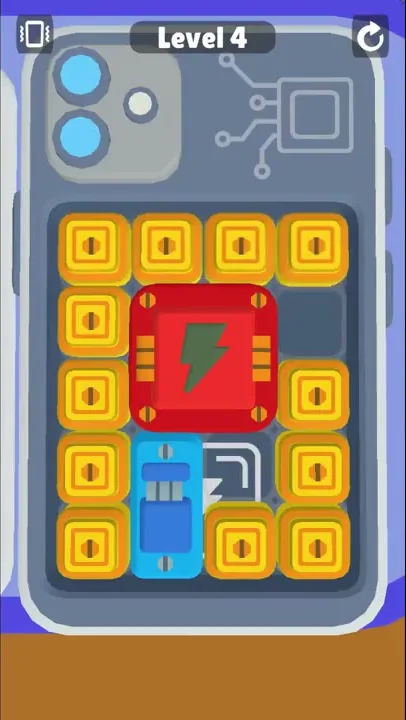
The red lightning block covers four cells and moves as one unit. Orange contact strips run down its left and right sides, with a screw in each corner. Its bolt stays dark gray-green during play. It moves only when both cells next to it in that direction are free, so it drops a row only after the two cells beneath it are cleared.
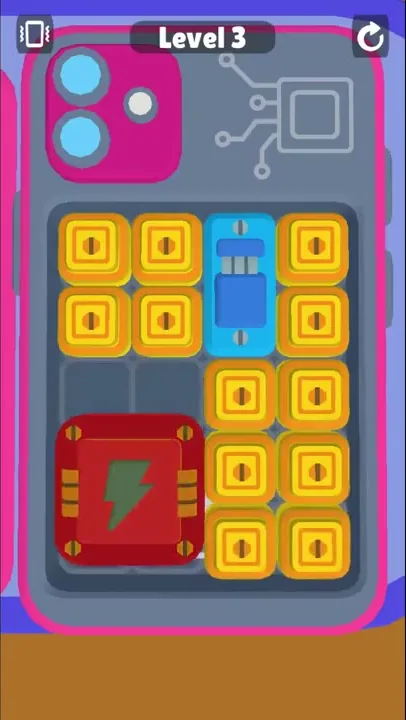
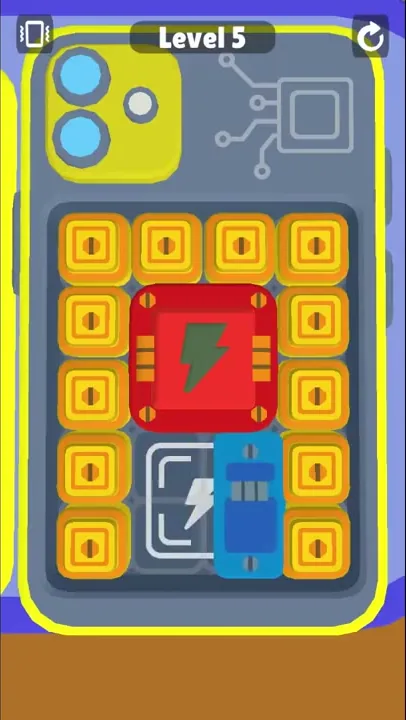
The blue two-cell piece stands upright in one column, with small gray pins above a darker blue panel and a screw at each end. It moves vertically in Level 3 and sideways in Level 4, crossing from the second column to the right edge. It often sits on the target, so it has to be moved out of the way.
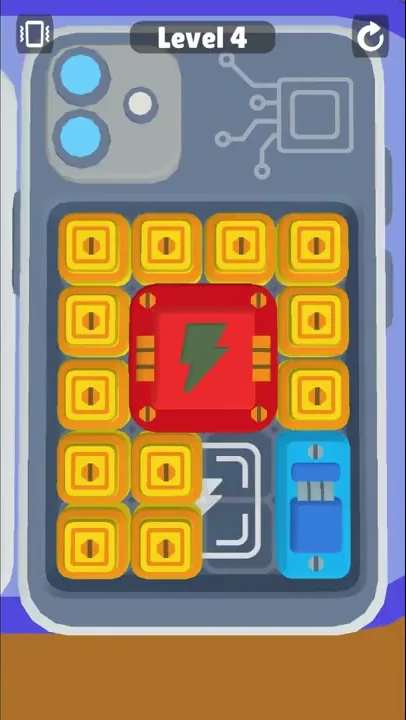
The target is drawn on the board itself as white corner brackets around a lightning-bolt mark. Pieces mostly hide it as a level begins, and it shows once they move away.
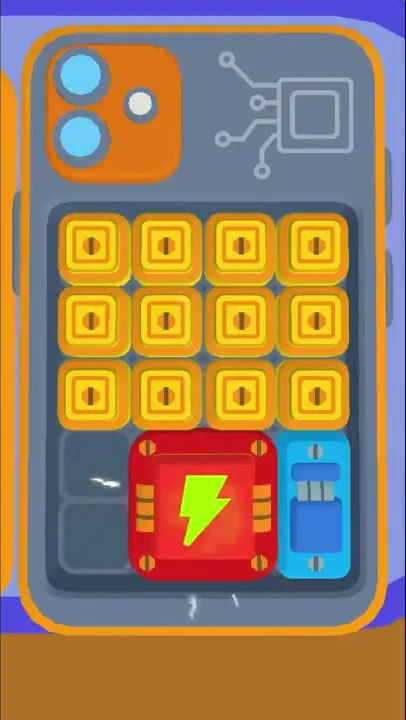
At the end of Level 2, with the red block on the outline, its bolt glows bright green and white sparks appear around it. The top bar disappears at the same moment.
A pink phone holds Level 3. As it begins, the red block fills the first two columns of rows 3 and 4, with both empty cells directly above it in row 2 and the blue piece to their right. The bottom row is full of yellow blocks.
The blue piece moves up a row, then yellow blocks shuffle through the right-hand columns until part of the outline shows. Once the two bottom-left cells are cleared, the red block drops into the bottom two rows. A few yellow moves later both free cells sit in the third column beside it. One step to the right puts it on the outline, and the ‘LEVEL COMPLETED!’ banner follows.
A new phone case and a higher red block
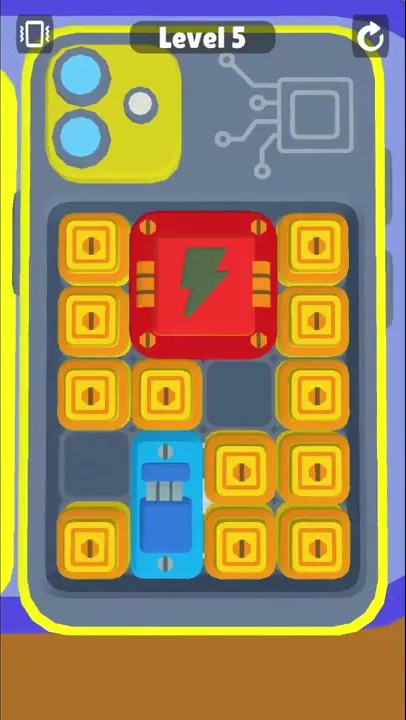
Every level is a different customer’s phone, told apart by its case color: orange in Level 2, pink in Level 3, light gray in Level 4 and yellow in Level 5. The color runs around the border and across the camera module, which holds two blue lenses and a white dot, while a drawing of circuit lines fills the top right.
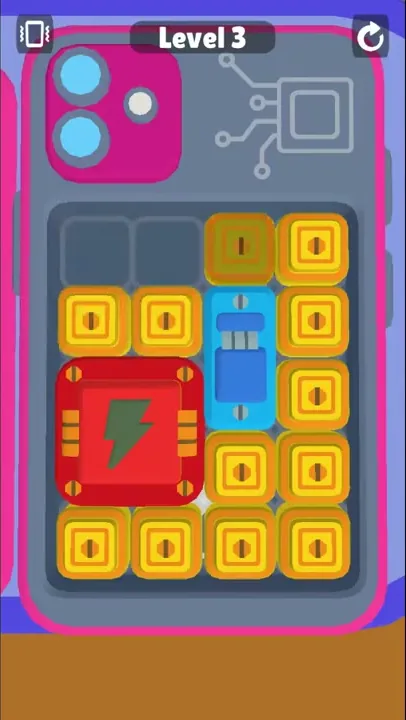
The pieces stay the same from phone to phone: one red block and one blue piece among yellow blocks, with two cells left empty. Within the grid, only the starting arrangement changes, and the red block begins higher each time. It sits in rows 3 and 4 as Level 3 starts, in the middle of rows 2 and 3 early in Level 4, and in the top two rows early in Level 5, as high as the grid allows.
Between puzzles the view pulls back to the repair counter, with a screwdriver and a yellow tray of parts in front of glass doors and trees. After the ‘LEVEL COMPLETED!’ banner a different customer steps up, and the next phone lies on the mat before the view moves down onto it. The customers are faceless cartoon figures in different outfits, among them a man in a black hat with a red band and a figure in a cream suit and dark sunglasses. Between Levels 2 and 3 two of them stand at the counter together, with the mat still empty.

A fixed phone earns a blue ‘LEVEL COMPLETED!’ ribbon over the customer, with confetti falling at the bottom of the screen and a green ‘Next’ button. There are no coins or stars on this screen, and no reward.

During a puzzle the only interface is the top bar. The level number sits in the middle, between a small phone icon flanked by short lines on the left and a circular arrow on the right; neither is seen in use in these levels.
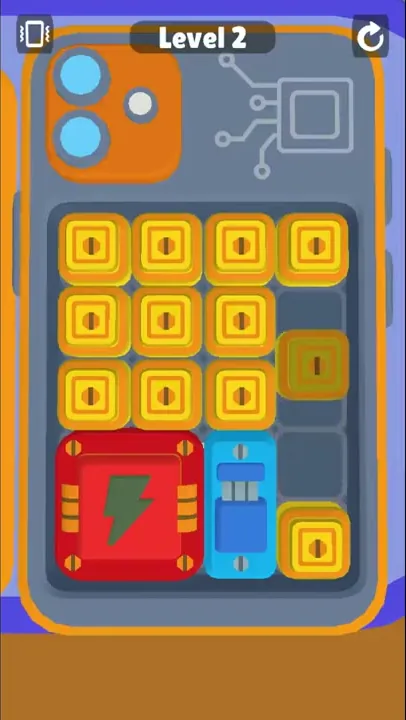
Nothing else appeared around the puzzles in these levels. No coin or gem counter appears, and neither does a shop, a booster, a lives display or an ad offer.
Klotski dressed up as phone repair
We see Fix Phone Puzzle as a textbook example of a game that blends a traditional puzzle with a creative setting. The sliding puzzle is left as it is: a crowded grid with two gaps and one large block to bring down to its mark. The setting is phone repair throughout, from the camera module above the grid to the screwdriver and parts tray on the counter.
There has always been plenty to gain from giving a traditional puzzle a setting, and Klotski is no exception. A casual setting is enough to move a pure logic puzzle out of brain-teaser territory and toward a hybrid-casual or lighter casual game, and this one is a standard case of that move. Here the wrapper is the customer who steps up with each phone and the banner over them once it is fixed. Any progression on top of the puzzles is very light: no upgrade or collection screen appeared between the four phones.
The same grid and pieces in every phone
We had no specific criticism of Fix Phone Puzzle. What follows are limits of the four phones on view, not faults.
Every grid uses the same four-by-five board and the same set of pieces, and we can’t say whether later levels add new pieces or bigger grids. Nothing on the puzzle screen counts moves or time, and no fail screen appeared.
Block shuffling with a customer after each fix
The job is the classic sliding-block one: planning a chain of moves so one big block can travel down the grid. Most of it is pushing yellow blocks into two gaps and often steering the blue piece off the target before the red block steps onto its mark.
That step-by-step clearing is what these levels ask for. A taste for a short scene between puzzles fits here too, since every grid comes with a customer at the counter.
Verdict
As a model of a traditional puzzle dressed in a fresh setting, Fix Phone Puzzle is a textbook case: the sliding rules are untouched, and the repair shop is built around them. Judged as a whole, it rates as average.