Jigsaw Quest Review: Jigsaw Pieces on a Block Puzzle Board
Jigsaw Quest review: pieces wait in a three-slot tray, two pictures grow on one 4×4 grid, and every finished one clears away and pays coins.
Game at a glance
Jigsaw Quest
7/ 10
Our score
Jigsaw plus block puzzle is a first for us, and it feels quite fresh.
In this article6 sections
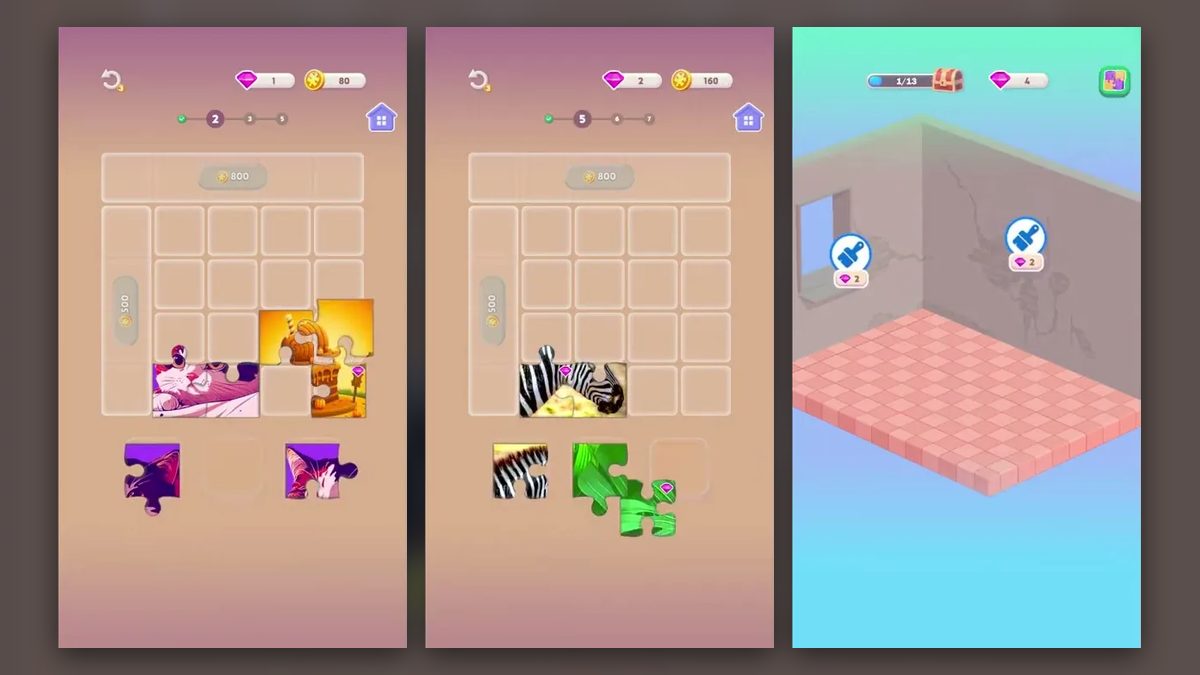
Three jigsaw pieces wait in a row of wooden tray slots, and above them is a 4×4 grid of glassy cells. Jigsaw Quest takes its pieces from jigsaw puzzle games and its board from block puzzles. Pieces from several small pictures land on that one grid, and each picture clears away as soon as it is whole.
In the one unbroken run we played, picture after picture cleared, from a rainbow swirl to diagonal stripes, until a tiger was left a single piece short. In between came one visit to a room that the board’s gems help renovate. The pairing of the two puzzle types is fresh and put together with care.
Three tray slots and one 4×4 grid
The aim is to finish pictures. Each one is cut into jigsaw pieces with the usual tabs and blanks, one piece to a cell, and it counts as complete once all of its pieces are joined. No timer, move counter or lives appear, and there is no results screen between pictures; the board simply carries on. A numbered track under the currency bar mostly moves up as pictures clear, though nothing on screen says what it counts.
Every move is a drag and drop. A piece is pulled out of its tray slot, which turns see-through while the piece is in the air, and let go over the grid. During the tutorial a dashed arc marks that path, and pieces already on the board answer to the same gesture.
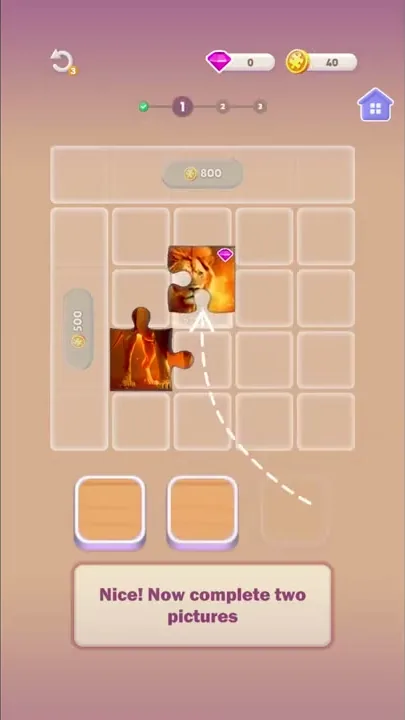
A rainbow swirl and a fiery lion share the board as the tutorial picks up, with a banner below the tray that reads “Nice! Now complete two pictures.” The swirl is taking shape in a 2×2 block on the right while one lion piece waits in the third row on the left. Once the swirl clears, the lion’s head, marked with a small pink gem, drops into place, and the lion fills its own 2×2 block in the second and third rows. All four of its cells flash a gold coin labeled 10, and the gem counter ticks up by one.
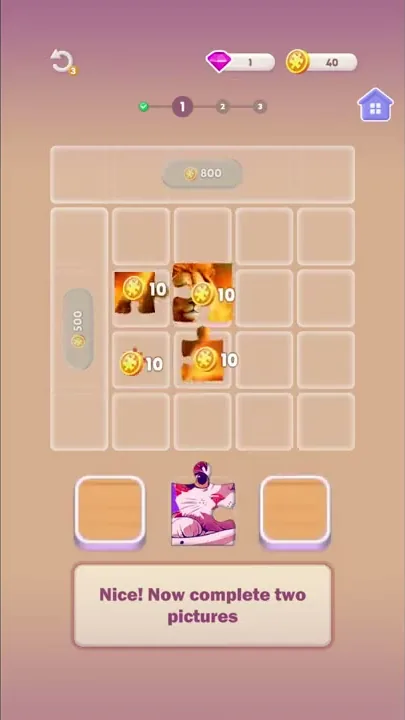
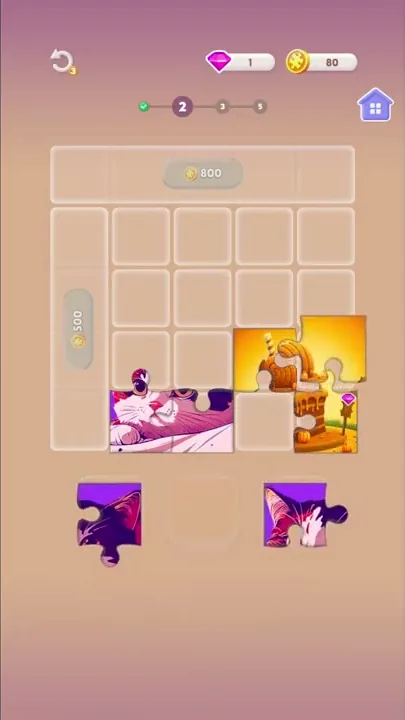
Clearing is what keeps the Jigsaw Quest gameplay loop turning. A finished picture shows its coins, then leaves the board and hands its cells back, while new pieces keep arriving in the tray. Right after the lion, a cat on a purple background starts in the bottom row on the left as a golden, sunlit cartoon scene grows beside it on the right.
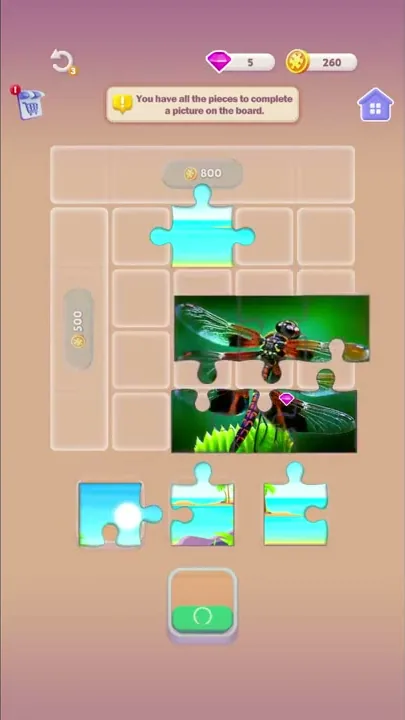
Since a piece can go into any open cell, one picture can end up in separate groups, and both single pieces and joined groups can be lifted again. A green dragonfly piece moves from the third row up to the second, one column to the right, and later the dragonfly’s upper group is carried toward its lower one. Diagonal rainbow stripes spend a while split between the upper left and the lower right, until the lower group is dragged up as one block to meet the rest. Moments later the stripes picture is gone.
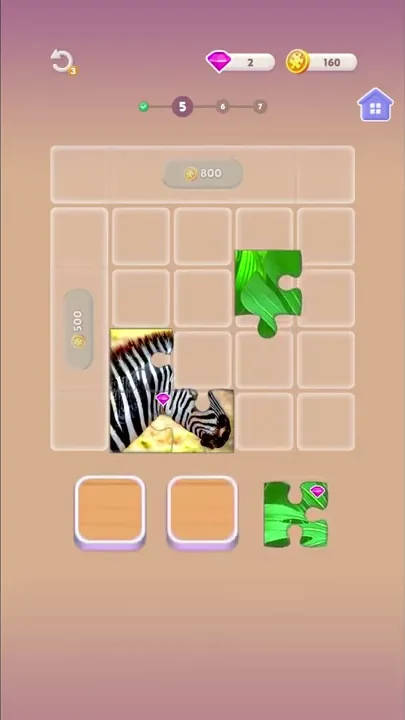
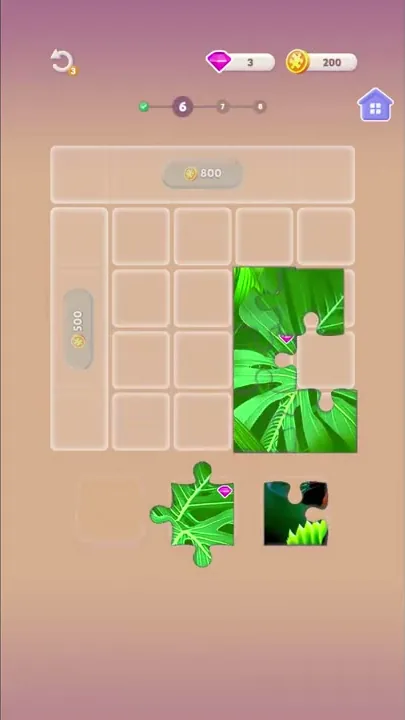
Some pieces carry a small pink gem marker. The gem is collected when that piece’s picture is finished, and one picture can hold more than one: the monstera leaves had two gem pieces, and the gem counter rose by two when they cleared.
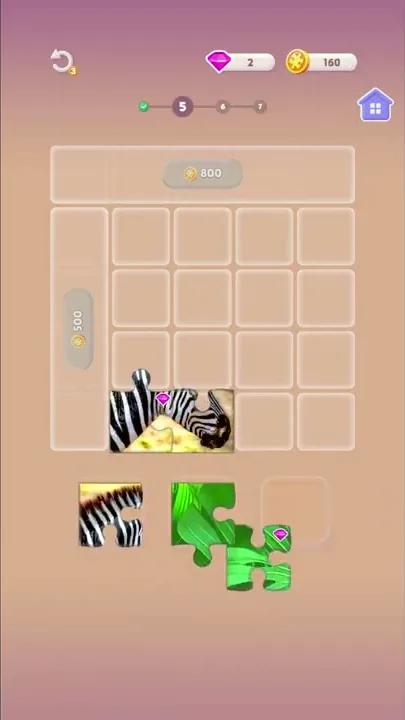
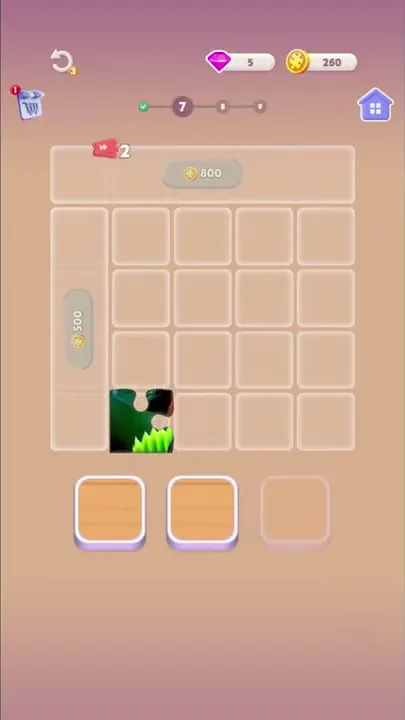
Space is the only limit in sight. The open area stays at 4×4 throughout. Outside it, a row of faint cells runs across the top with a coin badge reading 800, and a column of faint cells runs down the left with a badge reading 500. No piece is ever placed in either strip, and the coin total never reaches either price.
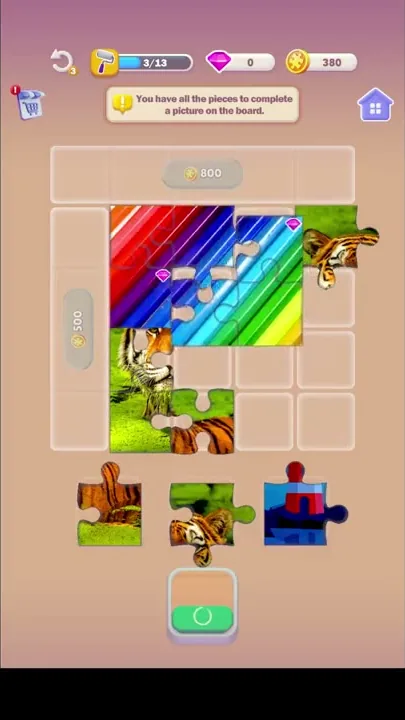
At times a banner with a yellow exclamation mark takes the numbered track’s place and reads “You have all the pieces to complete a picture on the board.” It appears while the two dragonfly groups are being joined, and again while the two stripe groups are apart.
From 2×2 pictures to a teal-walled room
Picture size does most of the changing. The first five pictures each fill a 2×2 block of four cells: the rainbow swirl, the fiery lion, the cat, the golden scene and the zebra.
Six-cell pictures come next. The monstera leaves stand two cells wide and three tall, while the dragonfly, the beach and the diagonal stripes lie on their side, three wide and two tall.
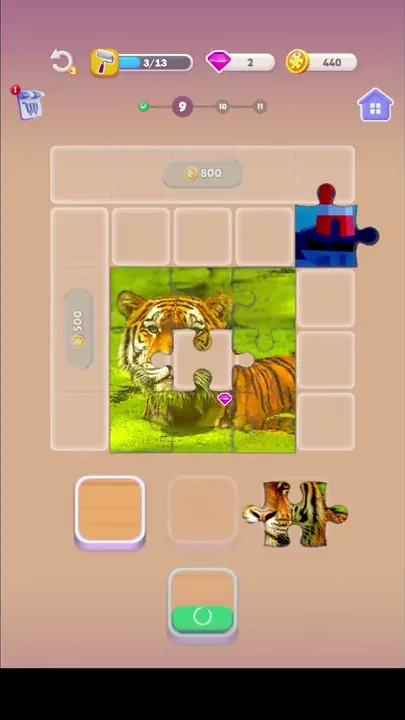
By the end of the run a tiger covers a 3×3 block of nine cells, three of the open grid’s four columns, with a lone red-and-blue piece in the top-right corner. Its center cell is the last gap left in it.
What the pictures show changes as much as their size. The subjects mix photos (zebra, leaves, dragonfly, tiger), illustrations (fiery lion, cat, palm-lined beach, golden scene) and abstract patterns, namely the swirl and the stripes. Every piece keeps its jigsaw tabs, and the seams stay faintly visible inside a joined picture. All of it rests on a soft pink-to-peach background, with glassy cells above wooden tray slots.
Outside the puzzles, two currencies are counted along the top of the screen. Coins come from every finished picture at 10 per cell, and the only coin prices that appear are the badges on the two locked strips. Gems come from the marked pieces, and they are what the renovation room charges. No ads or offer pop-ups turned up at any point.
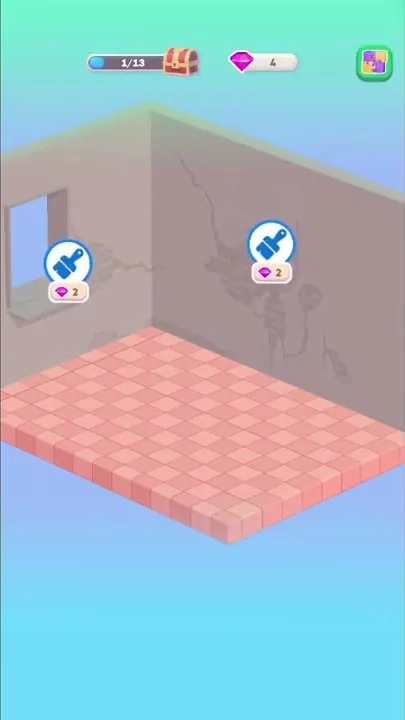
That room is a 3D isometric space on a mint-to-cyan background, with cracked gray walls around a window opening and a pink tiled floor. Two blue paint-brush icons, each priced at 2 gems, mark tasks on the walls, and a progress bar along the top runs to 13 steps and ends in a treasure chest. In the room screen’s upper right corner is a green button with a colorful grid icon. The screens in between the board and the room are a loading spinner over the dimmed puzzle screen and a plain cyan one.
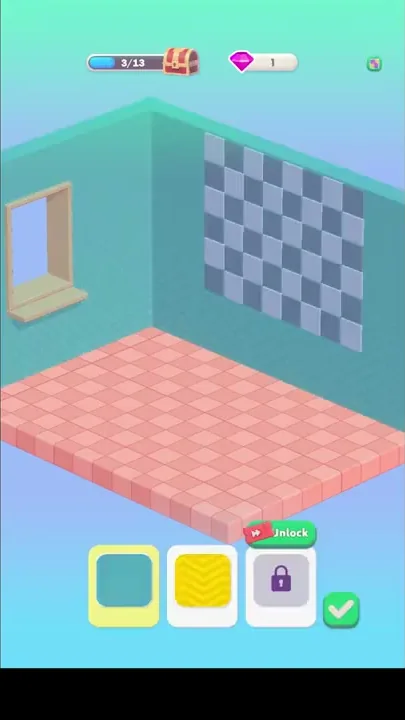
A couple of steps later the walls are teal, with a checkered tile panel and a window with a new surround, and a style picker runs along the bottom. It offers a teal swatch, which is selected with a yellow outline, next to a yellow zigzag swatch. The third option is padlocked under a green Unlock button that carries a red ticket icon, and a green checkmark button ends the row.
The renovation shows up on the puzzle screen too. Just before the room appears, a paint-roller icon with a red badge and a matching 13-step bar join the top of the screen. Back on the board, that bar holds the steps already completed.
A few more buttons frame the board. A curved undo arrow with a small orange badge stays in the upper left corner throughout, and a purple house icon with a grid symbol stays on the right, just under the coin counter. Partway through, a basket icon with a red badge appears under the undo arrow, and a red ticket marked 2 shows up once above the board’s top-left corner. Soon after, a fourth wooden slot settles in centered below the tray, with a green button whose icon is a plain circle.
Jigsaw tabs on a block puzzle tray
Jigsaw Quest blends jigsaw pictures with the block puzzle play of games like block blast. Its pieces wait in a three-slot tray and go onto a small fixed grid, and each finished picture clears off to make room for the next. This is the first time we’ve come across that pairing, and it feels quite fresh. Small as it is, it counts as a little innovation, and a very neatly made one.
Several small jigsaws share the board, and two are often in progress together. The cat goes up beside the golden scene and the zebra beside the monstera leaves; late in the run, stripe and tiger pieces fill the grid side by side.
That sharing gives spatial planning and arrangement extra demands and goals. Each new picture has to fit into the same 4×4 area as whatever is already growing there. The stripes, split between the upper left and the lower right, cleared only after one group was carried over to the other.
How it’s dressed up outside the puzzles follows the style of Decor Life, which was very popular not long ago. The long-term layer around the levels is a room makeover: gems from the board pay for brush tasks that turn cracked gray walls teal, and a picker offers other wall styles.
Locked strips and buttons left unpressed
We have no complaints about Jigsaw Quest. What’s left open is whatever the run never reached. The locked top row and left column keep their coin badges the whole time, and how they open is never shown.
The undo arrow and the basket icon are never pressed, and neither is the green button under the fourth slot. Nor does the run reveal what the red ticket is for or what the treasure chest at the end of the renovation bar holds. No piece is seen being turned (one beach piece carried over the locked left column does turn up back in a tray slot moments later, though what sent it there isn’t shown), and with no fail screen in sight, what happens when the grid runs out of room is something we can’t say.
Keeping room for half-built pictures
Play here comes down to reading a half-filled 4×4 grid, choosing where a new picture can grow, and moving a stray group across the board when a picture ends up in two parts. That mixes two tastes, the block puzzle one for keeping space free on a small board and the jigsaw one for watching a picture close up piece by piece. Between puzzles, the room speaks to a decorating taste instead, with gems spent on brush tasks and a wall style picked from the swatches.
Verdict
Jigsaw Quest deals out jigsaw pictures like block-puzzle pieces, several at a time on one small board, and the pairing is a fresh one. Keeping more than one picture going in so little space asks more of where each piece goes, while the room makeover around it borrows the look of Decor Life. It counts as something new for the genre, small in scale and very finely made.