Island Splash Review: Beach Boards That Build a Resort
Our Island Splash review follows the keys won on grassy beach boards as they pay for a dock, a signboard gate and a stall on a resort island.
Game at a glance
Island Splash:Build Resorts
7/ 10
Our score
Match-3 is growing past the game itself and starting to carry a social side.
In this article6 sections
Level 3 is over, and the screen cuts straight back to a tropical island. A “+121” rises over the lawn in a spray of green bills. A big golden key tumbles toward the key counter, and a hammer bubble hangs over the next spot that needs fixing.
That back-and-forth is how Island Splash runs. It is a mobile puzzle game from the family of match 3 games. Matching and clearing pieces on beach boards wipes away green grass, and keys pay for buildings on an island resort, such as a dock and a signboard gate. We played Levels 2 to 4, together with the island building around them, and we liked its island resort holiday theme, its fresh, easygoing feel and its fairly strong social side.
Swapping shells to clear beach grass
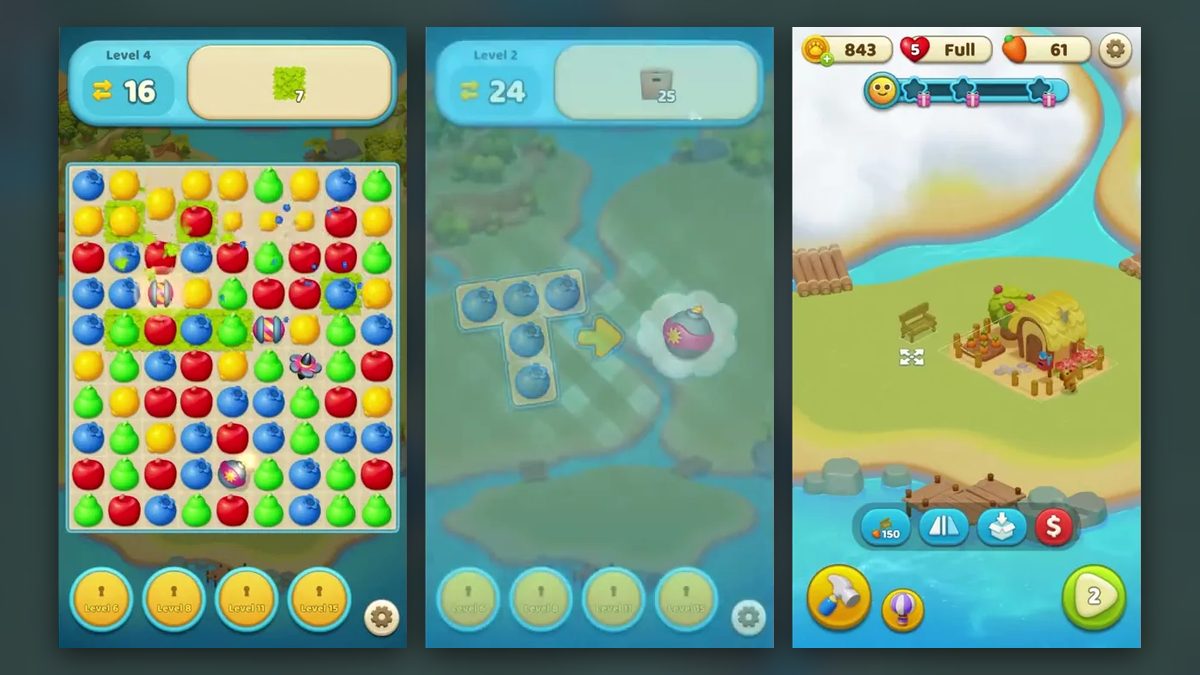
Every board sits on sand beneath a goal panel. At its center, a white rounded icon on green leaves carries a number that counts down as matches clear the green grass beneath the pieces. When it reaches zero, a green check mark takes its place and the board is won. A second number in the panel’s top-left box also falls during play, the captain’s portrait fills the right end, and at times a large sand-colored figure swells to fill the panel.
Moves are swipes: drag a piece into a neighboring cell and the two trade places. During tutorials the board dims except for the cells of the suggested move, and a cartoon hand demonstrates by sliding a blue shell one cell sideways. The water bomb tutorial, though, has the player tap a glowing piece rather than swipe it. Levels start from the orange play button on the island; before Level 4, a level panel adds a yellow “Play” button of its own.
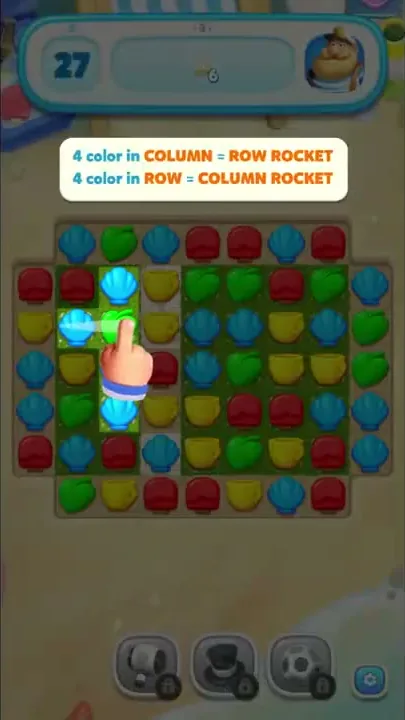
Island Splash gameplay swings between two screens. On the board, swaps that line up matching pieces chip away at the grass until the goal is checked off. Back on the island, a tap on a hammer bubble or a build-menu item spends keys, and the orange play button, which shows the next level number, opens the next board.
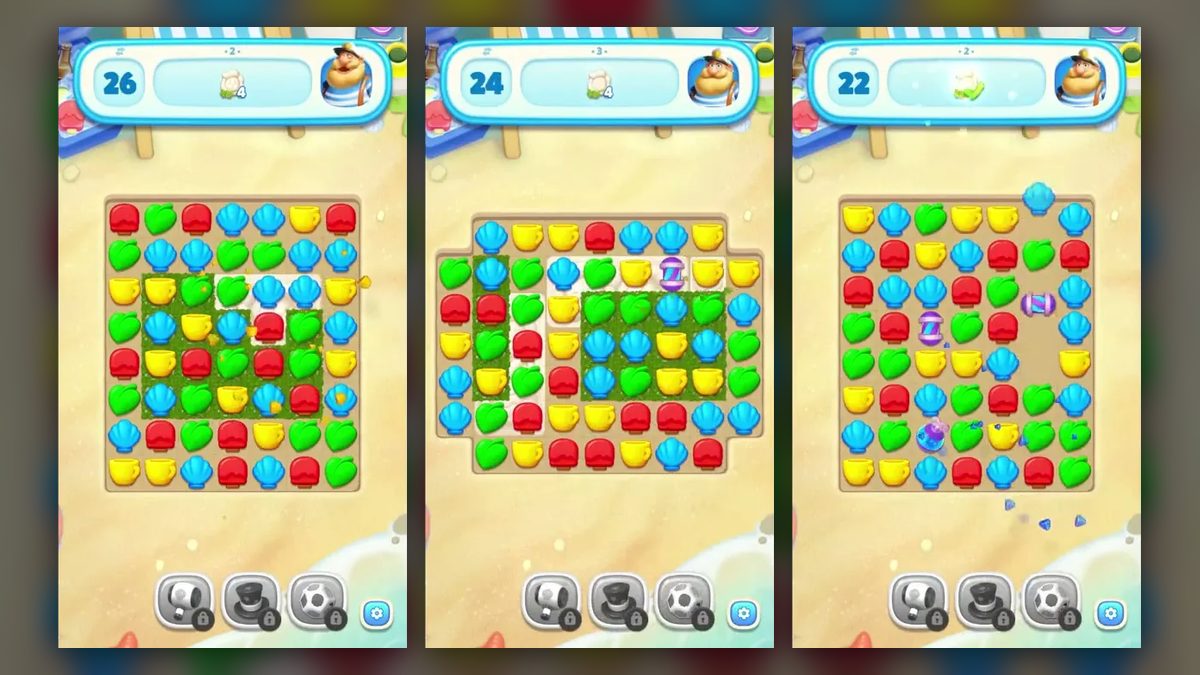
Blue scallop shells and green leaves share every board with red rounded pieces and yellow cups. The other pieces described below turn up among these four as play goes on.
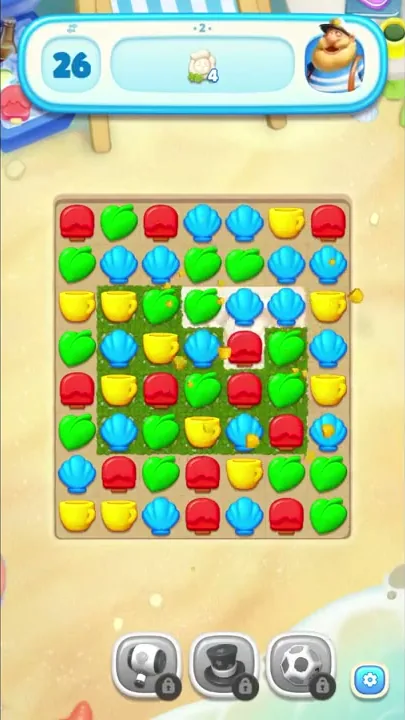
Grass lies under part of each board, beneath the pieces. As matches go off on top of it, grassy cells turn pale and the goal number falls. In Level 3 it went from 7 to 6, then down to 4 and 3, as the green patches shrank.
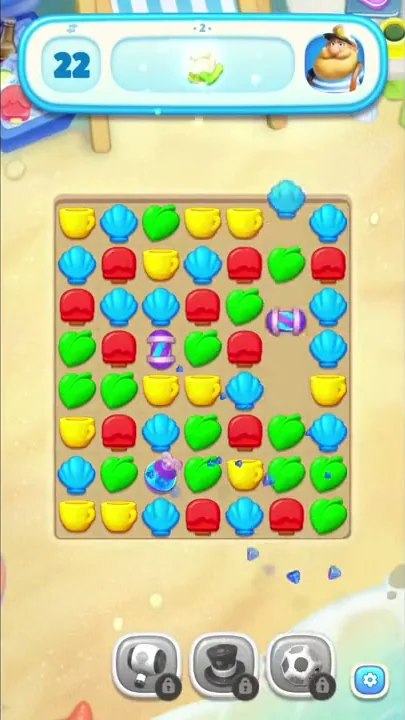
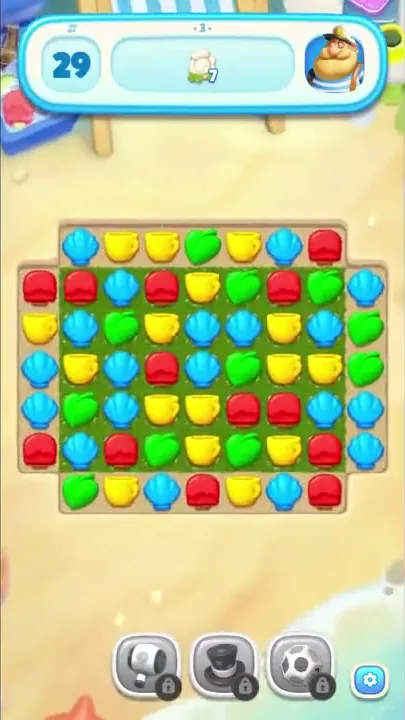
A rectangle seven cells wide and eight rows tall holds Level 2, with a green patch in the middle where a few cells have already turned pale. Early on, the goal reads 4 and the top-left box shows 26. By the time that box is down to 22, the grass is gone, and two purple striped rockets and a round purple piece with a pink top have joined the board.
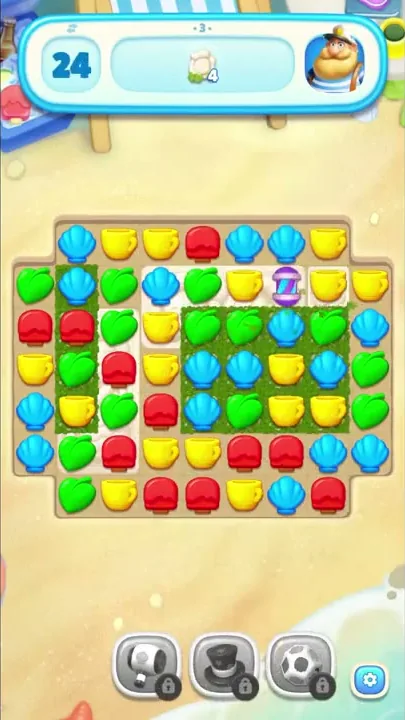
Rockets look like purple striped barrels, and they show up both standing upright and lying on their side. The tutorial in Level 3 spells out how to make them: “4 color in COLUMN = ROW ROCKET” and “4 color in ROW = COLUMN ROCKET.”
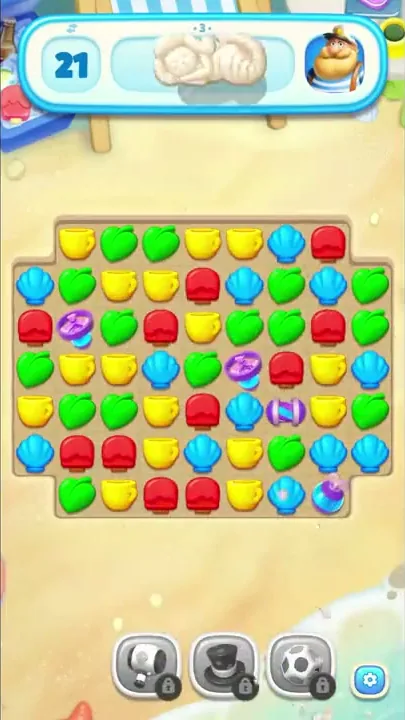
Flat purple discs with a white mark sit on the board like regular pieces. Two of them turn up partway through Level 3, beside a pair of rockets, and more appear in Level 4.
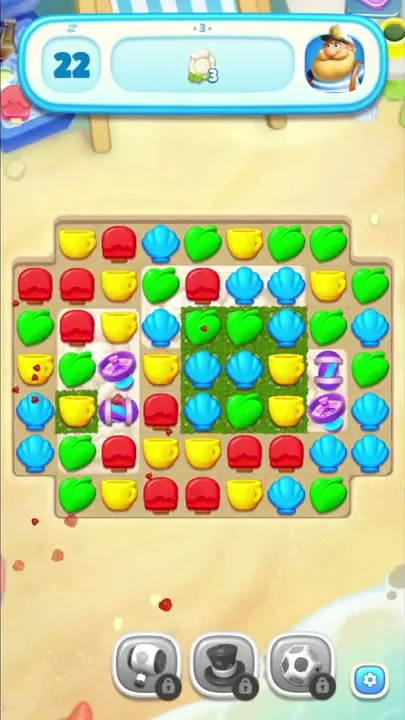
Another piece stands apart from the regular four: a round purple-blue piece with a pink tip. It first shows up during Level 2 and keeps appearing on the later boards, sitting among the regular pieces.
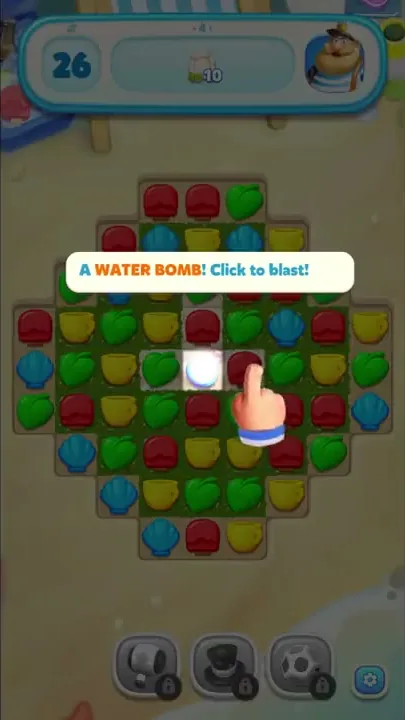
Early in Level 4, a tutorial line reads “A WATER BOMB! Click to blast!” while a hand points to a glowing piece in the middle of the board. Moments later, a large white burst covers the left-center of the board, and the goal number has slipped from 10 to 9.
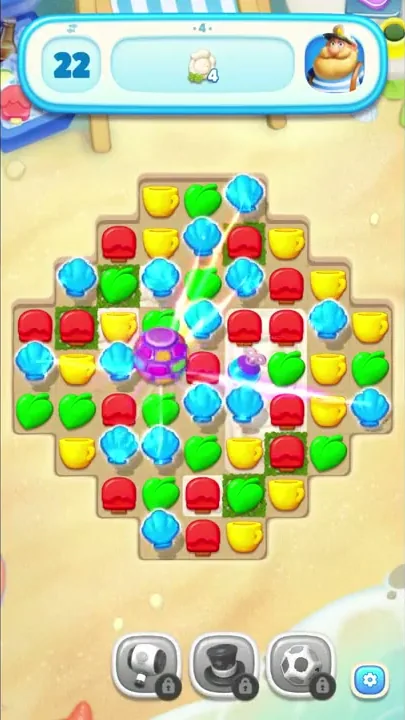
Later in that level, a large purple ball with an orange center sends beams of light to blue shells across the board, and the shells it reaches glow. The ball sits just left of the board’s center while the beams fan out.
Once the Level 4 goal was checked off, an “ISLAND Splash” logo covered the top of the board and a “Skip” button appeared at the bottom. Rockets and discs were still scattered across the board underneath.
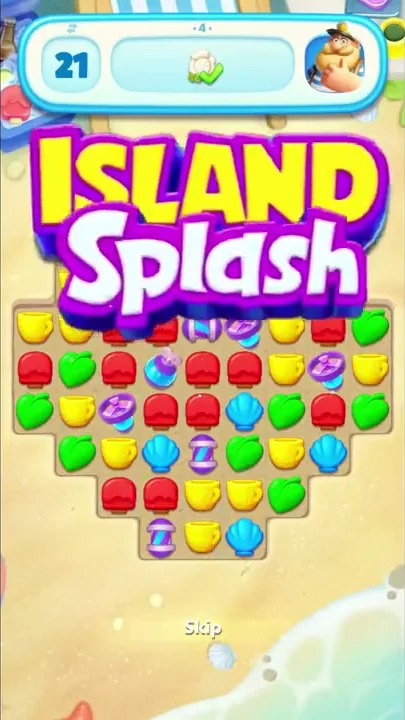
Board outlines from rectangle to diamond
The board’s outline shifts as the stages go by. After the plain rectangle of Level 2, the next board keeps seven cells in its top and bottom rows but stretches the five rows between them to nine. Early on, grass covers the inner seven columns of that wide middle.
The diamond in Level 4 cuts the corners away. Its rows grow from three cells at the top to three rows of nine across the middle, then narrow back to three, with grass under much of it early on.
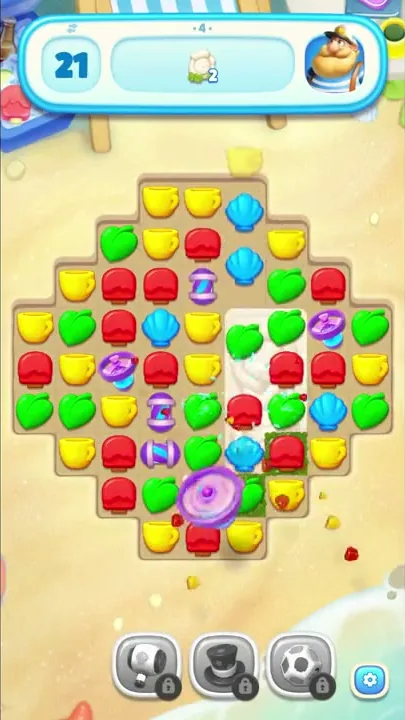
Goal numbers rise along with the boards: the white icon read 4 early in Level 2, 7 early in Level 3 and 10 early in Level 4. None of these boards ended on a fail screen, and no out-of-moves offer or lives counter appeared.
Each stage also has something new to show. Rockets already form during Level 2. Level 3 follows with the rocket tutorial and the first purple discs, while the water bomb lesson and the purple-and-orange ball belong to Level 4.
A panel before the board is first seen ahead of Level 4. Headed “Level 4”, it shows the goal icon and, under “Select Boosters”, three gray padlocked boosters shaped like a striped barrel, a ball and a disc. Below them sit a yellow “Play” button and “Cost 100” next to the cash icon.
A second row of locked boosters waits under every board beside a settings gear: a blower-like tool, a black top hat and a soccer ball, all gray with padlocks.
Cash comes as green bills, counted at the top left of the island screen. A “+121” and a burst of bills followed Level 4 just as they followed Level 3, and the panel’s “Cost 100” is priced in the same bills.
A chest icon at the island’s lower right holds more cash. After Level 3 it read “full” with 400 on it; moments later it showed 0 as bills flew out, and the cash total rose by the same 400. From then on it carried a “1h59m” label and a small count that crept up from 0.
Keys are the building currency. They fly to the counter after levels and go back out with each build, from the dock and the signboard gate to items in the build menu. A purple gem counter sits in the top bar as well, but no gems were spent.
Spots that need work carry white bubbles marked with a hammer, and early prompts such as “Click to build the signboard” point to them. Tapping one wraps the spot in a white cloud until the finished piece appears. A dock with a hut came first. A carved signboard gate followed in a shower of confetti, and later the path entrance got flower-decked posts.
The build menu is a “Tropical Paradise” panel with a five-star progress bar and four tabs, three of them marked with a red “1” badge. One item carried a “NEW” tag and a price of 4 keys, and four gray ones read “Locked.” The item bought there, a small stall with a red-capped figure, then stood beside the path.
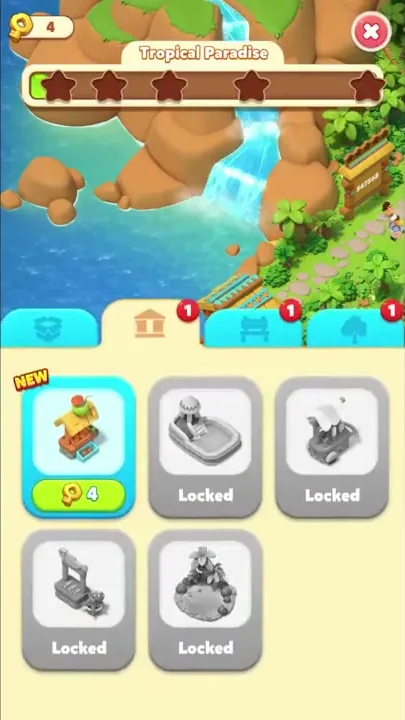
Those five stars track the area’s progress. Repairing the entrance posts lit the first star on the “Tropical Paradise” bar, and the first of five stars in the top bar turned gold right after. Panning out shows more of the island, with overgrown ruined huts and empty plots beyond the path.
The bottom row of the island screen holds four buttons: a yellow hard-hat button with a red badge, a gold compass-like button, a market-stall button with a gem on it and the orange play button. After Level 4, a small padlocked “UnLocks at” tag sat above the market-stall button.
Una, a girl with a flower in her hair, calls out “Look! Guests are coming!” as a small boat nears the dock, and visitor figures walk the lawn from then on. We saw no ad between a finished board and the island; after Level 2 a short loading screen came first.
Island resort theme and a social streak
We found the social side relatively strong, and it fits a wider shift in the genre. Matching and clearing is slowly becoming more than a game and taking on more social content, as PUZZUP and Lilith Games’ matching game already do. On screen, the only related prompt is an “Enter name” box over the island, with a “Type your name…” field and a “Continue” button. No friends list or chat turned up by the end of Level 4, so we can’t say yet how far those features go.
The theme is an island resort holiday with a very fresh, laid-back mood. The island is a 3D tropical scene seen from high above, where a waterfall spills between sandstone cliffs and palm trees stand over bright blue sea. The boards stay on the beach, set on sand with surf in the lower-right corner and a beach chair behind the goal panel.
The holiday is also one to build and run. Guests arrive by boat at the new dock, and a cash chest on the island fills and pays out. Story scenes put Una and a bearded captain in a striped shirt in front of it all, talking in a dialogue box at the bottom.
Padlocked boosters and unexplained purple pieces
We have no complaint to raise about Island Splash. What follows are things the early boards leave unexplained.
Nothing on screen shows what the flat purple disc or the round purple piece with the pink top does. Rockets are explained only by the tutorial line, not by how far they clear. Every booster is locked, both on the pre-level panel and in the bar under the board, and none shows an effect or a price.
The “Cost 100” line is seen only on the panel before Level 4, so it is not clear whether other levels cost cash. Gems sit unspent, and the compass and market-stall buttons stay closed.
Grass-clearing boards with an island to build
The loop alternates two activities: boards where swaps clear patches of grass toward one goal number, and visits to an island where keys turn hammer bubbles into a dock or a gate. The boards follow the same swap-to-match rule as games like Royal Match, while the time between them goes to the resort.
That split fits a taste for watching a place fill in step by step, with a stall appearing by the path and guests walking the lawn. Story scenes with Una and the captain sit between the boards, and no timer runs while a board is in play.
Verdict
The pull of Island Splash lies in its island holiday setting, fresh and casual in tone, and in the social features built around the matching. It also counts as one more case of matching games taking on a social role beyond the puzzle itself.