Puzzle Dots Review: Connect-the-Dots Wrapped Around a Cube
From a flat Level 1 tile to a turning cube, this Puzzle Dots review traces how chains of colored dots cross from one face to the next.
Game at a glance
Puzzle Dots
6.5/ 10
Our score
Classic 2D game formats going 3D is something to look forward to.
In this article6 sections
Partway into Level 4 of Puzzle Dots, a white cube sits on a wooden tabletop. It is turned so that two of its dotted faces meet at an edge pointing out of the screen. An orange line starts on one face and runs over that edge onto the other: one chain in a level that began with 15 moves and a goal of 50.
At first glance, this 3D connect-and-clear puzzle looks like tile match games stepping from flat boards into three dimensions. What the player actually does is draw chains through same-colored dots to clear them against a move limit, first on a flat tile and then on a cube. We played Levels 1 to 5, leaving Level 5 unfinished.
A flat format seen from a new angle is the main draw. Past that, there is little else to single out.
Drawing chains through five colors of dots
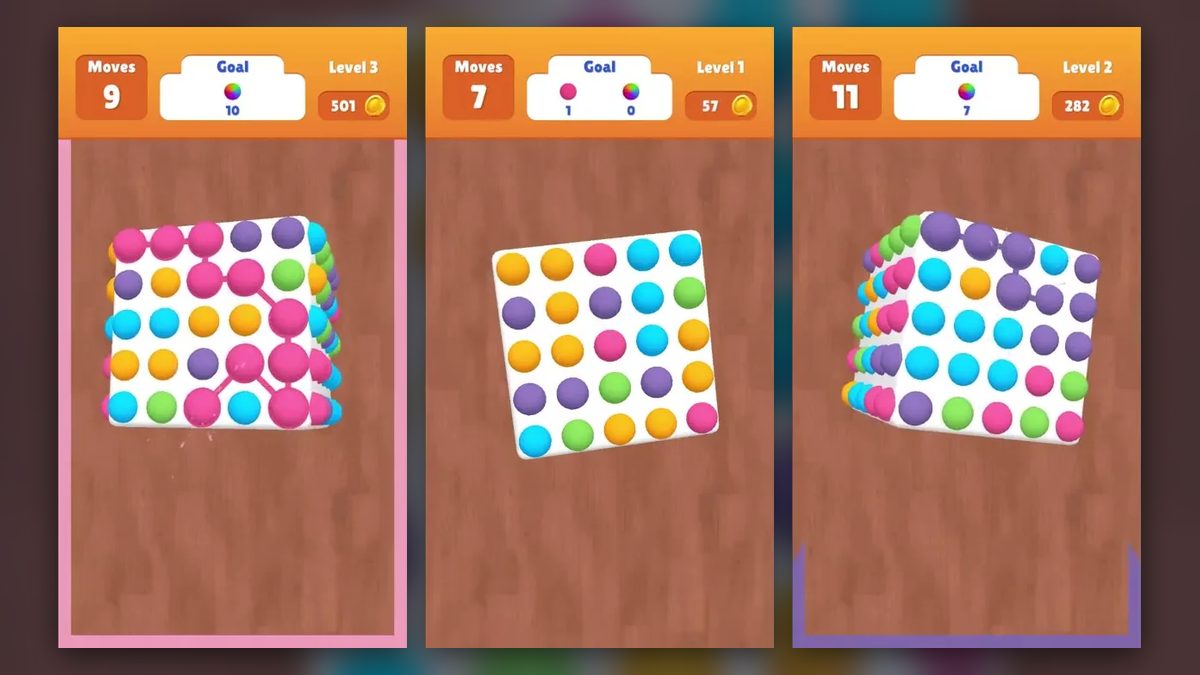
A level’s target sits in a white Goal panel at the top of the screen. The panel shows colored dot icons, each with a count beneath it. Clearing matching dots lowers those counts, and the level ends when every one reaches 0. Some icons are a plain colored dot, such as pink, and others are a multicolored dot. Beside the panel, a Moves box goes down by one with every chain.
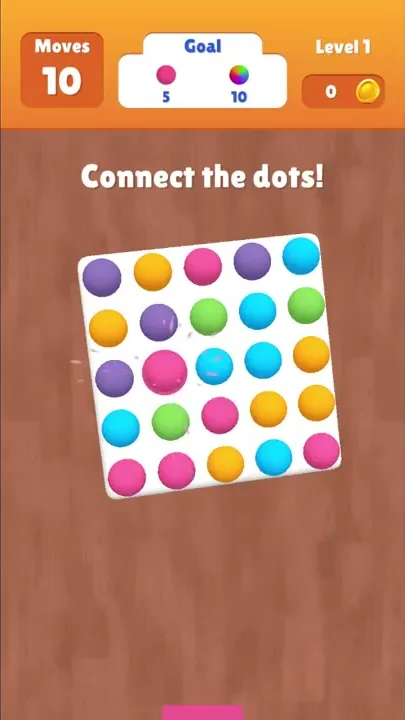
Dots are linked by drawing a line through them, and the game spells this out with “Connect the dots!” above the board as Level 1 begins. A line can run side to side, up and down or diagonally. It can also turn partway, so one chain can wind from the top row of a face down to the bottom.
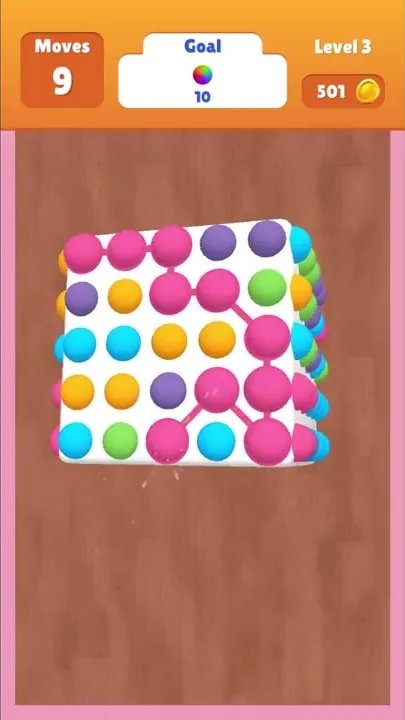
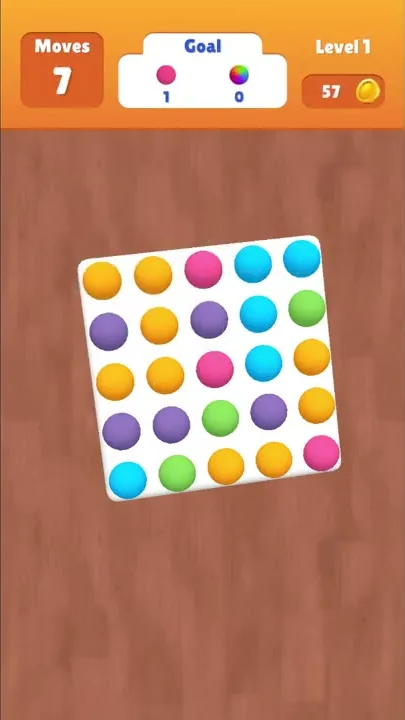
The dots themselves are glossy round balls in five colors: purple, orange, pink, cyan and green. On the Level 1 tile they form an even 5-by-5 grid, and the front face of each cube that follows carries the same grid.
Puzzle Dots gameplay runs on a short loop. When a chain is finished, its dots burst into small fragments of their own color and the Moves box ticks down. Small colored balls and tiny coins float up from the clear toward the Goal panel and the coin counter. New dots then drop in from above the board to fill the gaps, and the loop repeats until every goal count reads 0.
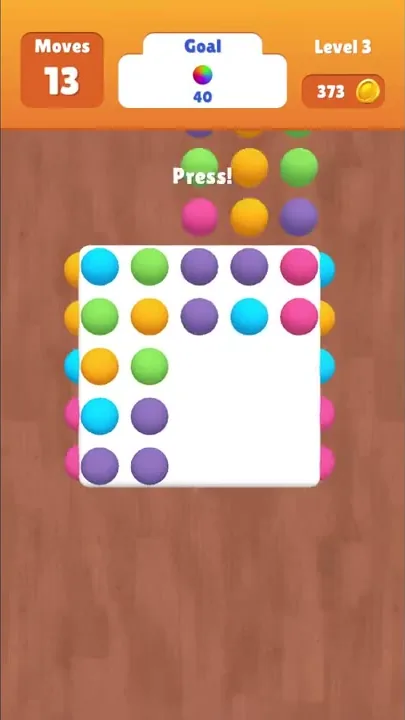
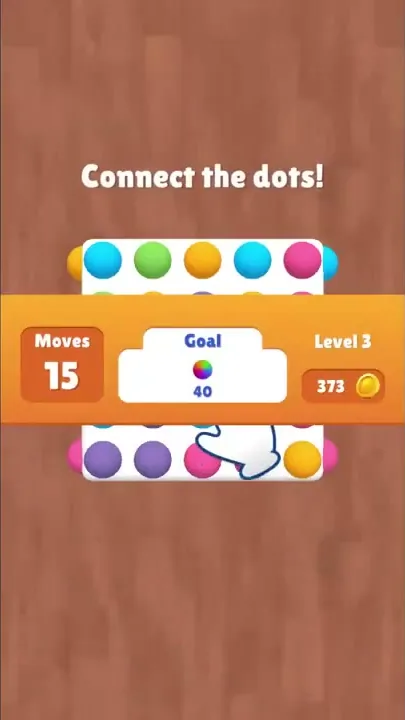
A goal of 40 and 15 moves frame Level 3, which is played on the front face of a cube with extra dots poking out past its left and right edges. Early on, a clear leaves that empty corner while the word “Press!” shows in white above the board. Further clears keep pulling the count down. Later, a long pink chain is drawn while a pink border runs down both sides of the screen and along the bottom, and the next screen seen is Level 4.
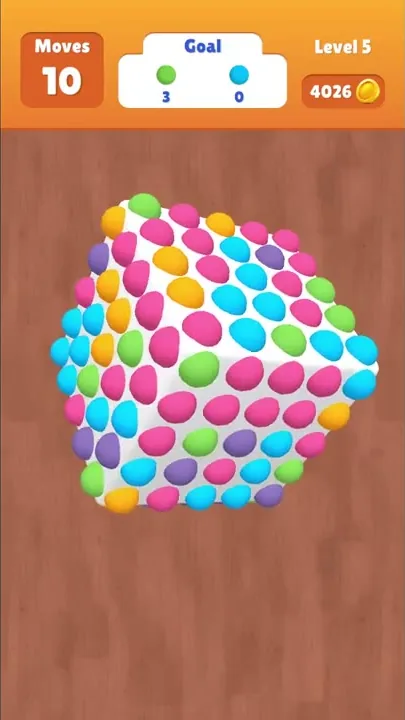
On the cube, a single chain can carry on from one face onto the next. In Level 4 an orange chain crosses the edge where two faces meet, and a cyan one later runs from the front face onto the right face. In Level 5 a pink chain cuts across faces while the cube is seen corner-on.
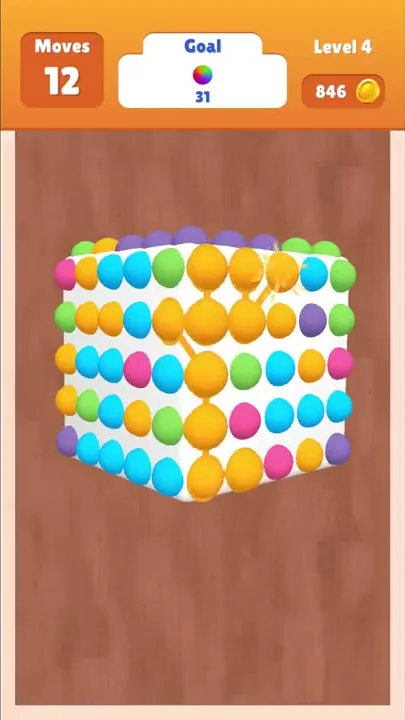
The cube’s angle changes during a level. It can be turned to show a second face or set with two faces meeting at an edge toward the player. It also appears tilted so one face sits on the diagonal, angled into a ridge of two faces, and seen corner-on with three faces of dots in view at once.
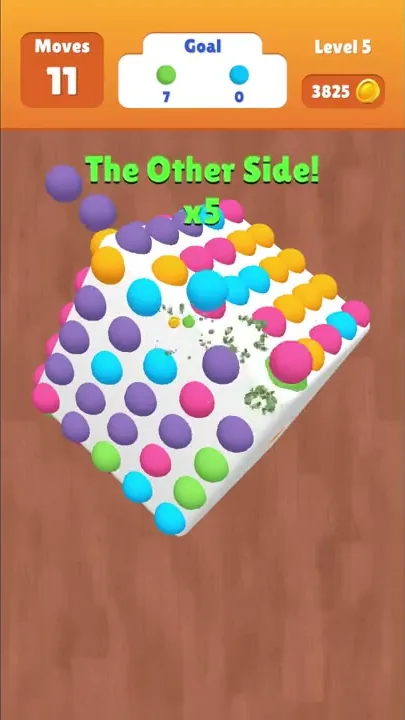
Green words pop up above the board after some clears. “Combo x6” and “Amazing!” appear during Level 2. In Level 5, “The Other Side!” shows with “x5” beneath it as a batch of green dots bursts apart.
While a chain is being drawn, a bar in its color appears along the bottom edge of the screen. It is a short strip when a single pink dot is enlarged, and wider when three orange dots are linked. During longer chains it climbs both sides of the screen, as it does for a purple chain in Level 2. It can also become a full border down the sides and across the bottom, sometimes in the chain’s own color and sometimes pale, close to white.
Flat tile first, then a turning cube
The board starts flat. Level 1 is one square tile, slightly tilted on a wooden table, with dots on its top only. It asks for 5 pink dots plus 10 on the multicolored count within 10 moves. When both counts reach 0, the whole screen dims before Level 2 appears.
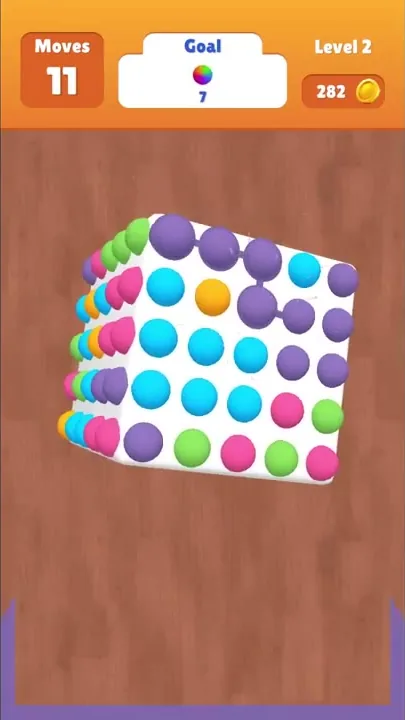
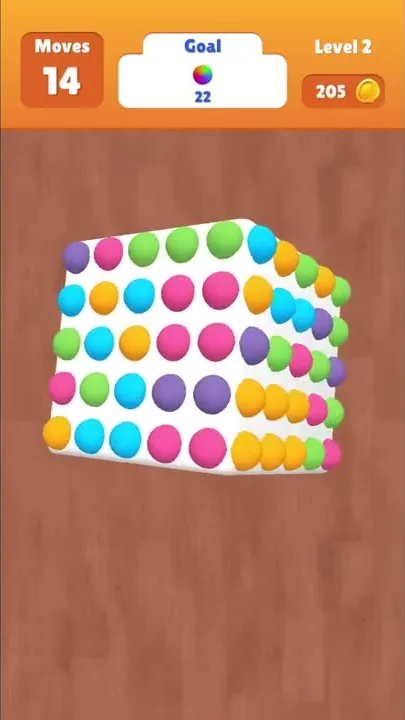
After that, the board is a cube. Its front face still carries a 5-by-5 grid, but more dots stick out past its right edge, and turning the cube brings a second dotted face into view. The move limit rises to 15 and stays there through Level 5, while the goal becomes a single multicolored count of 30.
The opening hint comes back at the start of Level 3, this time with a hand pointer. The top bar’s readouts appear as an orange banner across the middle of the screen. “Connect the dots!” sits above the board, and the white hand rests on its bottom row.
The edges of the front face change from one level to the next. Extra dots poke out past the right edge in Level 2, past both sides in Level 3 and over the top as well in Level 4, and in Level 5 they show past all four edges. The cube is also seen from new angles as the levels go on: edge-on during Level 4, then tilted diagonally and corner-on in Level 5.
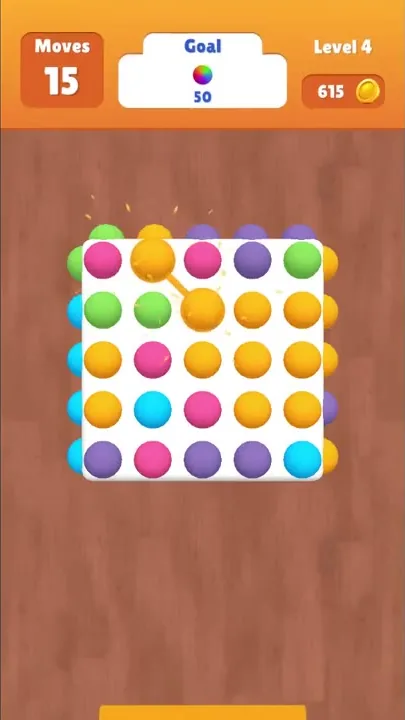
The goal counts climb as well. The multicolored target is 30 on the first cube, then 40 and 50 on the two after it. Level 5 drops the multicolored icon and asks for two specific colors instead: 12 green and 16 cyan.
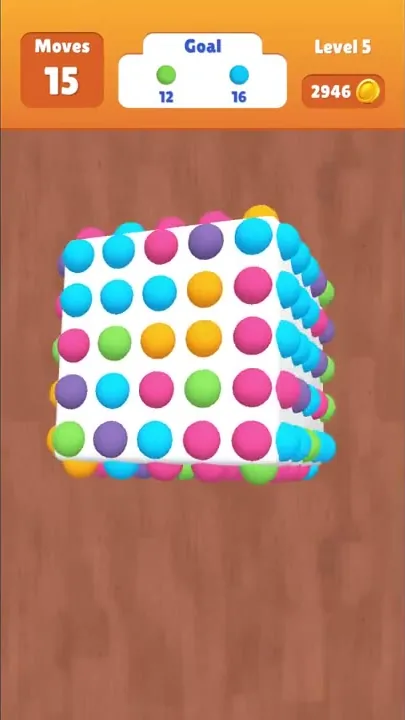
Beyond the dots, the currency in view is coins. A counter at the top right climbs as dots are cleared, gathering the small coins that float up from them, and its total carries from one level into the next. The orange top bar around it also holds the Moves box and the Goal panel, with the level label above the coins.
A flat connect-and-clear board turned 3D
The change in perspective and form is the game’s highlight: it takes 2D connect-and-clear and gives it a 3D shape. The flat tile of Level 1 becomes a cube in Level 2, turned to show more than one dotted face, and by Level 5 three faces can be in view at once. In Levels 4 and 5, chains also cross from one face to the next.
At first glance, the jump from that tile to the cube has the air of tile matching evolving from a flat 2D board into a 3D one. In play, though, the pieces are dots linked into chains rather than tiles picked into a tray.
Plain dots and move counts beyond the cube
Apart from the 3D form, we found nothing else about Puzzle Dots that stands out. The pieces on the Level 5 cube are the same plain dots in five colors that filled the Level 1 tile.
We can’t say what happens when the Moves box runs out. The coins also pile up from level to level, but nothing to spend them on was seen: no shop, boosters, lives or ads appeared in the levels played, and each level led straight into the next.
Tracing color paths around a turning board
The task at the center is spotting where dots of one color touch, diagonals included, and pulling them into one line. On the cube that search reaches over its edges, since a run of one color can continue onto the next face while the shape is seen from new angles. Each level frames it with a short list of color targets and a set number of moves. These mechanics fit a taste for scanning bright grids for paths and following one color around the corner of a shape.
Verdict
Puzzle Dots rests on a single idea: connect-and-clear lifted off a flat grid and spread over the sides of a cube. That shift in viewpoint is what it has going for it. Beyond it, nothing about the game is out of the ordinary. The broader trend it points to, familiar flat game formats gaining a third dimension, is one we hope to see more of.