Zumba Triple Match Review: Tile Matching on a Zuma Track
Symbol marbles leave a Zuma-style chain one by one and clear in threes in a seven-slot tray: a Zumba Triple Match review.
Game at a glance
Zumba Triple Match:Marble Ball
7/ 10
Our score
Tile Match Zuma: tile matching seen from a whole new angle.
In this article6 sections
Seven brown slots sit near the bottom of the screen in Zumba Triple Match, and marbles leave the winding track above them one at a time to drop into them. When three identical marbles land in that tray, they vanish in a bright flash, and a level ends once the track is empty. The game belongs with the tile match games on mobile, but its board comes from Zuma, the classic marble game where a chain of colored balls winds along a track toward a hole.
We played Levels 1 to 4 and left the fourth unfinished. Every level was set against an Egyptian backdrop of a golden pyramid and a temple gate. The result is a triple-tile matching puzzle seen from a new angle. It’s fun to play, though rather crudely made.
From the marble chain to the seven-slot tray
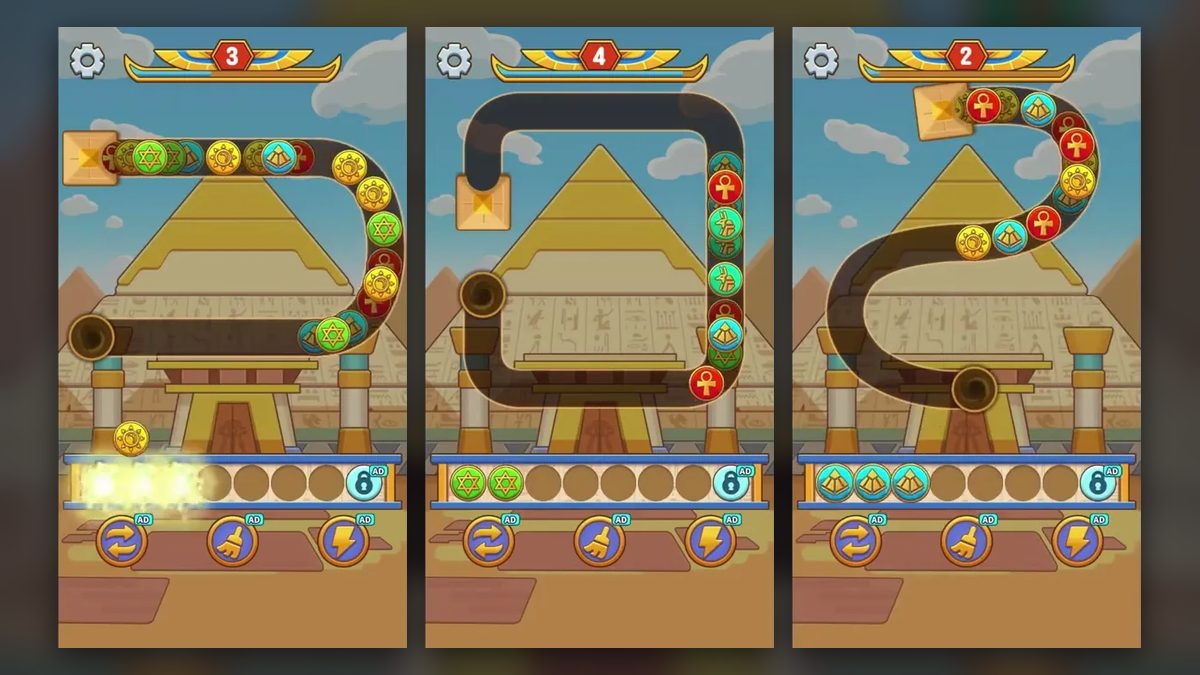
The goal is to clear the track. Marbles sit packed in a chain along it, and each one taken off flies down into the tray at the bottom of the screen. When three identical marbles have gathered there, they disappear under a yellow-white flash. Progress shows at the top, where the level number sits in a red hexagon on a gold winged bar, with a blue bar beneath it that fills as the level goes on.
Each track ends in a dark round hole. In Zuma, a chain that reaches the hole ends the game. How this game treats a marble that gets that far, or a tray that fills up, stays unclear on these boards.
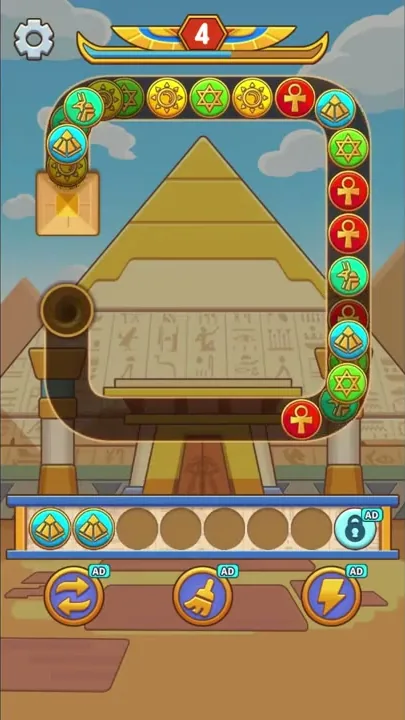
Play happens one marble at a time. A single piece lifts out of the chain and flies down to the tray: a red ankh on one move, a light-blue pyramid on another. A gear icon for the settings occupies the top-left corner of the play screen.
That cycle of one marble down and three identical ones gone repeats until the track is empty, and it is the core of Zumba Triple Match gameplay. A clear and the next pick can overlap, with a fresh marble already dropping in while the flash still covers the slots.
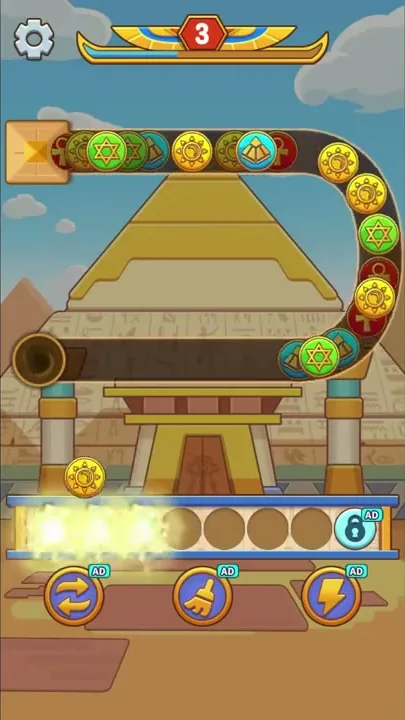
The track is a dark translucent band laid over the backdrop, so the pyramid shows through it. From Level 2 on, it begins at a golden square block. As marbles are taken, the stretch next to that block empties first, and the rest of the chain is left farther along the band.
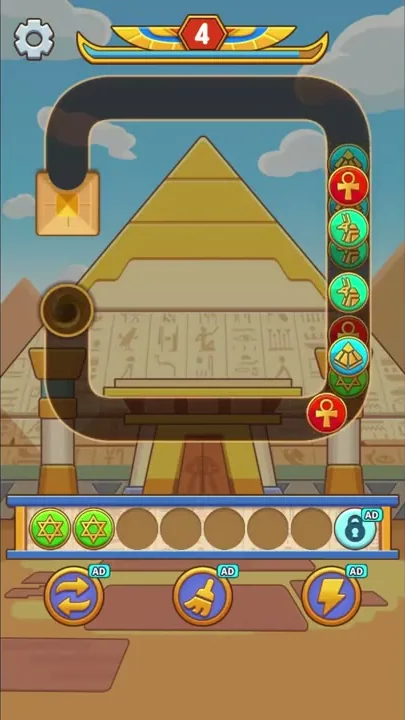
Each marble is a flat colored disc with a gold symbol. Yellow marbles carry a sun and red ones an ankh, while the light-blue ones show a pyramid. Lime-green marbles with a six-pointed star join in Level 3, and mint-green marbles with a gold figure arrive in Level 4. Only identical marbles clear together in the tray.
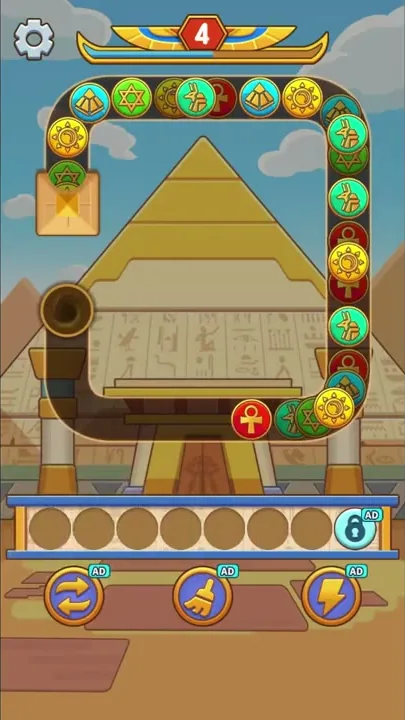
Some marbles are drawn in darker tones and sit partly beneath the brighter ones beside them, so in places the chain looks two layers deep. They turn up as early as Level 1.
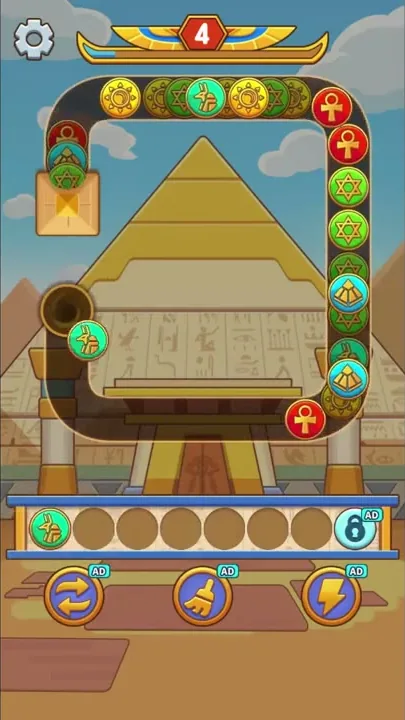
The tray is a strip with a blue border and seven brown round slots, set below the track in the lower third of the portrait screen. Picked marbles wait in it until three identical ones are collected. To the right of the seventh slot sits an eighth round space, a light-blue circle marked 6 with its own AD tag.
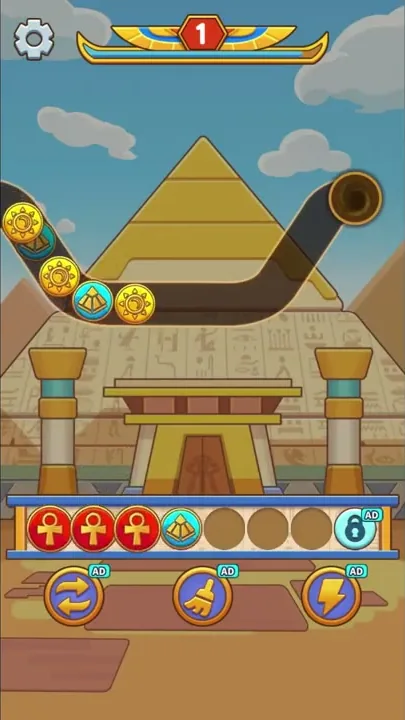
Three marble types make up the chain in Level 1. A red ankh flies down from the chain, and with only a few marbles left on the track, the tray holds three red ankhs beside a single light-blue pyramid. The “CONGRATS!” banner follows soon after.
New symbols and longer, winding tracks
The track changes shape from one board to the next, and the set of marbles grows along the way. The first track is short. It enters from the left edge of the screen and dips across the middle before it rises to a hole at the upper right.
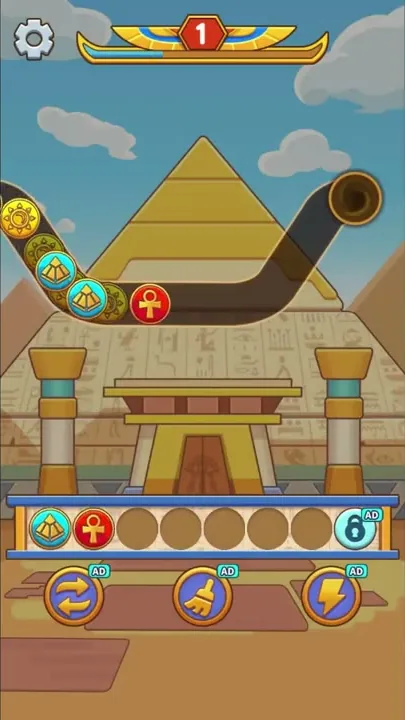
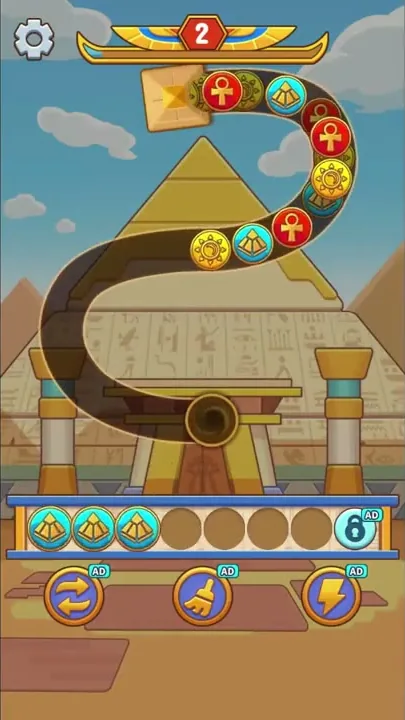
The second track is the first to begin at the golden block, and it stretches into an S-curve. From the block at the upper left it runs right and down the right side, then swings back across the screen to a hole in the center, just above the temple doorway. Early in that level, the chain reaches from the block along the top and down the right side to about the middle of the screen.
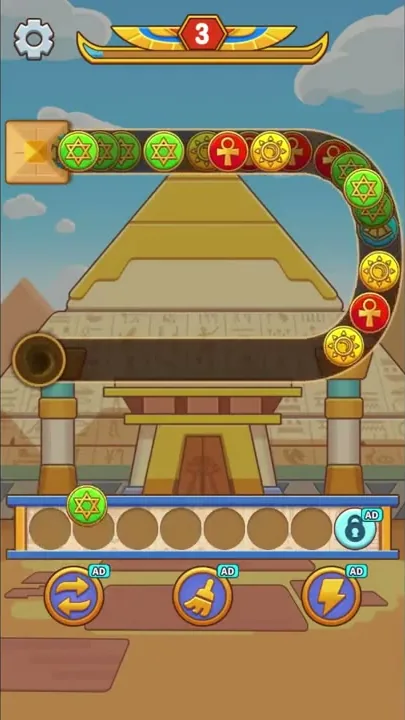
Lime-green marbles with a gold six-pointed star join the three original types in Level 3. That track runs along the top from a block at the upper left and curves down the right side. It then comes back across the middle to a hole on the left.
The fifth type, mint green with a gold figure, arrives in Level 4 with the longest track seen. It is a rounded rectangle. From a block on the left side it climbs to the top, crosses the screen, runs down the right side and along the bottom, then comes back up the left to a hole just below the block. Early in the level the chain fills the loop from the block around the top and down to the bottom-right corner, and the level runs well over a minute.
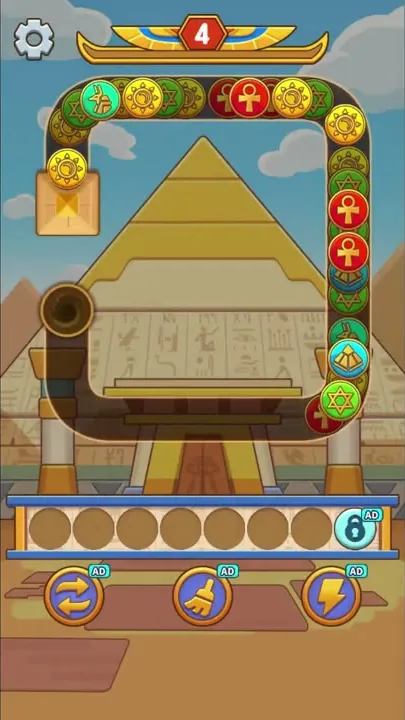
Half-hidden marbles grow in number too. Several sit under others in the top row of Level 3, and many line the right side of the Level 4 loop.
A finished level dims the board behind a gold winged “CONGRATS!” emblem, with a magenta gem on top and light rays and confetti around it. An orange Next button and a green Back button follow below it.
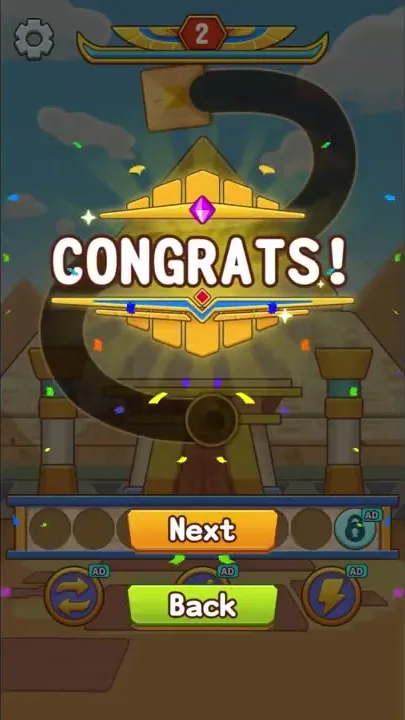
Two curved arrows, a broom and a lightning bolt mark the three round buttons under the tray. Each one wears a small AD tag, and they are already in place on the first board.
After Level 3, a plain white pop-up with the game’s icon covers the level-complete banner. It asks “Do you like this game?” and requests a rating, with five empty stars and a blue Not Now link at the bottom.

Tile matching seen from a Zuma track
We liked the angle it takes: tile matching approached from somewhere completely new. The pieces are marbles packed in a chain on a Zuma-style track rather than tiles on a board, and the tray at the bottom does the clearing. On the long Level 4 loop, with all five symbols mixed along the band, the familiar collect-three routine plays out on what looks like a Zuma board.
It also shows what the pairing can do. Tile matching can be combined with another game’s basic rules or laid over them, the way this game lays it over Zuma’s track, and the result can be a distinctive experience.
It still plays like a triple-tile matching puzzle, and it is a lot of fun. TileMatchRun works along somewhat similar lines but feels more like puzzle-solving. Next to it, this game is much simpler, because it pares back the covering along the track. Here that covering comes down to darker marbles tucked partly under brighter ones, as in the top row of Level 3.
A coarse finish on the marble puzzle
Too bad it is rather roughly made. That is the one complaint against it.
Picking matching marbles off a winding chain
Each move sends one marble from the chain to the tray, and the aim is to gather identical symbols in threes until the band is bare. That is the routine of tile matching, with the pieces lined up along a winding track instead of stacked on a board, and by Level 4 there are five symbols to sort. It leans toward plain matching rather than the puzzle-solving that TileMatchRun goes in for. A taste for Zuma’s winding tracks finds the same shape here, a dark band running from a golden block to a hole, put to use as the supply for the tray.
Verdict
Zumba Triple Match finds a new way into tile matching by building it on Zuma’s track, and the mix has a character of its own. Set beside TileMatchRun it is the far simpler of the two, closer to straight matching than to a puzzle, and we had plenty of fun with it. What counts against it is how unrefined it is.