Pipejam Review: Burst Color Pairs Until the Chain Snaps
This Pipejam review follows same-colored pairs from a single straight pipe to a six-color spiral, and the chain that sags as their bursts pile onto it.
Game at a glance
Pipejam
6/ 10
Our score
Old-school match-clearing meets hyper-casual play, all inside a pipe.
In this article6 sections
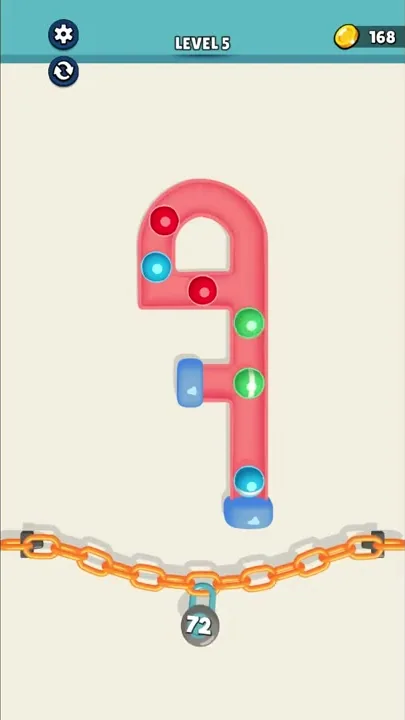
In Level 5 of Pipejam, only two cyan balls are left. One sits in the closed loop at the top of a pipe shaped like a 9, the other where a short capped branch leaves the stem. Below them, small red and green balls from the two earlier bursts are still landing on an orange chain, and the padlock hanging from it has dropped from 72 to 27.
Pairing like this is the main task in this mobile connect the dots game, played on an upright screen. In the first six levels we played, the pipe takes a new shape each time, and the small balls from the bursts pile onto the chain until it snaps.
Pipejam blends traditional match-clearing with hyper-casual pick-up-and-play, all built around balls in a pipe.
Same-color pairs inside a sealed pipe
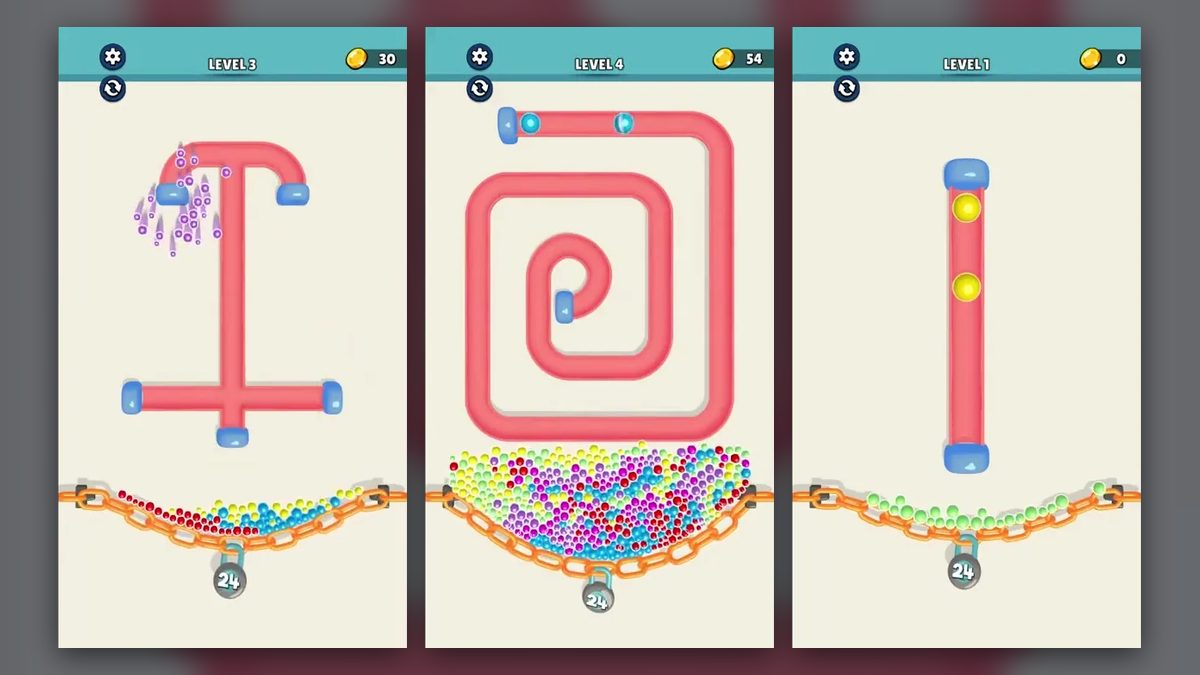
Each of these levels is one pipe, sealed with rounded light-blue caps, with colored balls inside in pairs. When two balls of the same color meet, they burst, and the small balls from the burst fall onto the orange chain strung across the lower part of the screen. Pipejam gameplay is built around that rule. In the anchor-shaped pipe of Level 3, the last purple pair bursts at the top left, and its small balls drop toward a chain already loaded with the colors of the pairs before it.
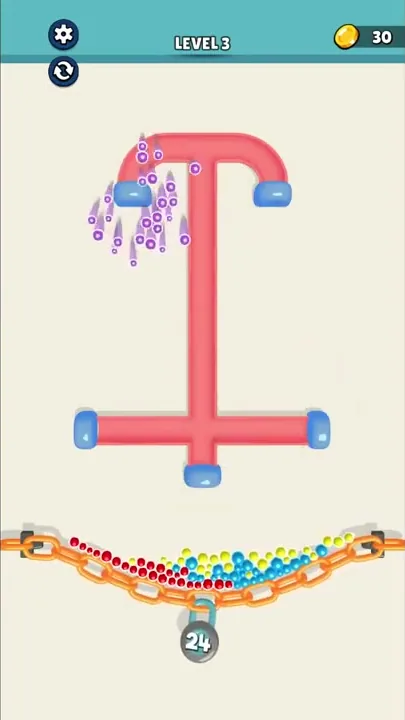
The view is fixed and straight-on, with the whole puzzle on one portrait screen. A glossy pink-red pipe sits on a plain cream background, under a teal bar that holds the level label and a coin counter. In the top-left corner are two round dark buttons, a gear with a circular-arrows icon below it.
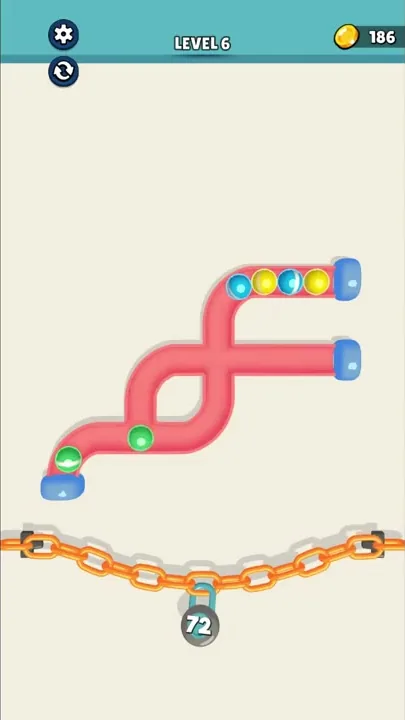
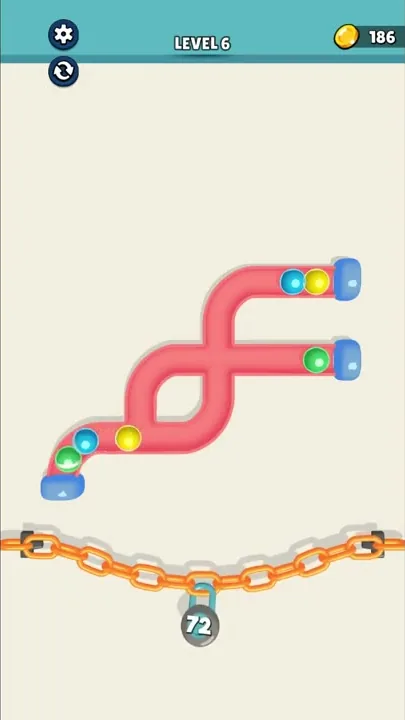
On the board, balls change position along the pipe, often one at a time. In Level 6, a cyan ball leaves the upper-right arm and a few seconds later shows up in the lower curve, beside a yellow ball near the crossing.
The balls are glossy, each with a lighter dot in its center, and six colors appear: yellow, green, purple, cyan, red and magenta. Balls of different colors can sit side by side without bursting. Later in Level 6, two cyan and two yellow balls end up packed in alternating order against the upper-right cap. A ball that has just changed position sometimes shows a white streak across its surface.
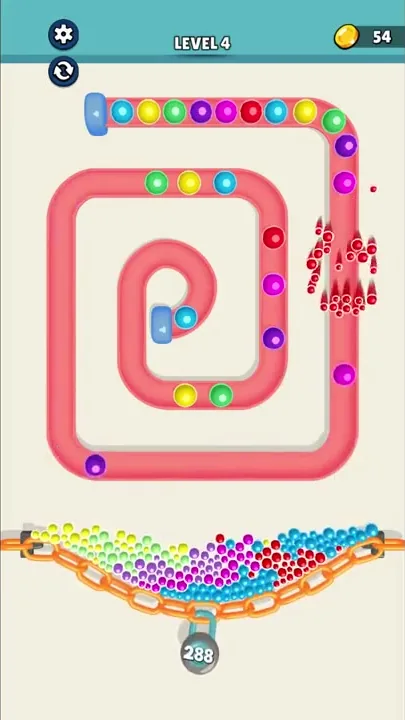
A burst replaces the pair with a spray of small balls in the same color, which shoots outward and then falls toward the chain. In Level 2 a green pair bursts like this beside the side branch, and in the spiral of Level 4 a red pair does the same on the right-hand side.
The chain has thick orange links fixed to dark brackets at the screen edges, with a gray padlock on a teal shackle hanging from its middle. Small balls from the bursts pile onto it in their own color. The number on the padlock goes down as they land, and the chain sags lower as the heap grows.
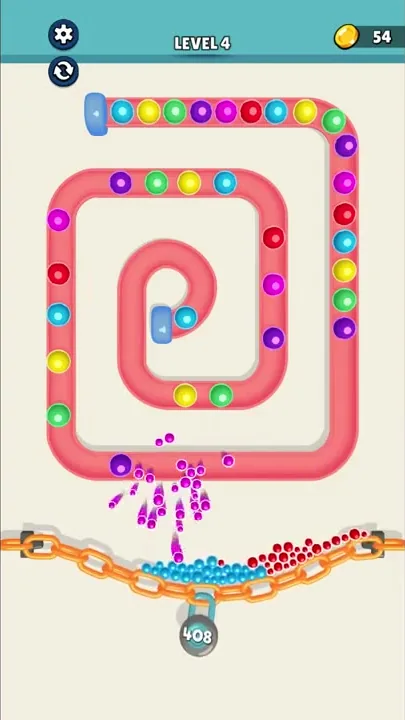
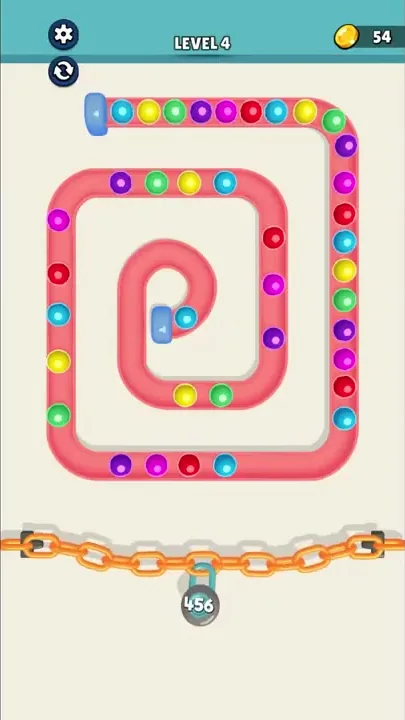
A long square spiral packed with balls in six colors makes up Level 4, with one cap at its outer end in the top left and another at its inner end in the center. Reading away from the bottom-right corner in either direction, the colors repeat in the same order: cyan, red, magenta, purple, green, yellow.
The pairs on either side of that corner clear first. Within five seconds the cyan, red and magenta balls there are gone. The padlock has fallen from 456 to 408, with the magenta spray still dropping onto the chain.
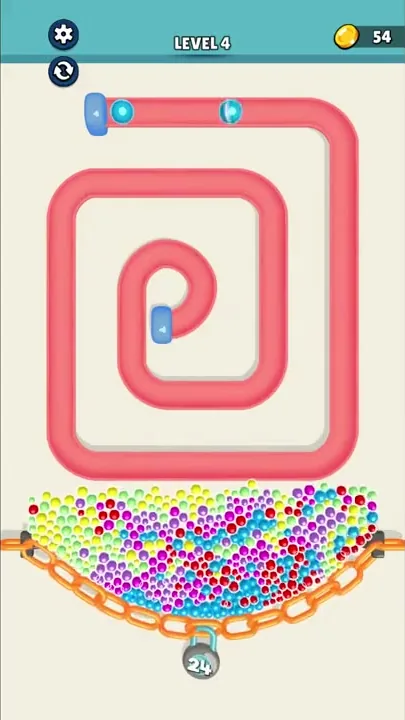
From there the pairs keep clearing and the counter keeps falling, until one cyan pair in the top arm is all that is left and the padlock reads 24. The chain was nearly straight while it was empty. Now it droops deep under a heap of small balls in every color.
The pipes also split and rejoin, which gives a ball more than one route. In Level 5, a closed loop sits on top of the stem of the 9-shaped pipe, and a short capped branch leaves the stem on the left. In Level 6, curved sections cross in the middle, and balls pass through the crossing from one side to the other.
A level ends when the chain breaks. Late in Level 6, with two yellow and two cyan balls left, the padlock reads 48. Moments later the pipe is empty and the padlock is gone, and the chain hangs in two halves from its brackets while a few small balls fall away.

From one straight pipe to crossing curves
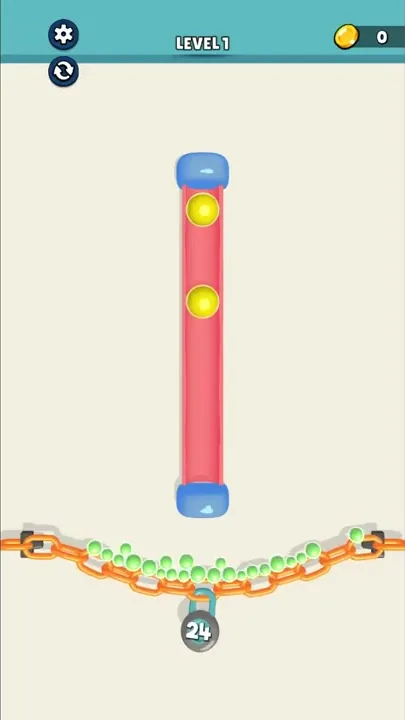
The pipes begin as a single straight tube. In Level 1 it stands upright with a cap at each end. Small green balls already lie on the chain while a yellow pair waits inside, and the padlock reads 24.
Branches come next, starting with one short side branch and three capped ends in Level 2. Early in Level 3, the pipe is an anchor: a long stem runs from an arch at the top, whose ends point down, to a crossbar near the bottom, with a short stub below it. That makes five capped ends in all. The number of colors grows with the branches, from three in Level 2 to four in Level 3.
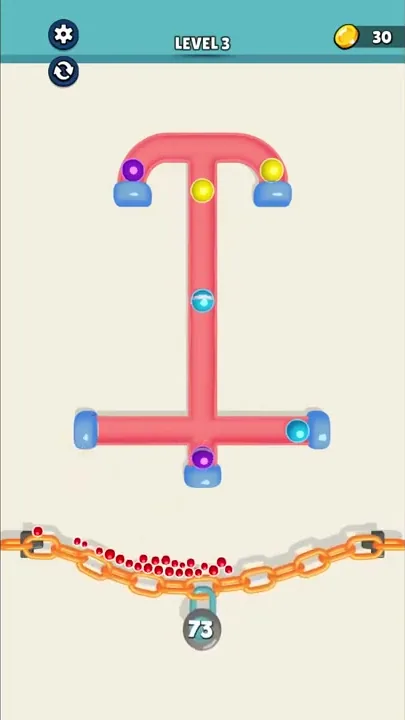
The spiral of Level 4 breaks from that pattern. Its six colors fill a pipe that winds in toward a cap at the center, and its padlock starts at 456, where the anchor read 73 early on. It also took the longest to clear of the six.
After the spiral, the levels drop back to three pairs and a padlock of 72, and the routes change instead. Level 5 brings the first closed loop. In Level 6, curved sections cross around a small loop and end in three capped arms.
Cleared levels give way to a completion screen. The board fades under a purple-to-yellow gradient, and a green ribbon across the top names the level just cleared, as in “LEVEL 1 COMPLETED!”. A large yellow emoji face sits in the center above a blue coin button. The face looked neutral after Level 1 and smiled after Levels 2 and 5.
The completion screens also pay out coins. They fly from the blue button up to a counter in the top-right corner of the screen. The spiral paid 114 coins, while Level 1 paid 12 and Levels 2 and 5 paid 18 each.

Pipe shapes and the order of the balls
Pipe-and-ball clearing is Pipejam’s highlight. Same-colored pairs meet inside pipes of many shapes, from the single straight tube of Level 1 to the six-color spiral of Level 4 and the crossing curves of Level 6.
The game also tests how well a puzzle player can arrange the balls in a pipe and plan how they roll together. In the anchor of Level 3, a yellow ball sits right on top of a purple one where the crossbar meets the stem. It then climbs the stem toward the arch, where the other yellow waits at the right-hand end, and the purple pair is the last to burst.
Open questions around coins and losing
We have no specific criticism of Pipejam. A few things remain unclear, though. We can’t say whether a level can be failed, or what the coins are for once they pile up. What the gear and the circular-arrows button at the top left do is unknown as well, and so is how the pipes develop after Level 6.
Rolling colored pairs together on one screen
Pipejam’s pipes appeal to anyone who enjoys sorting out an order inside a closed space. The player works out which ball should travel where, steers pairs toward each other through branches and loops, and watches the small balls heap up on the chain until it gives way. Everything happens on a single screen, one pipe above one chain.
That is far removed from Survivor.io, Habby’s auto-attacking horde survival hit, and other games like survivor.io, where a hero attacks on its own while the player moves it through waves of enemies. In Pipejam, the motion comes from balls rolling inside a pipe and small balls dropping onto a chain.
Verdict
Pipejam is built around its pipe-and-ball idea: colored balls that must find their partners inside a sealed shape, with their arrangement and rolling as the test. Around that idea sits a traditional clearing formula in the quick, simple style of pick-up-and-play games, and our overall view of it lands near the middle.