Sand Blocks Review: Tetris Pieces That Crumble to Sand
A Sand Blocks review: falling tetrominoes crumble into four colors of sand, and a band of one color touching both walls clears away.
Game at a glance
Sand Blocks
8.5/ 10
Our score
Tetris poured into sand: a look that makes you sit up, with nothing new to learn.
In this article6 sections
Four colors of sand pile up in the well of Sand Blocks, and every grain of it arrives as part of a falling block. The mobile game is one of the block puzzle games and borrows its look from Tetris, the line-clearing classic. Its tetromino pieces crumble into loose sand when they land, and a line clears when one color reaches from wall to wall, not when a row fills.
We played Levels 13 through 15 and got as far as the goal card for Level 16. The sand gives the game a strikingly new look, and the familiar rules rebuilt around it work out far better than expected.
Tetrominoes that slump into striped sand
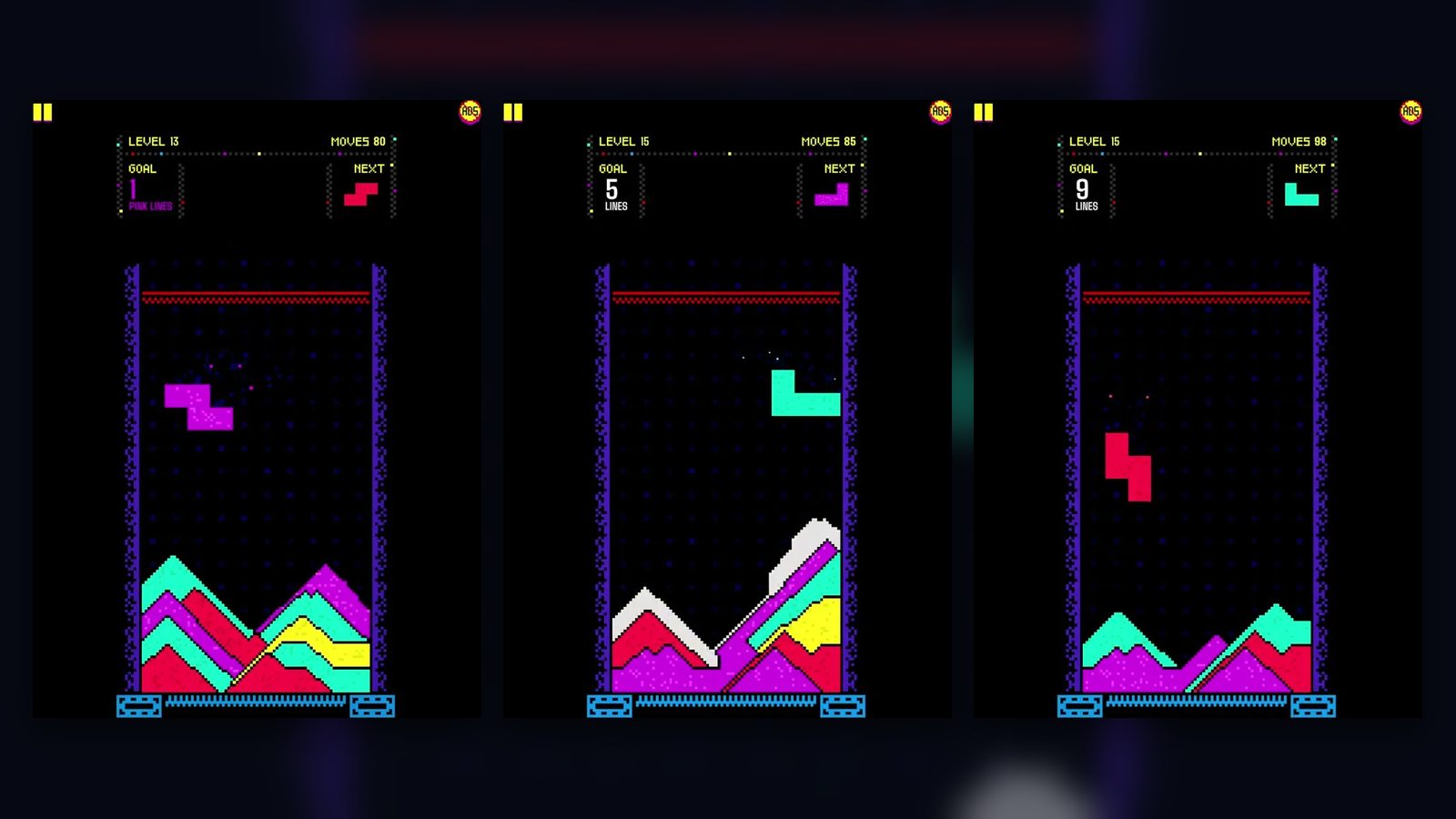
Each level sets a target in the GOAL box, the left-hand box of the dotted frame above the well, counted either in lines or in sand grains. The level ends when that number reaches 0. At the opposite end of the frame’s top row, the MOVES readout drops by one with each new piece: as Level 14 began it showed 100, and once the second piece appeared it showed 99. The portrait view is fixed, so the whole well stays on screen throughout.
Sand Blocks gameplay comes down to one cycle. A piece falls, and on landing it turns into sand that runs down whatever slope lies under it. Once a single color forms a band from the left wall to the right wall, that band clears, and the goal number drops if that color counts toward it.
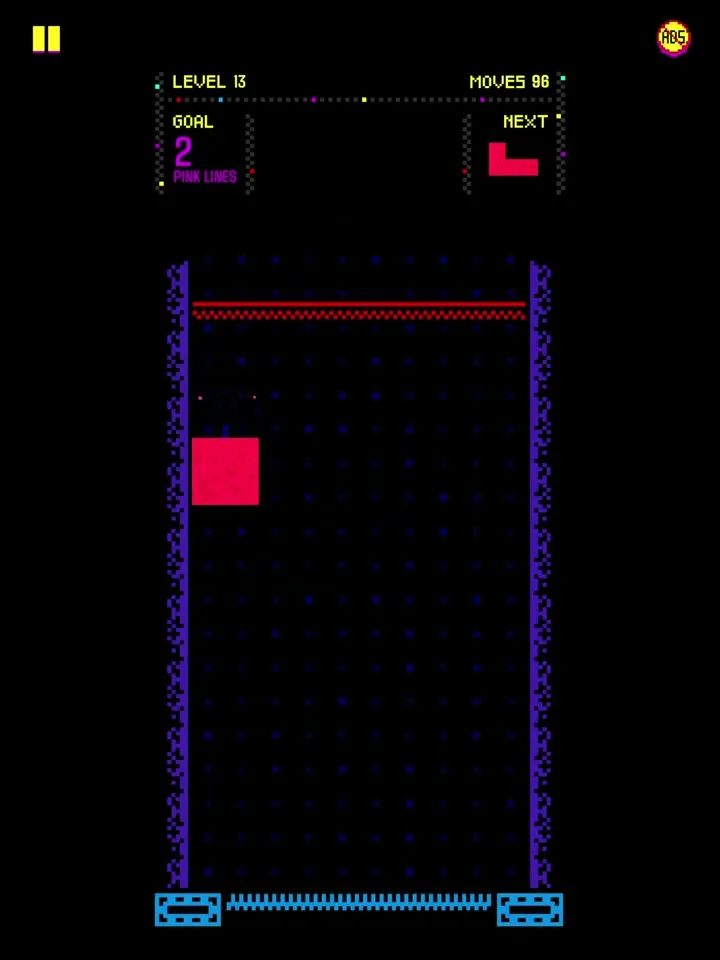
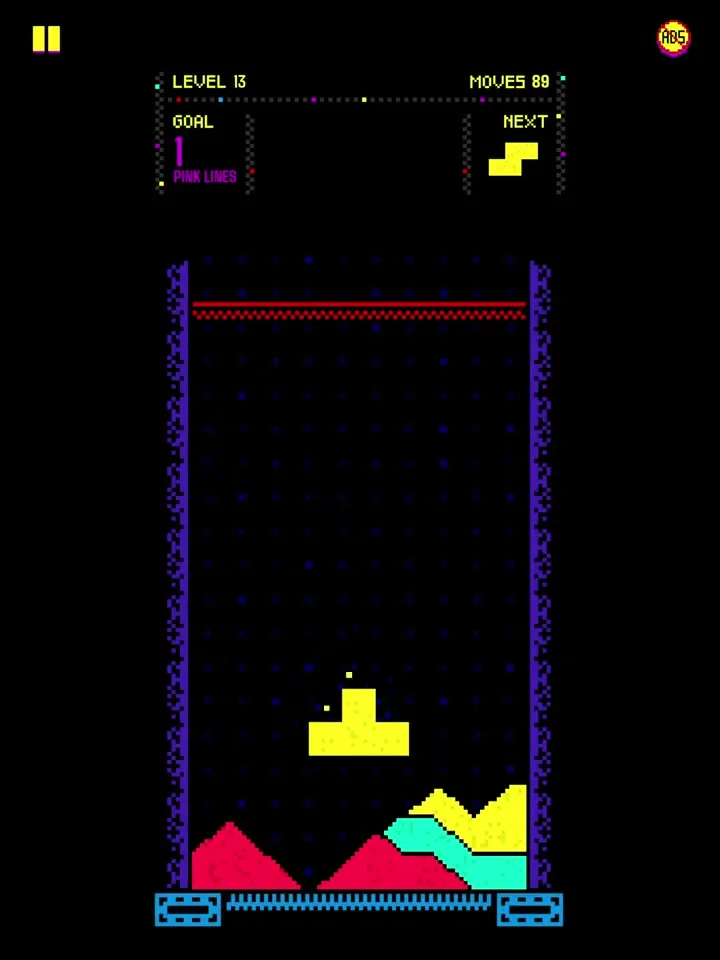
The pieces take the standard tetromino shapes, from the square and the straight bar to the T, S, Z, L and J. Each one is red, magenta, cyan or yellow and falls as a solid block with a speckled face, sometimes with small white sparks around it. In Level 13 a red square dropped into an empty well and slumped into a sloped red mound in the bottom-left corner while the next red piece came down.
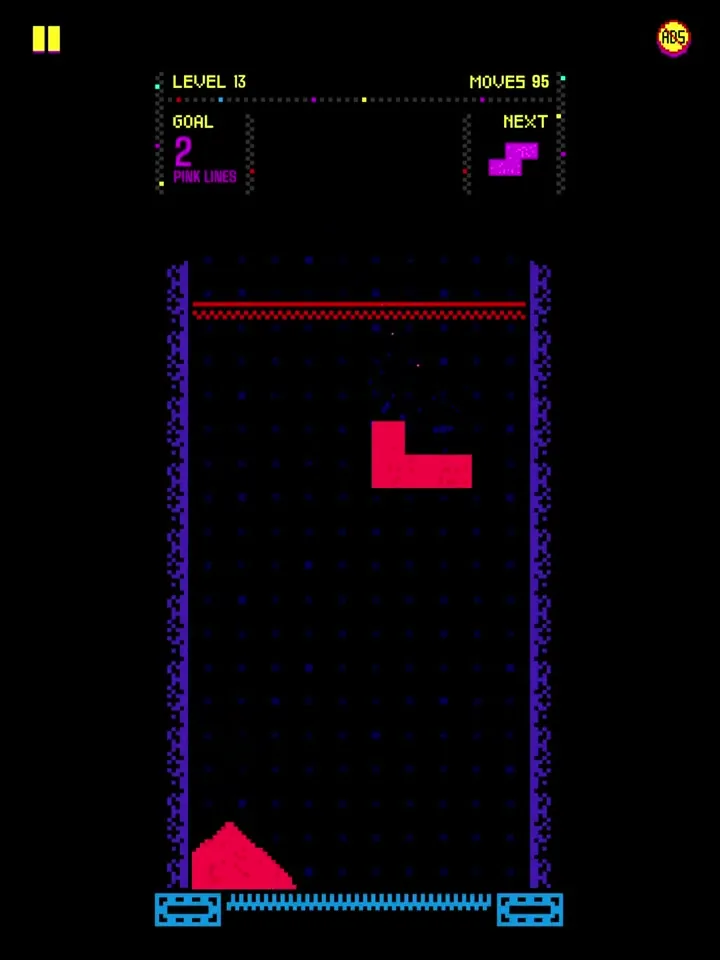
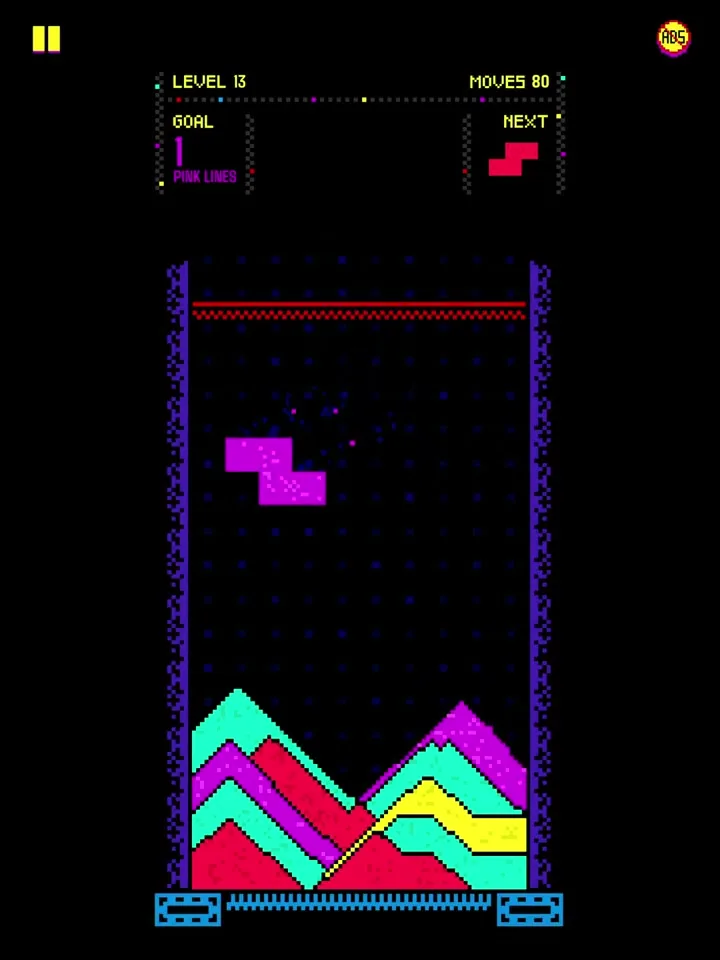
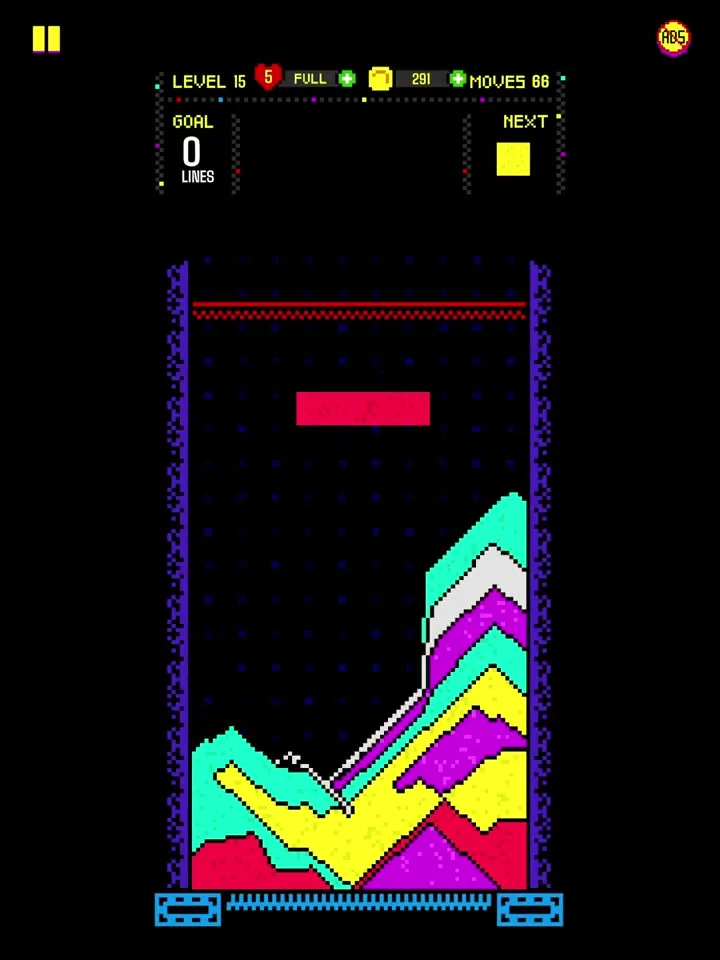
Rather than filling cells, the sand settles into mounds and valleys. Every color stays a separate layer with a thin black outline, and each new piece spreads over the slopes beneath it, so the piles rise as striped mountain ranges. By the end of Level 13 the well held two peaks layered in all four colors.
A clear needs one color to stretch across the full width of the well. The band turns or flickers white, then breaks into pale particles that drift upward. Clears can come in quick succession: in Level 14 the magenta and yellow sand both vanished within a single move, and another clear happened while the next piece was still falling, with the move count unchanged.
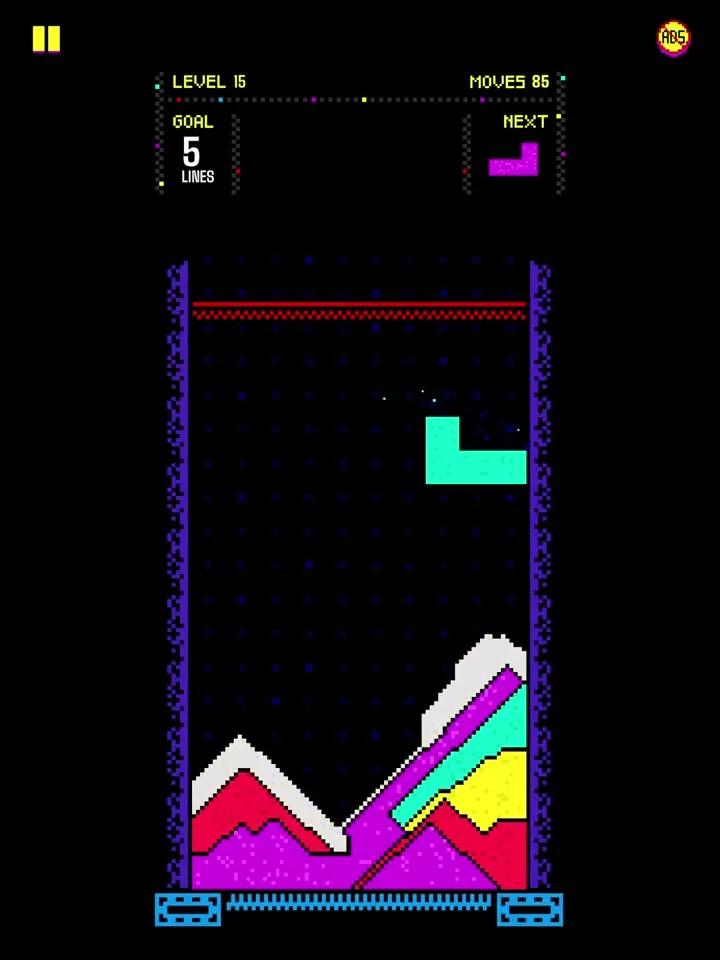
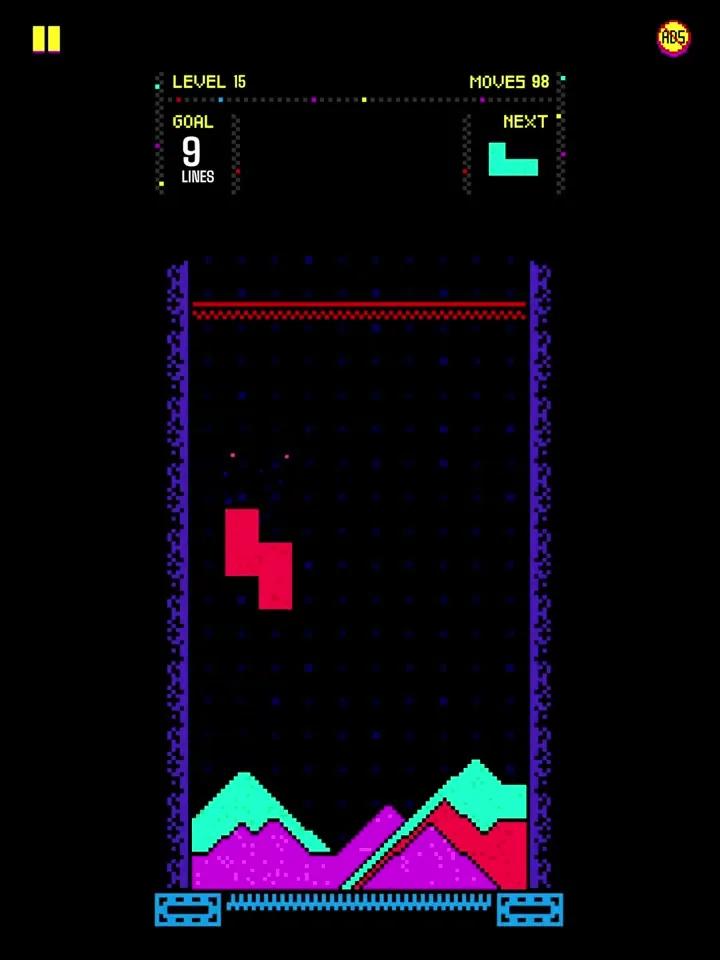
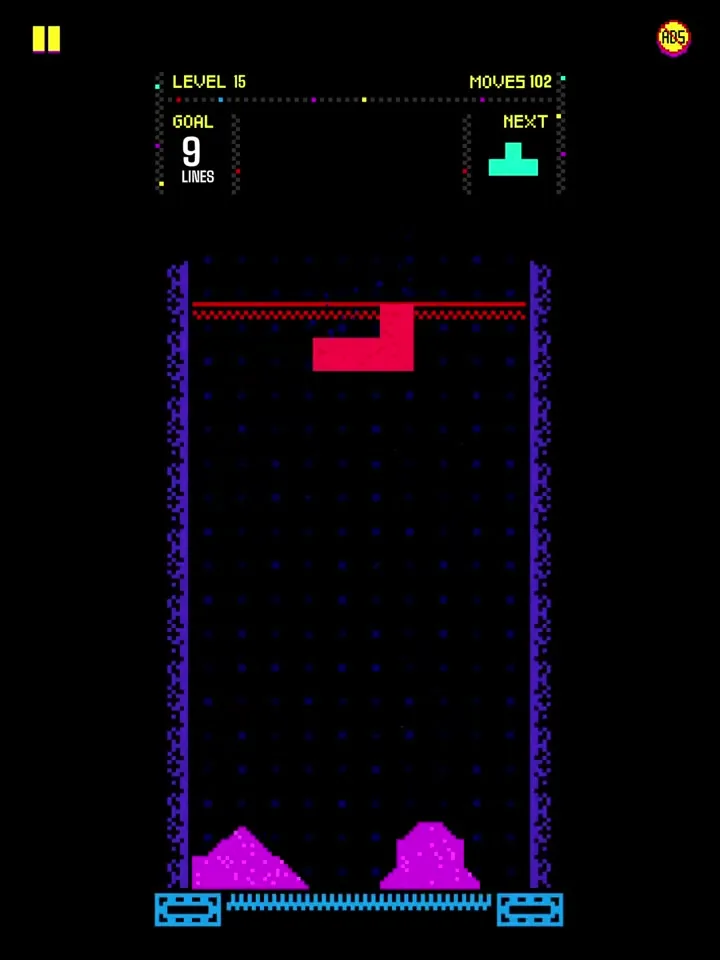
A goal of 9 LINES and a budget of 104 moves open Level 15. When the cyan sand vanished, the panel went from 8 to 7. Later a yellow band running across the whole well turned white and took it from 6 to 5, while a separate yellow patch lower on the right kept its color. The count went on falling to 0, and by then the right-hand pile stood above the middle of the well.
The NEXT box, the GOAL box’s partner on the right of the frame, previews the shape and color of the coming piece. As the red square fell in Level 13, it already showed the red J that dropped after it.
A red line over a checkered red strip spans the well near its top, and each new piece enters at or just above it. No pile came near it; even the tallest, at the end of Level 15, stayed well below.
Pieces come down against either wall or anywhere between, and in different orientations: a red S that lay flat in the NEXT box fell standing upright in Level 15. What gesture positions them, we can’t say. A pause button drawn as two yellow bars is tucked into the upper-left corner of the screen.
From pink lines to blue sand grains
From one level to the next, the pieces and the four colors stayed the same; what changed was the target. Line goals come in two forms. The first asks for one named color: in Level 13 the panel wanted 2 PINK LINES, printed in magenta, and only magenta counted. The number fell to 1 when a magenta layer cleared and stayed there when the yellow sand vanished soon after.
The second form drops the color. Nothing on the Level 15 panel names one, so bands of any color count toward it. Two moves in, a pair of magenta mounds already sat on the floor as a red L entered.
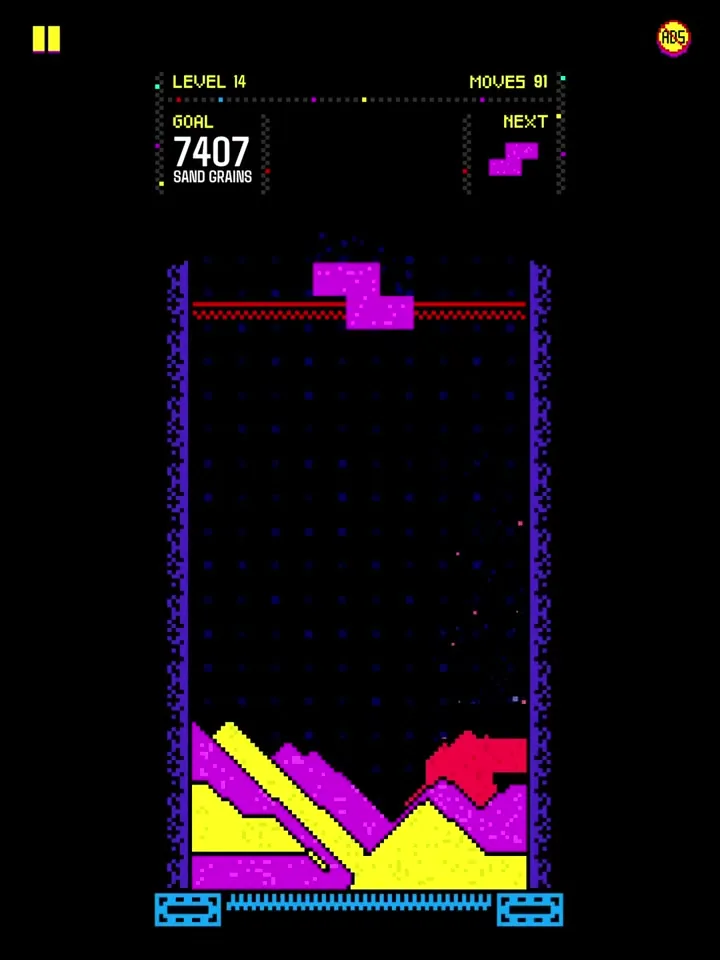
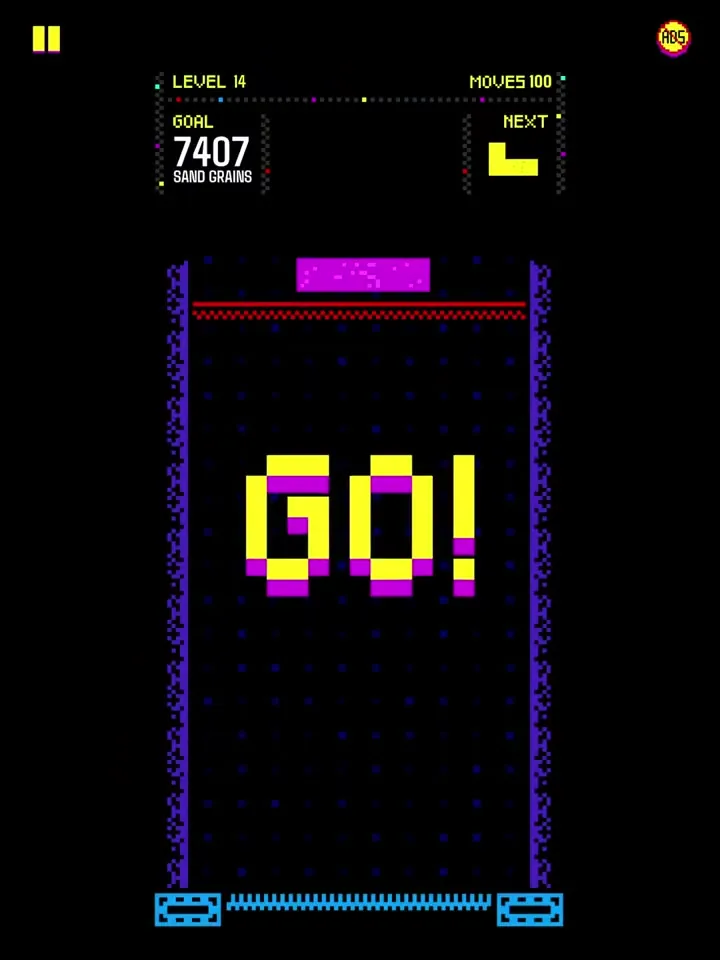
Grain goals count sand instead of bands. Level 14 opened on an empty well under a large GO!, with 7407 SAND GRAINS to clear in 100 moves. Every clear lowered that total, whatever its color. The magenta and yellow clears cut it to 5101, and later red and cyan clears took it lower still; 228 grains were left shortly before the level ended.
The goal card for Level 16 joins the two ideas: 2640 BLUE SAND GRAINS, a grain count tied to one color, printed in the same turquoise as the cyan sand.
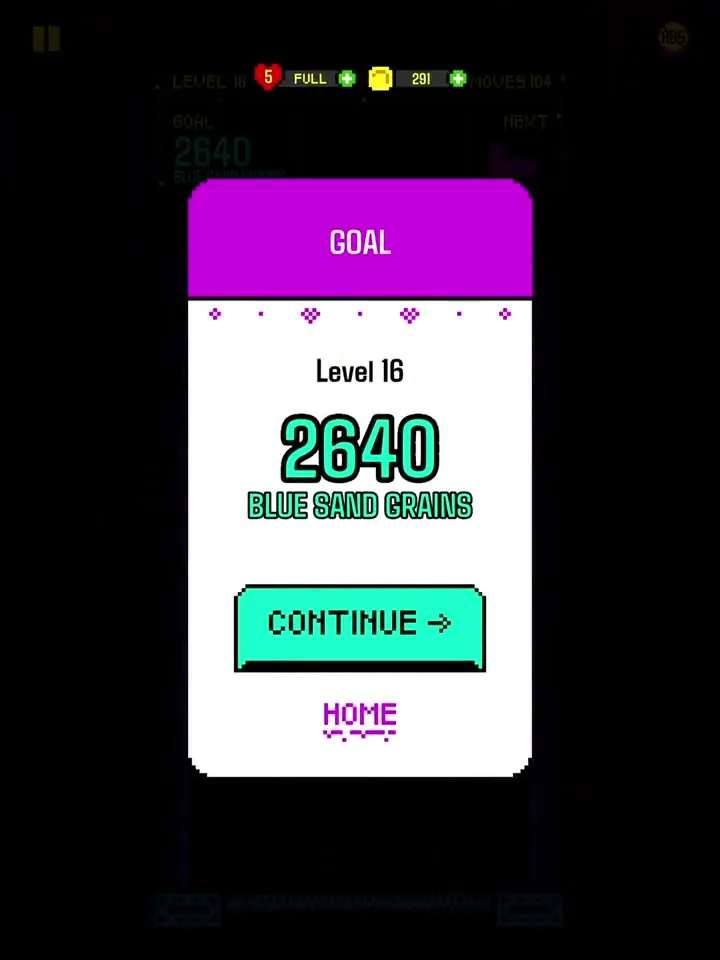
The move budget grew as well, with 104 moves behind the goal cards that opened Levels 15 and 16, up from 100 in Level 14. The board also filled higher in Level 15 than in earlier levels. After Level 13, the board dimmed behind a yellow LEVEL banner with magenta streaks and square confetti. Right after that banner, a large GO! was already up over Level 14, while Levels 15 and 16 were seen opening on a white goal card with a turquoise CONTINUE button and a magenta HOME link.
A bar across the top holds lives and coins; it appears only during level changes and on goal cards, never during play. Lives show as a red heart marked 5 beside the word FULL, with a green plus button.

The coins sit next to the heart with a green plus button of their own. The total read 241 on the banner that closed Level 13. By the end of Level 15 it had reached 291, up 25 after each completed level.
No ad, shop screen, offer or booster button appeared at any point. During play the well has only the readout frame and the pause button around it, plus a round yellow badge in the opposite corner.
Classic Tetris rules rebuilt around falling sand
Between the Tetris surface and the Tetris clearing rule sits the texture: a physics-driven sand pile that makes the game catch the eye at first sight. Neon grains run down the slopes and stack into black-outlined stripes between purple pixel walls. A cleared band breaks into pale particles that float up. The new part is the material itself: pieces that turn to grains, and a line measured by color instead of by a filled row.
Under that look, a classic’s play and rules have been taken apart and rebuilt on new mechanics, and the result goes well beyond what we expected. The falling tetrominoes and the NEXT box come straight from Tetris, and so does a line across the well. Around them everything is reworked: the line is a single color and the pieces turn into sand. Each level sets a target in lines or grains against a move budget, from the pink-line goal of Level 13 to the blue grain count on the Level 16 card.
For all that is new, there is nothing to learn first. With the look of Tetris on the surface and its clearing rule underneath, the shapes fall and the NEXT box previews them the way they always have. The clearing rule changes in just one way, and the change sits inside a rule players already know: a line is now a single color touching both walls.
The red line and lives, left untested
There is no criticism to report. Some parts of the game simply never came into play. No pile got near the red line and no fail or out-of-moves screen appeared, while the lives bar read FULL every time it showed, so what the line does and what lives are spent on remain unknown. The green plus buttons and the HOME link were never opened, and no color or goal type beyond the four of each turned up.
Steering sand into one-color bands
The play centers on where the sand ends up. A piece comes down against a wall or somewhere between, and its grains spread down the slopes beneath it. Each landing either completes a band of one color across the well or leaves the layers building higher, while the panel counts lines or grains down against a move budget. That suits a taste for line-clearing puzzling in a Tetris mold, played with heaps instead of rows.
Sand Blocks shares a shelf with games like block blast because blocks are its pieces. Here, though, every block ends up as a pile of grains, dropped into a well from above.
Verdict
Swapping the bricks of Tetris for sand, and a full row for a single color, gives Sand Blocks an identity of its own. The neon piles turn heads straight away, and the rebuilt rules work out far better than expected. Nobody needs a lesson before the first piece drops.