Mahjong Tower Review: Match Tiles Until the Tower Falls
Tap food tiles out of a round tower and collect three of a kind while it topples: our Mahjong Tower review covers the whole loop.
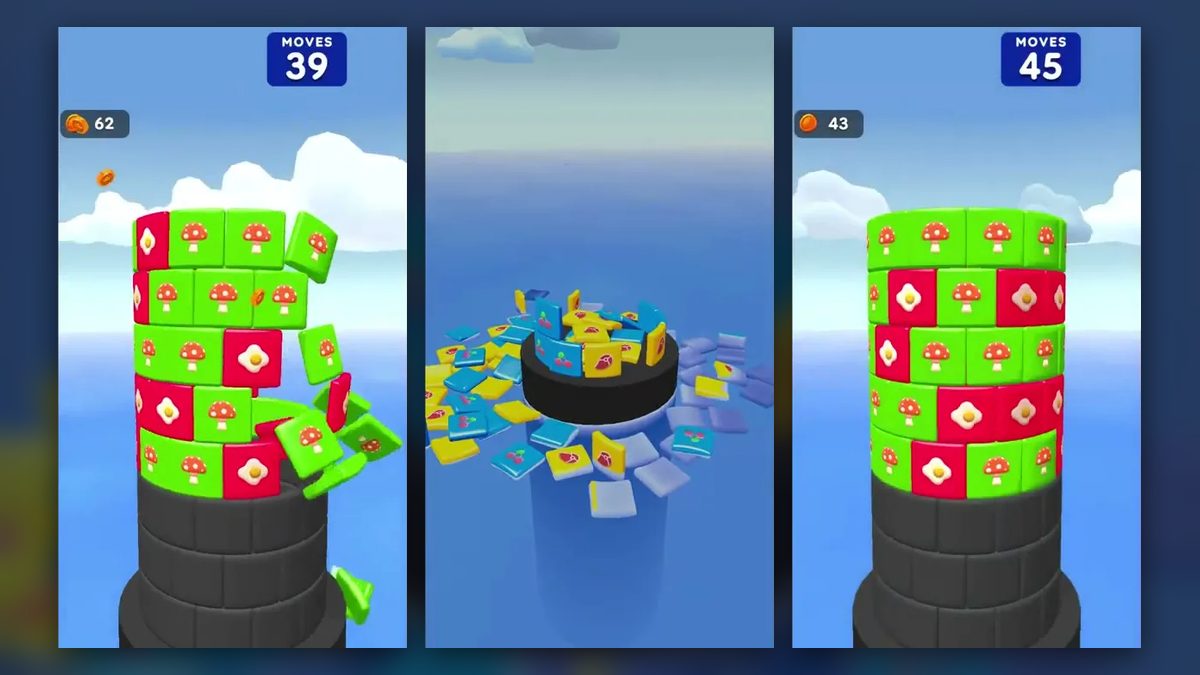
Game at a glance
Mahjong Tower
6.5/ 10
Our score
One more tile-match mashup: a bit tiring to see, but the hunt for new combos goes on.
In this article6 sections
Three cherry tiles sit side by side in the row at the top of the screen in Level 3. White rings and sparks flash on the yellow-and-blue tower below, at the spots where tiles have just come out. Moments later the three are gone, and two new cherries have taken their place.
That loop drives Mahjong Tower, a mobile game among the tile match games that pairs a triple-tile matching puzzle with a round tower that tips and sheds tiles until it collapses. We played the first five levels, the last one still unfinished when we stopped.
It is another tile-matching hybrid with its own rule set, and it shows that developers keep hunting for fresh combinations. After so many games of this kind, though, some fatigue has set in.
Pulling food tiles from a tower that falls
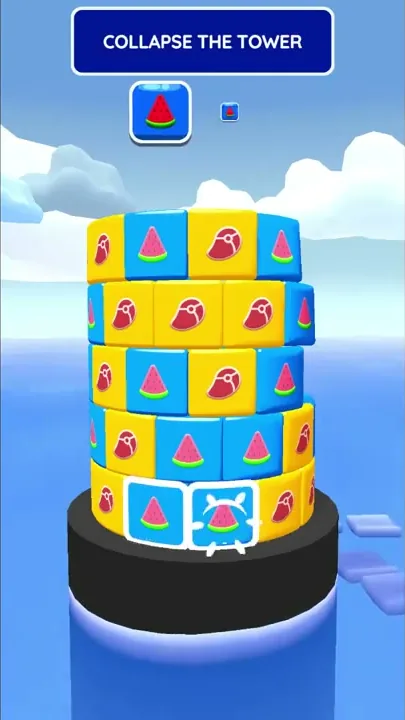
The playfield is a round tower of chunky tiles standing on a base. The first level states the goal in a banner across the top: “COLLAPSE THE TOWER.” A level is over once the tower has fallen into a heap.
A tap takes a tile off the tower. A white ring and a burst of sparks mark the spot, and the tile reappears in a row near the top of the screen, where identical tiles line up side by side. When three of a kind have filled the row, it empties again.
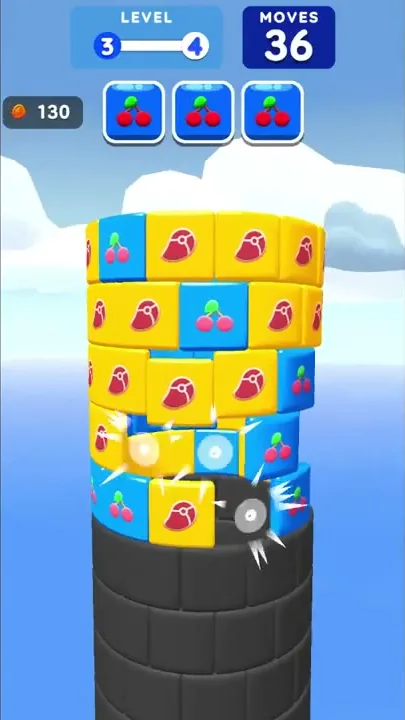
The tiles are thick squares with rounded edges, and within a level each color goes with one food icon. Blue tiles carry a watermelon slice in the first level and a pair of cherries later on. Yellow tiles show a red steak and green tiles a red-capped mushroom. On red tiles the icon is a fried egg.
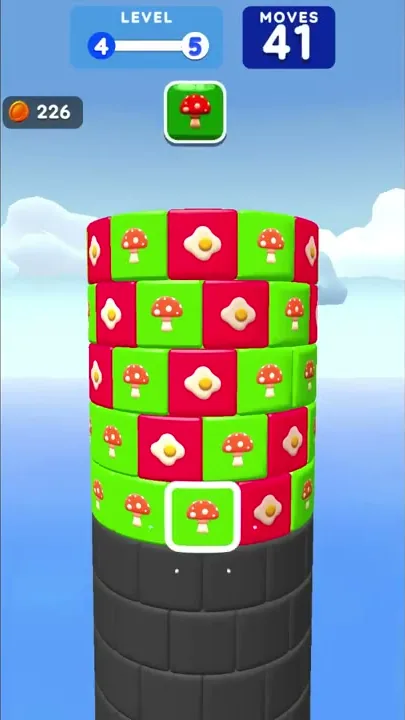
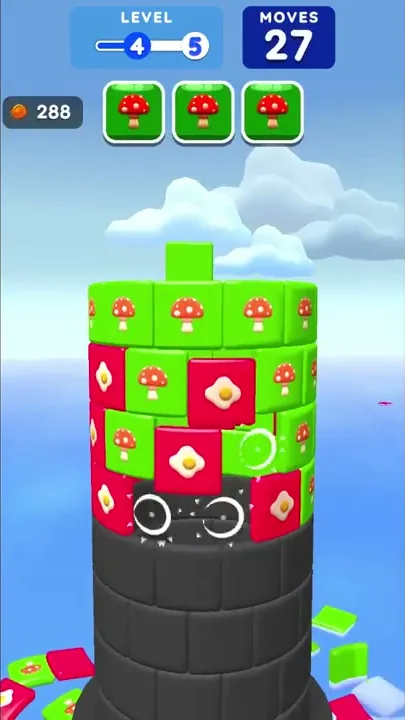
The collection row sits centered just under the counters at the top, with no empty slots drawn. Early in Level 4 it held a single mushroom. Later three mushrooms sat side by side, and shortly after that the row was empty.
Some tower tiles wear a white outline, and they show the same food as the tiles already waiting in the row. In the second level, two outlined fried eggs sat on the tower while one egg waited up top. In Level 3, two outlined cherries on the bottom row matched the two cherries in the row.
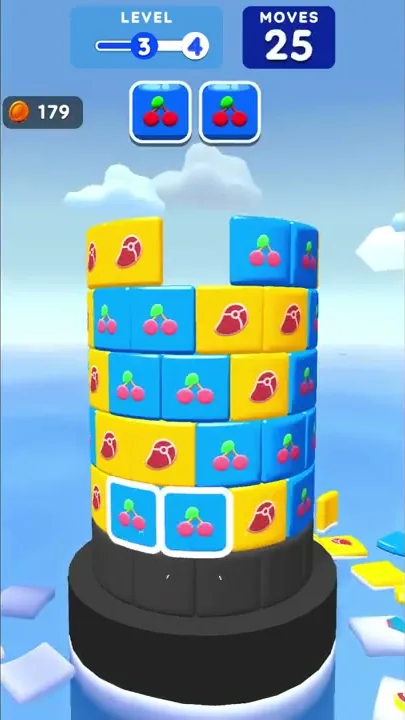
Pulling tiles out opens gaps in the walls. Tiles above and beside a gap tilt and slide out before tumbling off the side, then lie scattered on the ground around the base. At times the whole tower leans and shifts.
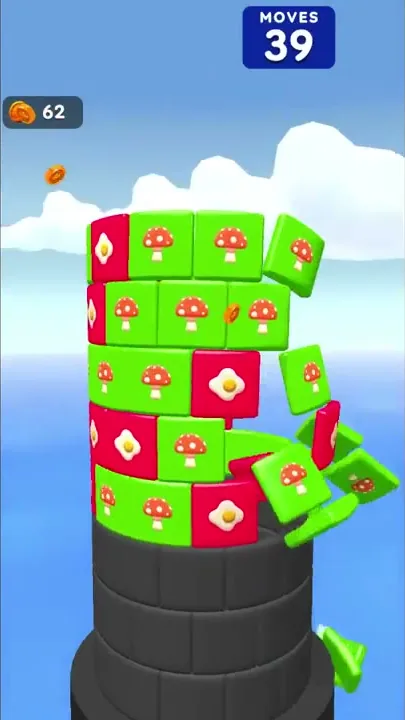
Words of praise pop up over the tower in large letters while it comes apart. “Good” appears in blue, and “GREAT!” in white.
Partway through Level 4, dark gray fragments burst out around the gray brick pillar under the tower, and shortly afterward the tower is standing on a wide black disc instead. Rubble burst the same way in Level 3. The second level and Level 5 also swapped the pillar for the disc partway through.
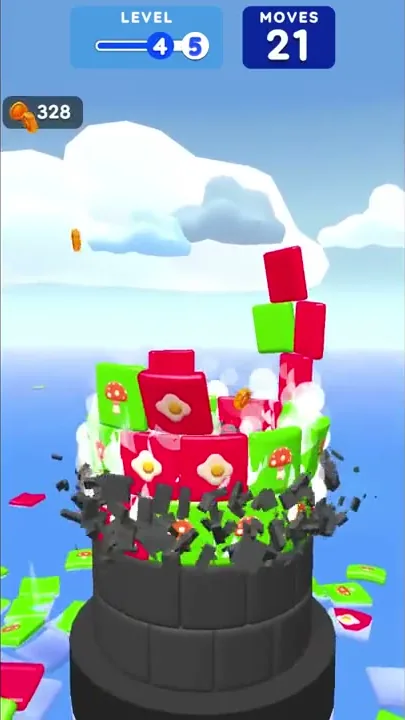
Each finished level ended in a heap. The tower lies in a low pile on its disc, and more tiles are strewn across the ground around it, many of them drawn pale and whitish. During play the camera faces the tower from the side, angled down; at the end it pulls up to look down on the wreck.

Yellow steak and blue cherry tiles fill the tower in Level 3, mixed through all five rows on its front, below an empty collection row and the “MOVES” counter. Early on, with the row still empty, 42 moves remain. Cherries and steaks take turns in the row as tiles come out. With two steaks waiting up top, dark gray fragments burst around the base, and soon the tower stands on its black disc, leaning and shifting. It topples with “Good” overhead and 16 moves still unused, ending as a heap of tiles on the disc.
From a tutorial tower to three food types
The first level works as a tutorial. Below the banner and the collection row, a hand pointer rests on one of two outlined watermelon tiles on the bottom row of a blue-and-yellow tower, and no counters are shown yet. Once that tower has fallen, the screen dims and a bright green bar stretches across the wreck.
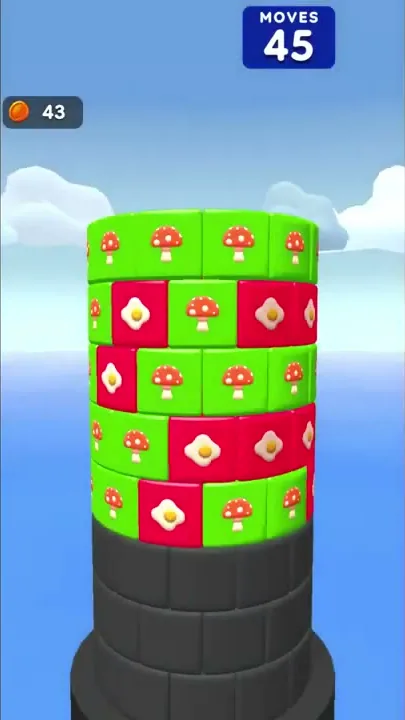
Counters arrive in the second level. A “MOVES” counter in the top right counts down during play, and a coin counter with an orange coin icon sits in the top left. The foods switch to green mushrooms and red fried eggs, and the tower now stands on a gray brick pillar. Levels 3 and 4 both ended with moves still left on the counter.
A “LEVEL” bar joins the moves counter from Level 3, with the current level’s number at its left end and the next one at its right. A marker slides from the first number toward the second as the level goes on. In Level 3 it had reached the 4 by the time the tower fell.
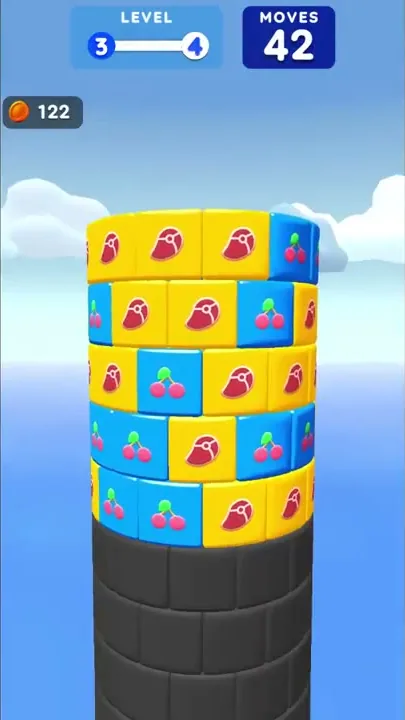
Up to Level 4, each tower mixes two foods, and the pairing changes from one to the next. Watermelon meets steak in the tutorial, steak meets cherries in Level 3, and the mushroom and egg pair shows up twice. The arrangement varies within a tower too. Early in Level 4 the front shows green and red in a roughly alternating pattern, while another side has whole rows of one color, with a red fried-egg row between mushroom rows.
Level 5 is the first tower with three foods: yellow steak, red fried egg and blue cherries. Partway through, it is seen narrowed to a few columns on the brick pillar, and a little later it stands on its black disc.
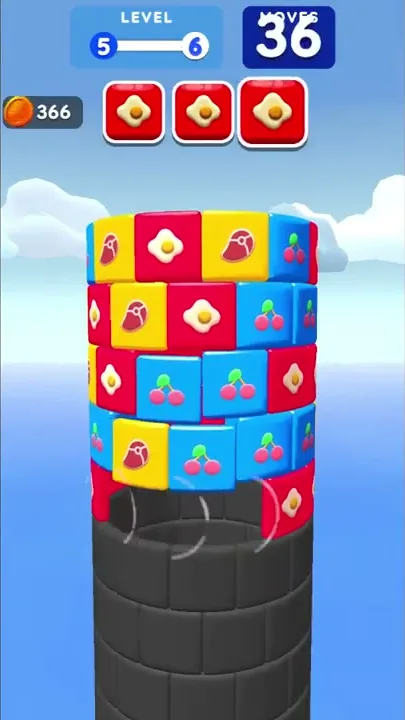
Coins come in during play. Small orange coins fly up from the tower toward the counter in the top left, and the total rose steadily through the session. What they buy is something we can’t say.
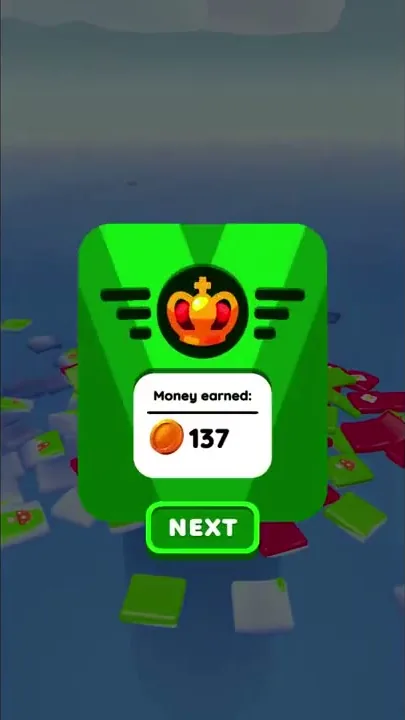
After Level 4, a green card appears over the dimmed wreck. Under a crown emblem it shows “Money earned:” with the coin icon and an amount, and a green “NEXT” button sits below it. Level 5 came next.
Tile matching blended with a toppling tower
Mahjong Tower blends tile matching with a second idea and comes out with a new set of rules. The matching half is the row of three at the top of the screen. The other half is the tower itself, where pulling tiles opens gaps and sends the tiles above sliding off, as the mushroom tiles spilling down the side of the second-level tower show.
Its partner for tile matching here is demolition: a tower of food tiles that finishes as a heap on its disc.
In presentation, it is very close to DeNA’s Block Bombarder. Its own look is bright, cartoony 3D, with thick tiles in saturated colors and simple food icons. The tower rises from a dark gray brick pillar against a blue, sea-like horizon and chunky low-poly clouds.
Weariness with tile matching plus a twist
Having seen a lot of games of this type, we have grown a bit tired of it. Mahjong Tower’s food-tile tower with its row of three above sits squarely in that type. That fatigue is the only criticism here.
Picking out foods and watching walls spill
The play comes down to two activities: spotting matching food icons on a curved wall of tiles and tapping them out, then watching the wall tip and spill as gaps open. A taste for sorting by picture fits the first half. A taste for watching a structure lean and come apart fits the second.
Chunky blocks are the common ground with games like block blast. Here, though, they are tapped off a standing tower that topples as it loses them, and matched tiles clear from the top row in threes.
Verdict
Collecting identical foods while a structure gives way beneath them gives Mahjong Tower a rule set of its own. It stands as further evidence that developers are still trying out new partners for tile matching. Against that sits some weariness with this kind of game, and the result is a middling overall impression.